
No products in the cart.



A bacterial endotoxin test measures lipopolysaccharide, or LPS, from gram-negative bacteria. For an injectable research peptide, that measurement matters because endotoxin can distort cell and animal studies even when the peptide itself appears pure.
A researcher opens a new lyophilized peptide lot, reconstitutes a vial, and notices cloudiness that wasn't present in the previous batch. The COA includes an endotoxin line, but the result is difficult to interpret because it doesn't show the method, dilution, or acceptance limit. That situation is common: the test result may be present, yet the evidence behind it remains unclear.
The practical question isn't whether a supplier writes “endotoxin tested.” You need to know what the bacterial endotoxin test detects, how the laboratory controlled interference, what the result means for your intended research use, and whether the COA supports the conclusion.
This guide explains BET from a quality-control perspective, including LAL formats, recombinant Factor C, endotoxin limits, supplier documentation, and the operational differences between major pharmacopeial frameworks.
Endotoxin is lipopolysaccharide, or LPS, from the outer membrane of gram-negative bacteria. When those bacteria grow, break apart, or shed membrane material, LPS can remain in the sample. The organism may no longer be viable, but the endotoxin can still be biologically active.
That distinction matters for peptides used in cell culture or animal research. LPS can trigger a strong innate immune response and introduce cytokine signaling that researchers may mistakenly attribute to the peptide. A contaminated sample can therefore shift immune baselines, complicate receptor assays, and make dose-response findings difficult to interpret.
Practical rule: A peptide can look clear, test well for chemical purity, and still require separate endotoxin evaluation.
A bacterial endotoxin test is specific to gram-negative bacterial LPS. It isn't a complete cleanliness test, and it doesn't answer every question about a peptide lot.
BET does not directly measure:
This is why endotoxin, microbial, purity, and visual inspection data should be interpreted as separate quality attributes rather than collapsed into one “clean” label.
Results are reported in endotoxin units, abbreviated EU. An EU expresses biological endotoxin activity against a standardized reference rather than describing the mass of LPS. The FDA's pyrogen and endotoxin questions and answers explains that the approximate human and rabbit pyrogen threshold dose is K = 5.0 EU/kg.
That threshold connects testing to exposure. A reported concentration only becomes useful when you know the sample amount, the intended route, the maximum dose, and the calculation used to establish the limit.
For a peptide buyer, the “so what” is straightforward. A BET result is evidence about one specific contaminant, not a general certification that the material is suitable for every experiment.
The LAL assay uses a biological alarm system found in horseshoe crab amebocyte lysate. In simple terms, the lysate reacts to LPS and forms a clot. The laboratory captures that reaction in a controlled tube or microplate, then reads the signal visually, optically, or through color development.
At the biochemical level, LPS activates Factor C. Activated Factor C starts a cascade involving Factor B and downstream clotting enzymes. The cascade ultimately cleaves coagulogen into coagulin, which forms the gel in the original assay format.
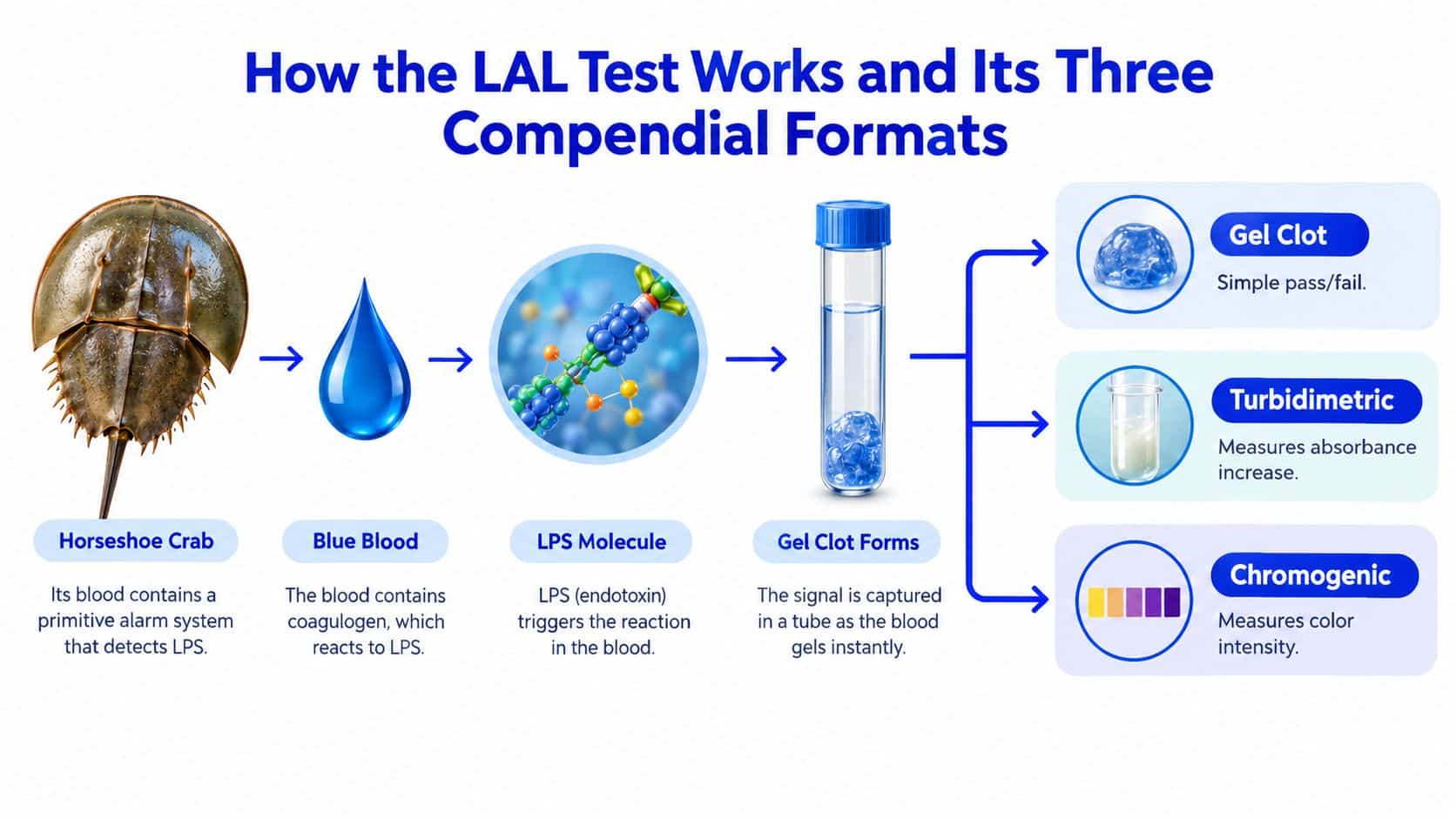
USP <85> recognizes three compendial BET formats, gel-clot, turbidimetric, and chromogenic. The USP <85> bacterial endotoxins text describes gel-clot sensitivity using the reagent's labeled sensitivity, represented by λ.
Gel-clot is the easiest format to visualize. If the reaction forms a stable gel at the selected sensitivity, the result indicates that endotoxin is present at or above that threshold. Depending on how the method is designed, the result can be qualitative or semi-quantitative.
Its advantages include simple equipment requirements, clear pass or fail interpretation, and usefulness as a referee approach when other formats produce conflicting results. Its limitation is lower information density. It won't provide the same continuous quantitative result as a kinetic optical method.
The turbidimetric format measures increasing cloudiness as the clotting reaction proceeds. A reader tracks optical density and relates the result to a calibration curve or kinetic response.
This format suits laboratories that need quantitative output and repeatable processing across many samples. Matrix effects can still interfere, so the result is only as credible as the controls and matrix validation supporting it.
Chromogenic BET uses a synthetic substrate that produces a color signal after the clotting cascade activates. The reader measures color intensity, commonly at 405 nm, to generate a quantitative result.
For peptide testing, kinetic chromogenic methods are often attractive because they support numerical reporting and automated plate workflows. They still require suitable sample preparation, inhibition or enhancement checks, and documented acceptance criteria.
The best format depends on the question. Gel-clot can provide a defensible threshold decision, while turbidimetric and chromogenic methods provide more detailed quantitative information. The method name on the COA should tell you which kind of evidence you're receiving.
LAL is the familiar choice for many laboratories because it has operated within compendial testing frameworks for decades. Recombinant Factor C, or rFC, uses recombinant Factor C produced in vitro instead of lysate derived from horseshoe crab amebocytes. The practical difference affects reagent sourcing, validation, documentation, and how a supplier supports results across regions.
| Attribute | LAL (Traditional) | Recombinant Factor C (rFC) |
|---|---|---|
| Source | Horseshoe crab-derived amebocyte lysate | Recombinant Factor C produced in vitro |
| Biological signal | Uses the LAL cascade, potentially including downstream elements | Focuses on the Factor C step |
| Animal dependence | Depends on horseshoe crab-derived reagent | Animal-free reagent approach |
| Specificity considerations | Some LAL configurations can respond to non-endotoxin materials through broader cascade components | Narrower Factor C response can reduce certain glucan-related concerns |
| Regulatory position | Established within USP <85> and other compendial frameworks | Recognized through newer compendial and regulatory developments, subject to validation |
| Validation burden | Existing method familiarity may simplify implementation in established workflows | Requires matrix-specific demonstration of suitability and comparability when replacing an existing method |
The FDA discussion of alternative pyrogen and endotoxin methods describes the regulatory movement toward recombinant reagents. USP Chapter 86 was published in May 2025, the FDA updated its pyrogen and endotoxin guidance in March 2026, and the European Pharmacopoeia fully integrated recombinant Factor C from Issue 13.1 while phasing out the rabbit pyrogen test in 2026.
These developments make rFC a recognized testing option, while leaving the laboratory responsible for method suitability. A peptide matrix can inhibit or enhance either assay, so the lab must demonstrate acceptable performance at the intended reporting limit. A switch also requires appropriate validation, method transfer, and documentation.
For peptide buyers, a COA line naming rFC may indicate an animal-free testing platform, but the method name alone does not prove that the result is meaningful. Ask whether the supplier can identify the method, show matrix suitability, and explain how the reported result was generated. A supplier serving multiple regions may find rFC useful as a shared platform. The trade-off is that ecological and reagent-specific advantages do not remove the need for validation, method transfer, and clear documentation.
A peptide result needs a decision boundary before it can be called acceptable. FDA guidance uses K/M for that calculation: K is the threshold pyrogen dose, while M is the maximum recommended human parenteral dose.
For drug and device contexts, the FDA identifies K = 5.0 EU/kg as the approximate human and rabbit pyrogen threshold dose in its endotoxin testing guidance. Research-use peptides often lack a validated human dosing context. A catalog limit, therefore, may be a screening convention rather than a scientifically justified limit for your planned use.
The Maximum Valid Dilution, or MVD, is the greatest permitted dilution that still allows the method to detect endotoxin at the applicable limit. Dilution can reduce interference from a peptide matrix, much like separating a faint signal from background noise. Excessive dilution can also reduce practical assay sensitivity.
A suitable run generally documents:
The FDA describes 50–200% spike recovery as the expected range for inhibition or enhancement checks in relevant contexts. A result outside that range does not automatically establish contamination. It does indicate that the laboratory must investigate method suitability before relying on the result.
| Parameter | Typical Acceptance Criterion | What It Tells You |
|---|---|---|
| Endotoxin activity | Below the established product limit | The measured activity is within the defined acceptance boundary |
| PPC recovery | 50–200%, where applicable | The matrix permits expected recovery of added endotoxin |
| NPC response | Meets the method's negative-control requirement | The sample and reagents are not producing an unexplained positive signal |
| MVD | Dilution remains within the validated range | The sample is diluted enough to control interference without losing useful sensitivity |
EU/mL expresses endotoxin activity by sample volume. EU/mg expresses it by peptide mass. Neither unit can be interpreted without the tested concentration, sample preparation, and limit calculation.
A COA “pass” means the tested sample, at the documented dilution, behaved acceptably in that assay. It does not establish zero endotoxin, sterility, or suitability for every experimental model. A meaningful supplier result should connect the reported value to its limit, controls, dilution, and intended use.
A COA should let you reconstruct the testing decision. If it only says “endotoxin-free” or “BET passed,” you have a conclusion without enough context to assess the evidence.
Start with these four fields:
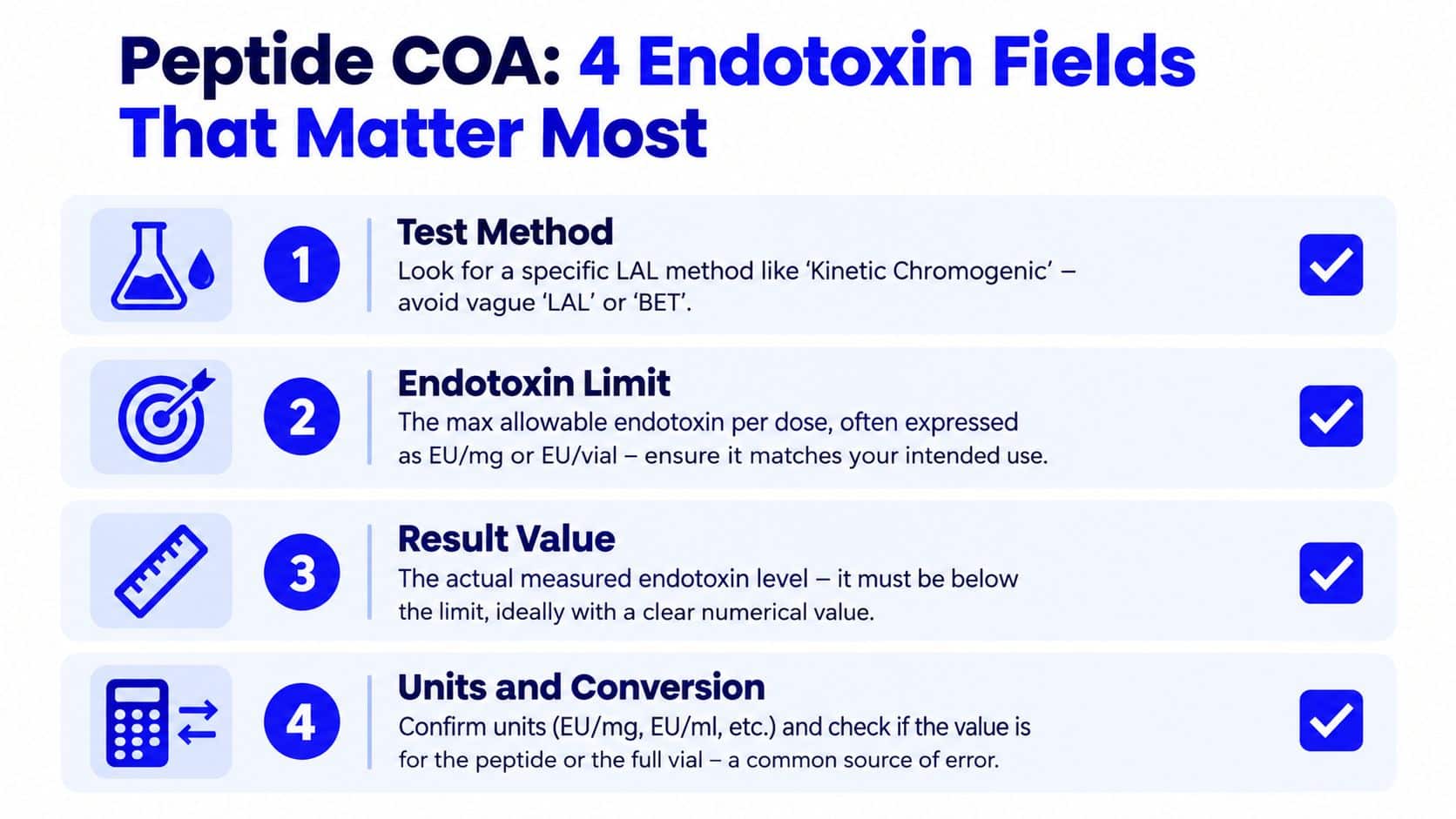
A value such as “below 1 EU/mg” may sound reassuring, but it's incomplete without the method, limit, dilution, and matrix controls. The number could describe the peptide itself, the entire vial, or a calculated conversion from a volumetric result. Those are not interchangeable.
For a higher-confidence review, ask whether the supplier can provide:
A credible COA shows the math and testing context, not just the conclusion.
A supplier's “endotoxin-free” marketing phrase may be useful as a starting point, but it shouldn't replace a quantitative report. Buyers should also keep endotoxin data separate from purity data. A high purity percentage doesn't establish low endotoxin activity, and a low endotoxin result doesn't establish peptide identity or chemical purity.
A peptide supplier can use the same basic endotoxin principle for customers in the United States, European Union, and Japan, yet the supporting paperwork may need to differ. The assay result is only one part of the review. The laboratory must also show which compendial framework it followed, how the peptide matrix was assessed, and whether the method fits the intended use.
The FDA describes LAL's acceptance as a replacement for rabbit pyrogen testing through several regulatory steps. FDA issued conditions for using LAL as a finished-product test in a November 4, 1977 Federal Register notice, proposed endotoxin-determination guidelines in January 1980, revised and reissued the draft in 1983, and published guidance for validating LAL as an end-product test in 1987. USP officially replaced the rabbit test with USP <85> in 1983. By 1987, FDA guidance reflected 15 years of test experience and millions of LAL tests conducted globally, as described in the FDA bacterial endotoxins and pyrogens technical guide.
| Aspect | USP <85> | EP 2.6.14 | JP 4.01 |
|---|---|---|---|
| Core approach | Gel-clot, turbidimetric, and chromogenic BET formats | Comparable bacterial endotoxin framework | Comparable bacterial endotoxin framework |
| Reference materials | Reference standard and control endotoxin concepts | Reference standard and control endotoxin concepts | Reference standard and control endotoxin concepts |
| Matrix controls | PPC and negative controls support suitability | PPC and related suitability controls support the method | PPC and related suitability controls support the method |
| Recombinant methods | Newer FDA and USP developments broaden recognition of recombinant reagents | Recent revisions support recombinant Factor C | Laboratories may need additional documentation when using recombinant approaches |
| Supplier impact | Clear method and validation records are expected | Cross-reference and validation details may be important for EU-facing work | Parallel or supplemental evidence may be requested depending on the use |
USP's first Bacterial Endotoxins Test chapter appeared in USP 20–NF 15 in 1980. It later harmonized with the Japanese and European Pharmacopoeias, with the first harmonized chapter appearing in USP 25–NF 20 in 2002, as described in the FDA bacterial endotoxins and pyrogens technical guide.
For research-use peptides, these chapters may serve as quality benchmarks rather than direct legal mandates. A supplier serving laboratories across regions should identify its chosen framework and explain how the method transfers between jurisdictions. That explanation helps distinguish a COA line supported by a defined testing program from a label used mainly for marketing.
A buyer sees “endotoxin tested” on a COA and assumes the question is settled. That line is only useful when its method, limit, units, and sample basis are clear. The following misconceptions often lead peptide researchers to overinterpret a result.
“Not detected” means there's no endotoxin.
“Not detected” means the signal was below the assay's stated detection or quantitation capability. It does not prove absolute absence. A meaningful COA identifies the assay and reporting threshold behind the phrase.
Endotoxin-free means the peptide is safe or clean for every experiment.
BET addresses bacterial lipopolysaccharide, or LPS. It does not replace sterility checks, broader microbial evaluation, particulate inspection, chemical purity testing, or identity confirmation. It also does not authorize human use. For a peptide buyer, endotoxin status is one quality attribute, not a complete safety assessment.
One successful LAL run settles the question permanently.
A passing result supports the tested lot under the reported conditions. It does not automatically cover a later lot, changed formulation, different dilution, or new sample matrix. Sampling, retesting, alternate methods, and continuing test plans should be defined for the product and its use, rather than inferred from one successful run.
EU, EU/mL, and EU/mg are interchangeable.
EU describes endotoxin activity. EU/mL reports activity per volume, while EU/mg relates it to peptide mass. Two COAs cannot be compared responsibly until the reader checks units, dilution, and sample basis. A lower-looking number may use a different denominator.
Final-product testing makes in-process controls unnecessary.
A final test describes the material that was tested. It may not show where contamination entered, which process step introduced risk, or whether later handling changed the outcome. In-process monitoring gives the laboratory evidence for investigating variation instead of finding it only at release.
| Common Misconception | What It Actually Means |
|---|---|
| “ND” means absolute zero | The signal was below the stated reporting capability |
| Endotoxin-free means fully clean | BET covers LPS, not every quality attribute |
| One pass proves ongoing control | The result applies to the tested lot and method conditions |
| EU/mL equals EU/mg | Units describe different sample bases |
| Final testing is enough | Process controls may help identify contamination sources |
A practical review starts with four questions: What method was used? What limit applied? Which controls supported the run? Is the result tied to this lot and a defined sample basis? Clear answers separate useful QC evidence from a marketing label.
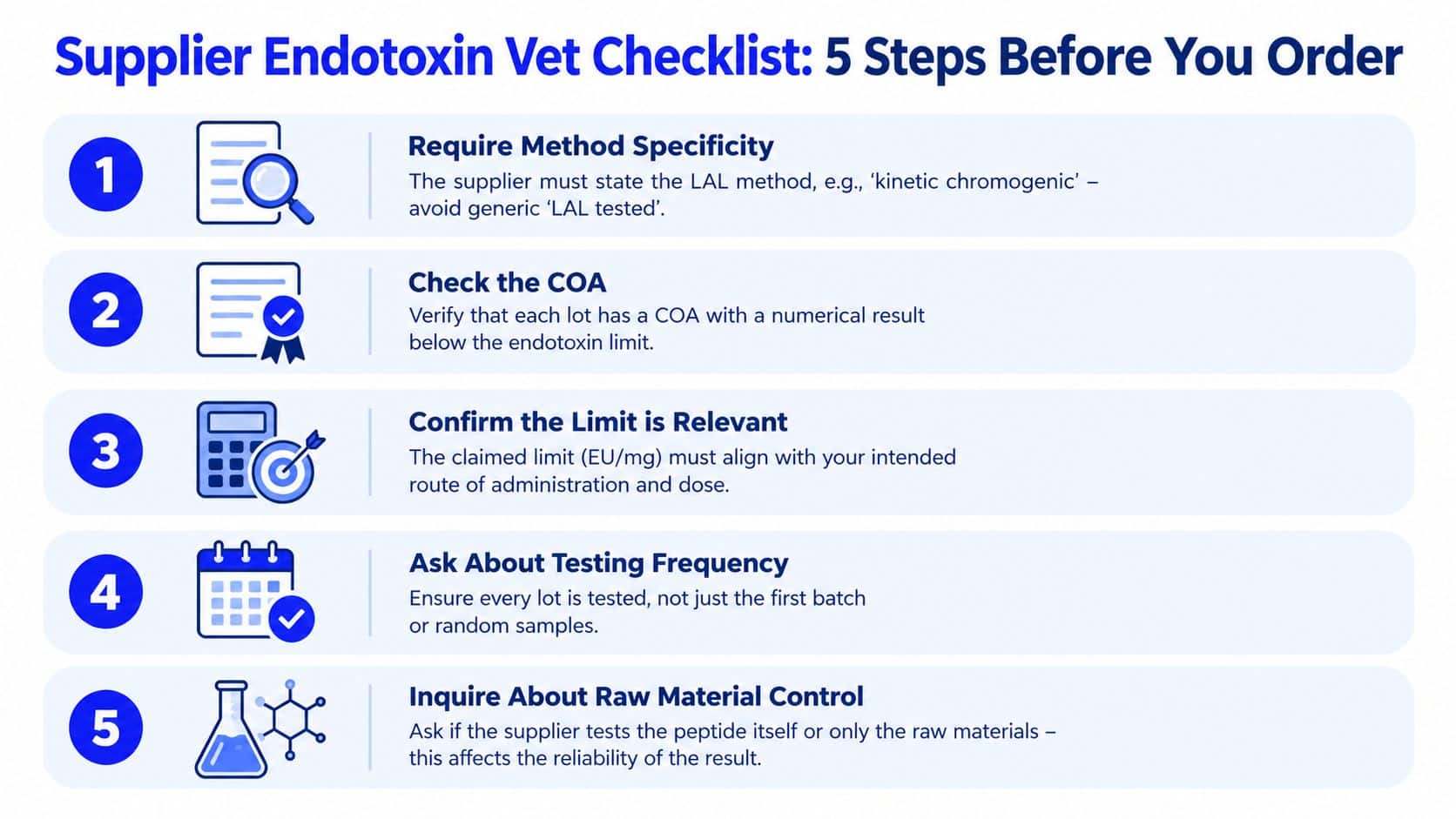
Supplier evaluation starts with method specificity. An “endotoxin tested” checkbox doesn't tell you whether the laboratory used gel-clot, kinetic chromogenic LAL, turbidimetric BET, or rFC.
Use the following checklist before placing an order:
The same documentation mindset applies beyond peptide procurement. For example, laboratories and manufacturing teams evaluating quality in 3D printed tooling also need traceable specifications, process controls, and evidence that the reported result matches the actual production condition. The material is different, but the quality principle is familiar: a certificate becomes useful when it records how the conclusion was reached.
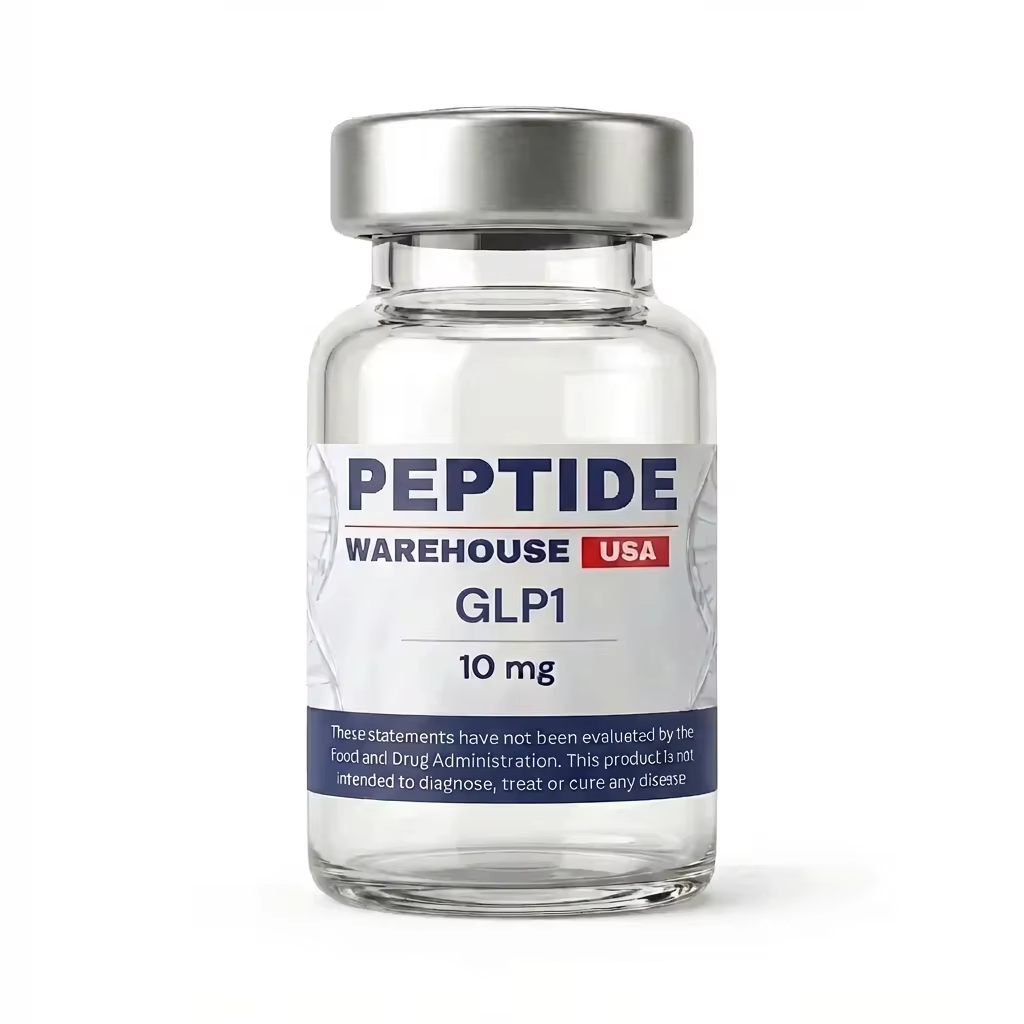
Peptide Warehouse USA states that its research products are supported by third-party documentation that can include COAs, microbial reports, and endotoxin reports, with products intended for laboratory, analytical, and preclinical research rather than human consumption. That type of documentation is the right starting point for a buyer who wants to compare lots, review testing context, and keep procurement aligned with research-use requirements.
Peptide Warehouse USA offers research peptides and related compounds with lot documentation that includes stated purity information and, where provided, microbial and endotoxin reports. Visit Peptide Warehouse USA to review available research-use products and request the COA details needed for your laboratory's quality review.
Leave a comment