No products in the cart.


Muscle growth research usually starts with load, nutrition, and hormones. But many athletes hit a different ceiling first. They can create enough training stimulus, yet they can’t recover from it fast enough to keep progressing.
That’s where bpc 157 muscle growth becomes interesting. Not because BPC-157 looks like a direct anabolic agent, but because the preclinical literature points toward something subtler and, for some researchers, more useful: faster repair of damaged muscle and connective tissue, better organization of healing, and a training environment that may support more consistent hypertrophy work.
For a researcher or advanced athlete, that distinction matters. BPC-157 is best understood as a recovery-oriented research peptide, not a shortcut to immediate size gains. The useful question isn’t “Does it directly build muscle like testosterone or growth hormone?” The better question is whether it can improve the repair process enough to preserve training quality and reduce recovery bottlenecks in preclinical settings.
This article takes that question seriously. It looks at what BPC-157 is, how the proposed mechanisms relate to muscle repair, what the animal data supports, where the safety gaps remain, and what careful sourcing looks like in a research-only context.
A common belief is that muscle growth is limited by how hard you train. In practice, many plateaus come from something less obvious. The tissue system around the muscle, including tendon, fascia, and the muscle-tendon junction, stops tolerating the training load before the muscle itself does.
That’s why bpc 157 muscle growth needs careful framing. The preclinical case for BPC-157 isn’t that it directly forces hypertrophy. It’s that it may improve the quality and speed of tissue repair in ways that help training stay productive.
For advanced athletes, that means the compound belongs in the same conversation as recovery capacity, connective tissue resilience, and session-to-session readiness. For researchers, it raises a narrower question. If a peptide improves healing biology after damage, could that indirectly support a better hypertrophy environment?
Working assumption: If tissue damage resolves faster and with less disorganized scar formation, the next training session often improves before muscle size changes do.
The important limitation comes first. The strongest evidence is still preclinical, not human hypertrophy data. So the right stance is educational and research-focused. BPC-157 is a compound of interest for laboratory, analytical, and preclinical investigation only.
BPC-157 usually refers to Body Protection Compound-157, a synthetic peptide associated with a protective protein sequence originally studied in relation to human gastric juice. The easiest way to understand it is to stop thinking of it as “muscle builder” and start thinking of it as a repair coordinator.
If anabolic agents act like stronger building signals, BPC-157 looks more like a cellular foreman. It doesn’t supply the bricks. It appears to organize the repair crew.
BPC-157’s origins trace back to its derivation from human gastric juice in the 1990s by Croatian researchers. By 2024, over 60 animal studies had been conducted, and that body of work included a reported 53% faster tendon healing and muscle functional recovery in models with corticosteroid-impaired healing, as described in this review of BPC-157 research history and musculoskeletal findings.
That background matters because it explains why the peptide keeps showing up in discussions of tendon, ligament, muscle, and wound repair. The research interest didn’t start with bodybuilding. It started with protection and healing.
The phrase bpc 157 muscle growth can mislead readers if it isn’t qualified. BPC-157 isn’t established as a direct hypertrophy compound in the way researchers discuss androgens, growth hormone, or compounds that act directly on muscle protein synthesis.
A cleaner distinction looks like this:
| Research category | Primary emphasis |
|---|---|
| Direct anabolic agents | Push growth signaling more directly |
| Recovery-focused compounds | Improve repair conditions after damage |
| BPC-157 | Fits best in the second category based on preclinical evidence |
That difference helps with expectations.
BPC-157 makes the most sense when the research question is about whether better healing can preserve training continuity.
The strongest argument for bpc 157 muscle growth is indirect. The peptide may support a tissue environment where hard training becomes easier to repeat, because repair resolves faster and more cleanly after damage.

In rodent models of skeletal muscle injury, BPC-157 enhanced myogenesis and muscle fiber regeneration. These studies also reported accelerated re-establishment of myotendinous junctions, reduced fibrosis, and up to 38% improvement in muscle contractile function post-trauma compared with untreated groups, as summarized in this skeletal muscle injury review.
That matters because hypertrophy training creates repeated bouts of local tissue disruption. The body doesn’t just need to build bigger fibers. It needs to restore force transfer, repair surrounding connective tissue, and limit messy scar formation that can reduce movement quality.
In practical terms, the indirect pathway looks like this:
This is also why outcome selection matters. If you’re evaluating a recovery compound, simple visual assessments aren’t enough. A useful companion resource is this guide to measuring muscle strength, which helps frame how force output and functional recovery can be tracked more rigorously than “felt better” reporting.
A second mechanism involves growth hormone receptor upregulation in fibroblasts. Preclinical data described in the verified literature reports dose-dependent increases of 100% to 300% in growth hormone receptor mRNA and protein levels, with tendon-to-muscle healing efficiency improving in biomechanical outcomes. This doesn’t mean BPC-157 acts like growth hormone itself. It suggests the tissue may become more responsive to repair-related signaling.
That distinction confuses people all the time.
A third mechanism often discussed is FAK-paxillin signaling, which is relevant to cellular migration, adhesion, and repair organization. In plain language, this pathway helps cells move where they need to go and attach in a way that supports proper rebuilding of injured tissue.
Here’s a visual explainer that many readers find useful before diving back into the papers:
The temptation in peptide discussions is to jump straight from “heals better” to “builds more muscle.” That leap is too big.
A better research frame separates outcomes into three buckets:
Practical rule: If a study only suggests that tissue looks better, you still don’t know whether training performance improved in a meaningful way.
That’s the key to reading the BPC-157 literature without overstating it. The preclinical data supports repair-oriented potential. It doesn’t establish direct muscle hypertrophy in humans.
When you put the animal literature side by side, a pattern appears. The most consistent BPC-157 findings sit around repair quality, not raw anabolic drive.
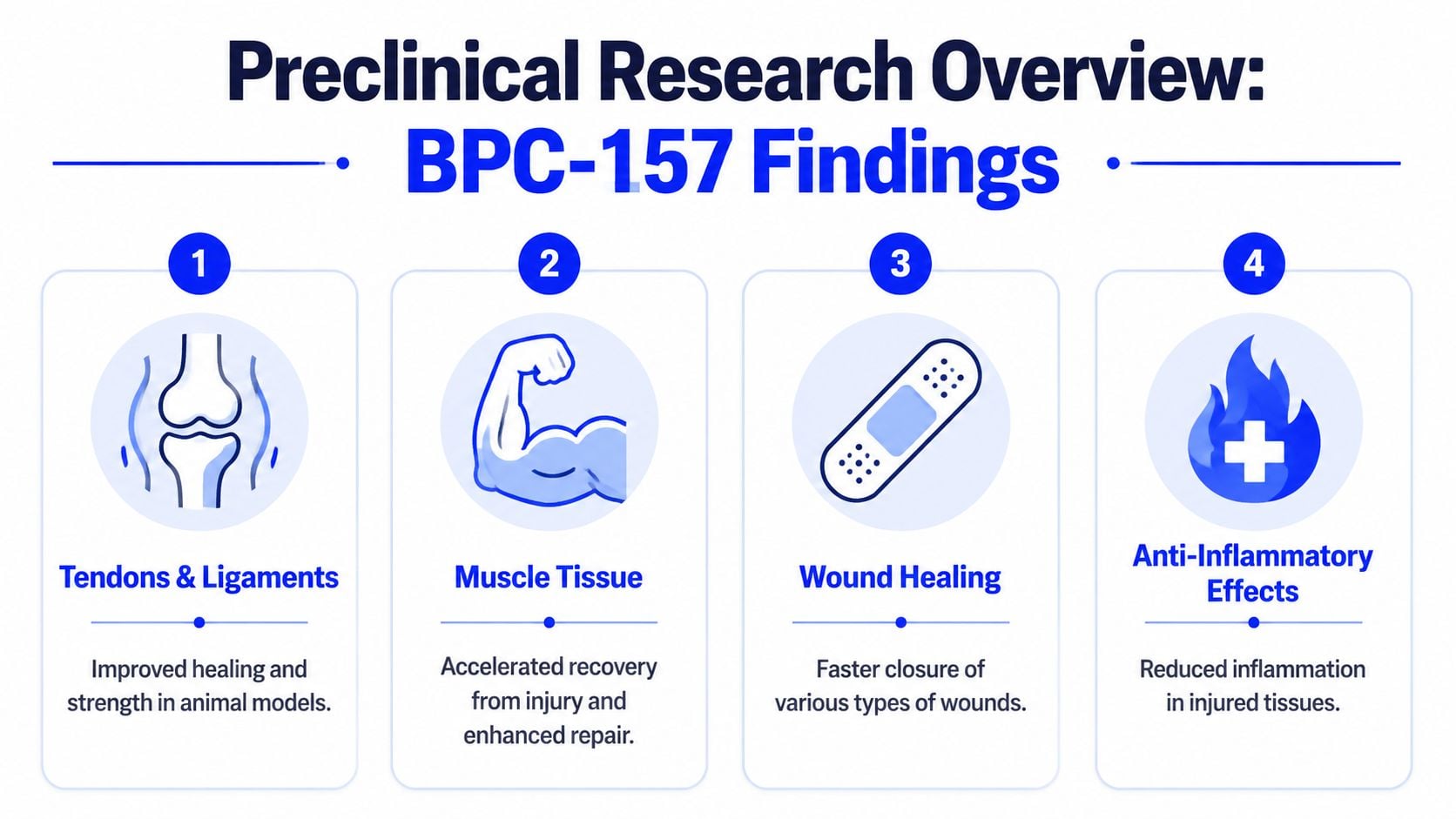
In muscle regeneration models, BPC-157 accelerated myogenesis via FAK-paxillin signaling. Rodent studies reported 2 to 3 times faster healing of transected gastrocnemius muscles, with fibrosis decreased by 40% to 60% and tensile strength increased 25% to 35% by week 2.
Those numbers give researchers a more concrete picture of what “better recovery” means in tissue terms. Less fibrosis means less disorganized scar tissue. Greater tensile strength suggests the repaired area is mechanically more capable sooner.
A useful way to sort the findings is by outcome type:
| Outcome area | Preclinical pattern |
|---|---|
| Muscle repair | Faster myogenesis and fiber recovery |
| Fibrosis control | Lower scar tissue burden |
| Biomechanics | Better tensile strength and contractile recovery |
| Tendon-muscle interface | Improved healing organization |
Better muscle growth often depends on fewer interruptions. Repair quality can matter as much as training intensity when an athlete is near their recovery limit.
For an advanced athlete, the translation isn’t “BPC-157 adds size on its own.” It’s closer to this: if the tissue system around hard training recovers with less disruption, more productive loading becomes possible.
That interpretation still needs restraint. Animal injury models are not the same as human hypertrophy blocks. A severe transection model is useful for understanding healing pathways, but it doesn’t equal a normal leg day.
Still, the logic is relevant for applied research:
For that last point, recovery research only makes sense when training substrate is controlled. If food intake is sloppy, the signal gets muddy. Researchers building a training-support framework may find value in structured nutrition tools like smart meal planning for muscle growth, especially when trying to reduce one more variable in performance and recovery observations.
Preclinical interest in BPC-157 often creates a predictable problem. Researchers see repair data, then skip ahead to informal use discussions before defining the model, endpoints, or material controls. That shortcut weakens the work.
A cleaner approach starts with one question: what exactly is the study trying to detect? In the context of muscle growth, that matters because BPC-157 is usually discussed as a recovery and repair variable, not as a direct anabolic signal. The protocol should reflect that distinction. If the model cannot separate tissue healing from hypertrophy, the interpretation becomes blurry.
The published preclinical literature includes animal dosing patterns and different administration routes. Those details help researchers understand how earlier studies were structured. They do not function as human guidance, and they should not be repackaged as personal-use instructions.
Protocol design usually begins with a small set of decisions that shape everything downstream:
That last point causes confusion more often than it should. A compound can appear promising at the level of tissue organization while showing a less clear signal on force production, or the reverse. Recovery biology works like rebuilding a bridge after structural damage. Better-looking concrete at one checkpoint does not automatically mean full traffic capacity has returned.
Material quality sits inside the method. It is not an administrative detail.
If purity is inconsistent, or if one lot carries contaminants that another lot does not, the study can mistake a sourcing artifact for a biological effect. That risk is especially relevant in peptide work, where small differences in identity, degradation, or contamination can distort the readout.
A practical sourcing checklist includes:
A peptide study is only as trustworthy as the material record behind it.
This is why sourcing should be treated the same way as endpoint selection or model choice. If the compound record is weak, the entire experiment becomes harder to interpret, and claims about recovery-driven muscle support become less credible.
The strongest way to discuss BPC-157 is also the most honest. The preclinical signal is intriguing, but the human evidence base remains incomplete.

Animal models show no toxicity in the cited material, but there are significant longitudinal safety data gaps for repeated BPC-157 use in humans. The same verified source also notes emerging concern about the untested risks of overstimulating angiogenesis in hypertrophy contexts, and critiques point out that there is zero direct proof for muscle growth claims despite animal repair data.
That’s the line many articles skip. A peptide can look promising in tissue repair studies and still remain unresolved as a long-term human-use question.
A responsible reading of the evidence does three things.
First, it separates repair evidence from muscle-building claims. Those are not the same category.
Second, it treats angiogenesis as context-dependent. New vessel formation may support healing, but biology that helps one process can create concerns in another setting. That’s why long-term, repeated exposure questions remain open.
Third, it keeps the label for research only where it belongs. Not as a marketing phrase, but as a direct reflection of the evidence gap.
A balanced summary looks like this:
| Question | Current evidence position |
|---|---|
| Does BPC-157 have promising repair data? | Yes, in preclinical models |
| Does it directly build muscle in humans? | No direct proof |
| Is long-term repeated human use well characterized? | No |
| Should claims stay within a research context? | Yes |
Promising biology is not the same thing as established human application.
That’s especially important for advanced athletes, because this audience is often the most tempted to over-translate early data into performance certainty.
They usually sit in the same broad conversation, but they aren’t identical. BPC-157 is commonly discussed in relation to localized repair, connective tissue organization, and muscle-tendon healing. TB-500 is often discussed more broadly in systemic recovery conversations.
For a researcher, the better comparison question is endpoint-specific. If the study focuses on tendon-muscle junction healing, localized tissue architecture, or force transfer after damage, BPC-157 may fit one hypothesis. If the model is broader soft-tissue recovery, TB-500 may be included as a comparator. Either way, the design should define what success means before the compound is chosen.
Yes, combination designs exist in research discussions, especially where investigators want to examine complementary repair pathways. But the main rule is simple. A stack should answer a real experimental question, not blur the result.
If multiple compounds are introduced at once, attribution becomes difficult. You might see an effect, but you won’t know which variable drove it. For that reason, many clean protocols start with single-agent observation before moving into comparative or combination work.
In this context, BPC-157 should be approached as a research chemical for laboratory, analytical, and preclinical use only. It isn’t established here as an approved consumer wellness ingredient or a direct-performance product.
That matters for both compliance and interpretation. If a supplier presents the compound in a research-only framework, that aligns better with the current evidence than consumer-style promises about guaranteed physique outcomes.
Current discussion should stay conservative. The evidence covered here supports indirect preclinical potential through recovery and repair, not direct human hypertrophy proof.
That may still be valuable. For a lifter limited by tissue breakdown, preserving training continuity can matter a lot. But it’s still different from saying the compound directly builds muscle.
If you’re evaluating compounds for laboratory or preclinical work, Peptide Warehouse USA offers research peptides with batch documentation designed for analytical traceability. Learn more about their research-use catalog and explore options that fit a compliant, quality-focused workflow.