
No products in the cart.



You've just received a sealed BPC-157 vial for laboratory work. The glass looks intact, the powder appears ordinary, and the label lists a mass, lot number, and storage temperature. Then you open the Certificate of Analysis and find HPLC results, molecular-weight data, and testing notes that don't immediately explain whether the vial is suitable for your workflow.
That confusion is common. A research peptide vial isn't just a small container of powder. It's a traceable lot, a storage problem, a concentration calculation, and a set of quality documents that must agree with one another. This guide focuses on those practical details, with no medical claims or human-use instructions.
A first-time buyer may see a sealed vial, an intact label, and a dry powder, then assume the material is ready for laboratory use. Procurement review requires more evidence. The lot number, stated mass, packaging, Certificate of Analysis, and shipping record should form one consistent trail.
This guide keeps the focus on the BPC-157 vial, rather than on possible biological effects. It explains lyophilized powder, label conventions, net peptide mass, reconstitution arithmetic for research workflows, storage before and after mixing, and the paperwork used to support lot traceability.
Procurement mindset: Treat the label, physical vial, COA, and shipping record like connected links in a chain. If one link conflicts with the others, pause the review and ask the supplier for clarification.
Research-use boundaries apply throughout. BPC-157 isn't FDA-approved for any therapeutic indication, and the FDA includes it in a Category 2 bulk drug substances review because compounded versions may present significant safety risks and are not eligible for routine pharmacy compounding under the relevant federal framework. The FDA's bulk drug substance compounding information belongs in a U.S. procurement review.
This article does not provide a dose, route, cycle, therapeutic benefit, or clinical protocol. Animal studies and limited human reports do not establish a validated human-handling standard. A 2026 pharmaceutical review described development as rudimentary, with no approved formulation, no validated dosing regimen, and no completed Phase II clinical trial after more than three decades of preclinical work, as summarized in the review of BPC-157 research from 1993 to 2024.
The practical question is simple: Does this vial have the documentation, storage history, and handling information your laboratory requires?
Before reviewing a vial, establish what the material is supposed to be. BPC-157 is a synthetic 15-amino-acid peptide, commonly described as a gastric pentadecapeptide. Its sequence is GEPPPGKPADDAGLV, and its approximate molecular weight is 1419 Da, according to the original pharmacology literature indexed by PubMed.
The name comes from Body Protection Compound, while the “157” designation refers to the 157th candidate in the original screening program at the University of Zagreb in the early 1990s. Those naming details help identify the compound, but they don't prove the contents of a particular vial.
That's where analytical identity testing matters. A label can say “BPC-157,” but a mass-spectrometry result provides evidence that the measured molecular mass is consistent with the intended sequence. Purity and identity are different questions. A powder can have a high purity result while still requiring separate confirmation that the dominant material is the intended peptide.
Mass spectrometry commonly reports a measured mass that can be compared with the expected molecular weight. For BPC-157, the expected reference point is approximately 1419 Da, not a generic peptide range. The exact report may also include instrument conditions, observed mass, calculated mass, and an acceptance statement.
The sequence matters for the same reason. HPLC can show how much of the detected material appears in the primary peak, while mass spectrometry helps answer whether that peak corresponds to BPC-157. A procurement file should preserve both when available.
The peptide's reported stability in human gastric juice is a technical property described in the original pharmacology literature, not a therapeutic conclusion. For vial handling, the more relevant point is that peptide degradation remains a formulation concern, especially after moisture, oxygen, heat, or repeated handling enter the process.
A research-grade vial normally presents several physical and administrative controls at once. The container is commonly a small glass vial made from Type I borosilicate glass, closed with an elastomeric stopper and secured by a crimp seal. The exact materials should come from the supplier's documentation, not from assumptions based only on appearance.
Most research-grade BPC-157 products are shipped as lyophilized powder, also called freeze-dried material. In that state, the vial contains a labeled mass of peptide but does not yet have a liquid concentration. A liquid product, by contrast, already includes a solvent and must be evaluated for its stated concentration, container closure, sterility claims, and storage history.
The label should let you connect the physical vial to the documents supplied with it. Look for:
A supplier may offer research vial sizes such as 5 mg, 10 mg, and 20 mg, but the size alone says nothing about identity, purity, sterility, or stability. The number must match the product page, packing slip, vial label, and COA.
| Label Field | What It Tells You | Why It Matters |
|---|---|---|
| Peptide name | The intended compound | Confirms that the lot matches the purchase order |
| Net peptide mass | Labeled peptide quantity | Provides the starting value for concentration calculations |
| Lot number | Specific production batch | Enables traceability to the COA and test records |
| Manufacture date | Production timing | Supports inventory review and shelf-life decisions |
| Expiration or retest date | Supplier's validity point | Prevents use outside stated documentation |
| Storage temperature | Required handling range | Helps preserve material quality during storage |
| Research-use statement | Intended application | Separates laboratory material from therapeutic products |
Red flags include a missing lot number, a vague “high concentration” statement without a mass or volume, unclear net weight, an undated COA, or a label that doesn't match the paperwork. A sealed vial with incomplete traceability is still an incomplete procurement record.
Reconstitution should work like a teach-back exercise. Before drawing anything, you should be able to state the labeled mass, the diluent volume, the resulting concentration, and the volume represented by a chosen research aliquot.
Start with the vial's stated peptide mass. Then identify the diluent approved by your laboratory's procedure, such as bacteriostatic water or sterile water for research. Don't assume that a community formula applies to every product, because the supplier's instructions and your laboratory's validated method take priority.
Use this basic relationship:
Concentration in mg/mL = labeled vial mass in mg ÷ diluent volume in mL
For example, a 5 mg vial mixed with 2 mL of diluent produces 2.5 mg/mL. A 250 mcg research aliquot equals 0.25 mg, so:
Volume = desired mass ÷ concentration
0.25 mg ÷ 2.5 mg/mL = 0.10 mL
That example demonstrates the arithmetic only. It isn't a recommended human dose or administration protocol. Changing the diluent volume changes every later measurement, which is why the calculation belongs in the batch record before any withdrawal occurs.
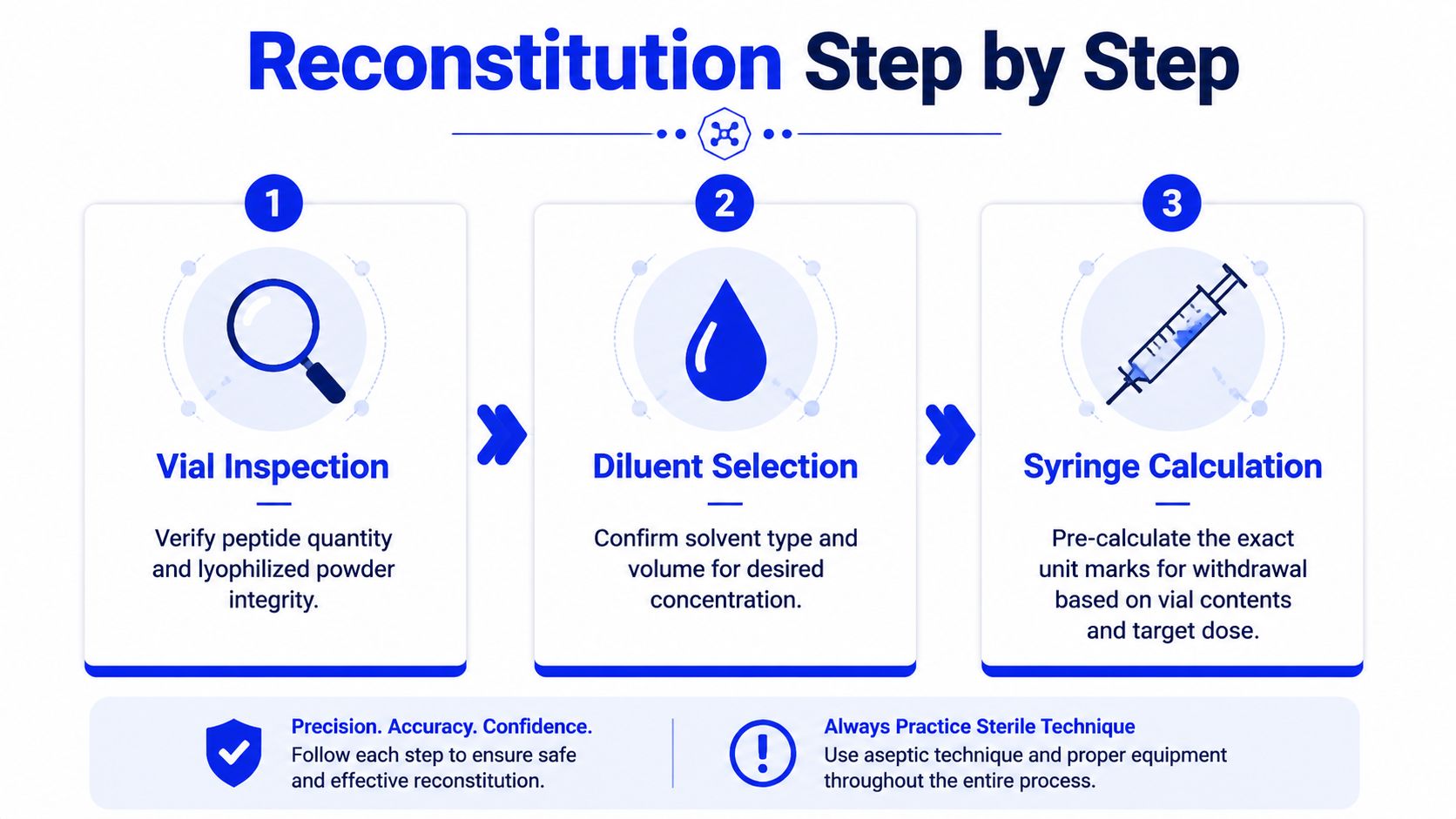
Inject the diluent slowly down the inside wall of the vial rather than directing a forceful stream at the powder. Gentle swirling can help the material dissolve, while vigorous shaking or vortexing can create unnecessary stress and foam.
Inspect the final solution under suitable lighting. The laboratory should define what appearance is acceptable, but visible particles, unexpected cloudiness, or incomplete dissolution should trigger a hold and investigation rather than an assumption that the material is usable.
Practical rule: Write the mass, diluent volume, final concentration, preparer, date, and storage condition on the working record before the vial leaves the controlled preparation area.
If the workflow requires repeated withdrawals, the laboratory may choose to prepare single-use aliquots according to its validated procedure. That approach can reduce repeated freeze-thaw exposure, but it doesn't replace a stability assessment or a product-specific beyond-use determination.
A BPC-157 vial has two different storage profiles, one before liquid is added and one after. The sealed lyophilized state is low in moisture, while reconstitution introduces water and creates a more vulnerable system.
Independent technical guidance reports that sealed, dry lyophilized BPC-157 remains highly stable at -20°C, while reconstituted solution should be refrigerated at 2°C to 8°C and used within a short window because potency declines faster after mixing, as described in the BPC-157 stability guidance.
Keep the vial sealed, dry, and protected from unnecessary temperature changes. Moisture exclusion matters because peptides can be affected by chemical pathways such as oxidation, deamidation, and hydrolysis. Desiccant in secondary packaging supports that moisture-control strategy. It isn't disposable filler.
Allowing a frozen vial to equilibrate to room temperature before opening can reduce condensation on cold surfaces. The key is to keep the vial closed while it warms, then inspect the stopper, crimp, label, and powder before proceeding.
Once the seal is breached and liquid is added, the risk profile changes. Microbial contamination, repeated access, oxygen exposure, and chemical instability become more important than the low-moisture protection provided by the original cake.
| Condition | Lyophilized Vial | Reconstituted Vial |
|---|---|---|
| Moisture | Kept low while sealed and dry | Introduced through the diluent |
| Main concern | Heat, humidity, and packaging damage | Microbial and chemical instability |
| Temperature | Follow supplier instructions, with frozen storage commonly used for long-term preservation | Refrigerated handling is commonly specified |
| Access | Limited to the sealed container | Each access adds handling exposure |
| Recordkeeping | Track lot, dates, and storage history | Add preparation date, concentration, and aliquot records |
A household freezer with an auto-defrost cycle can create temperature fluctuation and condensation, so it's a poor substitute for controlled laboratory storage. Use a monitored unit, document excursions, and follow the supplier's stated conditions rather than treating a general peptide rule as a guarantee.
A COA should answer a procurement question, not merely display an impressive purity number. Start by checking whether the document belongs to the vial in your hand, then move from identity to purity, contamination controls, and laboratory credibility.
The COA should connect the intended sequence, GEPPPGKPADDAGLV, with analytical identity results. Mass spectrometry should support the expected molecular weight of approximately 1419 Da, while HPLC should show a retention profile consistent with the intended material.
If identity doesn't match, a high purity result doesn't rescue the lot. Purity describes the proportion of detected material meeting the test method's criteria. It doesn't independently establish that the material is BPC-157.
For HPLC, look beyond a headline value. The chromatogram should show a dominant primary peak, with the report explaining the method, acceptance criteria, and notable secondary peaks. One supplier may report purity at or above 98%, but the number should be assessed alongside the trace, method, sample identification, and lot number.
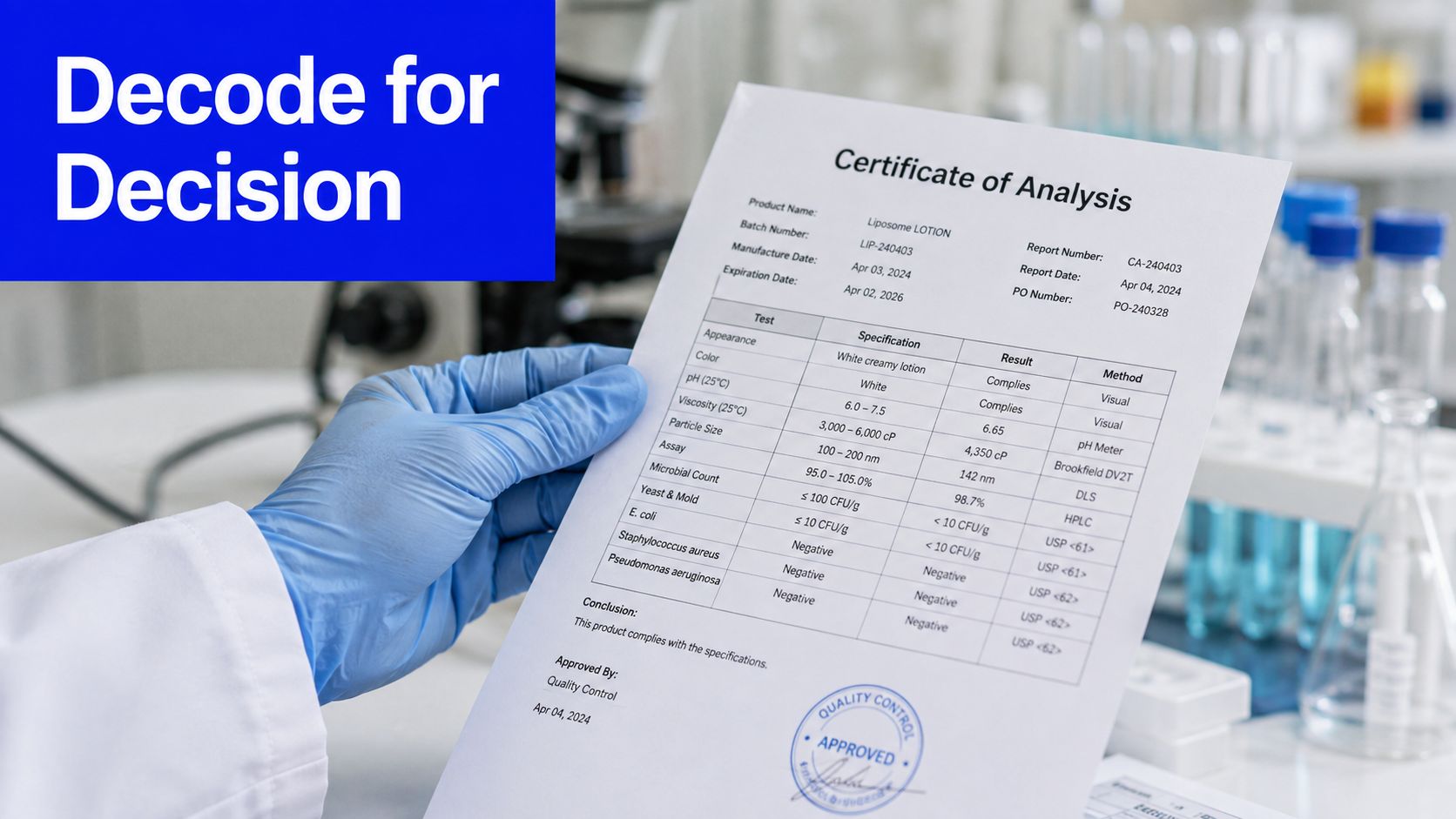
Endotoxin testing matters for cell-based and animal work because endotoxin can confound experimental results. Microbial testing should identify the tested sample, method, and whether the report addresses total count and objectionable organisms.
Ask the supplier:
A polished PDF without lot matching is weak evidence. A complete document set should make it possible to trace the material from purchase through receipt, storage, preparation, and experimental use. Laboratories building formal records may also benefit from guidance on meeting MLR traceability standards, especially when multiple teams handle the same lot.
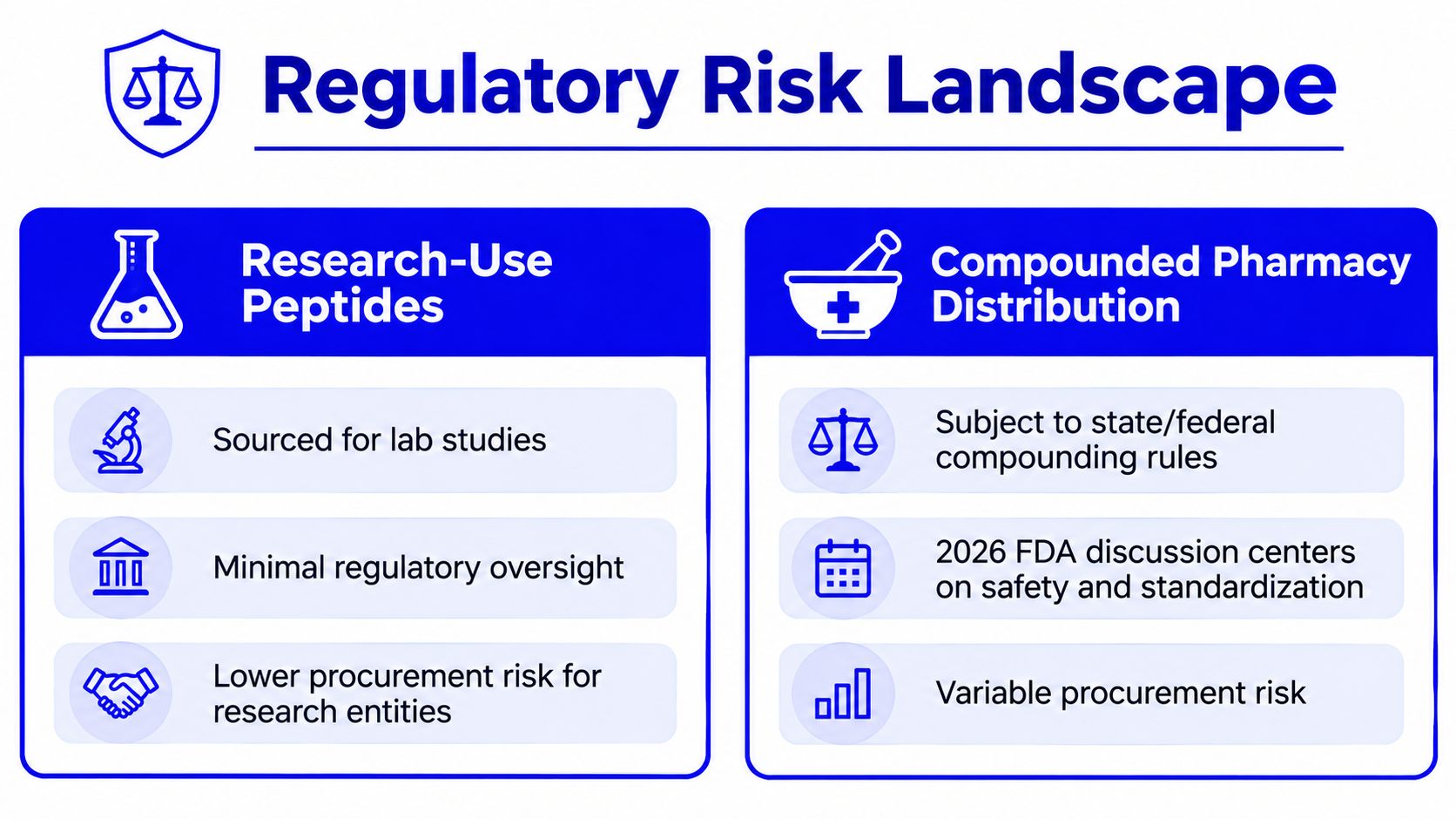
A buyer comparing a research-use BPC-157 vial with a compounded pharmacy product is comparing different regulatory categories. Gray-market imports and domestic bulk materials add further questions about sourcing, distribution, and documentation. The vial may look similar, but its label does not establish the same compliance position.
The FDA has discussed BPC-157 in connection with the Section 503A bulks list. Recent reporting described a Pharmacy Compounding Advisory Committee discussion and a narrow vote to loosen restrictions for specialized pharmacies. The FDA still must decide whether to accept that recommendation and complete formal rulemaking. The reported rulemaking timeline can take 12 to 24 months, as covered by the 2026 FDA peptide discussion.
For procurement, treat that process like a pending specification change, not a new product authorization. A possible future decision does not make a research vial approved, interchangeable with a compounded preparation, or suitable for human use. Keep the material's stated purpose, seller, and documentation aligned with the laboratory's research protocol.
Request records that match the purchasing route:
The supplier should explain its regulatory position in specific terms. If the answer depends on a future agency decision, record that uncertainty and avoid treating an unresolved outcome as a basis for long-term inventory planning.
Use the following checklist before accepting a BPC-157 vial into laboratory inventory. It turns a general quality discussion into a repeatable receiving process.
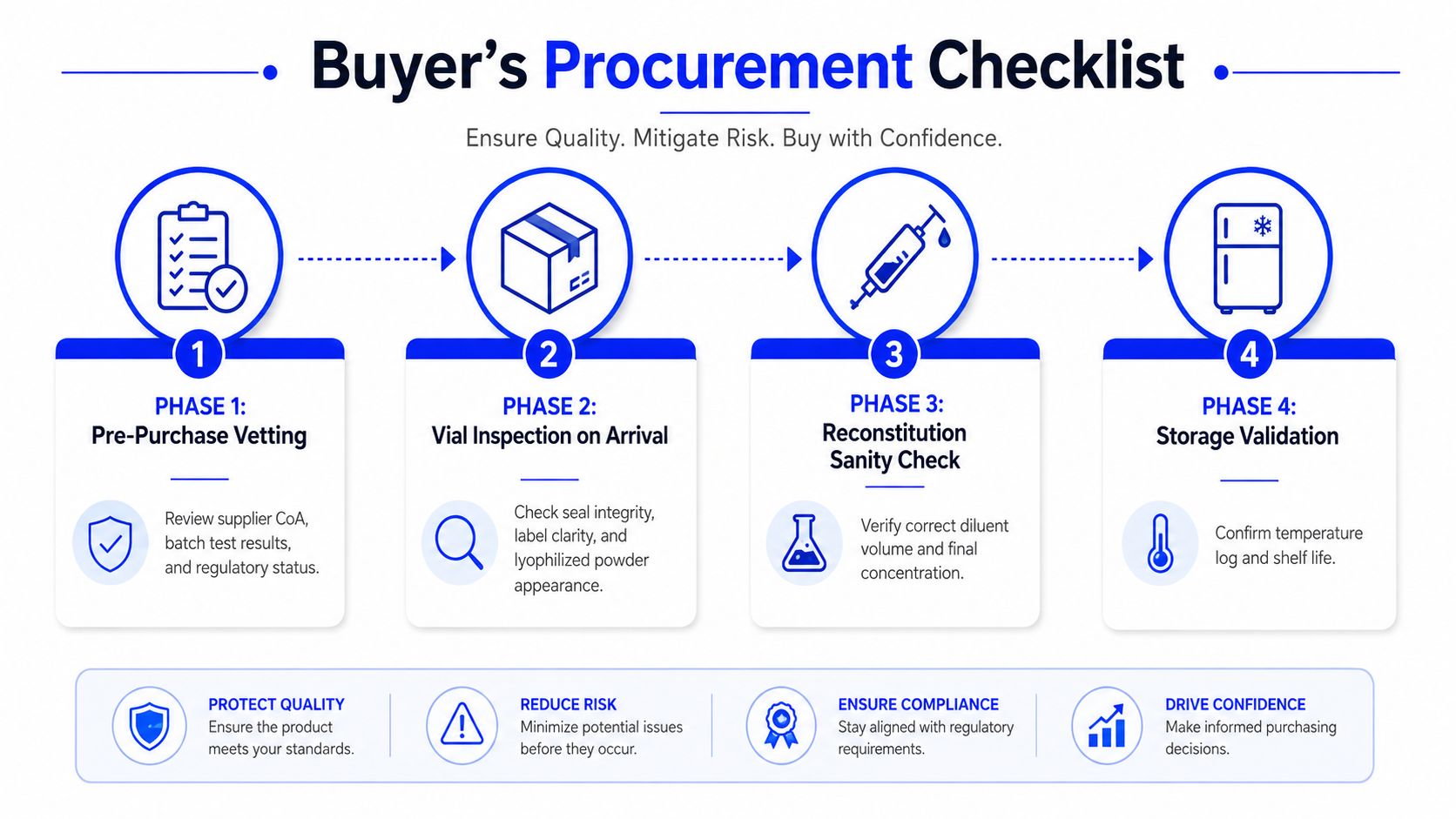
Independent 2026 testing of 68 vials from 43 vendors reported a median purity of 99.92% and found no vial below its labeled content, according to Vial Audit's BPC-157 testing coverage. That finding suggests some batches can meet stated specifications, but purity alone doesn't answer questions about endotoxin risk, lot consistency, storage history, or post-reconstitution stability.
Peptide Warehouse USA offers research-use products and related documentation, including COAs and microbial and endotoxin reports, through its laboratory-focused catalog. If you're comparing suppliers, visit Peptide Warehouse USA to review available BPC-157 formats, documentation, and sourcing information, then match the option to your laboratory's quality and traceability requirements.
Leave a comment