
No products in the cart.

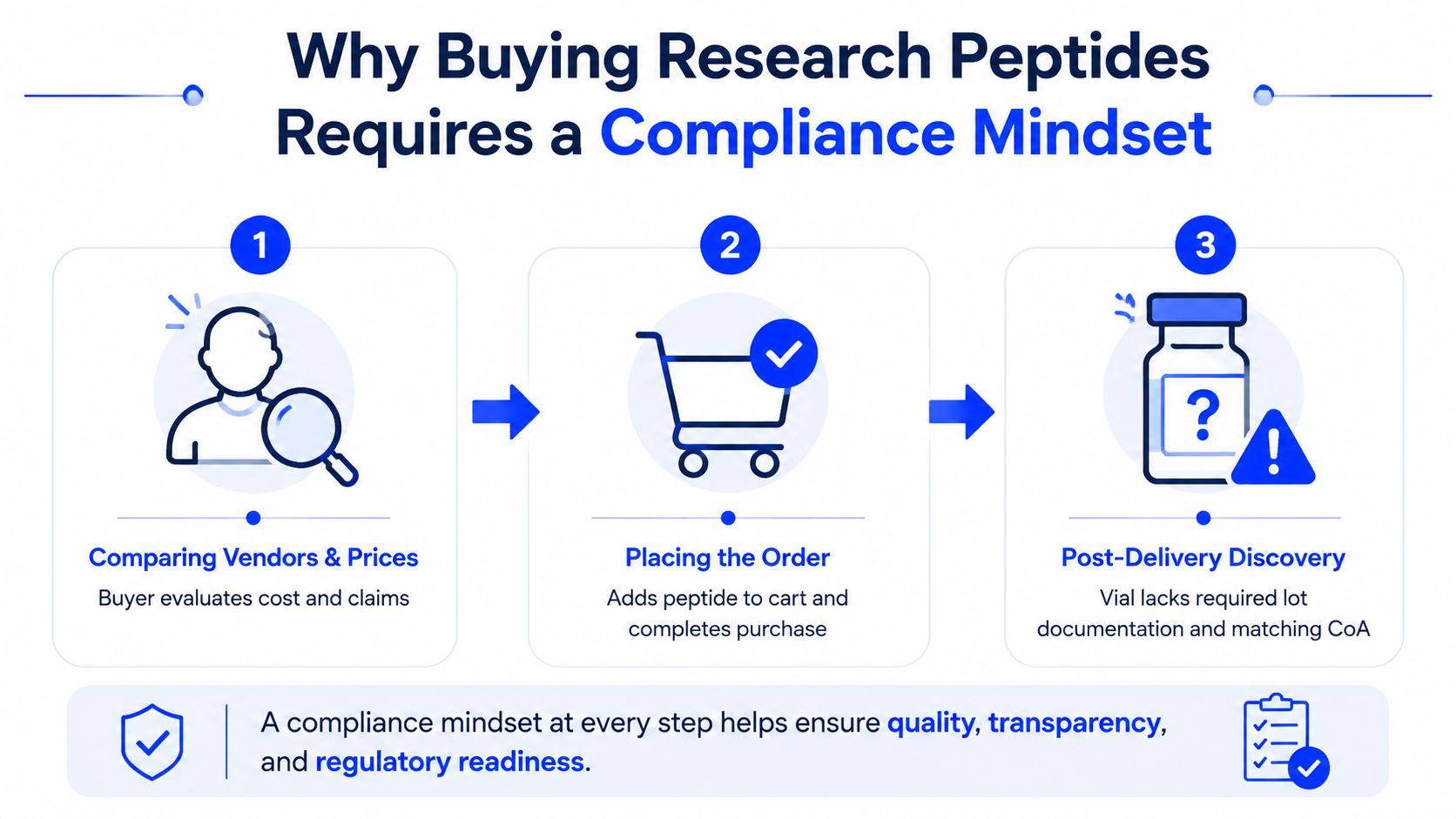
You're comparing peptide prices, adding a vial to your cart, and assuming the work ends when the payment clears. It doesn't. Many first-time buyers discover the problem only after delivery: the vial has no matching lot number, the certificate of analysis appears generic, storage instructions are vague, or the product page makes human-use claims beside a research-only disclaimer.
To buy research peptides responsibly in 2026, treat the transaction as a procurement and compliance decision, not a hunt for the lowest price or the largest purity number. This guide shows you how to verify supplier records, interpret COAs, separate identity from purity, assess endotoxin documentation, recognize enforcement risks, and build a purchasing file that can withstand institutional review.
A legitimate laboratory purchase should be reconstructable after delivery. That means you can identify the supplier, catalog number, lot number, quantity, storage conditions, intended research purpose, and documents associated with the exact material received.
The seller's assurances don't transfer responsibility to you. Your lab still needs to confirm that the compound is appropriate for its intended research, permitted under institutional policies, and handled under applicable laboratory, animal-research, customs, and workplace-safety procedures. Human and veterinary use must remain outside the stated purpose of a research-only product.
Before placing an order, save the product page and record:
A thoughtful supplier should provide realistic descriptions, transparent contact information, batch-level documentation, and shipping procedures that fit the product's handling requirements. If the company won't answer basic questions before payment, it probably won't become more transparent after a problem occurs.
Procurement rule: The safest order is the one another qualified person can audit from the invoice, vial, COA, shipping record, and experimental file.
Digital traceability tools can help teams organize supplier, batch, and compliance records. For organizations formalizing that workflow, the DPP Grid compliance solution provides a relevant reference point for structuring product documentation and traceability.
A research peptide can still create customs, safety, regulatory, or controlled-substance concerns depending on the compound and destination. Price matters only after the transaction passes those checks.
Peptides have a long pharmaceutical history. Insulin first reached patients in 1922, and independent summaries of FDA approvals report roughly 100 peptide-based drugs approved since then. Peptides represented about 10% of all new FDA drug approvals between 2020 and 2024, according to the FDA-approved peptide drug summary.
That history includes synthetic oxytocin, recombinant insulin, and modern GLP-1 medicines. Recent reviews also describe continued approval activity in the 2020s across obesity, rare disease, and cardiovascular care. The important procurement lesson is simple: peptides moved from specialized laboratory compounds into a major pharmaceutical and commercial category.
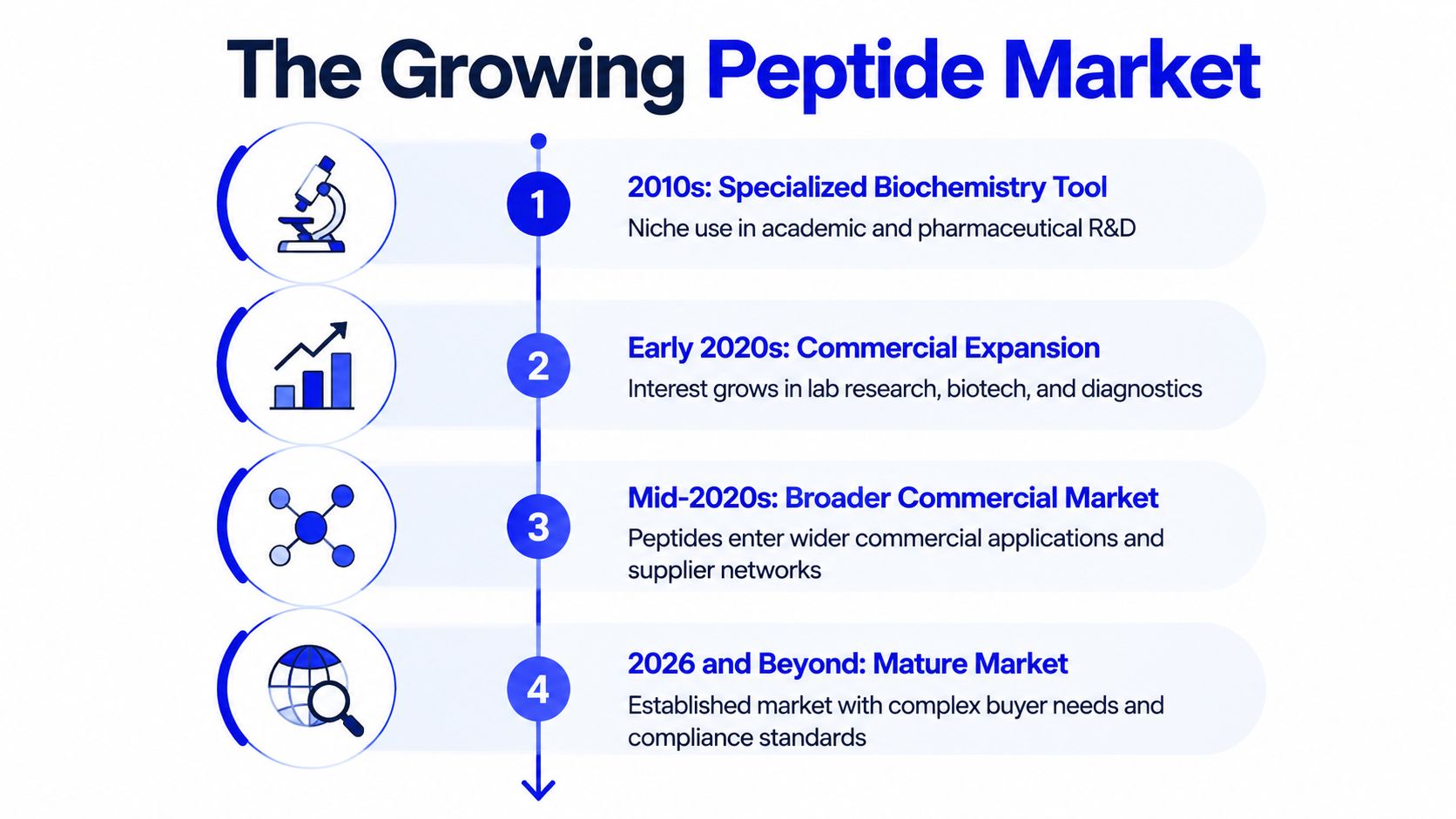
Industry estimates differ because research groups define the peptide market differently. One estimate values the global peptide market at USD 21.4 billion in 2022 and projects a 10.2% CAGR from 2023 to 2030. Another forecasts growth from USD 46.19 billion in 2025 to USD 91.79 billion by 2035, at a 7.11% CAGR. A separate estimate of peptide therapeutics places the segment at USD 140.9 billion in 2025 and USD 164.0 billion in 2026. These figures and definitions are compared in the peptide market analysis.
The figures shouldn't be treated as interchangeable. They do establish a consistent commercial reality: demand is no longer marginal, and a larger market attracts contract manufacturers, resellers, informal sellers, and suppliers with very different quality systems.
A polished website doesn't prove that a supplier manufactures its own material. Competitive pricing can coexist with relabeling, incomplete analytical testing, or weak lot control. Before comparing prices, verify:
The mature-buyer approach is evidence first, price second. Market expansion gives you more choices, but it doesn't give you more certainty.
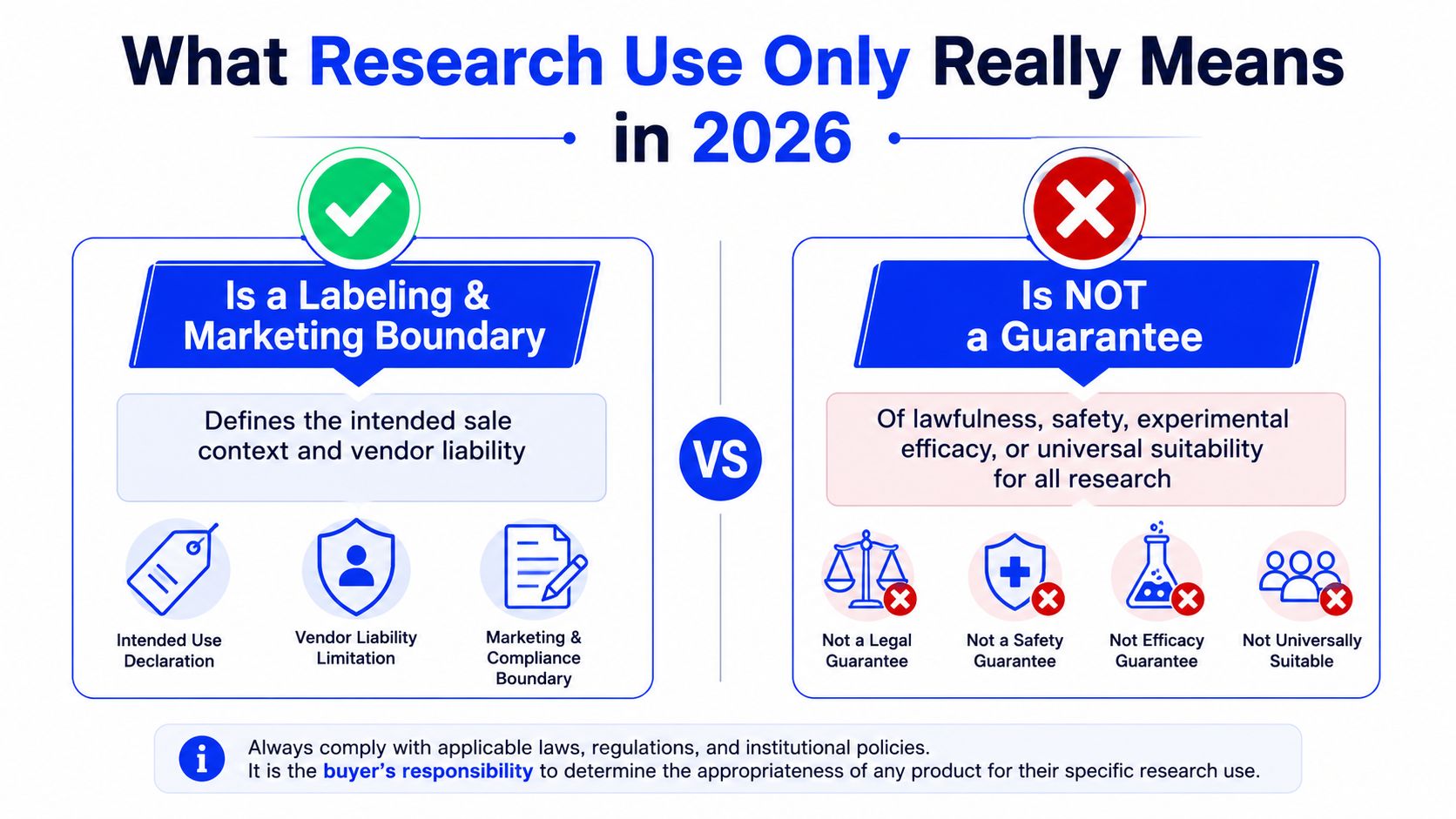
Research use only, or RUO, is a boundary on labeling and marketing. It isn't a guarantee of lawfulness, safety, efficacy, or universal suitability.
FDA-style laboratory labeling language expects products in the laboratory research phase, when they aren't represented as diagnostic products, to carry a prominent statement such as “For Research Use Only” and “Not for use in diagnostic procedures.” The research chemical labeling guidance explains that this language defines the intended laboratory context.
It doesn't override customs requirements, workplace procedures, controlled-substance restrictions, animal-research approvals, or institutional purchasing rules. It also doesn't convert an unapproved laboratory reagent into an FDA-regulated medicine.
An FDA-approved peptide drug has a defined regulatory status and approved labeling. An investigational or unapproved drug follows a different compliance pathway. A laboratory reagent may carry no clinical or therapeutic claim at all.
That distinction matters because some product pages pair an RUO disclaimer with language about recovery, fat loss, anti-aging, muscle growth, or human use. Those claims conflict with the research-only boundary and should trigger a supplier review before you order.
Read every part of the transaction.
An RUO label has value only when the advertising, sale, shipment, receipt, and experiment all remain within the same non-clinical research purpose.
Before purchasing, confirm that your organization permits the compound and that your protocol, facility, and personnel can handle it appropriately. A disclaimer cannot repair a contradictory sales page or an improper use.
A COA is useful only when it describes the exact production lot you received. A defensible certificate should be tied to a representative sample from that production run and should state the methods and results for that batch, rather than implying that every future vial will have identical characteristics. The batch-specific COA guidance explains this distinction clearly.
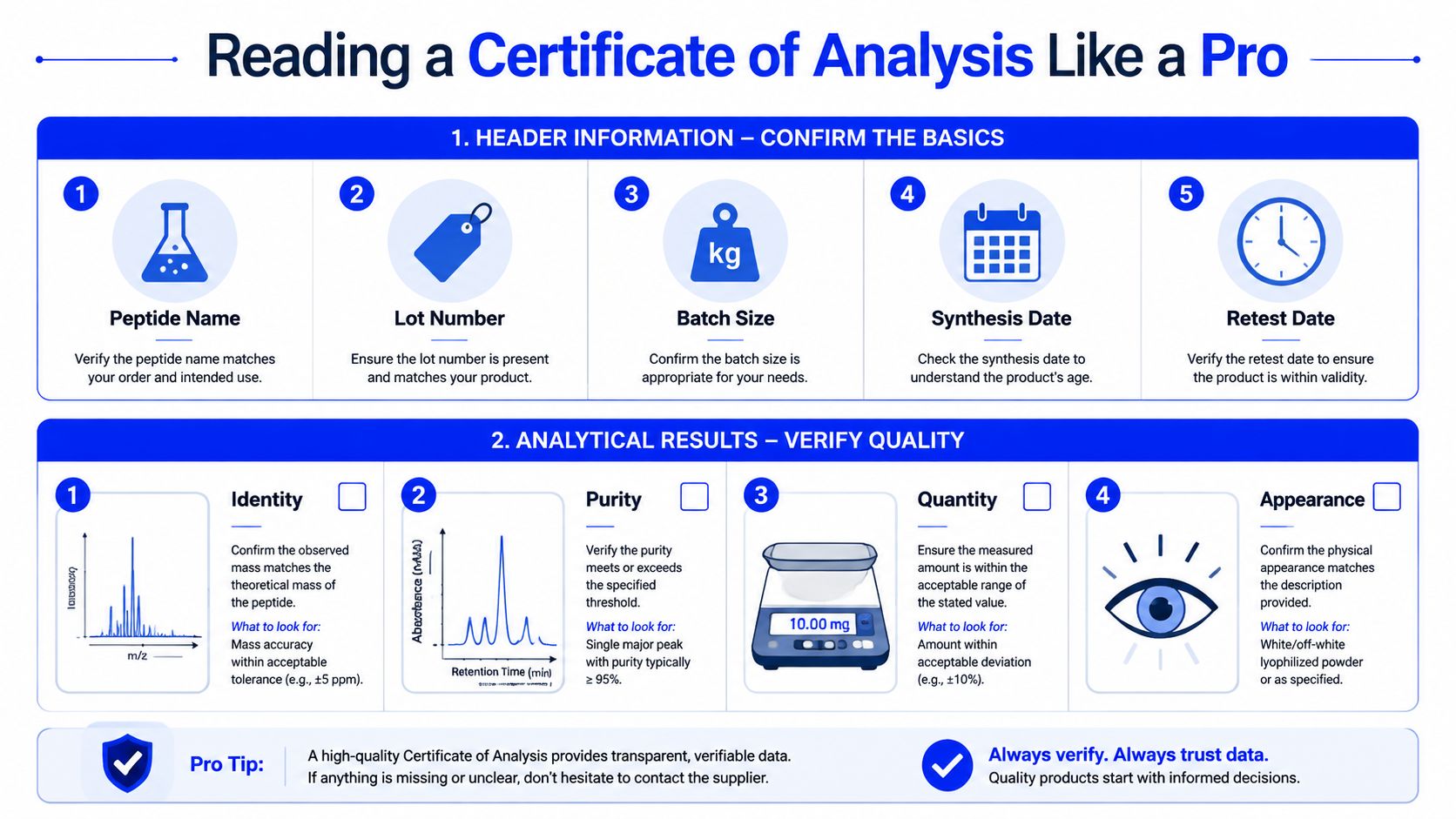
Check that the document identifies the peptide, lot or batch number, quantity or batch context, testing date, and issuing laboratory. A strong COA should also provide laboratory contact information, as outlined in independent COA guidance.
The lot number on the paper must match the vial. If the supplier sends a COA with a different lot, stop the receiving process and request the correct document.
Reversed-phase HPLC separates detected compounds and calculates purity from target peak area. It does not establish that the target peak has the correct molecular identity.
Mass spectrometry checks whether the dominant species matches the expected molecular weight. It can also reveal truncations or side products that a single HPLC result may not expose.
Amino acid analysis can support composition assessment, but it shouldn't replace sequence or identity confirmation when the experiment depends on a particular peptide.
The peptide purity testing guidance recommends treating HPLC purity and MS identity as a paired workflow. A vendor claim such as “99% purity” means little if the chromatogram method is undisclosed.
A credible COA should identify the HPLC column chemistry, gradient, detection wavelength, and relevant MS information. Be cautious when a document rounds every result to a whole number, omits chromatograms, uses identical formatting across unrelated lots, or provides no issuing-lab contact.
If a result looks unusually clean, request raw data or a complete analytical report. The goal isn't to demand paperwork for its own sake. It's to determine whether the document supports the exact material in your freezer.
A peptide can show a high HPLC purity result and still be unsuitable for a particular assay. Purity, identity, impurity profile, and biological contamination answer different questions, so your specification should separate them rather than compressing everything into one headline number.
The FDA notes that peptide-related impurities may matter at very low levels, with impurity identification and qualification thresholds in comparability assessments often around 0.10% to 0.5%. Those thresholds appear in the FDA peptide impurity guidance, and they reinforce a practical point: a small impurity can matter when it changes assay behavior or comparability.
| Quality Parameter | Analytical Method | Acceptance Threshold | Why It Matters |
|---|---|---|---|
| Identity | Mass spectrometry, with sequence confirmation where necessary | Expected molecular identity must be supported by the assigned analytical data | A similar mass alone may not establish the intended sequence or stereochemistry |
| Purity | Reversed-phase HPLC with disclosed method and chromatogram | 99% or higher is commonly treated as research-grade guidance, while 95% to 98% is described as preliminary research quality in industry guidance from PS Peptides | Peak area helps quantify detected target material, but co-eluting impurities can remain hidden |
| Endotoxin | Kinetic chromogenic LAL testing | Sub-5 EU/mg is commonly treated as an important control limit, with some checklists reporting limits as low as 0.005 EU/mL, as described in GMP-oriented endotoxin guidance | Endotoxin can confound inflammation, cytokine, toxicity, and efficacy readouts |
| Impurity profile | HPLC, MS, and supporting analytical methods | Review identified and unidentified peaks against the experiment's requirements | Truncations, deletion products, residual synthesis materials, and counterions can affect results |
| Microbial and moisture control | Microbial testing and moisture analysis such as Karl Fischer | Use the laboratory's validated specification for the intended application | Contamination and moisture can affect stability and biological interpretation |
Highly pure material can still trigger false biological signals if endotoxin is present. For cell culture or in vivo work, request an explicit endotoxin result, test method, reporting limit, batch identifier, and sample relationship.
Don't treat “99%” as a substitute for identity or contamination data. Ask for the complete package before spending money, especially when your readouts involve inflammatory signaling or toxicity.
The fastest way to reject a risky supplier is to examine behavior, not branding. A vendor that makes aggressive human-use claims, refuses to identify its business location, or supplies a generic COA is asking you to accept unverifiable risk.
Warning signs include:
Enforcement has also become a procurement issue. Recent coverage describes warning letters and import-control actions involving peptide sellers marketing products as unapproved drugs. A 2026 industry timeline cites FDA warnings against multiple peptide vendors and expanded import controls, while a separate 2026 legal update describes a Green List import alert aimed at quality-concern APIs entering the U.S. supply chain. Review the peptide enforcement timeline before assuming an RUO label protects a transaction.
Search the company's legal identity, inspect its documentation samples, and ask whether the lot-specific COA will be available before shipment. Check whether the product description remains laboratory-focused from the landing page through checkout.
Import risk doesn't apply only to medicines. Documentation, product classification, customs review, and carrier handling can affect laboratory materials too. Buyers dealing with international supply chains can use this overview of challenges in medical device imports to identify broader documentation and clearance issues.
A shipment can be delayed or flagged because of how a seller markets and documents the product, not merely because the vial carries an RUO label.
Keep invoices, product screenshots, COAs, shipping records, and correspondence together. If an agency, institution, or internal auditor asks what you bought and why, your file should answer without guesswork.
Use this checklist before ordering, not after the vial arrives.
No. Appropriate shipping helps protect material during transit, but it doesn't prove identity, purity, endotoxin status, or lot consistency. Match the shipping conditions to the supplier's storage instructions and record any temperature concern at receipt.
Place the lot on hold and request a batch-specific COA before use. Don't accept a generic document that refers to a different lot or makes a universal claim about future stock.
Purity describes the proportion of detected target material under the stated analytical method. Net peptide weight describes how much material is present in the container. A vial can contain the stated mass while still requiring purity correction for quantitative experimental work.
No. HPLC is important, but it should be paired with MS identity confirmation. Review the chromatogram method and ask whether co-eluting compounds, truncations, or side products were investigated.
Not by itself. Your institution may require supplier approval, safety review, import documentation, animal-use approval, or additional analytical evidence. Confirm those requirements before ordering.
The strongest basic signals are a matching lot number, test date, identity result, purity method, endotoxin result where relevant, testing laboratory contact information, and clear linkage to the received batch.
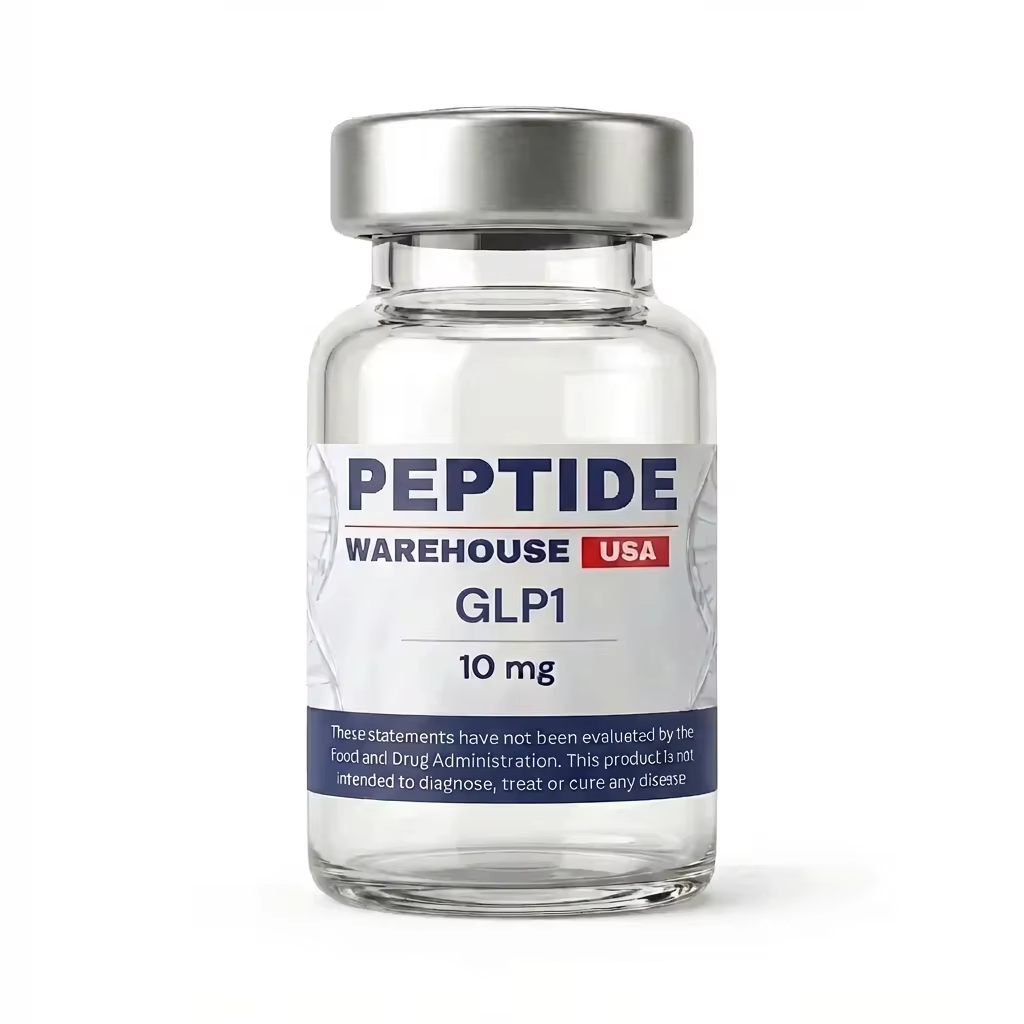
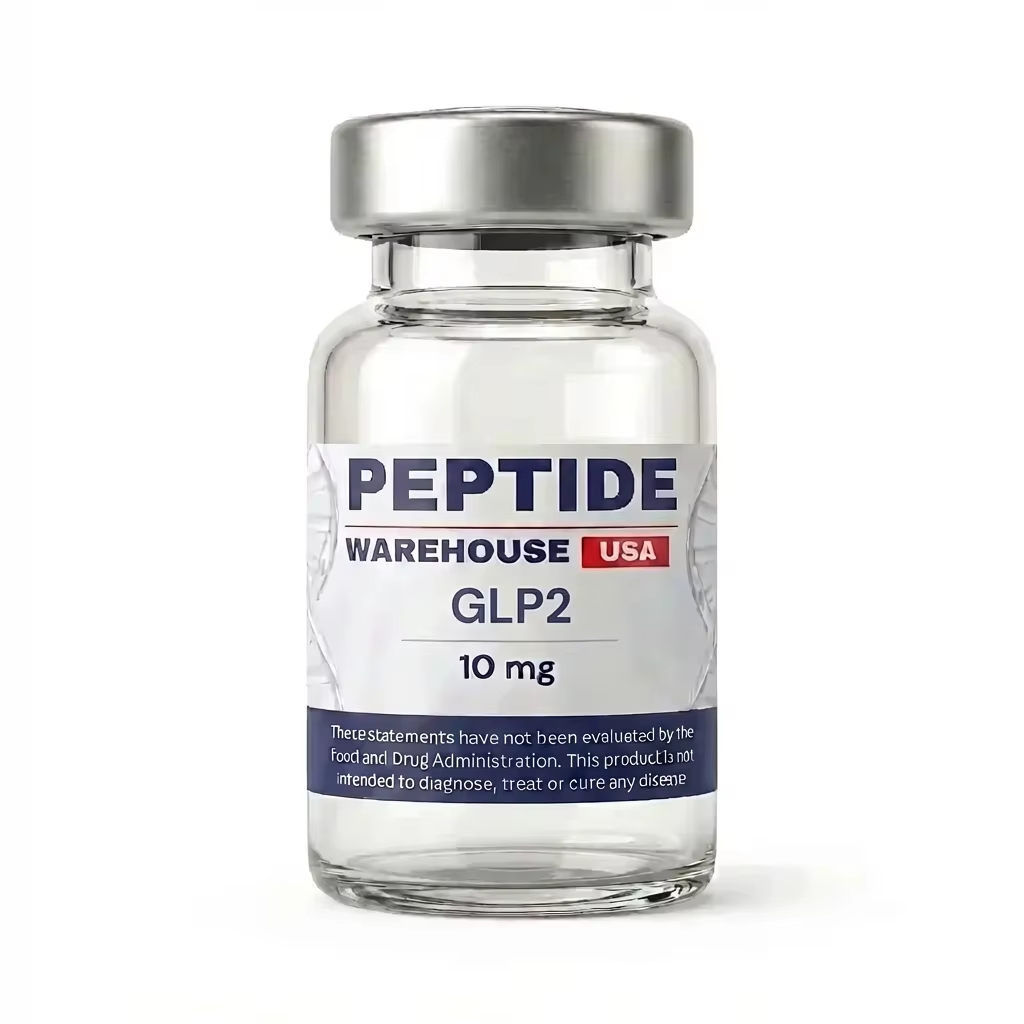
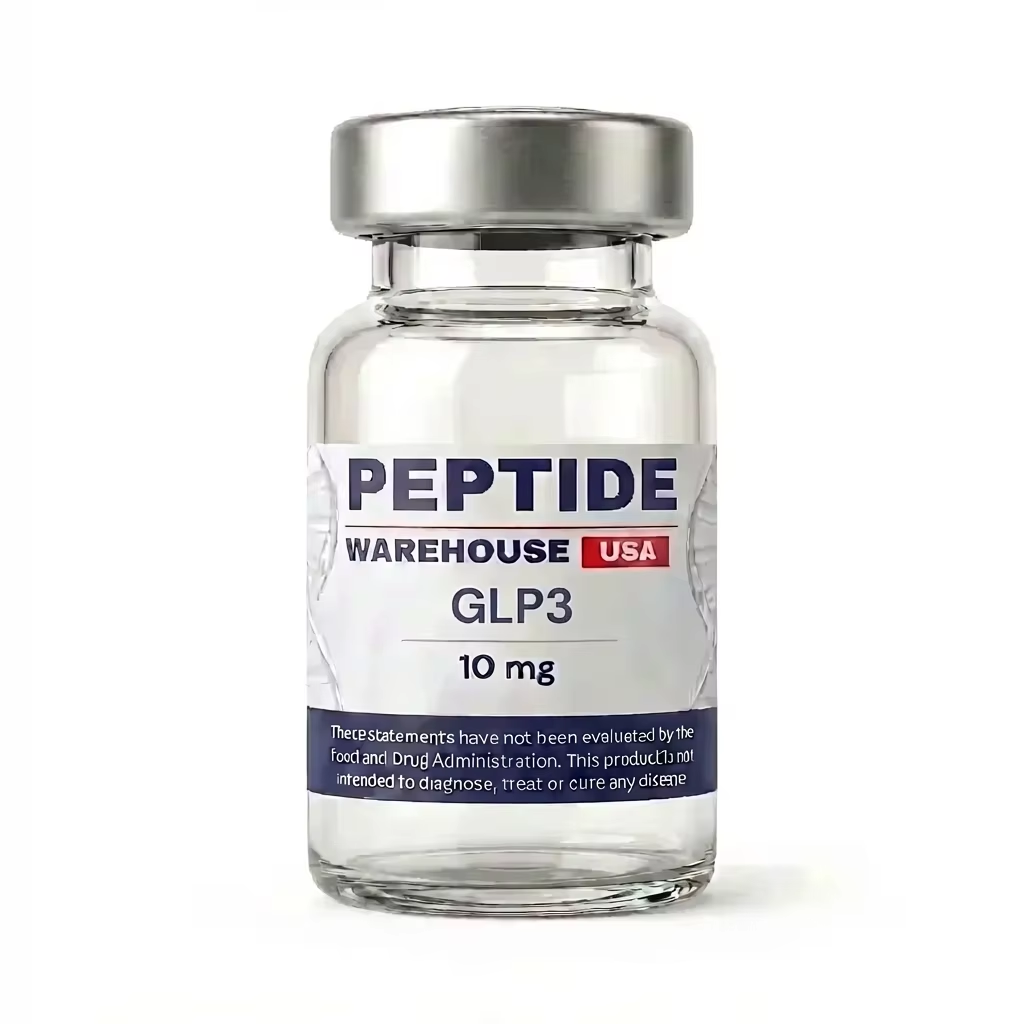
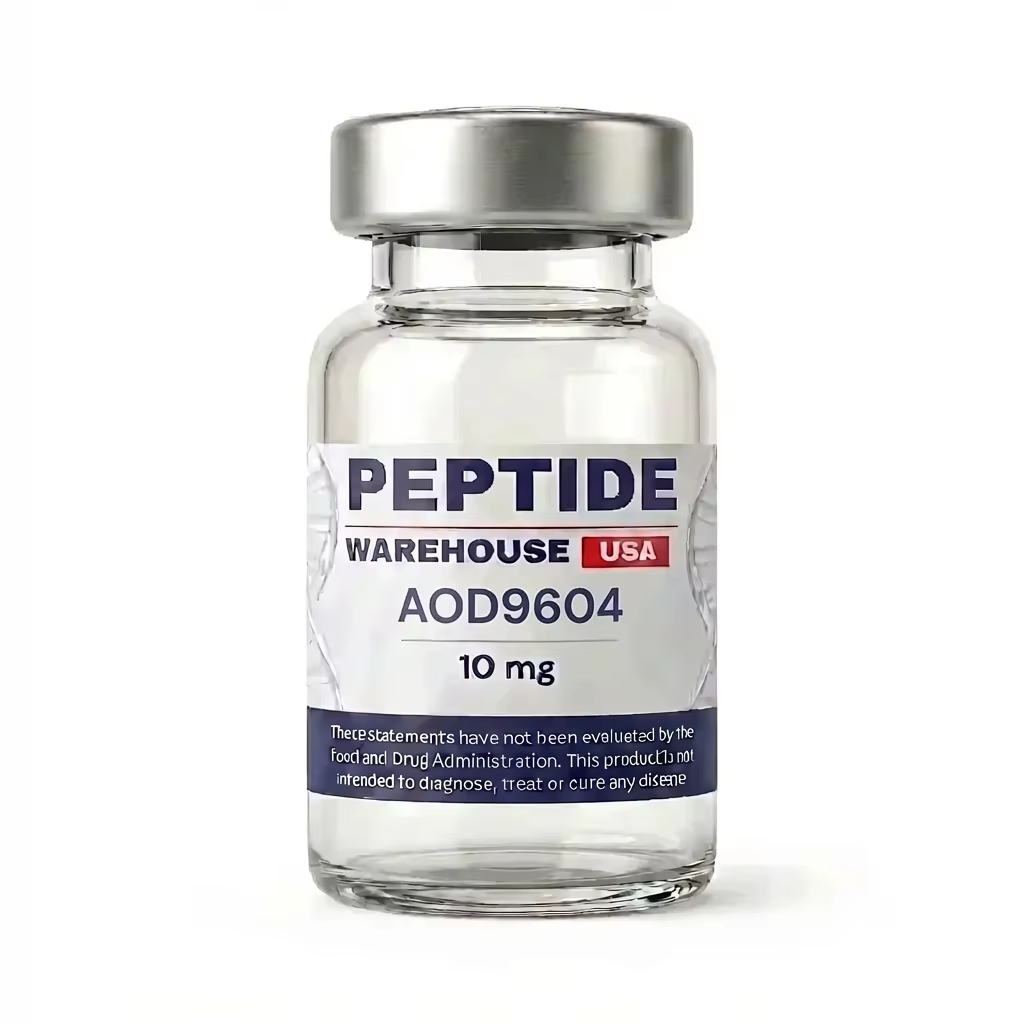
If your lab needs a US-based research supplier, Peptide Warehouse USA lists high-purity research peptides and related compounds with batch documentation, including COAs, microbial reports, and endotoxin reports, while clearly stating that its products are for laboratory, analytical, or research use only. Review the documentation and intended-use terms before you visit Peptide Warehouse USA, then compare its records with your institution's procurement requirements.
Leave a comment