
No products in the cart.


You've been asked to source Selank for a laboratory project, but the vendor page gives you little more than a product name, a purity claim, and an attractive delivery promise. Before you place an order, you need to know whether the material is correctly identified, whether the batch documentation is genuine, and whether the transaction stays inside the boundaries of research-only procurement.
The phrase buy Selank online describes a purchasing channel, not a quality standard. A defensible acquisition starts with molecular identity and regulatory classification, then moves through vendor qualification, Certificate of Analysis review, shipping controls, and storage records. This guide treats Selank as a research compound for qualified laboratories, not as a product for human or veterinary use.
A laboratory purchase file may contain a Russian regulatory history, a supplier invoice, and a batch record. Those documents answer different questions. Selank is a synthetic heptapeptide derived from tuftsin. Its research path included late-1990s and early-2000s preclinical work, human studies in Russia, and reported approval by the Russian Ministry of Health in 2009 as a prescription anxiolytic nasal spray. A commonly cited Russian study also enrolled 62 patients with generalized anxiety disorder and neurasthenia and compared Selank with medazepam during a 14-day treatment period, as described in this historical overview of Selank research and registration.
That history supports scientific interest. It does not turn an online research product into an approved medicine in the United States, and it does not authorize a laboratory to administer a purchased vial to people. File the Russian approval note as background only, and mark the lot record as research-use-only with no FDA indication.
The practical U.S. position is clear. Selank has no FDA-approved human indication, and available summaries report no publicly indexed FDA-approved human pharmacokinetic package. Published human evidence remains concentrated in short Russian studies rather than large, multi-country trials, as discussed in this research and procurement review of Selank. Record those limits beside the intended use, not only in a general compliance folder.
A material can be suitable for in-vitro, analytical, or preclinical work while remaining outside ordinary pharmaceutical channels. Treat the label research use only as an operating restriction. It should govern who may access the material, which protocols may use it, how records are maintained, and how unused material is disposed of.
Define the experiment before requesting quotations. The purchase file should state the assay or model, required form, any route-related formulation requirements, quantity, storage plan, responsible investigator, and disposal procedure. A supplier's community protocol is not a laboratory protocol. Selank literature includes intranasal work, including an animal study using a single intranasal dose of 6 μl at 300 μg per kg body weight. That detail does not establish a human dose or validate a commercial formulation claim, as reported in this published intranasal Selank research.
Procurement rule: Research history can justify analytical interest. It cannot replace product identity, batch testing, or authorization for human use.
The most important document you receive after you buy Selank online is the batch-specific Certificate of Analysis, not the product description. A credible COA should allow another qualified person to connect the material in your possession with a defined manufacturing lot and a stated analytical result.
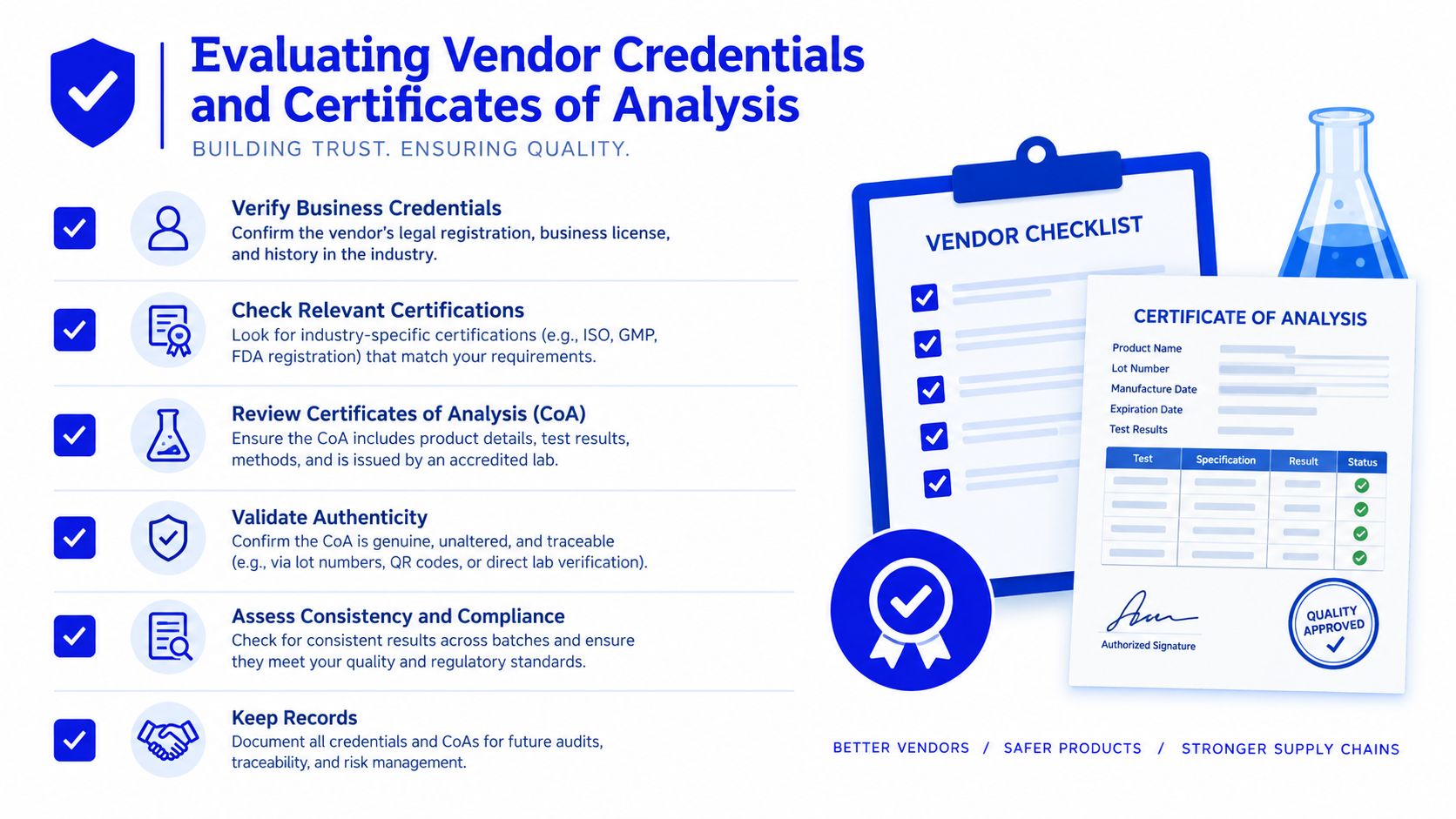
Start with traceability. The product name, lot or batch identifier, test date, manufacturing or release reference, and supplier identity should align with the vial, invoice, packing slip, and any outer label. If the lot number on the COA doesn't match the container, stop the intake process until the discrepancy is resolved in writing.
Then examine the analytical scope:
There isn't a universal purity threshold that makes an online peptide acceptable for every experiment. Your method determines what impurity profile, residual solvent information, water content, or concentration tolerance you need. A protein-binding assay, analytical standard comparison, and cell-based experiment may require different controls.
A vendor that sends only a generic PDF, refuses to identify the testing laboratory, or provides the same COA for every lot hasn't given you batch evidence. The same applies to a report that lists “high purity” without a numerical result, method, release date, or sample identity.
Unvetted markets create practical risks that marketing pages rarely explain. Independent coverage identifies mislabeled concentrations, contamination, incorrect compounds, and missing source traceability as recurring concerns, especially where prescription and FDA oversight don't apply. A 2026 report on peptide regulation and online access also describes the unresolved authenticity problem for buyers relying on online listings.
Treat the COA as one part of qualification, not as a guarantee. Verify the supplier's business identity, contact details, lot continuity, return procedure, and response to technical questions. If the vendor won't discuss methods, chain of custody, or discrepancies before payment, the material isn't ready for your laboratory.
“Research use only” isn't a loophole that permits a supplier or buyer to make treatment claims. It defines the intended context of the transaction and places responsibility on the laboratory to prevent the material from being represented, dispensed, or used as an approved human-use drug.
Current U.S. reporting describes Selank as not FDA-approved and not scheduled as a controlled substance, while also placing it in a regulatory gray area. A research chemical may be offered for lawful laboratory work, but that doesn't authorize a seller to market it for anxiety, cognition, stress, healing, or any other treatment purpose. The FDA-focused reporting on peptide access and product regulation explains why labeling, enforcement, and compounding questions remain separate from simple availability.
A research-only label can support a compliant procurement process when the actual transaction matches the label. Your organization should be able to show that:
A disclaimer also doesn't establish that the material is safe, sterile, correctly concentrated, or suitable for any particular assay. It describes intended use. It isn't an identity test.
Research supply and pharmacy compounding are different channels. One research summary states that Selank isn't on the FDA's 503A bulk drug substances list, meaning there is no lawful routine U.S. pharmacy compounding pathway under that framework, as described in this Selank regulatory reference. Don't infer that an online vial is equivalent to a prescription product because both may appear in a nasal-spray format.
Regulatory discussions may change access, labeling, testing expectations, or enforcement. They don't retroactively validate a purchase or establish medical efficacy. Keep your procurement decision tied to the rules and institutional policies in force when the order is placed.
A qualified vendor can still deliver a compromised batch if logistics are poorly controlled. Your purchasing procedure should specify how the material is packaged, tracked, received, inspected, and accepted before it enters inventory.
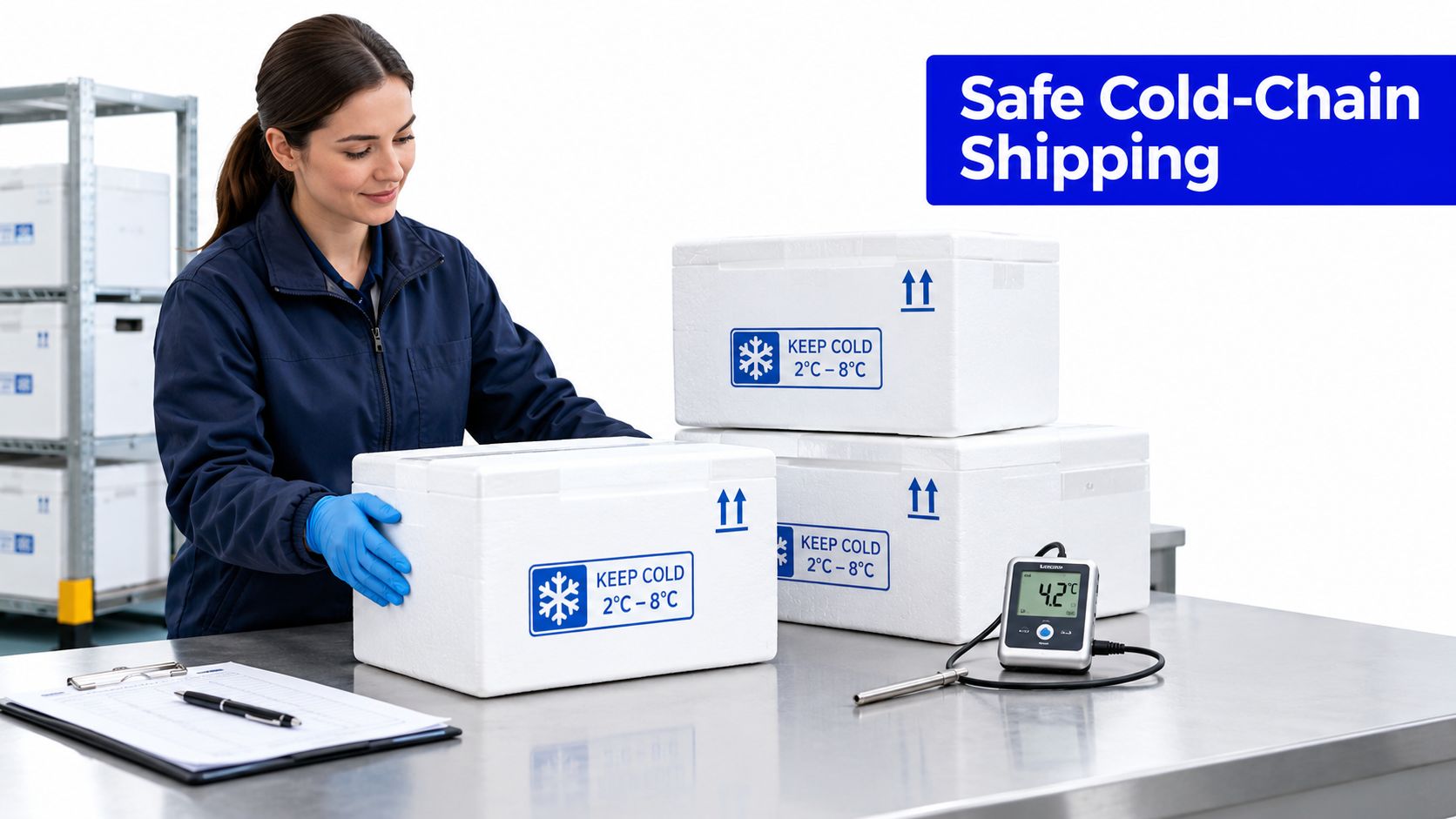
Ask the supplier about fulfillment location, packaging configuration, temperature guidance, carrier tracking, and the procedure for damaged or delayed shipments. Domestic manufacturing can simplify sourcing records and reduce customs-related uncertainty, although it doesn't remove the need to inspect the product when it arrives.
At intake, assign one person to compare the shipment with the purchase order. The receiving record should capture:
Don't release a questionable shipment directly to a working bench. Place it in a clearly marked quarantine location while the supplier explains the discrepancy and your quality lead decides whether independent testing is necessary.
Peptide Warehouse USA manufactures in the USA with strict batch production protocols, offering fast shipping and clear sourcing to streamline procurement for labs and institutions. That information can be relevant to a purchasing comparison, but your team should still request the lot documents and inspect the delivered material rather than relying on a country-of-origin statement alone.
Fast fulfillment is useful only when the shipment remains traceable. Save the tracking record, packing slip, supplier correspondence, and acceptance decision with the lot file. If a carrier delay occurs, document what happened and ask whether the material should remain under quarantine.
Temperature instructions should be specific enough for your receiving team to act on them. “Store properly” isn't a shipping control.
Packaging also deserves a practical review. The outer container should protect the vial from physical damage, moisture, and light exposure. Discreet packaging may protect privacy, but it doesn't replace a seal, a readable label, or a lot-specific COA.
Storage begins when the package is accepted, not when someone eventually finds room in a freezer. Lyophilized Selank should remain in a cool, dry, light-protected environment consistent with the supplier's written instructions and your laboratory's validated storage procedure.
For the product information supplied by the publisher, the recommended condition for lyophilized material is -20°C in a dry, light-protected environment, and the guidance says to avoid repeated freeze-thaw cycles. Treat that as a product-specific storage instruction, not as a universal rule for every Selank formulation. Keep the relevant Selank research product information in your batch file and reconcile it with the manufacturer's current documentation.
Moisture is a practical threat to a lyophilized peptide. Keep vials closed until the moment of use, limit time outside controlled storage, and avoid placing a cold vial in a humid workspace where condensation can form. Do not open a vial just to inspect the powder if the inspection isn't part of an approved procedure.
Use a storage log that records:
Don't assume appearance proves identity or purity. A clean-looking powder can still be mislabeled, underfilled, contaminated, or chemically unsuitable for the intended method.
Reconstitution should occur under the laboratory's approved technique, with the solvent, container, mixing approach, concentration calculation, and labeling recorded before use. The research source describes reconstitution with an appropriate sterile laboratory solvent and advises avoiding repeated freeze-thaw cycles. It doesn't create a human-use instruction or establish a universal stability period for a reconstituted solution.
Once reconstituted, label the container with the compound identity, lot, preparation date, solvent, calculated concentration, preparer's initials, storage condition, and assigned discard or retest point. If your laboratory hasn't established solution stability, don't invent a shelf life from a vendor discussion or an online dosing forum. Use an approved stability protocol or consult your analytical lead.
Inspect the container before each analytical use. Unexpected turbidity, particles, color change, a damaged closure, or an unexplained volume discrepancy should trigger quarantine and investigation. Record deviations while they are fresh. That small discipline protects the validity of later results.
A reliable Selank supply chain is a repeatable system, not a single successful order. The workflow should make it difficult for an unverified lot, ambiguous label, or unsupported use claim to move from an online listing into an experiment.
Start with a written specification. Define the research purpose, required form, documentation package, storage capacity, receiving owner, and acceptance criteria. Then qualify suppliers against the same criteria so a lower price or faster promise doesn't subtly weaken your controls.
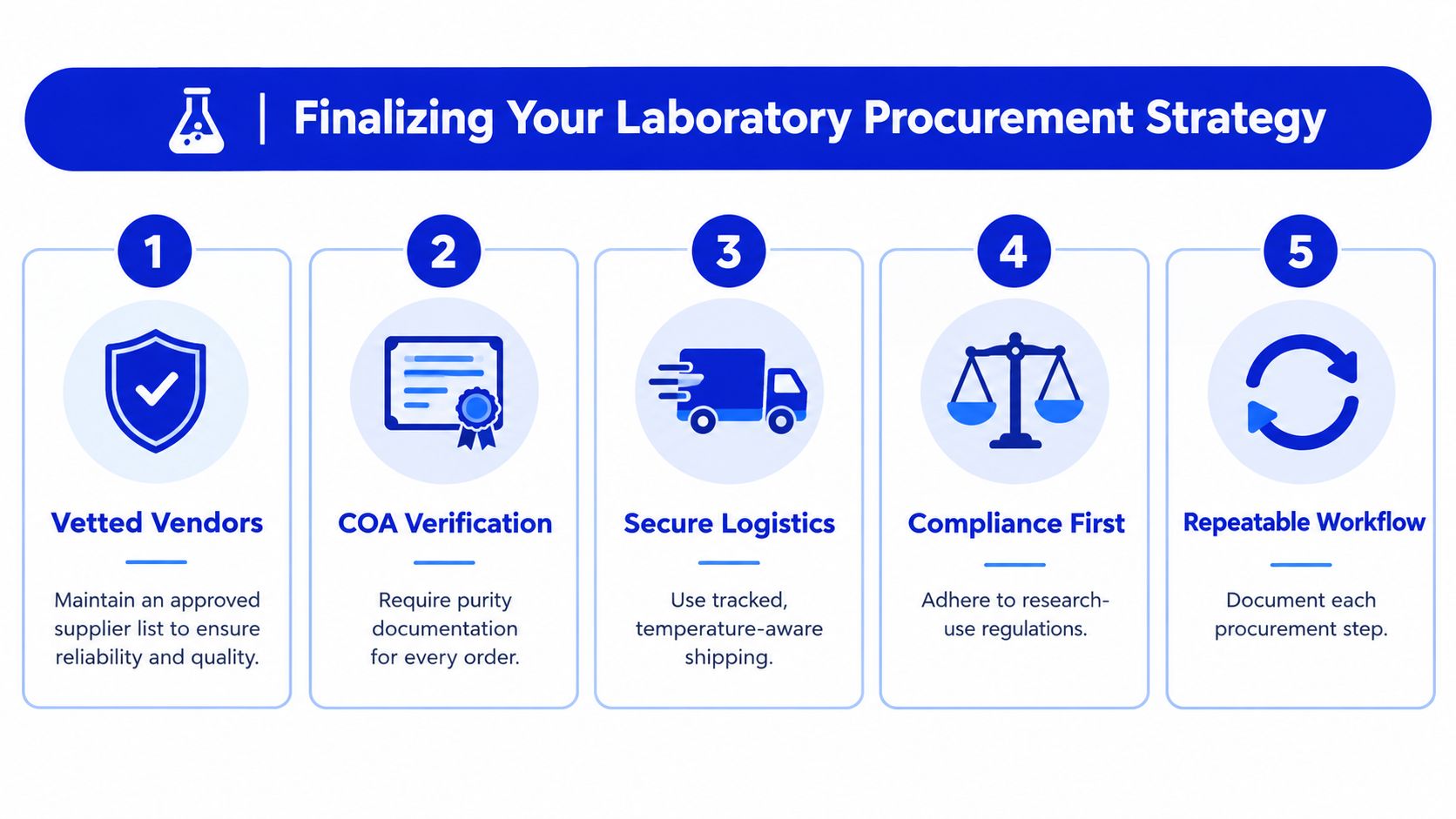
Your record should connect the commercial transaction to the scientific result. Include:
This structure lets a laboratory distinguish a failed assay from a failed supply input. Without it, investigators may spend weeks troubleshooting instruments or methods when the original problem was an incorrect concentration or contaminated material.
Before analytical work begins, ask whether the answer to each question is documented:
If any answer is no, quarantine the material and resolve the gap. A transparent supplier should be able to explain documentation, sourcing, shipping, and research-use boundaries without redirecting the conversation toward treatment claims.
The strongest procurement decision is often the one that creates fewer unknowns. Compare vendors on traceability, batch documentation, technical responsiveness, shipping controls, and consistency of records. Product benefits such as a convenient format or rapid fulfillment matter only after identity and compliance requirements are satisfied.
Peptide Warehouse USA offers USA-manufactured research peptides, including Selank, with batch documentation, COAs, microbial and endotoxin reports, and tracked sourcing intended for laboratory and analytical procurement. Review the available research-use materials, confirm that the lot documentation fits your protocol, and visit Peptide Warehouse USA to explore options for your next documented order.
Leave a comment