
No products in the cart.



If you're searching for Chemyo MK 677 right now, you're probably running into a messy mix of old product pages, forum chatter, and half-updated legal takes. One page talks about Chemyo like nothing changed. Another suggests the vendor situation may have shifted. If you're trying to figure out whether older reviews still matter, whether MK-677 is still relevant for research, and what the current compliance picture looks like, the confusion is understandable.
MK-677, also called ibutamoren, is best understood as an oral growth hormone secretagogue. In simple terms, researchers study it because it can stimulate the body's own growth-hormone signaling pathway after oral administration, rather than delivering growth hormone by injection. That oral profile is a big reason it became so widely discussed.
Chemyo became part of that discussion because branded vendor references often stick around long after the original context changes. In 2026, that matters more than usual. One source reports that Chemyo stopped accepting payments on 8 September 2026, while other discussions still treat Chemyo MK 677 as an active product topic, which helps explain why search results feel fragmented (vendor continuity context for Chemyo in 2026).
Old reviews can stay visible for years. That doesn't mean the vendor, listing, documentation, or compliance context is still the same.
This guide takes a calm, research-first approach. It focuses on what MK-677 is, how it works, what human research showed, why Chemyo is still a common search term, and how to think about sourcing and legality without hype. It also stays within a research-use frame. MK-677 is not FDA-approved, and that point needs to stay front and center when people discuss it in any practical context.
A common scenario looks like this. A researcher, buyer, or a well-read consumer searches for Chemyo MK 677, finds references to liquid formulations, sees dosing anecdotes, then notices recent comments questioning whether Chemyo is still operating normally. At that point, the question stops being “What is MK-677?” and becomes “What still applies?”
That's the right question.
Chemyo shows up in search because brand names often become shorthand. People don't always mean only one vendor. Sometimes they mean a format, a reference product, or a familiar starting point from older discussion threads.
In practice, searches for Chemyo MK 677 usually reflect a few overlapping needs:
MK-677 has a specific niche. It was advanced by Merck in the 1990s as an oral growth hormone secretagogue, reached at least Phase II testing in older adults, growth-hormone-deficient children, and patients recovering from hip fracture, and was later discontinued in 1999 without FDA approval for any indication (historical development summary of MK-677).
That history matters because it separates MK-677 from purely speculative compounds. It was studied in real human populations, including a Phase IIb hip-fracture study that randomized 123 patients aged 60 years or older to 25 mg daily or placebo for 24 weeks (same historical clinical overview).
The most useful way to approach MK-677 is to separate four questions that people often blend together:
Keeping those separate makes the whole topic much easier to evaluate.
MK-677 is easier to understand if you stop thinking of it as “oral growth hormone” and start thinking of it as a signal. It doesn't supply GH from the outside. It pushes a receptor pathway that influences the body's own GH release.
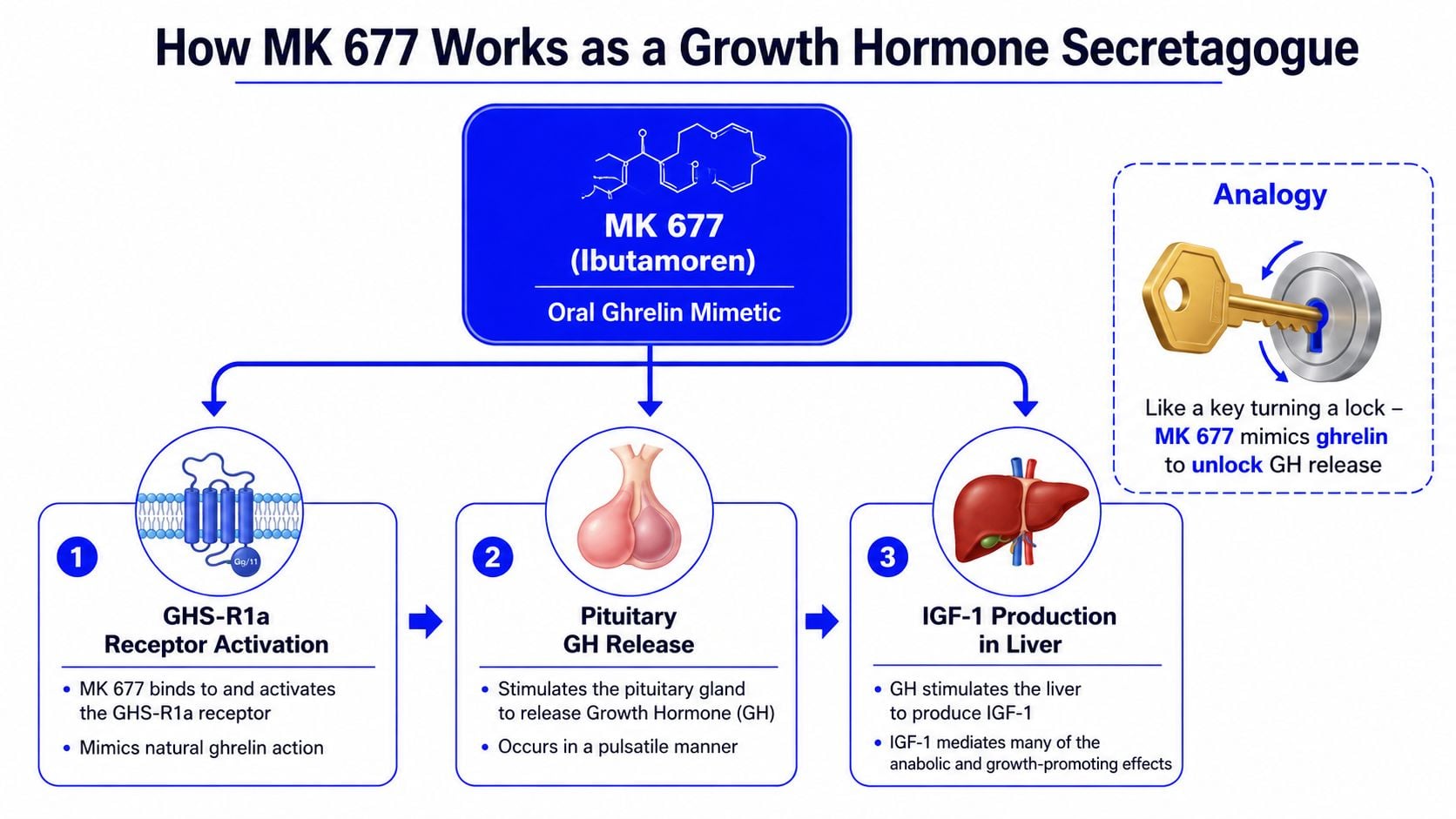
A useful analogy is a key and lock.
Ghrelin is one of the body's natural “keys” involved in signaling around appetite and growth hormone release. MK-677 acts like a ghrelin-mimetic signal, so researchers study it as a compound that can “turn the lock” on that pathway without being injectable growth hormone itself.
That distinction shapes how people compare it to other compounds. If you're evaluating science-backed peptide protocols, it helps to separate compounds that act through signaling from those that directly replace a hormone.
Once that receptor pathway is stimulated, researchers track downstream endocrine changes, especially:
The key point is that MK-677 is described in human studies as an orally active growth hormone secretagogue that produces sustained downstream IGF-1 elevation rather than just a brief pulse. Its pharmacodynamic effect can persist for up to 24 hours after a single oral dose, which is why once-daily dosing has been used in trials (human pharmacodynamic overview of ibutamoren).
Practical rule: If a compound's signaling effect lasts across much of a full day, researchers won't think about it the same way they think about short-acting injectables.
This is one reason MK-677 stood out historically. A lot of GH-axis research compounds are discussed through the lens of injections, pulse timing, or complex administration windows. MK-677 drew attention because the oral route made study design and handling discussions look different.
That doesn't make it simple. It just changes the questions.
Researchers often care about the timing profile too. Available human and regulatory summaries describe rapid oral absorption with peak concentrations around 1 to 2 hours after dosing, a plasma elimination half-life of roughly 4 to 6 hours, and accumulation to near steady state within about 5 to 7 days. Those same materials also note metabolism primarily through CYP450 and glucuronidation, which is relevant when researchers think about interaction risk in multi-compound settings (FDA-reviewed pharmacokinetic summary for MK-677).
Two ideas often get mixed up:
That's why MK-677 keeps showing up in GH-axis discussions. The route is convenient from a research perspective, but the reason it remains relevant is the signaling profile.
A common research scenario in 2026 goes like this. Someone finds an old forum thread about Chemyo MK 677, sees confident claims about growth hormone and recovery, then runs into a second layer of confusion about whether the compound is still available through the same vendors and whether discontinued clinical development means “it never worked.” Human data helps sort those questions into the right buckets.
Mechanism is one bucket. Measured outcomes are another. Regulatory status is a third.
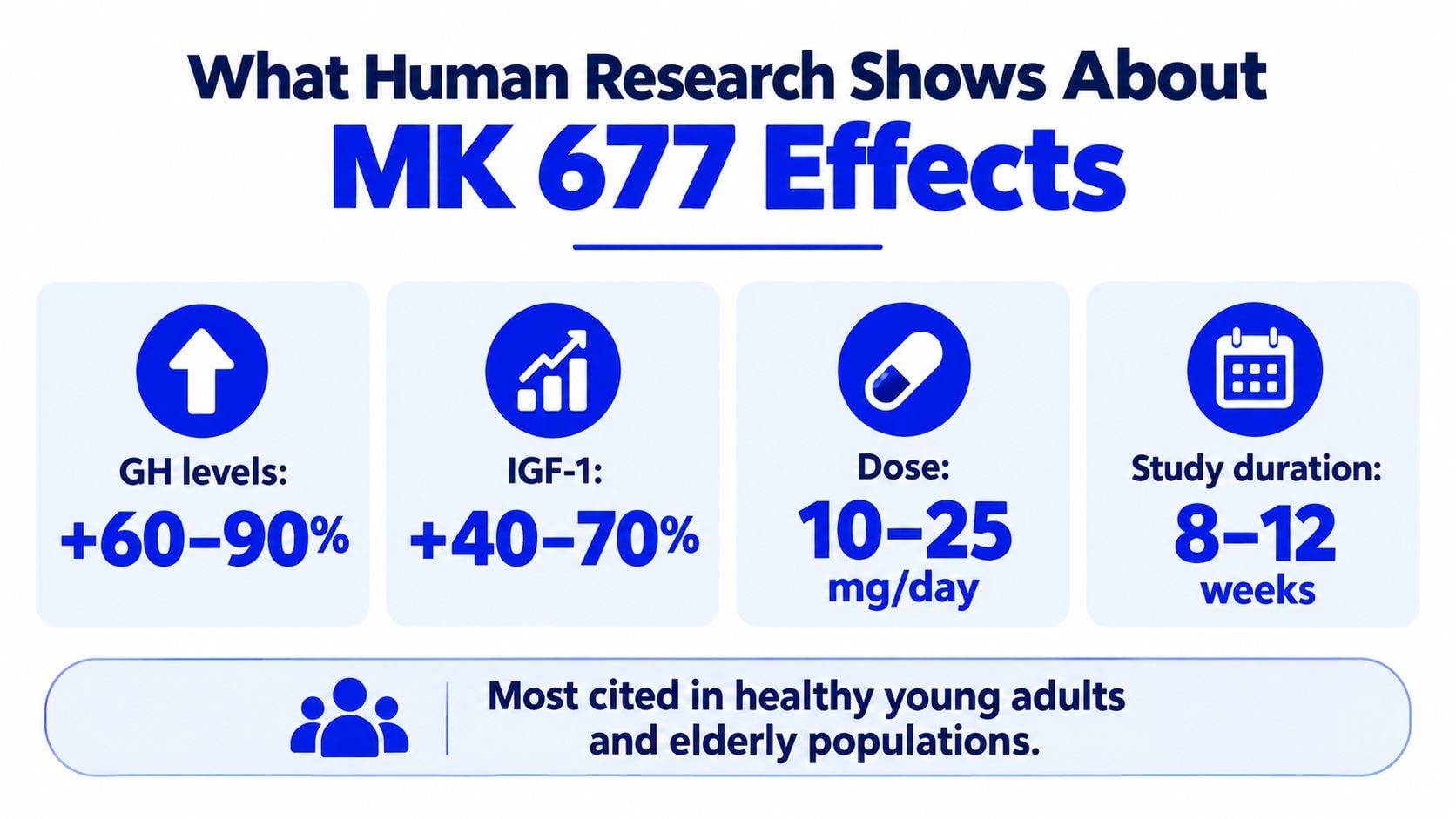
One of the cleaner places to start is the older-adult endocrine work, because it asked a simple question. If oral MK-677 acts as a ghrelin-receptor agonist, does that show up in human GH-axis measurements?
In a randomized, double-blind, placebo-controlled study in healthy adults aged 64 to 81, investigators measured dose-related increases in 24-hour growth hormone secretion and a marked rise in IGF-1 with daily oral dosing. A 25 mg regimen increased mean 24-hour growth hormone by about 97% and raised serum IGF-1 from 141 to 265 µg/L, according to a published summary of the study design and results in the National Library of Medicine record for Murphy et al. (PubMed summary of the older-adult MK-677 trial).
That result matters for a practical reason. It confirms that the compound was biologically active in humans under controlled conditions, not just interesting on paper.
A simple analogy helps here. Plasma half-life describes how long the compound stays in circulation at a given level. GH-axis response is more like the thermostat it triggers after it binds the receptor. Those are related, but they are not the same measurement.
The harder question is what changed downstream once those endocrine shifts occurred.
Rather than repeat the hip-fracture trial setup already covered earlier, the more useful detail is what investigators looked for in that study. The registered Phase IIb trial in older adults recovering from hip fracture included functional and recovery-oriented endpoints such as physical performance and clinical recovery measures, not just hormone labs (ClinicalTrials.gov record for the MK-677 hip-fracture study).
That distinction is easy to miss online. A lot of summaries stop at “GH and IGF-1 went up.” Later-stage studies usually ask a different question: did those hormonal changes translate into meaningful recovery effects in a real patient population?
Another human signal that often gets mentioned, and should be interpreted carefully, is appetite. Because MK-677 mimics ghrelin signaling, appetite-related effects seen in clinical development are not surprising. FDA-reviewed development materials for ibutamoren describe increased appetite among observed effects during the program, which fits the receptor biology and helps explain why discussions of body weight changes can become muddled if readers only focus on GH and IGF-1 (FDA-reviewed MK-677 development summary PDF).
Human research supports a narrow but important conclusion. MK-677 showed reproducible endocrine activity in controlled studies, and clinical programs examined whether that activity carried into functional outcomes in older or frailty-related populations.
That is different from proving every popular claim attached to it.
The confusion around Chemyo availability and the FDA or WADA status tends to blur this point. Vendor continuity is a sourcing question. FDA non-approval is a regulatory question. WADA prohibition is a sport-governance question. None of those categories changes what the human trials measured, but each one changes how researchers should interpret present-day claims about use, access, and legitimacy.
For readers who organize papers before drawing conclusions, Rivul AI's evidence matrix tool can help separate mechanism studies, endocrine endpoints, and functional outcome trials so they are reviewed as different kinds of evidence.
A short visual explainer can also help if you want a second pass on the research context.
MK-677 reached serious clinical investigation. It produced measurable hormone changes in humans. It still never became an FDA-approved drug.
That combination explains why it remains heavily discussed in 2026, especially in threads about Chemyo MK 677 and similar vendor listings. The research record shows real pharmacology. The regulatory record shows discontinuation, non-approval, and continued confusion about how to classify the compound outside research and anti-doping contexts.
Most conversations about MK-677 eventually become practical. People stop asking only what it is and start asking how it's usually presented for research and why one vendor name becomes the reference point.
Chemyo MK 677 became a familiar phrase partly because community memory is sticky. Once a liquid or capsule listing gets repeated across forums, that brand reference can remain the default search term long after researchers should be looking more closely at current documentation.
The smarter approach is to separate the compound from the brand memory.
| Format | Research Handling Notes | Documentation to Request |
|---|---|---|
| Liquid solution | Convenient for volumetric handling and repeatable aliquoting if the concentration is clearly stated. Researchers need clear storage and batch labeling. | Batch-specific COA, concentration statement, lot traceability |
| Capsules or tablets | Familiar format in historical discussion, but less flexible for analytical subdivision and verification once packaged. | COA tied to active ingredient lot, identity documentation |
| Raw powder | Useful for analytical work where labs control preparation, but it requires stronger internal handling discipline. | COA, purity documentation, raw material traceability, contamination screening |
A liquid presentation often appeals to researchers who want straightforward handling in bench workflows. Capsules fit the way many people first heard about MK-677, but they can be less adaptable when a lab wants tighter control over preparation variables.
Powder sits at the other end. It gives a lab more control, but also more responsibility.
Common research use cases discussed around MK-677 usually center on:
A useful sourcing habit is to ask, “Am I choosing a format because it fits the research design, or because an old review made it feel familiar?”
Its oral route is what makes it stand apart in many peptide conversations. Researchers often compare peptides by injection burden, pulse timing, and short windows of action. MK-677 changes that comparison because the route and handling profile are different from the start.
That's also why older branded references can mislead. The decision usually isn't “Which name did the forum mention first?” It's “Which format and documentation fit the current research need?”
This is the part people often look up last, even though it should be near the top of the decision tree.
MK-677 may have a recognizable research profile, but that doesn't make its legal or compliance status simple. In 2026, the biggest source of confusion isn't mechanism. It's that old blanket answers no longer fit every context.
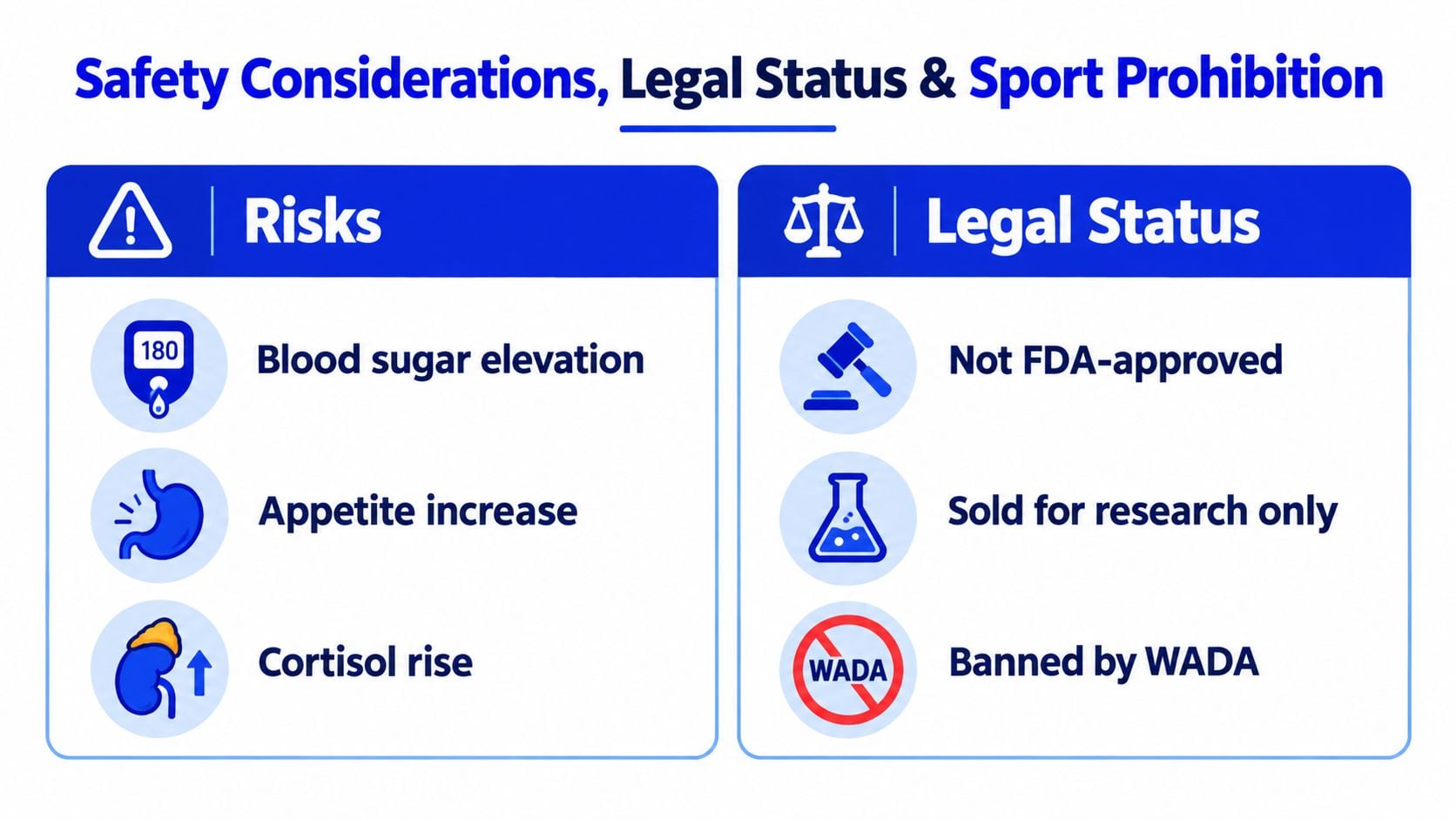
FDA-linked material states that ibutamoren is not approved and that its safety and efficacy have not been established (FDA warning-letter material referencing ibutamoren status).
That sentence should always be stated directly. It's the cleanest anchor in a topic that otherwise gets cluttered by opinions.
The current confusion comes from overlapping categories that people treat as if they're identical:
They aren't the same thing. One recent source notes that coverage in 2026 has become fragmented because some pages still say MK-677 remains prohibited in sport under WADA and not FDA-approved, while other pages report an April 2026 shift affecting a compounding restriction pathway. The practical takeaway is that regulatory status is becoming more jurisdiction-specific and time-sensitive, so old blanket answers are increasingly unreliable (2026 regulatory confusion around MK-677 and WADA status).
A lot of readers blur these together.
An athlete asking whether a substance is prohibited under sport rules is asking a different question from a researcher asking whether a compound can be procured for laboratory work. And both are different from asking whether the FDA has approved it for human use.
If you're using old forum posts to answer a current compliance question, you're likely mixing categories that should stay separate.
Because this article stays within a research frame, the most useful safety lens is risk awareness rather than casual anecdote. The available pharmacology material already noted metabolism via CYP450 and glucuronidation in FDA-reviewed and nonclinical summaries, which matters when a compound is considered alongside other substances in analytical or multi-compound settings, as covered earlier in the mechanism section.
That doesn't answer every safety question. It does tell you to treat interaction potential and status verification as active tasks, not assumptions.
Once vendor continuity becomes uncertain, brand familiarity stops being enough. If an older Chemyo reference no longer maps cleanly to a current buying path, the right move is to vet suppliers the same way you'd vet any other research input.
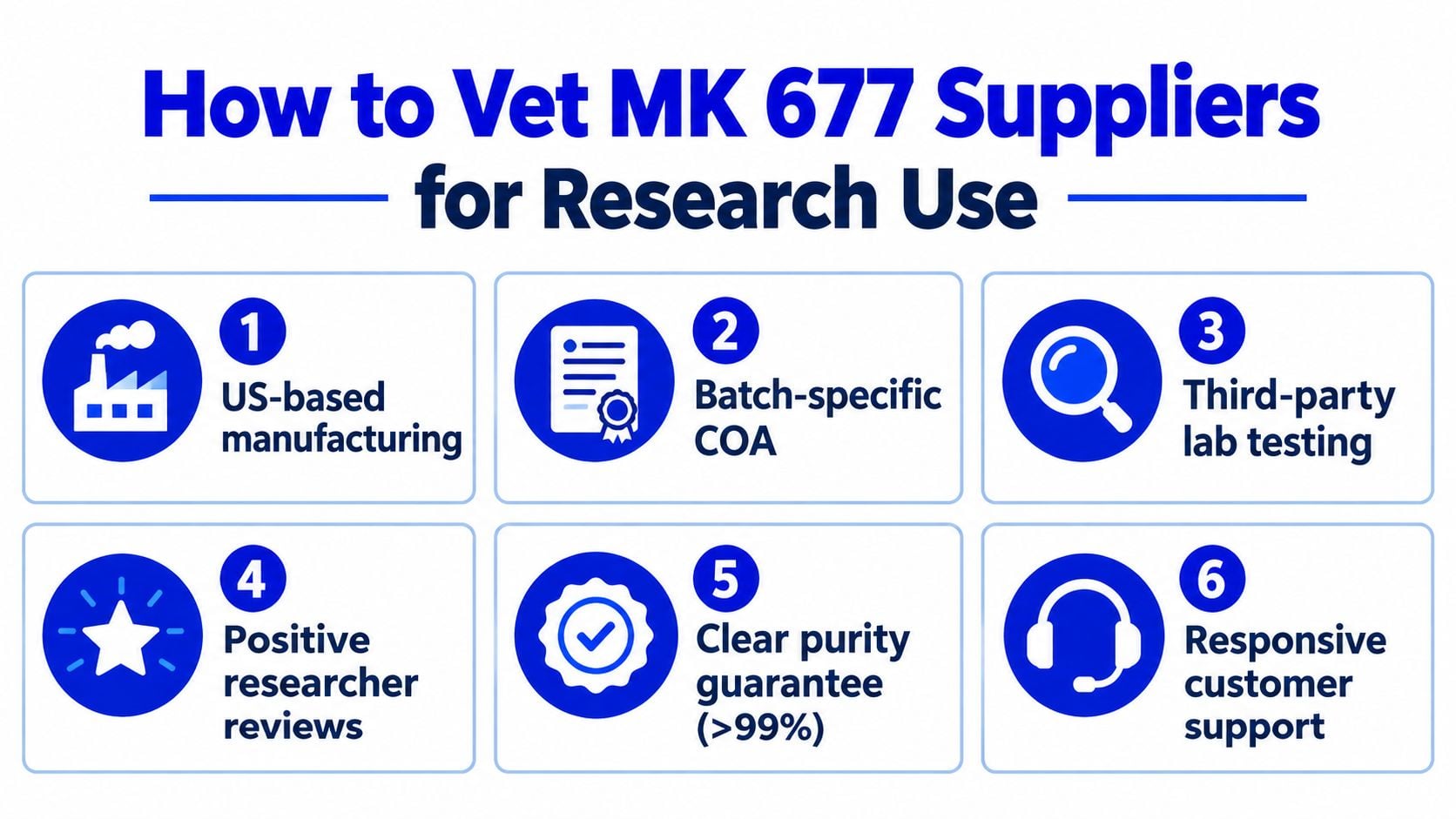
Researchers sometimes begin with reviews. That's understandable, but reviews age badly.
Start instead with a procurement checklist:
A lab that already thinks carefully about equipment choices often applies the same discipline across procurement. The same mindset used in laboratory furniture buying decisions applies here too. Documentation and workflow fit matter more than surface branding.
If a previously cited vendor appears to have stopped accepting payments, don't ask whether old reviews were “wrong.” Ask whether they are still current enough to be useful.
That leads to better replacement sourcing questions:
In this category, a supplier such as Peptide Warehouse USA presents MK-677-related research products within a broader research-chemical catalog and states that products are for laboratory and analytical use only, with third-party documentation including COAs, microbial and endotoxin reports, and stated purity levels up to 99.5% in its general publisher profile. That kind of disclosure is more useful than relying on stale brand chatter.
Use this sequence when comparing options:
Old reputation can start your search. It shouldn't finish it.
That's especially true for Chemyo MK 677 searches in 2026. The search term may still be common, but the task has shifted from finding a familiar name to confirming a reliable and current supply chain.
Chemyo MK 677 is really two topics folded together. One is MK-677 itself, an oral growth hormone secretagogue with a real clinical research history and a clear endocrine effect in human studies. The other is the vendor-memory problem, where an older brand reference stays popular even after availability and compliance context become less clear.
For researchers, the most useful path is simple. Separate mechanism from marketing, separate historical discussion from current sourcing, and separate FDA status from sport rules and research-use availability. That approach cuts through most of the noise.
If your interest is practical, keep your next step grounded in documentation:
If you want to learn more, look for current COA resources, research-use policies, and related compound explainers before making assumptions from old posts. If you're comparing options, focus on traceability and transparency first.
The topic hasn't become simpler in 2026. But it has become easier when you treat it like a research procurement question instead of a hype-driven product search.
Peptide Warehouse USA offers MK-677-related research products as part of a USA-made catalog built for laboratory, analytical, and preclinical use, with third-party documentation and clear research-use positioning. If you're sorting through the Chemyo MK 677 confusion and want a more documentation-first sourcing path, visit Peptide Warehouse USA to explore options and learn more.
Leave a comment