
No products in the cart.



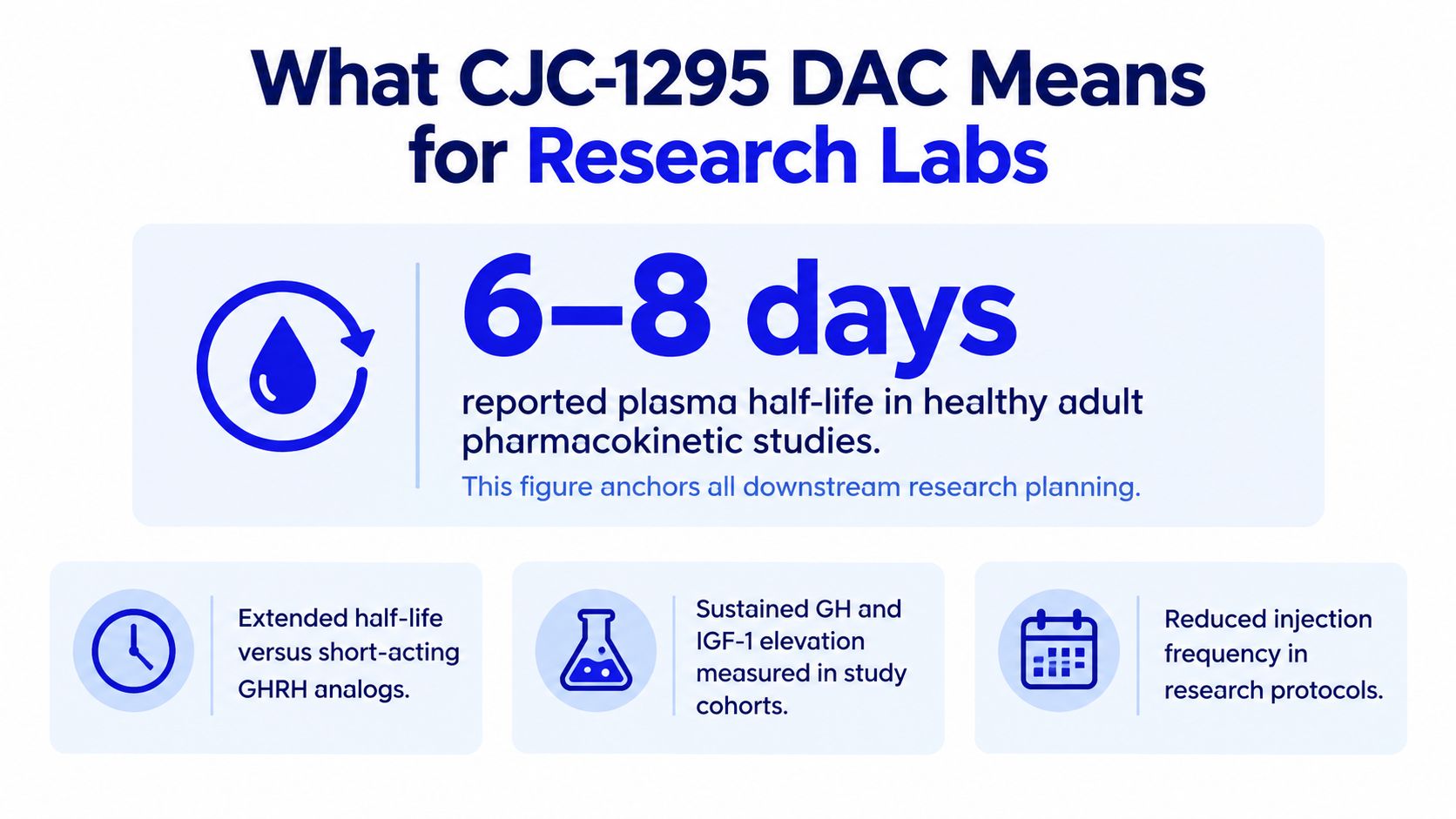
A CJC-1295 DAC 10mg vial is easy to misunderstand because the vial size says nothing about the molecule's biological duration or an appropriate research amount. The more important starting point is the compound's reported human elimination half-life, about 6–8 days after subcutaneous administration in healthy-adult pharmacokinetic studies (FDA briefing materials). That long exposure window affects study design, sampling intervals, reconstitution planning, storage, and lot documentation.
This guide separates CJC-1295 with DAC from non-DAC forms, explains why the Drug Affinity Complex changes the pharmacokinetic profile, and treats 10 mg as a research inventory format rather than a dose. It also covers what a laboratory should review before opening a vial, including concentration calculations, aliquoting, storage, and Certificate of Analysis records.
A laboratory workflow usually begins with identity and lot verification. Before a researcher calculates a working concentration or opens a vial, the material should be tied to its product description, lot number, and available analytical records. This process keeps the study anchored to a defined reagent rather than an unlabeled assumption about what the container holds.
CJC-1295 with DAC is a synthetic growth hormone-releasing hormone analog. The analog portion interacts with the GHRH signaling system, while the attached Drug Affinity Complex alters the molecule's circulation profile. For a lab, that difference affects the timing of observations, sample collection, and follow-up measurements. It also separates DAC-containing CJC-1295 from non-DAC forms, which should not be treated as interchangeable materials.
Healthy-adult pharmacokinetic work estimated a human half-life of approximately 6–8 days, with mean estimates ranging from 5.4 to 9.2 days (FDA product-specific review). Reported clearance estimates were about 1.1 to 3.3 L/h (FDA pharmacokinetic briefing document). Together, these findings support planning for sustained exposure rather than a brief concentration spike. The exact study schedule still depends on the research model and its sampling requirements.
A 10 mg vial states the total amount of lyophilized material in the container. It does not set the post-reconstitution concentration, assay quantity, or interval between research sessions. Those variables come from the protocol, study model, analytical method, and institutional controls.
The practical sequence is straightforward: verify identity and lot, choose a compatible diluent, calculate the working concentration, prepare traceable aliquots, and record each handling event. Linking every aliquot to a specific experimental session helps preserve reproducibility and makes the vial a documented inventory source.
Practical rule: Treat 10 mg as an inventory value. Treat concentration, aliquot size, sampling cadence, and exposure duration as separate protocol variables.
The key questions are:
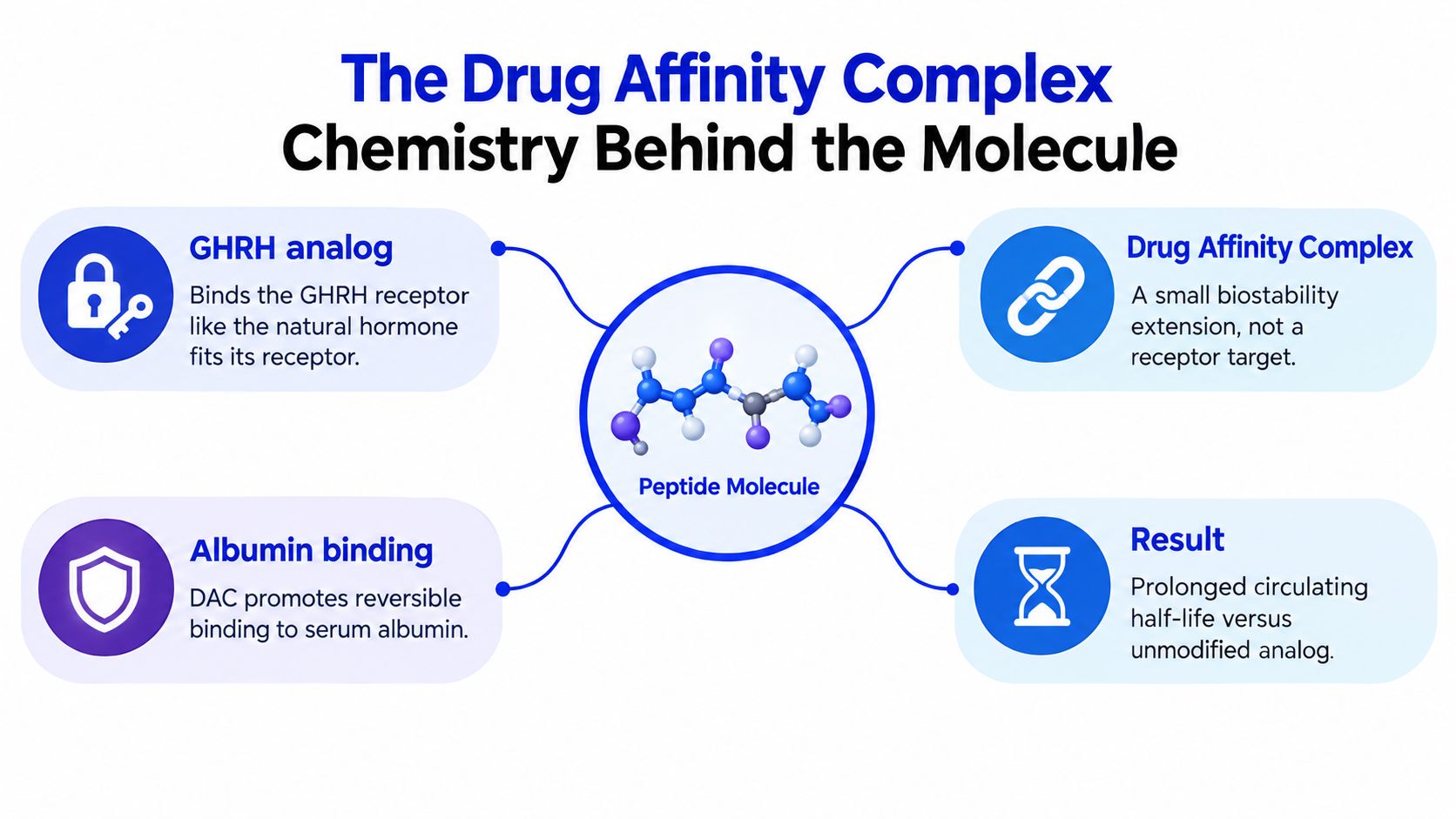
The easiest way to understand CJC-1295 DAC is to separate two jobs performed by the molecule. The GHRH analog portion provides the biological recognition element, while the DAC portion functions as a biostability extension that supports prolonged circulation.
A lock-and-key analogy is useful here. The GHRH analog portion resembles a key shaped to interact with the relevant GHRH receptor system. The Drug Affinity Complex isn't a second key for a different receptor. Instead, it acts more like a reversible carrier-binding feature that changes how quickly the peptide leaves circulation.
The DAC chemistry is associated with a maleimidopropionic acid-linked albumin-binding tag. After subcutaneous exposure, this modification can form a reversible covalent bond with circulating albumin. Albumin binding helps shield the peptide from rapid clearance and enzymatic breakdown, producing a longer-lived exposure profile than researchers would expect from an unmodified, short-acting GHRH analog.
CJC-1295 with DAC emerged from ConjuChem Biotechnologies' early-2000s Drug Affinity Complex platform. The first peer-reviewed human characterization appeared in 2005, and Teichman and colleagues described randomized, placebo-controlled, double-blind dose-escalation trials in healthy adults ages 21 to 61 (CJC-1295 with DAC development history).
FDA materials later summarized dose-dependent increases in growth hormone and IGF-1, along with effects that could persist for several days after dosing. The program reached Phase II before development was discontinued, so the historical record describes a compound with a documented human pharmacokinetic and pharmacodynamic profile, not an FDA-approved therapy.
The DAC label also matters for procurement. A supplier listing that says only “CJC-1295” may not identify whether the material includes the albumin-binding modification. Researchers should confirm the exact designation, sequence or structural description where available, and lot documentation before treating two products as interchangeable.
A single CJC-1295 DAC administration can leave measurable plasma concentrations for roughly 10–14 days, even though the administration event itself takes only a moment. That gap matters: the timing of the injection does not define the full observation period for the experiment.
The reported human profile includes an elimination half-life of approximately 6–8 days, growth hormone elevation for about 6 days, and IGF-1 elevation for approximately 9–11 days. The main clinical study also found dose-dependent single-dose Cmax increases across the 30, 60, 125, and 250 µg/kg groups (Journal of Clinical Endocrinology and Metabolism study). These values are most useful as planning anchors, not as a dosing guide for a research vial.
| Study feature | Reported observation | Practical implication |
|---|---|---|
| Human elimination half-life | About 6–8 days in healthy-adult data (FDA source) | Baseline collection should follow a washout period long enough to reduce influence from the prior exposure |
| Mean estimated half-life in the main PK study | 5.4–9.2 days | Use a schedule that can accommodate participant-level and dose-related variation rather than assuming one fixed clearance time |
| Measurable plasma concentration | Roughly 10–14 days after subcutaneous dosing | Extend sampling beyond the administration day when persistence is part of the research question |
| Growth hormone response | About 6 days | Early samples alone may miss later pharmacodynamic behavior |
| IGF-1 response | Approximately 9–11 days | Continue downstream-marker collection after the initial concentration phase |
| Single-dose Cmax | Increased across 30, 60, 125, and 250 µg/kg groups | Separate concentration effects from time effects when comparing dose groups |
The FDA pharmacokinetic review summarizes the range of half-life estimates and the persistence of measurable material (FDA pharmacokinetic review). In practical terms, albumin binding gives the concentration and response curves a prolonged, depot-like shape. “Depot-like” describes the observed exposure pattern. It does not mean the peptide forms a literal implant or reservoir.
A laboratory should set the washout interval before collecting baseline samples. A previous exposure may still affect plasma measurements or downstream markers after the visible administration event has ended.
Sampling cadence should match the question being tested. An early sample can describe absorption or an initial concentration, while later collections help characterize persistence, IGF-1 behavior, or recovery toward baseline. A single time point cannot represent the full profile.
Repeated-exposure designs require added control. Researchers should distinguish cumulative exposure from the response to one administration, record the interval between experimental sessions, and avoid treating a short gap as a clean baseline. The 10 mg vial does not change this pharmacology. It is a reconstitution and stability decision, separate from the molecule's DAC-driven duration.
CJC-1295 with DAC and non-DAC CJC-1295 are often listed under the same name, even though they serve different experimental purposes. Both belong to a GHRH analog framework. The DAC modification changes how the molecule behaves in circulation by promoting reversible albumin binding, which extends exposure.
The useful comparison is therefore about exposure pattern, not merely product labeling. Non-DAC material is generally suited to a shorter, pulse-like signal. DAC material supports a more sustained exposure model. The vial size remains a separate question. A 10 mg vial describes how much material is present, not whether the molecule is DAC or how often a study should use it.
| Parameter | CJC-1295 non-DAC | CJC-1295 DAC |
|---|---|---|
| Structural distinction | Parent GHRH analog without the albumin-binding DAC extension | GHRH analog modified with the Drug Affinity Complex |
| Exposure behavior | Shorter, pulse-like profile | Sustained profile associated with reversible albumin binding |
| Human half-life | Not established in the human PK data cited here | See the PK summary above for the reported human duration (FDA pharmacokinetic review) |
| Pharmacodynamic pattern | Better suited to experiments focused on transient signaling or timing | Better suited to experiments examining delayed or sustained downstream responses (human clinical study) |
| Research cadence | Often requires closer attention to the interval between observations and experimental events | Can support wider observation windows, with the interval set by the protocol |
| Reconstitution consideration | Working-solution planning centers on short exposure and sampling timing | Working-solution planning must also account for repeated handling, aliquoting, and validated stability over the study period |
| Main workflow question | Does the experiment need a transient GHRH-like signal? | Does it need sustained exposure and a longer observation window? |
The DAC form is not automatically the better choice. Selection depends on the model. A short-acting reagent may fit a design in which pulse timing, rapid changes, or recovery are the main variables. DAC may fit a design examining prolonged exposure or downstream effects that develop after the initial administration event.
“CJC-1295” alone does not identify the experimental behavior precisely enough. Researchers should confirm whether the material is with DAC or without DAC before comparing protocols, interpreting results, or preparing a working solution.
The search phrase CJC-1295 DAC 10mg combines several separate questions: molecular form, total vial mass, reconstitution approach, working-solution stability, and lot documentation. Keeping those questions separate prevents a common error. A larger vial contains more material, but it does not make the peptide stronger or longer acting.
The practical decision is to match the molecular form to the study question, then treat the 10 mg vial as an inventory and preparation choice. That distinction keeps pharmacology, concentration calculations, and stability records from being conflated.
The phrase 10 mg vial describes total lyophilized mass. It isn't a recommended amount for a person, an animal, or an assay. Researchers must convert that mass into a working concentration that fits the validated protocol and the laboratory's measurement capabilities.
A simple calculation illustrates the logic. If a laboratory adds 2 mL of a selected diluent to 10 mg of lyophilized material, the nominal concentration is 5 mg/mL, calculated as mass divided by volume. That arithmetic doesn't establish stability, sterility, compatibility, or an appropriate experimental amount. It only translates vial content into a concentration for planning.
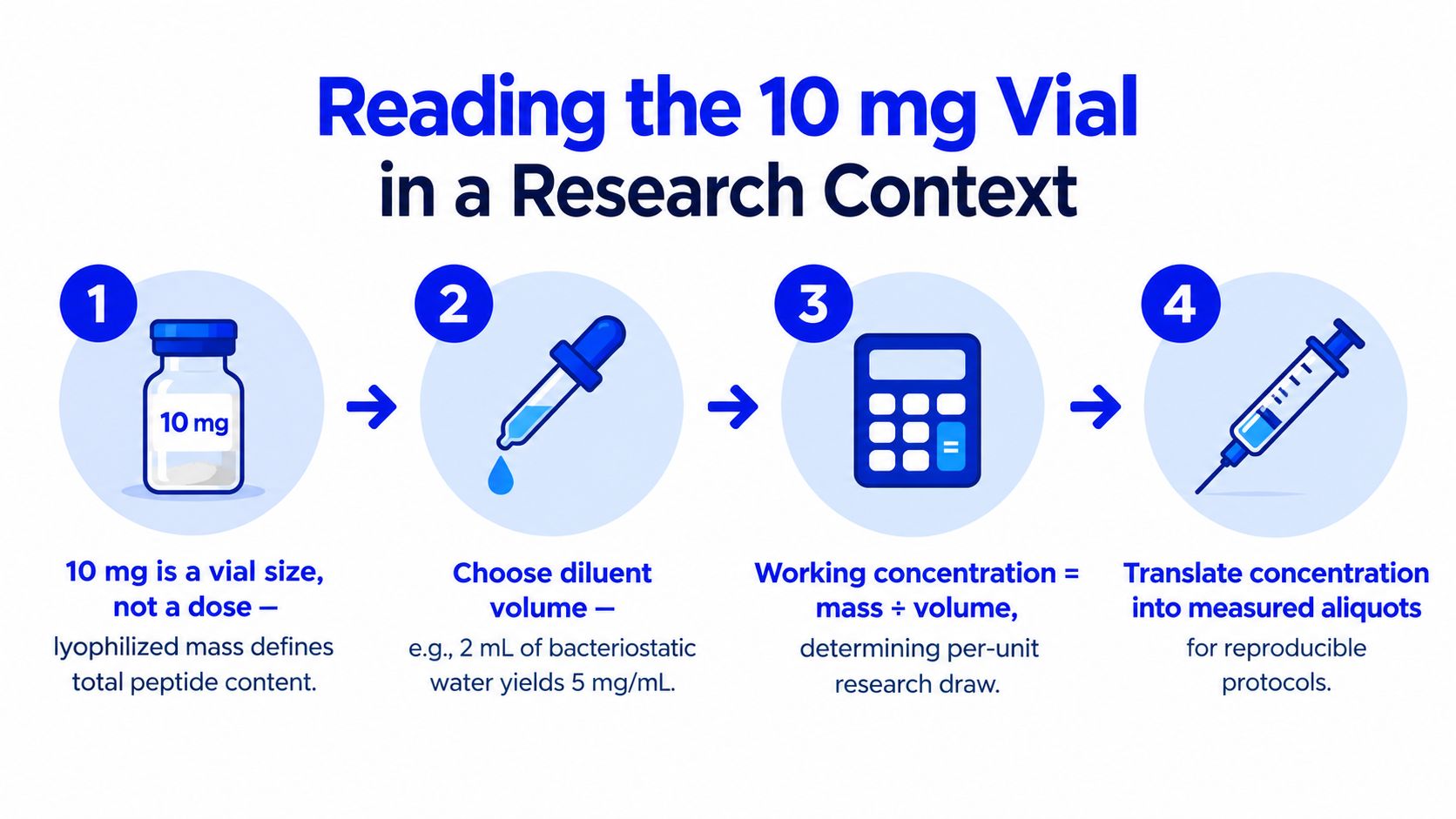
A reliable preparation record should show the original mass, diluent identity, added volume, calculated concentration, date, operator, and storage destination. Researchers can then connect every later aliquot to the original vial and lot.
The 10 mg format can be practical for longitudinal laboratory work because one lot may support repeated sessions, provided the protocol validates stability and the material is handled correctly. That convenience comes with a documentation responsibility. A larger vial shouldn't become an excuse to keep opening and closing the same working container without a controlled aliquoting plan.
A conceptual workflow looks like this:
Bench principle: The best concentration is the one that allows accurate pipetting, consistent sample preparation, and clear traceability within the approved protocol.
Repeated freeze-thaw cycles can complicate interpretation because handling becomes another uncontrolled variable. Single-use or limited-use aliquots reduce the need to repeatedly warm and refreeze the full working solution, but the exact aliquot schedule should come from validated stability information and the laboratory's quality system.
The same logic applies to reconstitution technique. Gentle handling, accurate volume measurement, and avoidance of unnecessary agitation support consistency. Reconstitution isn't a shortcut around validation. It is a preparation step that must be recorded like any other experimental variable.
A 10 mg vial therefore solves an inventory problem, not a biological one. It gives the researcher a defined amount of material from which working solutions can be prepared, but the protocol still determines how that material is measured, stored, and used.
Storage protects two things at once, material integrity and experimental confidence. A vial that has experienced undocumented temperature changes or repeated handling may no longer provide the same level of interpretability as a vial with a complete chain of custody.
For lyophilized material, a common laboratory framework uses 2–8 °C for short-term storage and −20 °C for longer holds. Reconstituted material generally requires colder storage, protection from light, and a validated stability window. The exact window should come from applicable stability data, not from a generic internet recommendation.
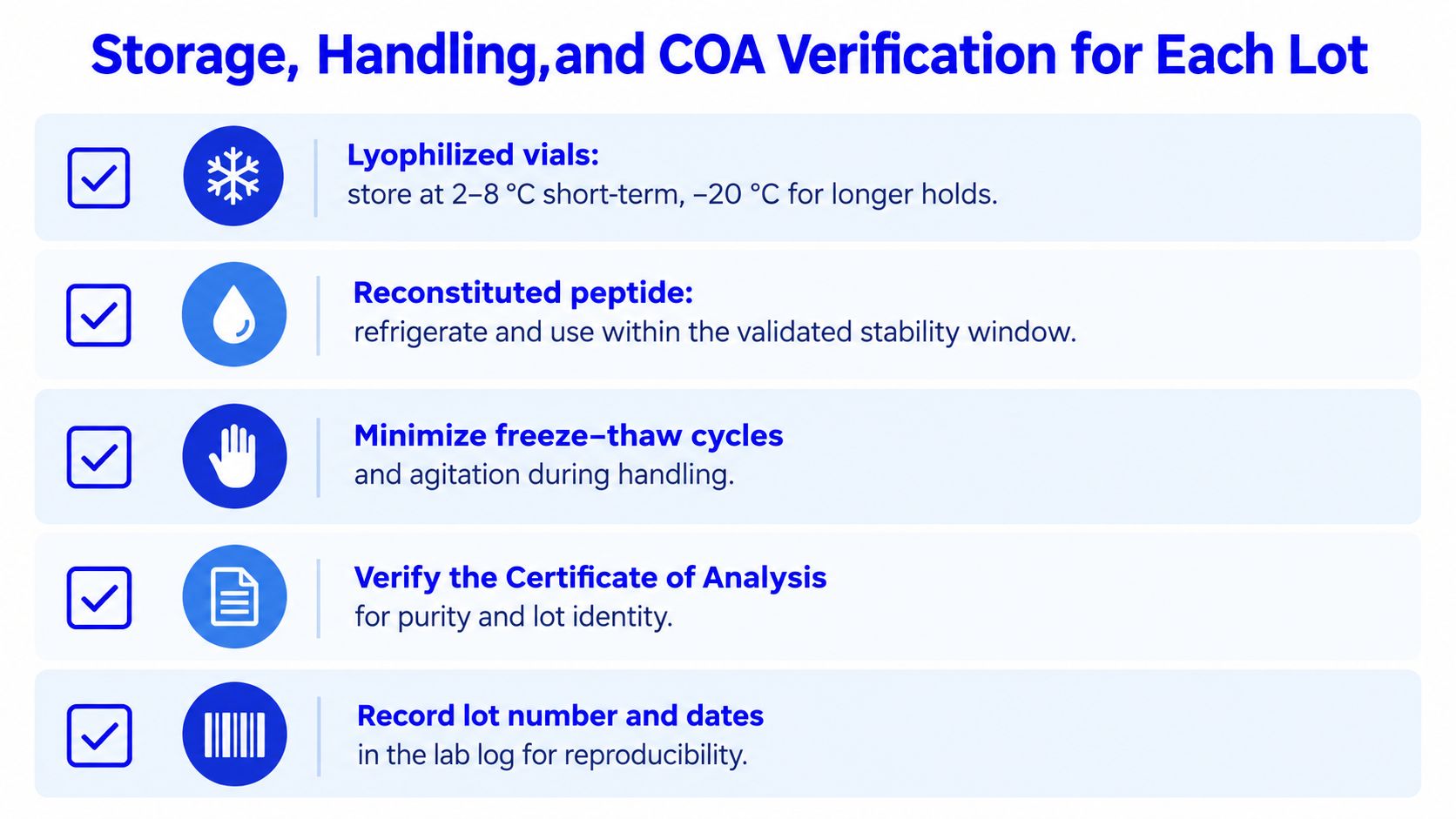
A lot-specific Certificate of Analysis should identify the material and provide testing relevant to the intended research use. Researchers should review:
The COA belongs in the study record, not only in an email inbox. Log the lot number, receipt date, storage chain, reconstitution event, and intended use before the material enters an experiment. That record helps researchers distinguish a biological result from a lot, handling, or preparation issue.
Regulatory history should frame procurement decisions. CJC-1295 with DAC was studied in randomized, placebo-controlled, double-blind trials in healthy adults. A documented Phase II program included 192 HIV-positive patients with lipodystrophy. FDA briefing materials reported one death from myocardial infarction in that 2006 trial, after which development stopped; the compound did not reach Phase III or FDA approval (Phase II history and FDA briefing summary). This record supports strict laboratory, institutional, and regulatory controls. It does not turn a 10 mg vial into an approved treatment or make the vial size a dosing recommendation.
Before ordering CJC-1295 DAC 10mg, make the product identity and study records agree.
Peptide Warehouse USA lists CJC 1295 with DAC and provides access to product and COA information. Laboratories comparing lot identity, storage planning, and procurement records can review the available research materials at Peptide Warehouse USA.
Leave a comment