
No products in the cart.


What if the question isn't whether the CJC IPA peptide is popular, but whether anyone can clearly separate the blend's theory, the single-peptide evidence, and the lab realities that decide whether a vial is worth trusting? That's the gap most readers run into. They hear about growth hormone signaling, recovery, sleep, and synergy, then run straight past the part that matters most, what has been shown, what hasn't, and how the material is documented before it ever reaches a bench.
The CJC IPA peptide sits at the intersection of mechanism and procurement. It's usually discussed as a paired research blend, but the best-known human data come from the individual peptides, not the exact combination. That distinction matters because a blend can sound tidy on a product page while still leaving you with unanswered questions about identity, purity, storage, and whether the published evidence really supports the claims being made.
This article walks through the blend the way a careful researcher would. It starts with what the components are, then moves into how they work, what human evidence exists, how to handle the material in a lab, and how to read the paperwork that should travel with it.
Why do researchers keep returning to the CJC IPA peptide? The appeal is straightforward. The blend brings together two tools that work on different parts of the growth hormone axis, one associated with a longer signal and one associated with a brief pulse. That makes it a useful subject for lab discussion around GH, IGF-1, recovery-related endpoints, and peptide stacks.
The public conversation often stops at that mechanism. It emphasizes “synergy” and “pulses,” then leaves out the harder question of what has been shown in humans. The strongest historical evidence centers on CJC-1295 alone, while the best-known human data describe the individual component rather than the exact blend, and the published signal is about hormone changes, not broad outcome claims. The older human trial reported about 2 to 10 times higher GH for roughly 6+ days, 1.5 to 3 times higher IGF-1 for around 9 to 11 days, and an estimated half-life of about 5.8 to 8.1 days (BodySpec review of CJC-1295 research and safety).
That gap matters because buyers often assume the blend has been proven the way the marketing sounds. It hasn't. A clinician-facing review points to one study population, women in perimenopause and menopause, and says there is “very little evidence” that CJC-1295 produces the outcomes being promised, while much of the supportive material still comes from animal work or people with diagnosed growth hormone deficiency rather than healthy users (Midi review on CJC-1295).
Practical rule: treat the blend as a research question, not a conclusion.
For a lab-savvy researcher, that means the ceiling of support is fairly narrow. Documented hormone changes are useful, but they do not justify bigger claims about recovery, performance, or other downstream effects without direct evidence.
The CJC IPA peptide is a two-component lyophilized blend, not a single molecule with one action. One part is CJC-1295 No DAC, the other is Ipamorelin. They're paired because they work through different parts of the growth hormone axis, which makes the combo easier to understand if you think of the system as plumbing with two controls.
CJC-1295 No DAC acts like the longer control lever. It's the GHRH analogue side of the blend, the component meant to support a more sustained growth hormone signal. Ipamorelin is the pulse trigger, a selective ghrelin receptor agonist that nudges the pituitary into a brief GH release without the broader cortisol pattern seen with some older stimulatory peptides (BodySpec review of CJC-1295 research and safety).
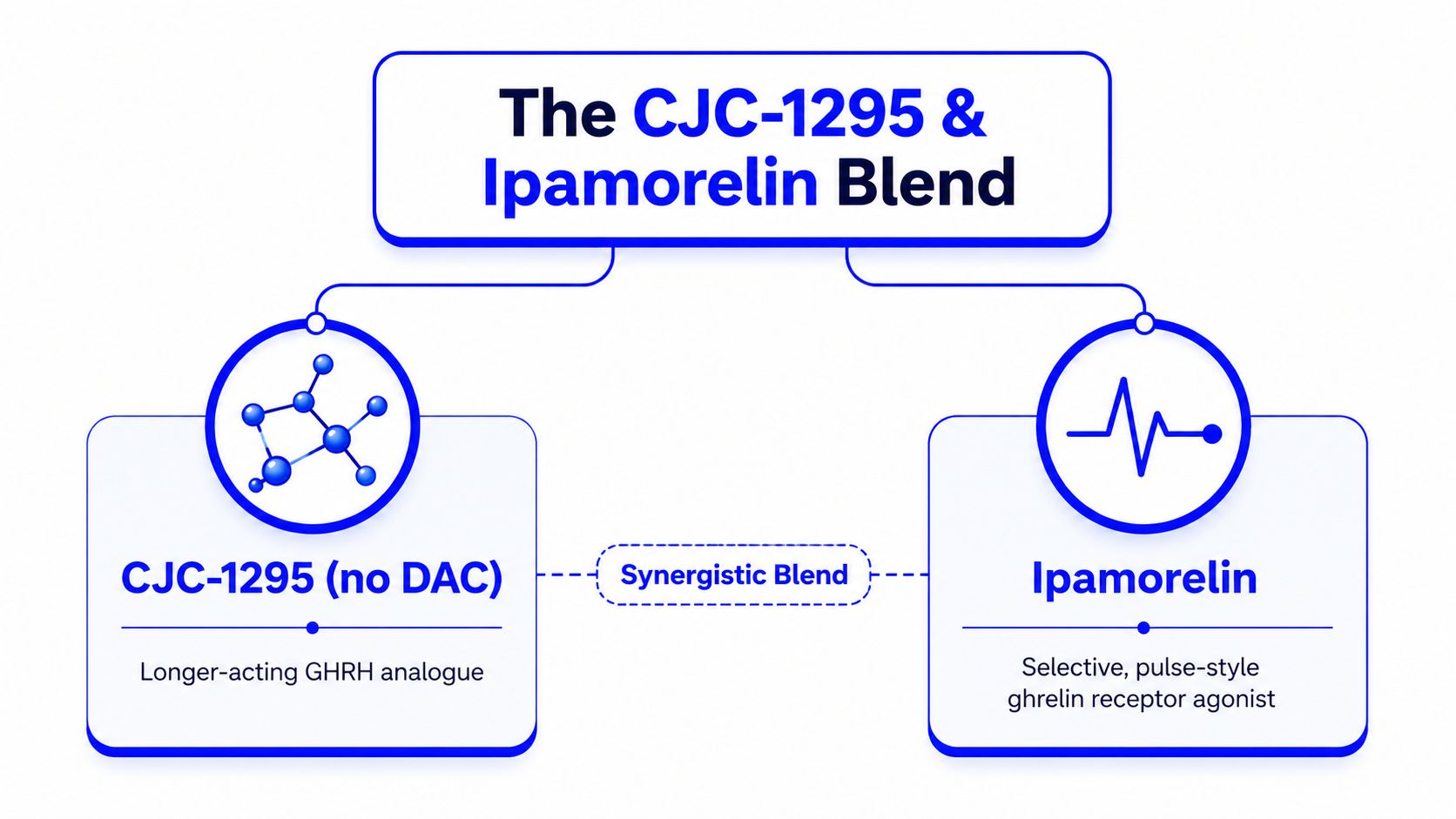
The size gap between the components is one reason they're handled as a blend rather than as interchangeable materials. CJC-1295 No DAC is reported at 3367.97 g/mol with formula C152H252N44O42, while Ipamorelin is reported at 711.86 g/mol with formula C38H49N9O5 (Puratek product sheet). That difference matters analytically, because LC-MS and HPLC can separate and verify each component independently.
A dry blend also changes the sourcing conversation. Some product sheets specify ≥99% HPLC purity and storage at -20°C for the lyophilized material (Puratek product sheet). That doesn't prove biological quality by itself, but it does tell you the product was designed to be treated as a defined research reagent, not a casual mixture.
The useful mental model is simple, one component shapes the duration of the signal, the other shapes the pulse that starts it.
That's why researchers keep returning to this combination. The appeal isn't mystery, it's complementary function. One peptide keeps the conversation going, the other starts it.
In a typical research run, a single injection can produce a GH curve that rises early and then stays high, and that pattern only makes sense if you track signal trigger and signal duration separately. CJC-1295 No DAC extends endogenous GHRH signaling, so the pituitary remains responsive for longer. Ipamorelin adds a short, selective GH pulse through the ghrelin receptor, which is why the pair is usually treated as complementary rather than redundant.
The older human data on CJC-1295 alone help anchor that model. In the cited trial, a single injection raised mean GH by about 2 to 10 times for roughly 6+ days, raised IGF-1 by about 1.5 to 3 times for around 9 to 11 days, and carried an estimated half-life of 5.8 to 8.1 days (Peptide-db summary of CJC-IPA protocol research). Those numbers matter because they show how long a growth-hormone-related signal can persist in a human research setting, even before a blend enters the picture.
Ipamorelin's value is less about brute force and more about selectivity. In the research literature summarized in the protocol brief, it is described as producing short GH pulses without the broader cortisol effects seen with some other stimulatory peptides (Peptide-db summary of CJC-IPA protocol research). That is one reason it gets paired with a GHRH analogue instead of being treated as a stand-alone answer.
The timing question follows from that. A pulse-style signal behaves differently from a slow baseline signal, so the lab question is not only whether the vial contained both peptides. It is also whether the blend preserved the intended chemistry and timing profile after storage, reconstitution, and handling.
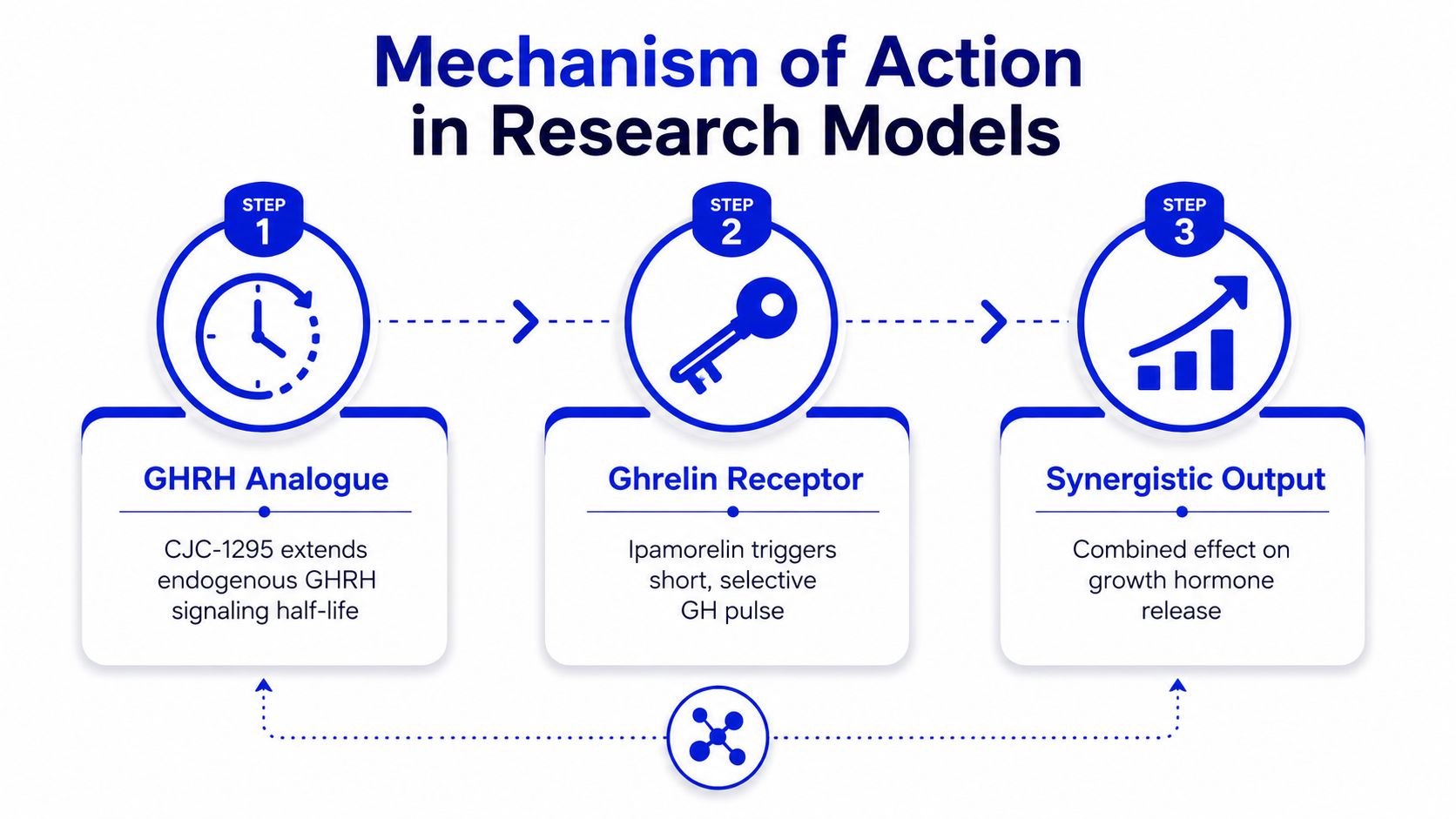
Useful takeaway: if one component sets the stage and the other delivers the cue, the blend only makes sense when both parts are intact.
That is also why it is a mistake to treat the blend as proven on the basis of mechanism alone. The mechanism is plausible, the single-peptide human data are real, but the exact stack still does not have the same depth of controlled evidence.
The cleanest way to read the literature is to separate single-peptide evidence from blend-specific evidence. The single-peptide side has the clearer human data. The blend-specific side is mostly inference, protocol language, and product discussion rather than trials of the exact combination in healthy adults.
That split matters because the endpoints people care about are often the least directly studied. Claims about body composition, sleep quality, and longevity-style effects show up often in public content, but the older CJC-1295 human study did not test those real-world outcomes. It showed sustained hormone changes and generally good tolerability, which is useful, but it does not show that the blend produces the wider effects people often infer from those hormone shifts.
The clinician-facing review from Midi helps keep the picture grounded. It says there is “very little evidence” that CJC-1295 delivers the outcomes being promised, especially in women in perimenopause and menopause, and it points out that much of the support comes from animals or people with diagnosed growth hormone deficiency rather than healthy users (Midi review on CJC-1295). That does not make the blend meaningless. It means the confidence level should stay modest.
A new researcher should keep two questions separate.
The gap between those questions is where sloppy content usually enters. Strong hormone data can tempt writers to imply broad benefits, but the evidence does not support that step. In the CJC-1295 research that gets cited most often, the sample was small, so the finding is informative but still narrow in scope. That is exactly why lab buyers should care about identity testing, lot documentation, and whether the material they received matches the label before anyone starts reading too much into a marketing claim.
The CJC IPA peptide should be treated like a delicate research reagent, not a shelf-stable consumer product. The lyophilized material is typically stored around -20°C in its dry state, then reconstituted before use with a suitable solvent such as bacteriostatic water, depending on the protocol being followed (Puratek product sheet). The point of careful handling is simple, protect identity, protect concentration, and reduce variability from one prep to the next.
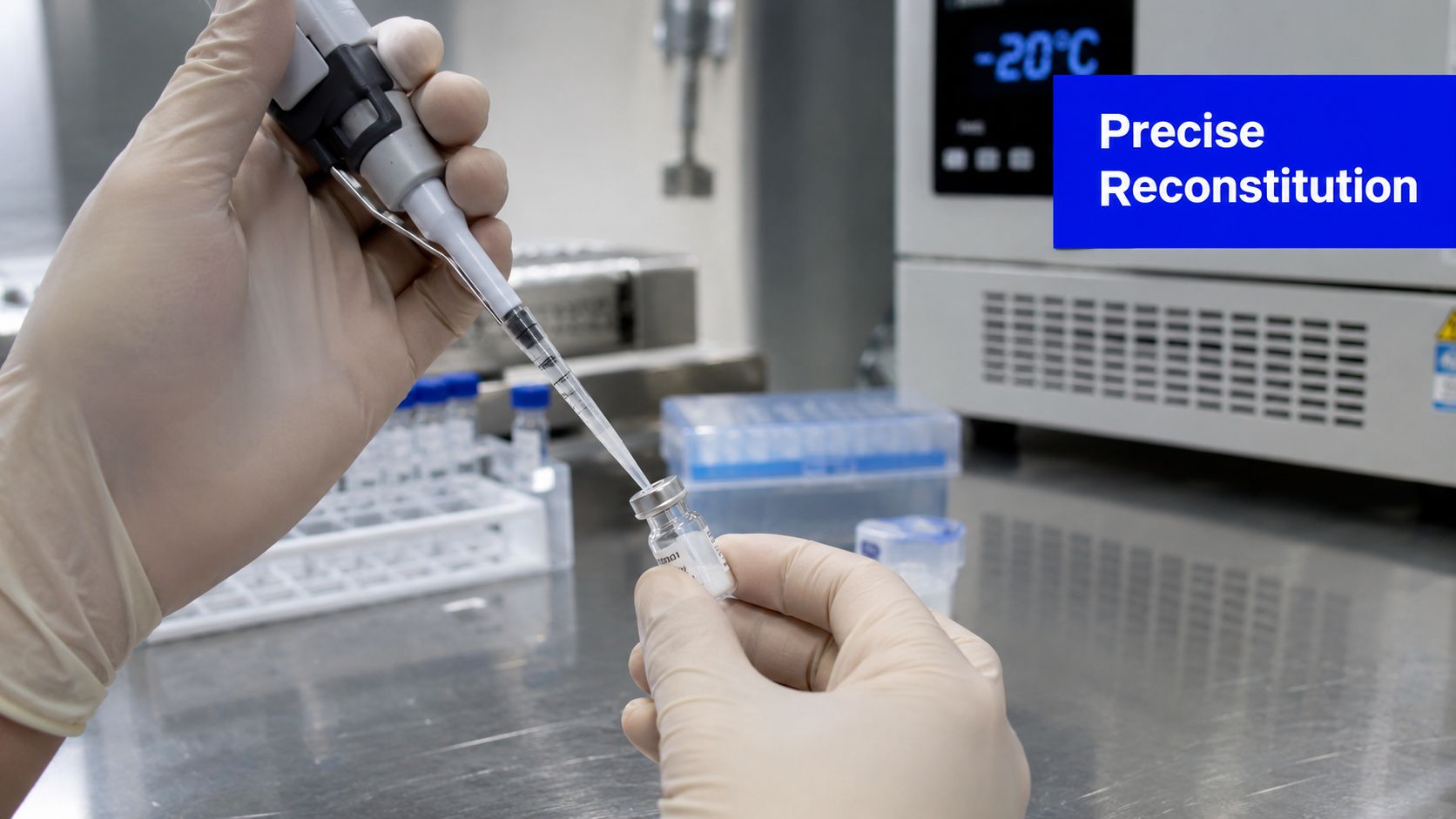
After reconstitution, many independent protocol guides recommend refrigeration at 2–8°C and suggest use within 30 days as a working guideline (PepGuide protocol content). That window isn't a universal law, but it's a practical way to reduce drift in a lab setting where repeated opening, temperature swings, and handling errors can quickly become the source of inconsistency.
The blend format changes how a researcher should think about traceability. A combined vial isn't just “CJC plus Ipa,” it's a specific batch with a specific ratio, specific fill, and specific handling history. If your work depends on reproducibility, you need to record the lot number, reconstitution date, storage temperature, and any deviation from the standard workflow.
Keep the record before you trust the result.
A short protocol log sounds mundane, but it's what lets you distinguish a real observation from a handling artifact. If a later run behaves differently, you'll want to know whether the difference came from the peptide, the solvent, the cold chain, or the time after reconstitution.
The other practical difference is how the product is described by vendors. Some public guidance treats blended and separate vials as if they're operationally identical, but they're not. Separate vials give you more control over each component, while a premixed blend trades some flexibility for convenience. That tradeoff belongs in the lab notebook, not just on the product page.
A good certificate of analysis answers a different question than a marketing page. It tells you whether the vial matches the claimed identity, whether the quantity is what the label says, and whether there's evidence of unwanted biological contamination that could confound preclinical work. For the CJC/IPA 5 mg/5 mg example, the independent CoA reported 99.57% HPLC purity, 5 mg/5 mg target loading, and endotoxin ≤0.5 EU/mg (Valar Peptides CoA PDF).
That combination is important because a clean chromatogram doesn't automatically mean the lot is biologically clean. HPLC tells you about chromatographic purity, but it doesn't tell you whether endotoxin or other contaminants could affect a cell-based or animal study. For that reason, researchers should look for a full profile, not a single percentage.
The fastest way to read a CoA is to check four fields in order.
| Field | What it measures | Reference value |
|---|---|---|
| Peptide identity | Whether the material matches the named components | CJC/IPA blend |
| Target loading | Whether the labeled amount matches the vial content | 5 mg/5 mg |
| HPLC purity | How chromatographically clean the lot is | 99.57% |
| Endotoxin | Whether biological contamination is within a usable research range | ≤0.5 EU/mg |
Once those are in place, look for batch-specific documentation. A real CoA should let you connect the vial in hand to a specific analytical record, not just a generic purity claim recycled across multiple products.
Endotoxin matters because it can muddy experimental readouts, especially in any system where inflammation could distort your interpretation. If a peptide lot is highly pure but carries an unknown contamination burden, you can end up blaming the compound for an effect that came from poor manufacturing control instead.
That's why the best practice is to prioritize lots with both HPLC purity and LAL endotoxin data. The number alone is never the whole story. A solid CoA lets you compare lots, document the one you used, and reproduce a result without guessing what was in the vial.
Neither CJC-1295 without DAC nor Ipamorelin is FDA-approved for any indication, and the combined blend has no regulatory approval either (Eon Peptides encyclopedia entry). The source also states the product is sold exclusively for in vitro research purposes. That legal status shapes how a researcher should handle the material from the start, because procurement, storage, and documentation all sit inside the same compliance picture.
For lab planning, the useful questions are concrete. Is the vial tied to a lot number? Does the package include batch-specific identity data, purity data, and endotoxin data? Can you trace the material back to the record that supports the claim on the label? If any of those links are missing, the material is harder to defend in a study, even before you consider the biology.
Safety in a research setting depends on lot-level documentation, proper storage, and a traceable sourcing trail. A vial should be handled like any other assay input that can change the readout if its identity, concentration, or contamination profile is off. That is especially true for a peptide blend, where the result depends on both the individual components and the way the lot was prepared.
Reconstitution records matter for the same reason a calibration log matters for an instrument. If the powder was mixed incorrectly, stored outside the stated conditions, or documented inconsistently, the study inherits avoidable uncertainty. The label alone does not establish quality. The batch record, analytical data, and storage history do.
A good sourcing decision starts with transparency. If you're evaluating the CJC IPA peptide for research use, look for a vendor that shows the exact blend identity, the batch documentation, and the analytical data that prove the lot is what it claims to be. If the product page only gives you a purity percentage and a catchy description, you're missing the context that matters.
A useful checklist looks like this:
For readers comparing options, Peptide Warehouse USA lists CJC-1295 No DAC plus Ipamorelin in its research catalog and says its peptide products are supported by third-party COAs, endotoxin reports, and microbial reports. That kind of documentation is the part worth comparing first, before you compare anything else.
Practical rule: buy the paperwork you can verify, not the wording you hope is true.
If you're still evaluating whether a specific blend belongs in your workflow, start with the documentation and work backward. Review the CoA, confirm the handling instructions, and check whether the product matches the model you're trying to run. Then explore options that fit that standard, not the other way around.
If you're comparing CJC/IPA research options and want clear documentation before you order, Peptide Warehouse USA is a place to review the available blend listings, batch support, and product paperwork in one spot. For researchers who care about identity, traceability, and research-use compliance, it's worth taking a closer look and seeing whether the documentation fits your workflow.
Leave a comment