No products in the cart.


A small vial arrives at your bench. Inside is a thin layer of white powder, sometimes barely visible. The label might give a sequence name and a purity claim, but if your experiment depends on that material, the primary question isn’t just what it’s called. It’s how are peptides made, how they’re cleaned up afterward, and how anyone proved the vial contains what the label says.
That question matters more than many new researchers expect. A peptide isn’t created in one neat step. Chemists build it residue by residue, remove it from its support, separate the desired product from closely related mistakes, and then verify identity and purity with analytical testing. If any of those stages are weak, the final material can still look fine in the vial while giving unreliable results in the lab.
This gets especially confusing because peptide content online often stops at “solid-phase peptide synthesis” and leaves out the harder part. The hard part is often what happens after assembly. Purification, analytical review, and documentation are what turn a crude reaction product into a dependable research reagent.
If you’re also interested in how peptide concepts show up in consumer products, this guide to explore the magic of collagen peptides offers useful background from a skincare angle. In the lab, though, the standard is higher. You need traceability, analytical evidence, and a clear chain from chemistry to certificate.
When researchers ask how are peptides made, they’re usually trying to answer a practical problem. Can this material be trusted in a binding assay, cell experiment, analytical method, or preclinical workflow? That answer starts long before the vial is capped.
A peptide begins as a plan for a sequence of amino acids in a specific order. The manufacturing team then has to assemble that order accurately, remove protective groups, separate the target from similar byproducts, and confirm that the final material matches the intended molecule. Each stage creates opportunities for error, but also checkpoints for quality.
The common misconception is that synthesis alone determines quality. It doesn’t. Synthesis creates the chain, but purification and quality control decide whether the chain is usable.
Practical rule: A peptide name on a label tells you what the supplier intended to make. The analytical record tells you what they actually released.
For a new researcher, that distinction changes how you evaluate every vial. You stop treating purity as a marketing badge and start treating it as the result of a manufacturing and testing process that should be visible on paper.
If you walk into a peptide lab during production, you will usually see one of two setups. In the first, the growing peptide is attached to solid resin beads and built step by step. In the second, intermediates stay in liquid solution and must be isolated as the sequence grows. Both routes can produce the same target sequence. They differ in how the chemist controls the process, removes leftovers, and documents what happened at each stage.
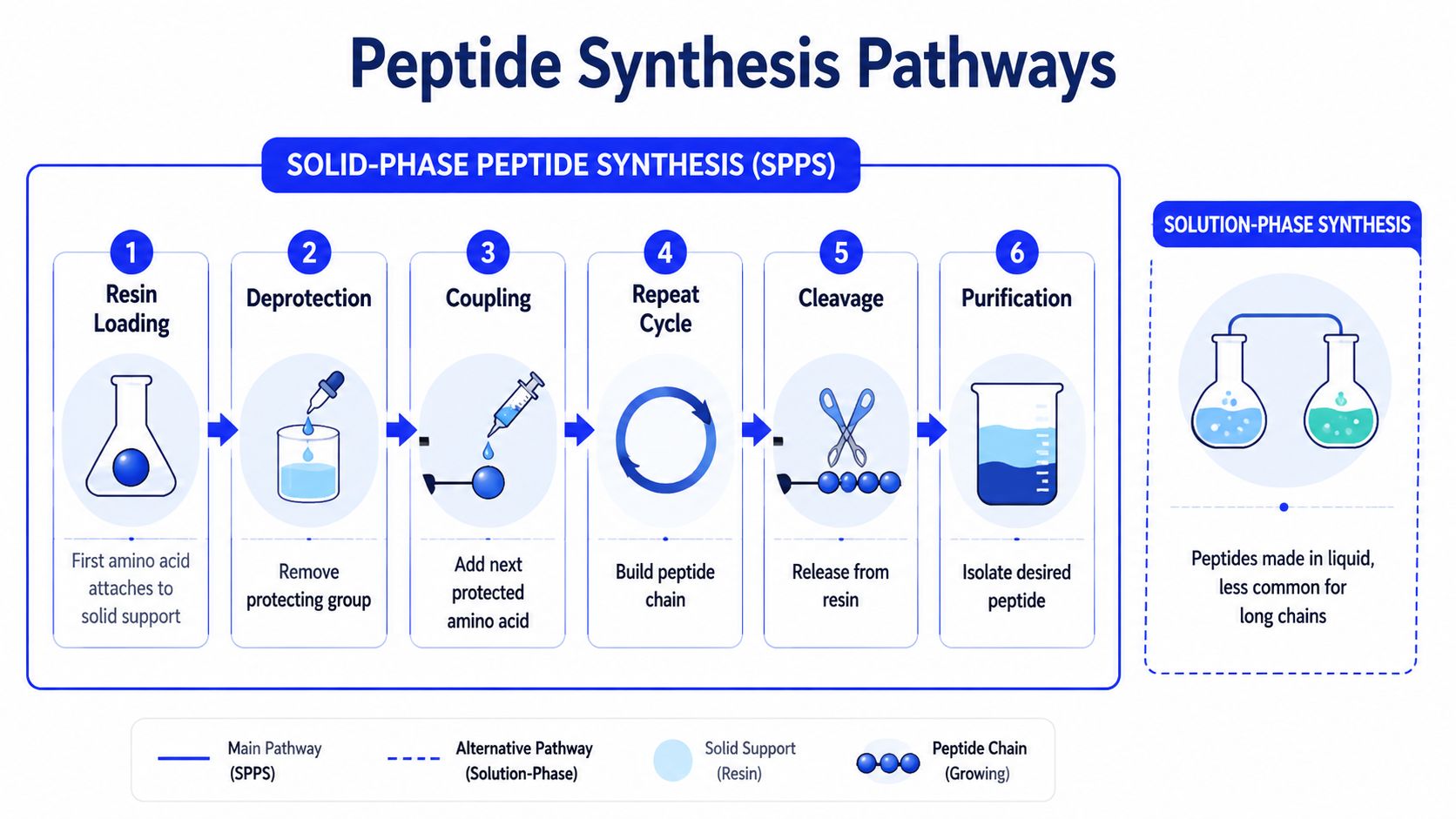
Solid-phase peptide synthesis, or SPPS, is the method used for most research peptides. The peptide is assembled while attached to an insoluble support called a resin. That setup made peptide chemistry much more practical because the product stays put while the chemist washes away excess reagents after each step.
A useful comparison is a part clamped into a vise during machining. Because the workpiece stays fixed, each operation can be done in order with less handling loss. SPPS works the same way. The resin bead holds the growing chain in place while the synthesis cycle repeats.
The cycle usually follows this pattern:
In most modern workflows, the chain is built from the C-terminus toward the N-terminus. Chemists commonly use Fmoc or Boc protection schemes to control which amine can react at a given moment, as outlined in this overview of peptide synthesis.
SPPS is popular for a simple reason. It turns a long sequence of similar reactions into a repeatable process. That repeatability matters for quality because every cycle can be tracked. A careful production record may include resin loading, coupling times, deprotection conditions, wash steps, and any recoupling needed to push a difficult residue to completion. For a new researcher, this is an early sign that peptide quality depends on more than the intended sequence. It also depends on whether the synthesis history was controlled and written down clearly.
Solution-phase synthesis builds the peptide, or peptide fragments, in liquid solution rather than on a solid support. This older route is still used in selected cases, especially when chemists want to prepare shorter fragments, combine pre-made segments, or work at scales where the economics differ from resin-based production.
The chemistry can be effective, but the handling is less direct. If the intermediate is floating in solution, it cannot stay behind on a resin while everything else is washed away. Each stage may require isolation before the next one begins. That adds labor, creates more opportunities for material loss, and puts more pressure on step-by-step analytical checks.
Here is the practical comparison:
| Method | Main advantage | Main limitation | Typical fit |
|---|---|---|---|
| SPPS | Repetitive cycles are easier to run and clean up because the chain stays attached to resin | Some sequences and manufacturing scales may be less efficient on resin alone | Most research and development work |
| Solution-phase synthesis | Useful for certain shorter peptides, fragment assembly, and some cost-sensitive manufacturing setups | Intermediates often need more involved isolation between steps | Selected manufacturing cases |
A production review from BioProcess International explains that peptide manufacturing uses solid-phase, solution-phase, and hybrid strategies, with SPPS dominating laboratory work while solution-based approaches still appear in selected manufacturing contexts. That comparison appears in this manufacturing overview from BioProcess International.
For most researchers asking how are peptides made, the practical answer is still SPPS. But the more useful answer is broader. A synthesis route only explains how the chain was assembled. It does not tell you how much incomplete material was created, how well impurities were removed, or whether the batch record is detailed enough to support confidence in the vial. Those questions start after assembly, and they are often the ones that matter most.
A newly synthesized peptide is rarely ready for use the moment it leaves the resin. What you have at that point is usually a crude mixture.
Even if most coupling steps worked, peptide synthesis can still generate side products. Some chains may be missing one amino acid. Others may stop early. Some may carry residual protecting-group-related byproducts or cleavage-related contaminants.
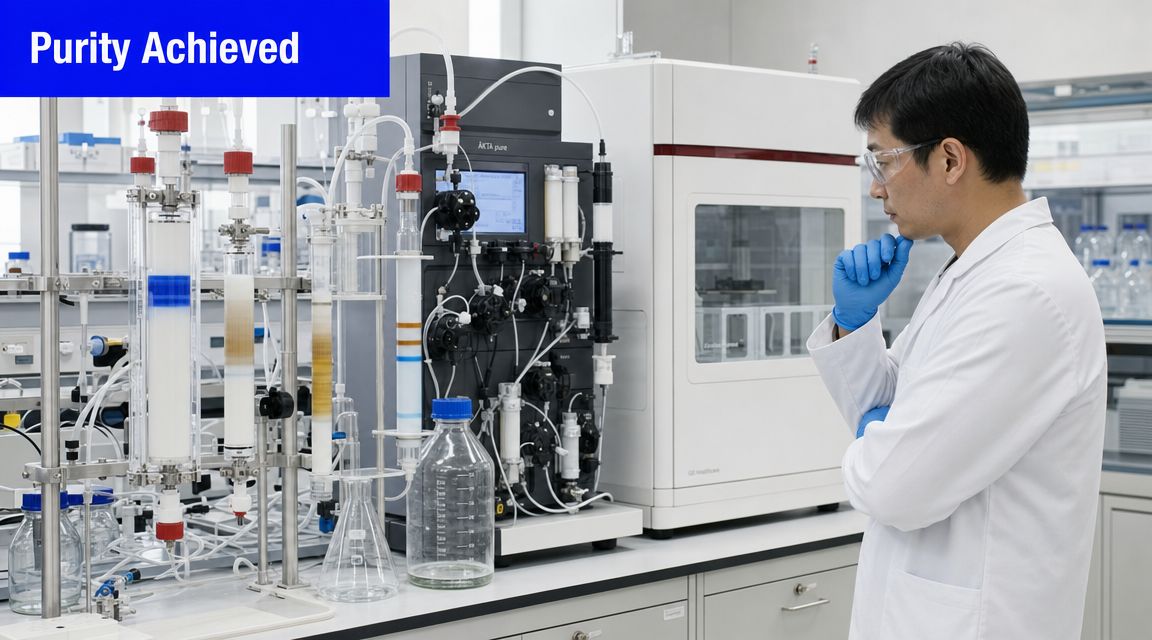
That’s why purification matters so much. After the peptide is synthesized and cleaved from its resin support, the crude product must be purified, typically by reverse-phase HPLC, to remove synthesis-related impurities such as truncations or deletion sequences that can affect research results, as noted in this step-by-step peptide manufacturing guide from Bachem.
For a new researcher, this is one of the most important mindset shifts in peptide work. High purity is not an automatic outcome of synthesis. It is the result of successful cleanup after synthesis.
Reverse-phase HPLC separates components in a mixture based on how they interact with a column and solvent system. In plain language, it acts like a very selective sorting tool. Closely related molecules don’t all travel through the system the same way, so the desired peptide can be collected apart from many unwanted species.
Here’s the practical sequence:
Many quality differences between suppliers become apparent in the manufacturing process. Two manufacturers can start with the same intended sequence and still end with very different products if one process has tighter purification control.
A short visual walkthrough helps if you haven’t seen this equipment in action:
Crude peptide can contain the right molecule and several almost-right molecules. Your assay may not care about the label. It will respond to what’s actually in the vial.
That’s why experienced chemists pay close attention to purification strategy, not just synthesis claims. When buyers focus only on sequence name and advertised purity, they miss the stage that often determines whether the peptide behaves consistently in real research.
Purification gives you a cleaner sample. Quality control confirms whether that sample is the right one.
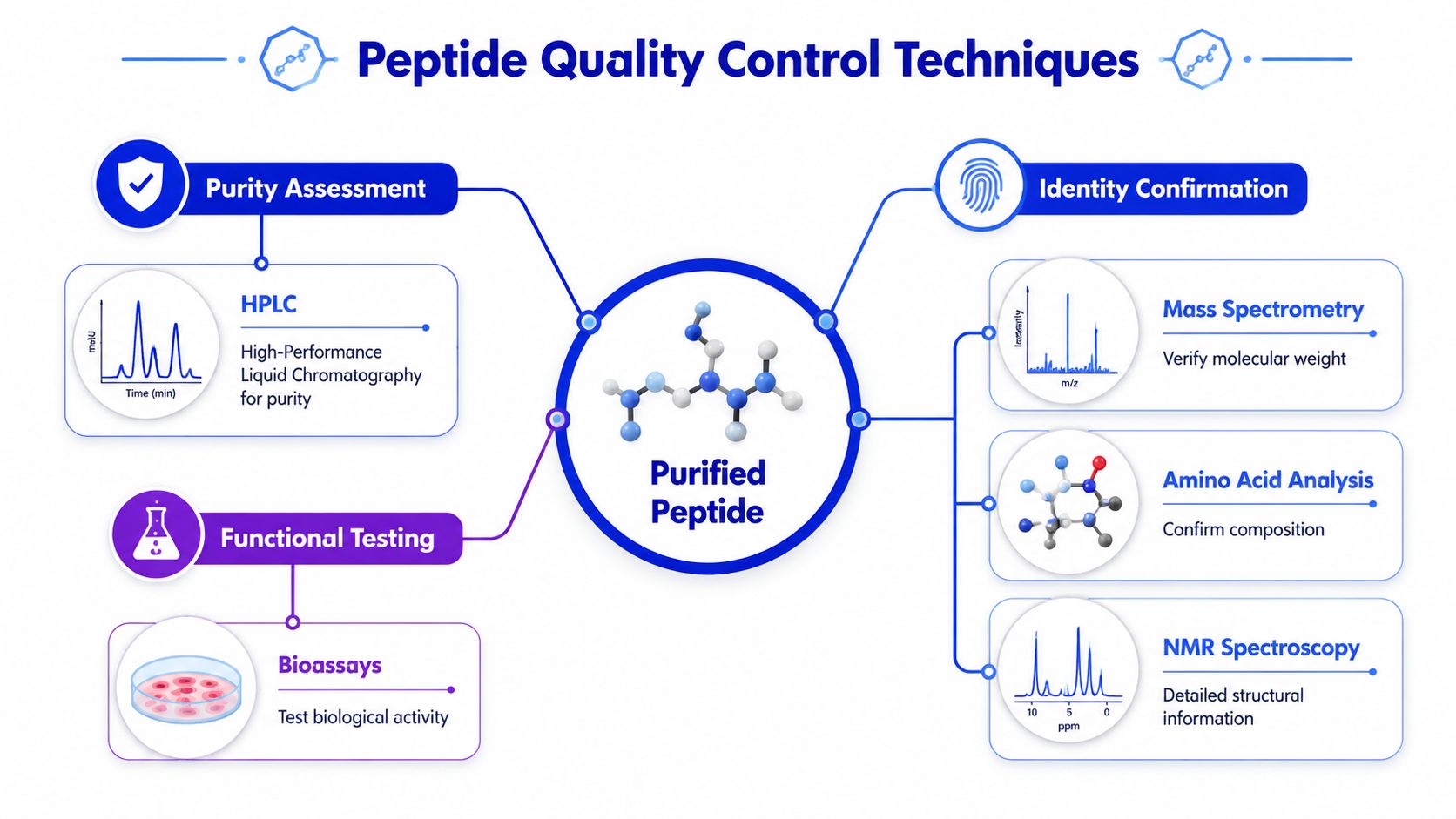
Analytical HPLC is often used after purification as an inspection tool. In this role, it isn’t mainly collecting product. It’s measuring the composition of the finished sample and showing how much of the chromatogram is represented by the main peptide peak relative to other peaks.
That’s where a purity figure on a Certificate of Analysis usually comes from. But that number needs context. It reflects an analytical method, a chromatographic separation, and the profile of that batch under those conditions. It does not automatically tell you everything about biological performance, handling behavior, or usable yield.
Mass spectrometry, or MS, addresses a different question. It helps confirm identity by showing whether the molecular weight matches the target peptide.
A sample can look fairly clean by HPLC while still being the wrong compound if the sequence or modification is off. A proper identity check reduces that risk.
A simple way to think about the two techniques is:
| Test | Main question answered | What you learn |
|---|---|---|
| Analytical HPLC | How clean is the sample? | Relative purity profile |
| Mass spectrometry | Is this the intended molecule? | Molecular weight confirmation |
Some workflows add more characterization. Amino acid analysis can support composition review. Other structural or functional methods may also be used depending on the peptide and the application.
The most important lesson for buyers and bench scientists is that no single line on a label replaces the underlying analytical record.
Key check: Purity and identity are related, but they are not the same claim. HPLC addresses one. Mass spectrometry addresses the other.
When a supplier provides transparent documentation, you can usually inspect the chromatogram, confirm the reported purity, and compare it with identity data rather than relying on a simple product-page statement. That’s the difference between a marketing description and a verifiable release standard.
A peptide can behave well in a small development run and still become difficult to manufacture reliably once production expands. The chemistry stays the same, but the process becomes less forgiving.
On the bench, a researcher may watch a single sequence closely, adjust timing, and solve a problem in real time. In larger production, that same sequence has to survive repeated cycles of synthesis, cleavage, purification, handling, and release testing without drifting from batch to batch. The challenge is no longer just making the peptide. The challenge is making it the same way every time, then proving that consistency with records tied to each lot.
That is why scale-up is really a control problem.
At higher output, small process differences become visible in the final material. A slight change in reagent quality, mixing, resin performance, reaction timing, or workup can shift the impurity profile enough to complicate purification or reduce usable yield. If those shifts are not tracked carefully, two vials with the same sequence label can behave differently in experiments.
Several pressure points show up repeatedly during manufacturing:
Sequence length often makes these problems harder to manage. As chains get longer, each additional step creates another chance for an incomplete coupling or a side product to carry forward. A useful lab analogy is copying a long sentence by hand. The more words you add, the more chances there are for a missing letter, a repeated word, or a punctuation error that was not present at the start.
For shorter peptides, straight stepwise assembly is often practical. Longer or more complex targets may require fragment-based strategies instead of building the entire chain in one uninterrupted run, as noted earlier. That helps in some cases, but it also adds more junctions, more intermediate checks, and more opportunities for variability if the process is not tightly controlled.
Many buying decisions go wrong because researchers often focus on whether a supplier can make a sequence at all. The better question is whether the supplier can reproduce that sequence across lots and show the evidence. A reliable manufacturing program produces material, tracks process conditions, compares analytical results across batches, and keeps documentation detailed enough to explain any deviation.
Reliable peptide production means repeatable chemistry, controlled purification, and lot-specific documentation that lets another scientist verify what happened.
A peptide’s paperwork should help you answer one question fast. Can you trace this vial back to real analytical evidence?
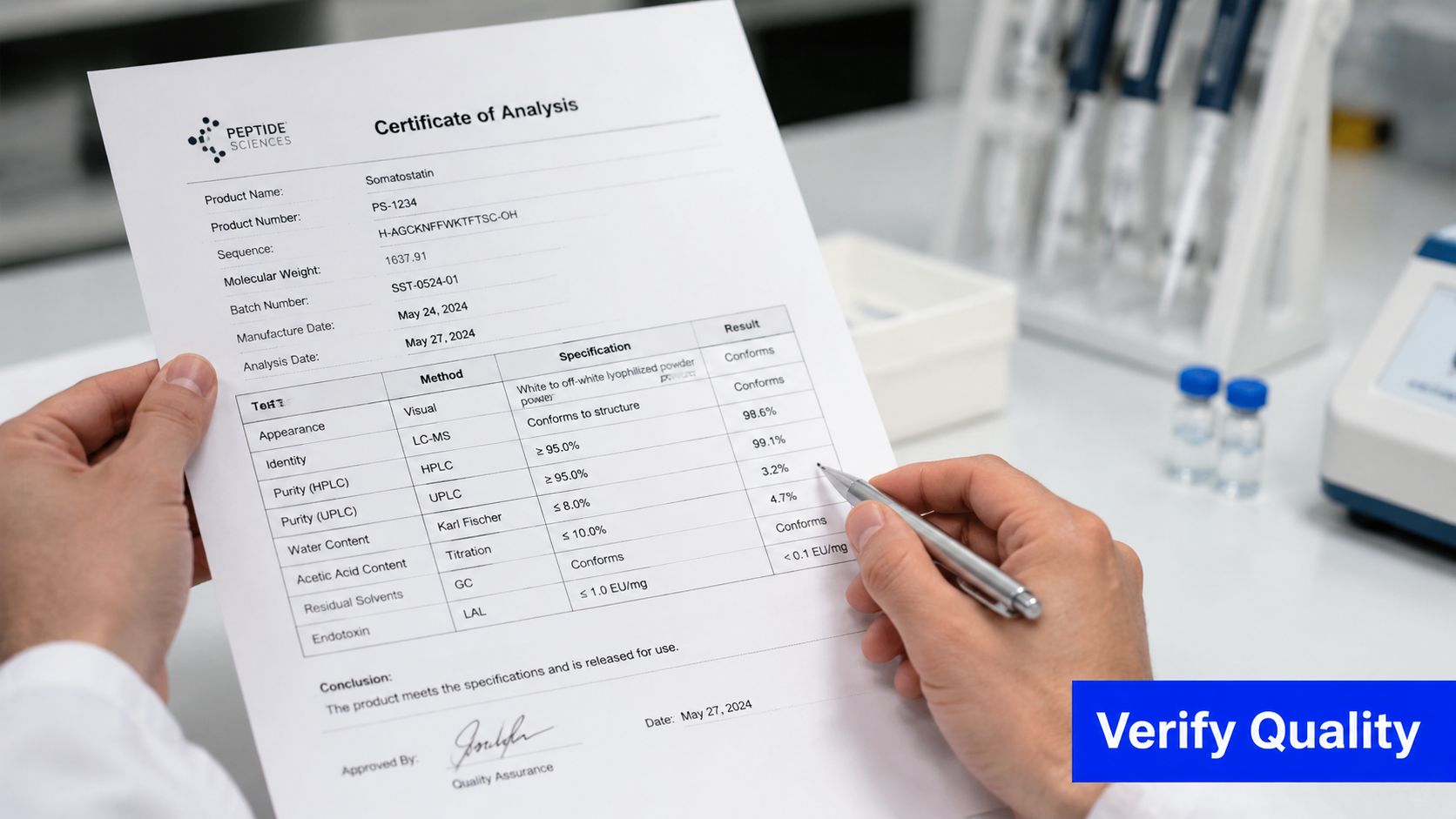
The first document most researchers ask for is the Certificate of Analysis, or COA. A useful COA should connect the batch in your hand to the testing performed on that exact lot.
Start with the identifiers:
Then inspect the data presentation itself. A strong COA usually includes more than a single purity line. If chromatographic and identity information are available, that gives you a better basis for evaluating the material.
A COA is important, but it shouldn’t stand alone. For many research settings, buyers also look for supporting quality records tied to the same lot.
A practical checklist:
What often confuses newer buyers is the difference between a stated purity number and a complete quality picture. A high purity claim doesn’t automatically answer whether the documentation is lot-specific, whether identity was verified, or whether other release checks were performed.
A reliable peptide supplier doesn’t just say “tested.” They show what was tested, on which batch, and how that batch is linked to the vial you received.
If a seller can’t provide coherent batch documents, that’s a warning sign. In peptide research, transparency is part of the product.
The answer to how are peptides made starts with chemistry, but it ends with documentation. Chemists assemble amino acids into a defined sequence through controlled synthesis. After that, the primary work of refinement begins. The crude product must be cleaned up, inspected, and verified before it becomes a dependable research material.
That’s why the most overlooked part of peptide production is also the part that often matters most. Purification removes the near-miss molecules that can interfere with research. Quality control confirms that the batch matches its intended identity and reports how clean the sample appears under analytical testing. Without those steps, the peptide is just a claim in a vial.
For researchers, this changes how purchasing decisions should be made. Don’t stop at the product name. Don’t stop at a purity line. Ask how the peptide was made, how it was purified, how identity was confirmed, and whether the batch documents are complete enough to support traceability.
The strongest suppliers make that review easier, not harder. They provide lot-specific records, analytical support, and the kind of transparency that lets you evaluate risk before the experiment starts.
When you choose peptides this way, you’re not just buying a compound. You’re buying confidence in the data you’ll generate with it.
If you want research peptides backed by transparent batch documentation, third-party testing, and USA-based production standards, learn more about Peptide Warehouse USA and explore options that support traceable, dependable peptide research.