
No products in the cart.


You've got a lyophilized peptide vial on the bench, a diluent beside it, and a protocol that assumes you already know what to do next. The difficult part isn't just adding liquid to powder. How to mix peptides correctly requires a controlled sequence that protects concentration accuracy, sterility, solubility, and the limited working life of the finished solution.
This guide follows the peptide beyond the initial mix. You'll learn how to choose a solvent, prepare an aseptic workspace, add diluent without damaging the cake, calculate stock concentration, aliquot intelligently, and recognize the handling errors that can make a clear-looking vial unsuitable for downstream research. The discussion applies to research-use laboratory handling, not clinical administration or personal use.
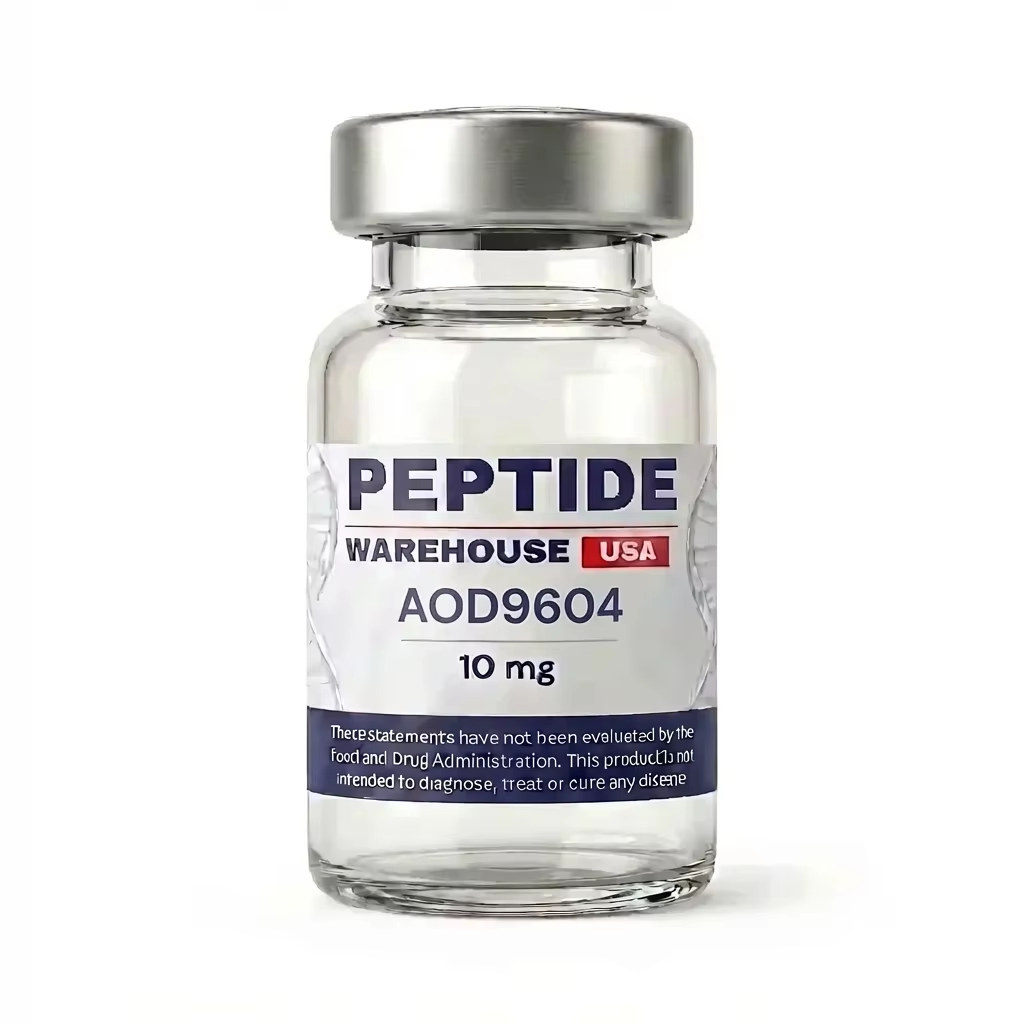
When a researcher places a 10 mg lyophilized peptide vial on the bench, the powder isn't ready to measure into an assay. Lyophilized means freeze-dried. Water has been removed from the peptide preparation, leaving a dry cake or powder designed for improved storage stability. Reconstitution is the controlled addition of a measured diluent, also called a vehicle or solvent, to return that material to a liquid stock solution.
The process has several linked decisions. You must select a compatible solvent, establish an aseptic setup, calculate the reconstitution volume, add the liquid slowly, mix with minimal agitation, and record the final stock concentration. Afterward, storage and access frequency determine whether the solution remains suitable for the intended experiment.
A few terms make protocols easier to read:
A dry vial can remain stable much longer than a solution. Guidance for lyophilized peptides commonly places long-term storage around -20 °C to -80 °C, with some references describing stability for 12 to 24 months or longer under those conditions (peptide storage and reconstitution guidance). Once water is introduced, the peptide enters a more mobile chemical environment, and the practical stability window usually falls to days or weeks.
Bench principle: Treat reconstitution as a controlled rehydration event, not a free pour.
This distinction also helps separate laboratory work from discussions about clinical products. Readers researching topics such as post-surgery weight loss medication should use medically supervised sources for patient care. The workflow here is for a sterile, accurately concentrated, traceable solution prepared for downstream assay work.
Good reconstitution starts before the vial is opened. Use a disinfected biosafety cabinet or clean bench when the protocol requires controlled handling, and clean the work surface with an appropriate alcohol-based disinfectant. Place a sharps container within reach, keep a labeled waste beaker nearby, and use a flat, vibration-free pad so small vials won't roll or tip.
A practical setup includes:
Solvent choice depends on whether the vial will be accessed once or repeatedly, whether the sequence tolerates preservatives or ionic strength, and what the validated protocol specifies. Bacteriostatic water contains 0.9% benzyl alcohol, or 9 mg/mL, which helps inhibit bacterial growth in multi-dose containers (bacteriostatic water composition). It's commonly used for multi-use research vials and is often associated with refrigerated use for roughly 28 days at 2–8 °C after mixing (peptide reconstitution solvent guidance).
Sterile water for injection contains no preservative. It's generally framed for a preparation that will be used in a single session, rather than a vial that will be punctured repeatedly (sterile water and bacteriostatic water comparison).
Sterile saline contains 0.9% sodium chloride. It can suit sequences and experiments that tolerate ionic strength, but compatibility must come from the peptide-specific method or formulation information. Don't assume that a familiar diluent is appropriate for every sequence.
| Solvent | Preservative | Recommended Window After Mixing | Best For |
|---|---|---|---|
| Bacteriostatic water | 0.9% benzyl alcohol | Refrigerated use often described as up to about 28 days | Multi-use research vials, when compatible with the peptide |
| Sterile water for injection | None | Commonly intended for immediate single-session use; some guidance describes sterile-water preparations as lasting around 24–48 hours | Single-use preparations |
| Sterile saline | No preservative stated here | Depends on the peptide, protocol, and storage validation | Sequences that tolerate ionic strength and applicable in-vivo research workflows |
Bacteriostatic water can reduce microbial risk in a multi-access workflow, but it doesn't guarantee chemical stability. For a more focused explanation of handling considerations, consult this laboratory reference on bac water.
For oxidation-sensitive residues such as methionine, cysteine, and tryptophan, technical guidance may call for oxygen-controlled solvents or other sequence-specific choices. Avoid buffers such as PBS for sensitive sequences unless the method specifically supports them.
Temperature comes first. Let the lyophilized vial and the diluent reach room temperature before opening, particularly after cold storage. This reduces moisture condensation on the dry cake and avoids introducing a cold surface into an otherwise controlled preparation.
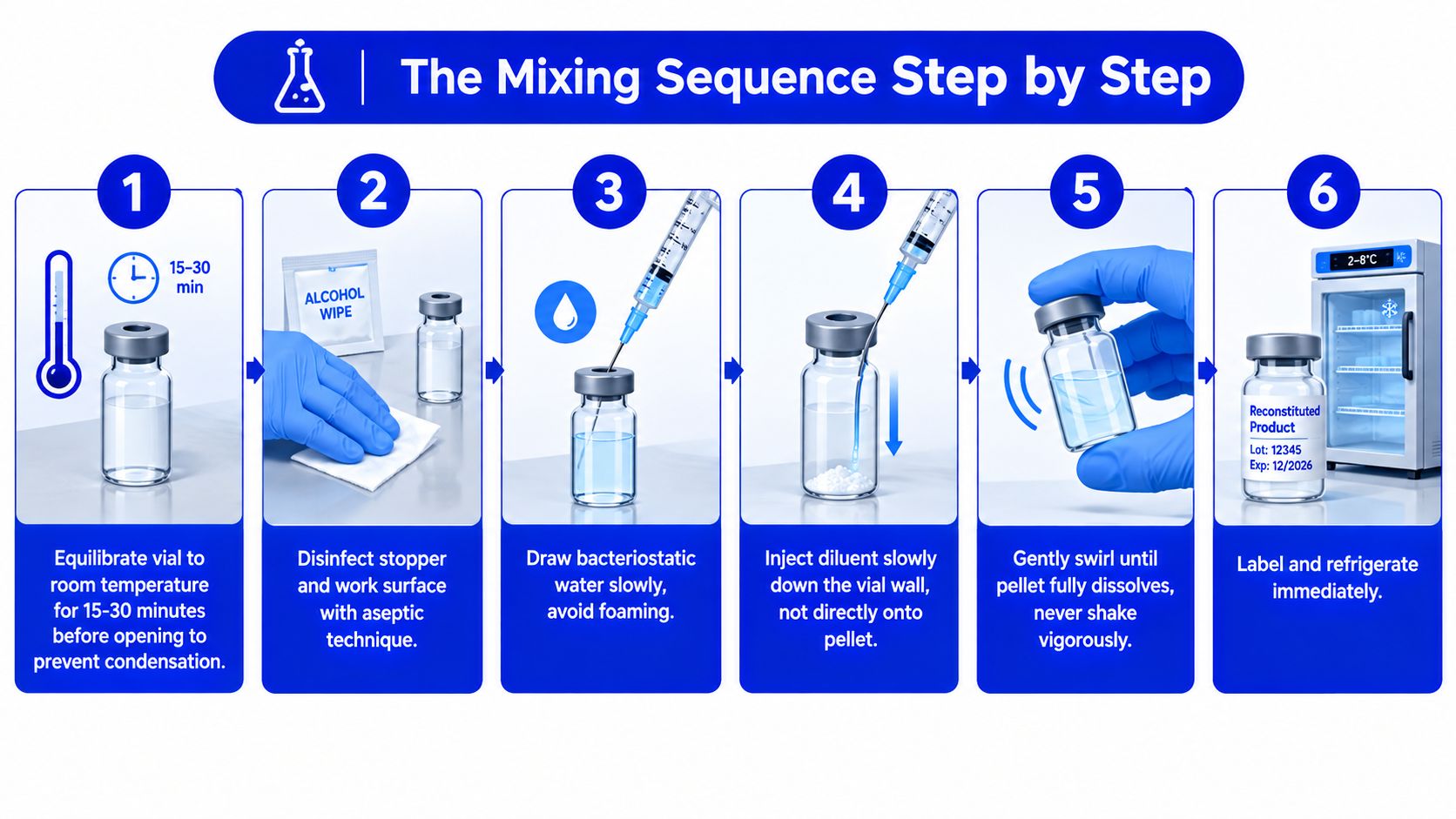
Remove the flip-off cap, then disinfect the rubber stopper with an alcohol swab. Clean the diluent stopper separately with a fresh swab. Allow each surface to air-dry fully, because transferring wet alcohol into the vial can affect the preparation.
Use sterile gloves where required, keep the work surface uncluttered, and avoid touching cleaned stopper surfaces. A sterile syringe and needle should be used for the solvent draw.
Draw the calculated solvent volume without introducing bubbles that could distort measurement. Insert the needle through the stopper and direct the stream down the inside glass wall at about a 45-degree angle.
The liquid should run along the wall instead of striking the powder directly. This reduces foaming and mechanical stress, especially for sequences that are sensitive to agitation.
Let the solvent contact the cake without active agitation for roughly 30–60 seconds. Don't shake, vortex, or sonicate the vial. Vigorous movement can create bubbles and may damage or aggregate the peptide.
Remove the syringe and use slow circular swirling or horizontal rotation. Continue until the cake has dissolved and the liquid appears clear and free of visible particles.
If material remains after approximately two minutes, stop and allow the vial to rest before reassessing the solvent and sequence compatibility. Persistent cloudiness or particles shouldn't be ignored. The peptide may require a different vehicle, a validated co-solvent, or investigation of the vial rather than more aggressive mixing.
Practical rule: If the only way to dissolve the peptide is vigorous shaking, stop and investigate the formulation instead of forcing the process.
The exact motion prevents a specific problem at each stage. Room-temperature equilibration limits condensation, stopper disinfection limits contamination, wall-directed addition limits foaming, and gentle swirling limits mechanical stress.
The basic calculation is straightforward:
Target concentration in mg/mL = peptide mass in the vial ÷ solvent volume in mL
For example, a 10 mg vial reconstituted with 2 mL of bacteriostatic water produces a nominal concentration of 5 mg/mL. On a 100-unit insulin syringe, where 1 mL equals 100 units, that equals 0.05 mg per unit, or 50 mcg per unit. The arithmetic is a laboratory conversion example, not human dosing guidance.
| Solvent Volume | Concentration for a 10 mg Vial | mcg per Unit on a 100 U Syringe | Typical Use Case |
|---|---|---|---|
| 1 mL | 10 mg/mL | 100 mcg per unit | More concentrated stock where the protocol requires smaller measured volumes |
| 2 mL | 5 mg/mL | 50 mcg per unit | Balanced stock concentration for routine laboratory calculations |
| 3 mL | Approximately 3.33 mg/mL | Approximately 33.3 mcg per unit | More dilute stock where larger working volumes improve handling |
You can use the same formula for another vial size, but the result still depends on the actual peptide content and the volume delivered. A concentration calculator, such as the type described in resources on healthcare dosing accuracy for 1500 mcg, can help check unit conversions, but it can't replace the peptide's certificate of analysis or validated protocol.
Some high-molecular-weight or hydrophobic sequences need a higher-concentration stock to remain soluble. The same nominal mass and solvent volume can behave differently across peptides, and visible residue near the meniscus may indicate incomplete dissolution rather than a math error.
Two accounting issues also cause avoidable confusion:
Record the theoretical concentration and any relevant assay or fill information separately. That keeps the calculation transparent and prevents a nominal stock value from being mistaken for a fully validated analytical concentration.
The moment the cake has dissolved, storage decisions become part of the experiment. A common short-term target is refrigeration at 2–8 °C, which slows chemical reactions and reduces microbial growth without subjecting the liquid to the stress of freezing (peptide storage stability guidance).
A reconstituted solution doesn't have the same stability profile as the dry cake. Water increases molecular mobility and can increase hydrolytic risk, while dissolved oxygen can contribute to oxidation in sensitive sequences. That's why practical guidance commonly describes solution use in days to weeks, rather than the longer storage periods associated with unopened lyophilized material.
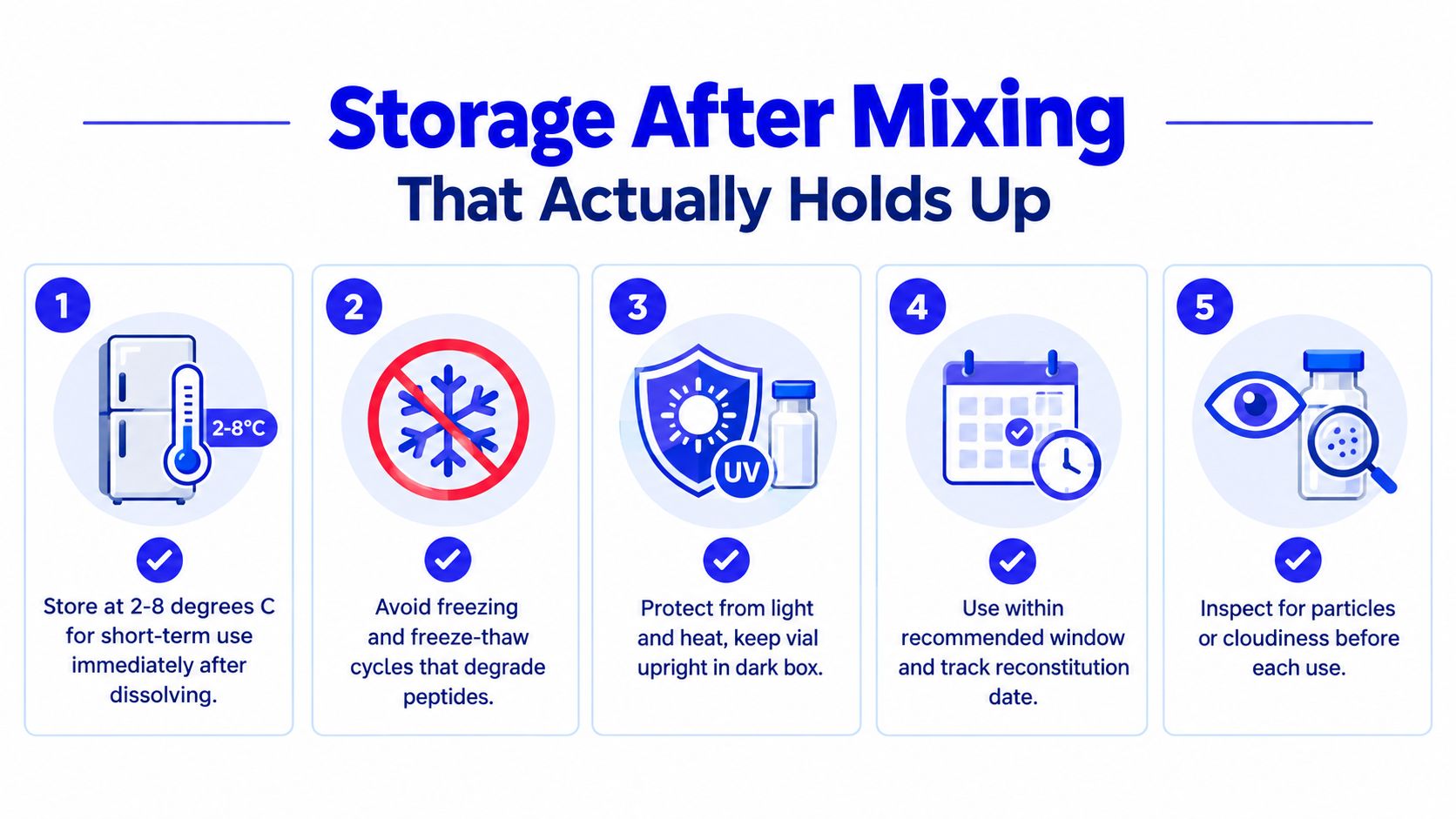
If the vial will be used soon and accessed infrequently, refrigerated storage may fit the protocol. If it will be accessed repeatedly, sterile aliquoting can reduce the number of stopper punctures and limit exposure of the unused material.
Prepare single-use portions under the same aseptic controls used for the original reconstitution. The purpose isn't convenience alone. Each opening or puncture creates another opportunity for contamination, rubber coring, oxygen exchange, and handling variation.
Some guidance recommends freezing single-use aliquots for later experiments, but the decision must be peptide-specific. Repeated freeze-thaw cycling is widely flagged as a degradation risk, and a thawed aliquot shouldn't be refrozen unless the validated method explicitly permits it. Size aliquots around the actual experimental requirement so the entire portion can be used after thawing.
At minimum, record:
A reconstitution log creates traceability between the original powder, the prepared stock, and the assay result. It also makes it easier to identify whether a result changed after a storage interval, a temperature excursion, or repeated access.
Traceability matters: A clear solution isn't automatically a stable solution. The preparation record is part of the evidence.
For bacteriostatic-water preparations, frequently cited guidance describes refrigerated use up to roughly 28–30 days, while other reviewed guidance uses a shorter 2–4 week working window depending on the sequence, solvent, concentration, and storage assumptions (in-use peptide stability synthesis). Sterile-water preparations are often treated as much shorter-lived, with one reference describing approximately 24–48 hours (post-reconstitution storage guidance).
The most damaging errors often happen after the powder has dissolved. A vial can look clear while its chemical profile has changed through aggregation, pH drift, oxidation, or contamination.
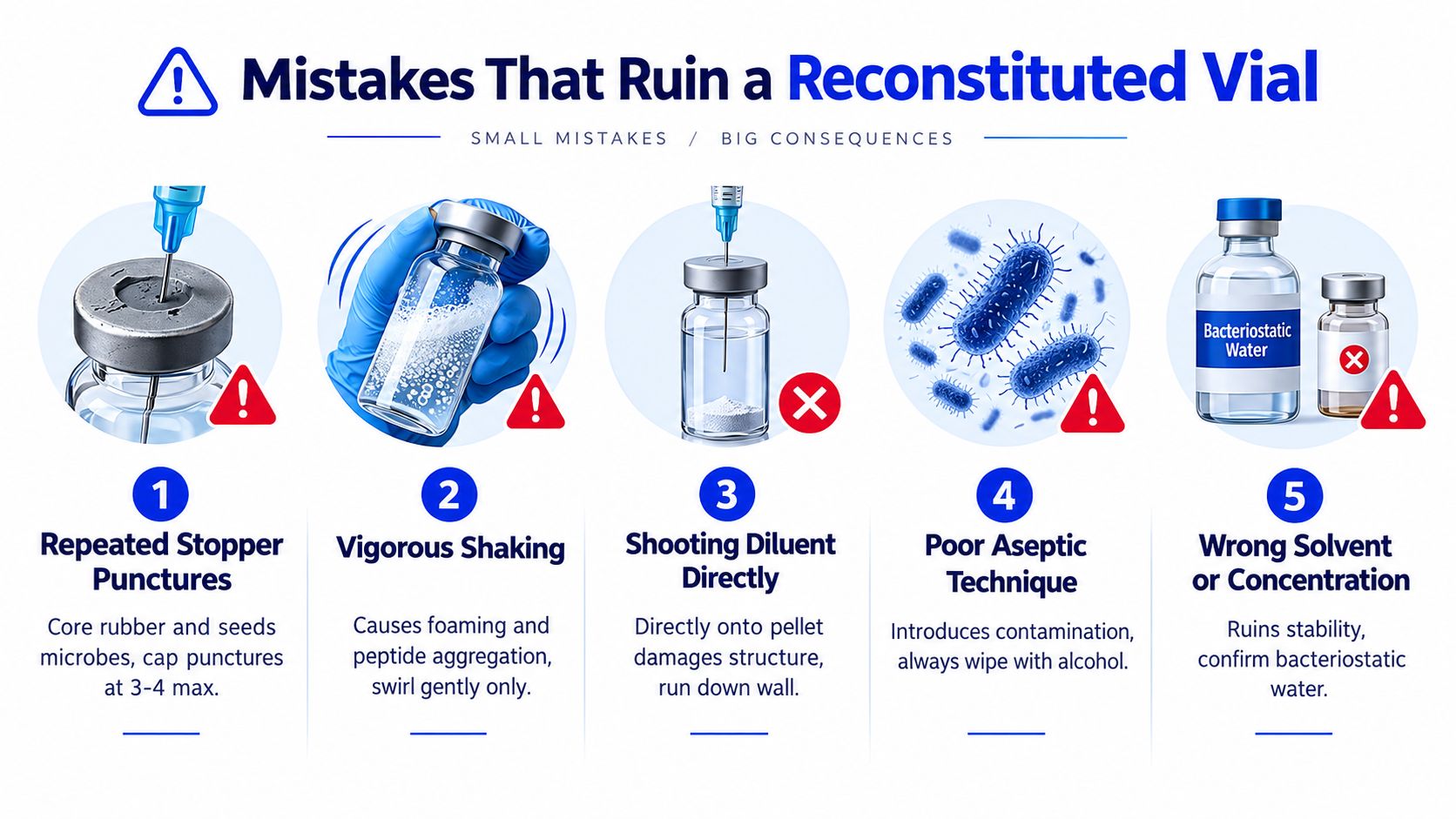
Every puncture can introduce rubber fragments or microbes. Wipe the stopper with 70% isopropyl alcohol before access and allow it to dry. If the workflow requires frequent draws, use aliquots instead of relying on one repeatedly accessed stock vial.
Unbuffered solutions can experience pH changes as they interact with laboratory air. That shift may accelerate degradation pathways in sequences containing asparagine, glutamine, or aspartic acid residues.
Oxidation-sensitive cysteine, methionine, and tryptophan residues deserve similar caution. Oxygen in the vial headspace, repeated opening, and trace metals in poor-quality solvents can all complicate stability.
Vortexing and vigorous shaking introduce foam and mechanical stress. Gentle swirling is safer for many preparations, but it still isn't a universal guarantee. If the solution remains cloudy, develops visible particles, or shows unexpected loss of assay activity, don't attempt to hide the problem with more agitation.
Adding less solvent to create a more concentrated stock can push a peptide above its solubility threshold. The result may be precipitation, residue at the meniscus, or later aggregation during storage.
Watch for early warning signs:
Purity testing alone may not reveal every stability problem. Freeze-thaw cycling, pH excursions, and aggregation can affect usability even when a routine purity result still appears acceptable.
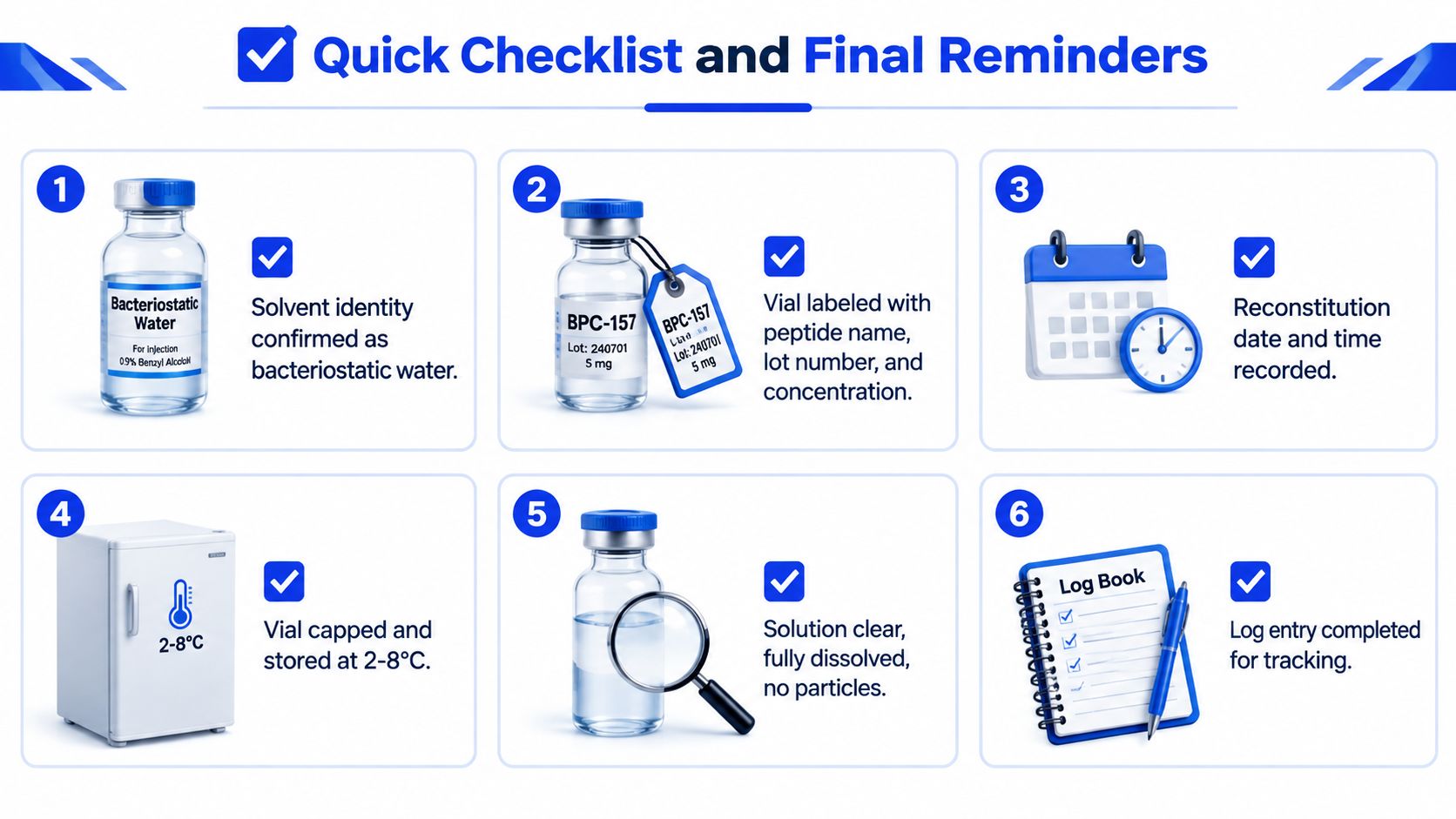
Before capping a freshly mixed vial, confirm the preparation against a short readiness check:
Peptides discussed here are for laboratory investigation use only, not human consumption, veterinary use, or clinical administration. Local regulations, institutional review requirements, biosafety procedures, and committee approval govern any downstream application.
The next procurement step should be verification, not guesswork. Look for high-purity research peptides supported by a verifiable certificate of analysis, clear lot information, and documentation that fits your laboratory's traceability requirements.
Peptide Warehouse USA offers high-purity research peptides and related compounds for laboratory, analytical, and preclinical applications, with batch documentation that can support identity, purity, and traceability checks. Visit Peptide Warehouse USA to explore research peptide options and review the available documentation before planning your next reconstitution workflow.
Leave a comment