
No products in the cart.



You've searched “KPV peptide buy” and found a crowded market of storefronts promising research-grade material, high purity, quick shipping, and convenient formats. The difficult part isn't finding a product page. It's deciding whether the material is documented well enough to support reliable laboratory work, whether the storage history protects your results, and whether the sale is clearly limited to research use.
KPV is a research peptide, not an established human therapy. The most defensible purchase decision therefore starts with evidence, not price. This guide walks through the molecule's research context, supplier documentation, Certificates of Analysis, stability requirements, format selection, and a practical pre-purchase review you can use before placing an order.
A quick search can produce many KPV listings with similar claims. One page may emphasize purity, another may highlight price, and a third may promote oral, topical, or injectable formats. Yet the information a lab needs is often missing, including the batch identity, analytical methods, synthesis details, shipping conditions, and storage history.
That creates a procurement problem rather than a simple shopping problem. A low listed price per milligram tells you very little if the material has an unclear sequence confirmation, inadequate packaging, undocumented temperature exposure, or no usable lot-specific testing. A peptide can be inexpensive to purchase and expensive to troubleshoot once an assay begins producing inconsistent results.
A documentation-first review asks whether the supplier can connect the vial in your hands to a specific manufacturing and testing record. The core evidence should include:
Residual solvents, endotoxin load, moisture exposure, and repeated warming can all affect downstream work. These variables may not appear in the product title, but they belong in the purchasing decision.
Practical rule: If a supplier sells the peptide before it can explain the batch, the test method, and the handling conditions, treat the listing as incomplete evidence.
The rest of the buying process becomes easier once you convert marketing language into documents you can archive and verify. The right question isn't only where to buy KPV. It's whether the supplier can prove what was supplied.
KPV is a three-amino-acid fragment, Lys-Pro-Val, of alpha-melanocyte-stimulating hormone, commonly abbreviated alpha-MSH. Its research identity emerged from broader work on alpha-MSH and immune regulation, rather than from one isolated discovery. In 2007, an NIH-hosted paper reported reduced intestinal inflammation after KPV uptake in in vitro and in vivo models, supporting further preclinical investigation (NIH-hosted KPV research paper).
For procurement, the short sequence defines a clear molecular target. Researchers can order a specified peptide sequence, assess its identity and purity, and build cell-based or preclinical experiments around a known input. That clarity supports reproducibility, provided the supplied material matches the stated sequence and the study design remains within its model limitations.
KPV appears in research involving inflammatory signaling, intestinal models, skin-related models, and other preclinical applications. These areas explain research demand. They do not establish that KPV treats a condition, improves symptoms, or provides demonstrated benefits in humans.
Available reviews characterize the evidence base as almost entirely preclinical, with no completed or registered human trials as of 2026 (KPV anti-inflammatory research summary). Another review reports no published human clinical trials, so proposed benefits remain laboratory or preclinical findings rather than established human efficacy or safety (KPV research overview).
Researchers needing a plain-language overview of the molecule's origin and research discussion can consult what is KPV peptide from PepFlow. For purchasing decisions, the compliance boundary is clear: KPV should be treated as a laboratory research compound, not an approved therapeutic ingredient or supplement. A supplier's research-use labeling should align with that boundary, and documentation should support the material's identity without implying clinical use.
A credible supplier makes it possible to trace a product from catalog listing to vial to test record. That usually means lot-specific documentation, clear product identifiers, analytical evidence, storage instructions, and a support channel capable of answering technical questions.
Not every supplier publishes the same depth of information. The difference matters most when your work depends on reproducibility, when the peptide will be compared across lots, or when an unexpected assay result needs to be investigated.
| Signal | Tier 1, Research-Grade | Tier 2, Mid-Market | Tier 3, Reseller |
|---|---|---|---|
| Certificate of Analysis | Lot-specific, with HPLC and mass spectrometry support | May be available, but can use generic templates | Often limited to a stated purity figure |
| Chromatograms | Published or supplied on request | May be incomplete or unavailable | Usually absent |
| Synthesis information | Method and counterion are disclosed | Some details may be withheld | Rarely provided |
| Storage and shipping | Conditions are stated and documented | General handling advice | Vague or missing |
| Batch traceability | Vial, invoice, and COA clearly correspond | Traceability may require follow-up | Difficult to establish |
| Technical support | Scientific staff can address method questions | Basic support is available | Primarily sales-focused |
Look for third-party testing, but verify what was tested. A third-party name alone doesn't tell you whether the lab assessed identity, purity, residual solvents, microbial burden, or endotoxin content.
Packaging also offers useful clues. Tamper-evident seals, a readable lot number, intact labeling, and protection from moisture support traceability. They don't replace analytical testing, but damaged or ambiguous packaging should stop the order from moving directly into an experiment.
Ask how the supplier handles material that has experienced a shipping excursion. A responsible answer should describe an evaluation process rather than suggesting that the vial be used anyway. The supplier's terms of sale should also state that the product is intended for research or laboratory use, not human consumption.
Readers who are also comparing supervised clinical pathways should keep that decision separate from research procurement and can explore peptide therapy options through a provider-oriented resource from Longevity Medical Institute. A research supplier sells documentation first and peptide second.
A Certificate of Analysis is only useful when it identifies the exact material you received and explains how the supplier evaluated it. Start at the top of the document, not at the headline purity result.
The product name should be specific, and the sequence should correspond to Lys-Pro-Val. Confirm the lot or batch number, manufacturing or synthesis date, test date, stated quantity, and any reference to a salt form or counterion. If the document describes a generic peptide without connecting it to the vial, it isn't a strong lot record.
Next, identify the testing laboratory and analytical methods. A serious COA should name the method used for purity assessment and identity confirmation, or provide enough method detail to understand what the result represents. An analyst signature, review date, and laboratory contact information add accountability.
HPLC purity is useful for assessing the proportion of the measured material associated with the target peak. It doesn't automatically prove sequence identity, sterility, low endotoxin content, or suitability for every assay. For a short tripeptide, mass spectrometry confirmation is especially important because it supports the identity claim rather than relying on a purity percentage alone.
Look for the chromatogram rather than accepting a rounded number in isolation. A trace should be legible, associated with the correct lot, and accompanied by the method conditions or a meaningful test reference. Missing chromatograms, generic templates, and unexplained round-number claims should trigger a request for clarification.
| COA Field | What It Should Show | Red Flag |
|---|---|---|
| Product identity | KPV, Lys-Pro-Val, and relevant form | Generic peptide name only |
| Lot number | Exact match to vial and invoice | Number is missing or inconsistent |
| HPLC result | Purity result with trace or method reference | Purity figure without supporting record |
| Mass spectrometry | Identity confirmation consistent with KPV | No identity test |
| Residual solvents | Tested result or documented specification | No solvent information |
| Endotoxin or microbial data | Results appropriate to the planned assay | No biological impurity information |
| Dates and approval | Test date, analyst, and review details | Undated or unsigned document |
| Storage statement | Conditions tied to the material | Generic advice with no lot context |
Before filing the COA, cross-check the analyst signature, test date, storage statement, and lot number. A COA is evidence only when it belongs to the vial being used.
KPV handling changes after reconstitution. Lyophilized powder has a different stability profile from a solution, so the storage plan should be decided before the vial arrives.
FDA briefing material reports that lyophilized KPV free base can remain stable up to 3 years at -20°C, up to 2 years at 4°C, and up to 3 months at 15°C (FDA KPV stability briefing material). The same material recommends storing reconstituted KPV at -80°C for 6 months, -2°C for 1 month, or 10°C for 1 week. These are handling limits for research planning, not permission to extend a solution's hold time.
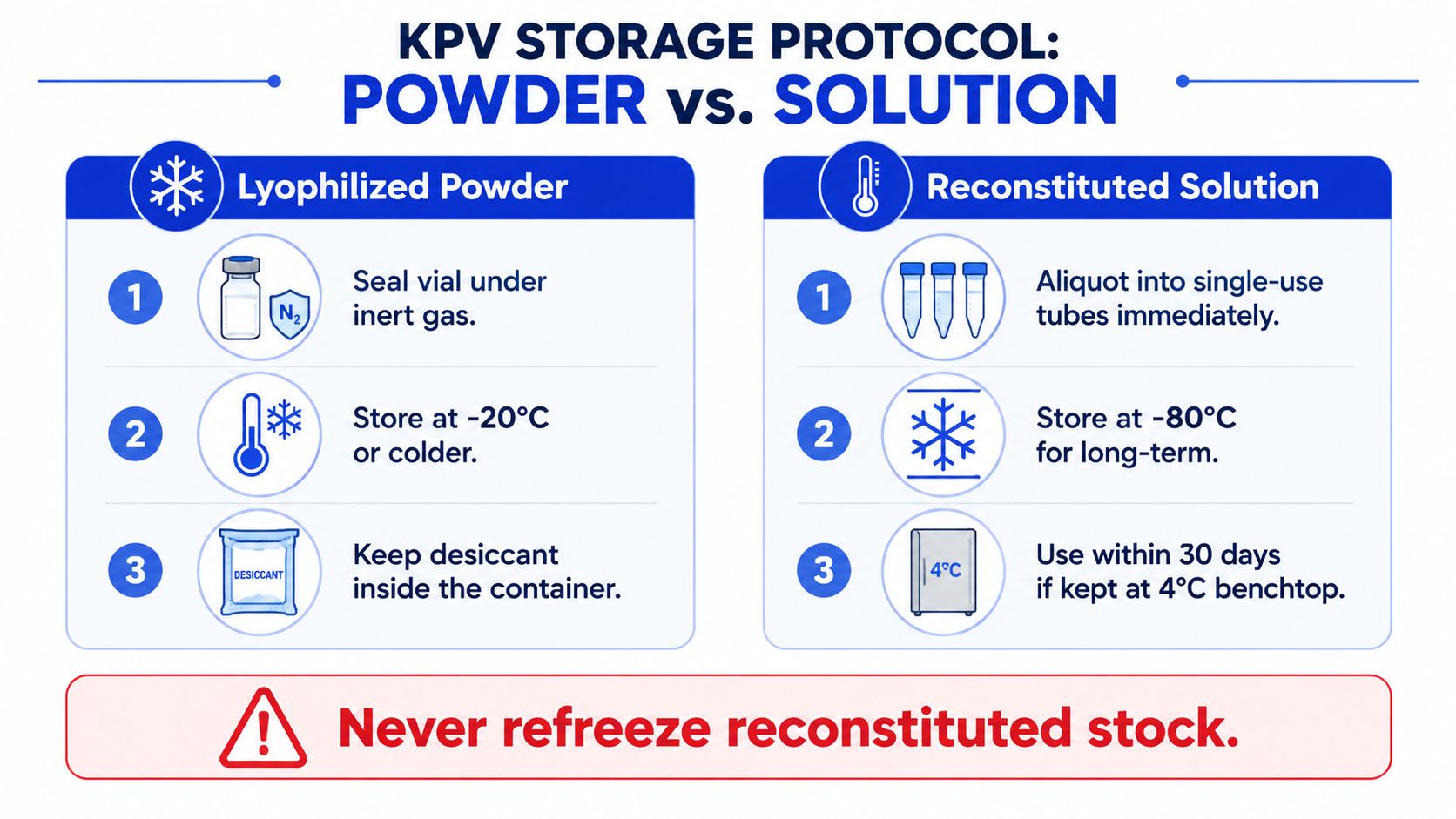
Keep the powder sealed, dry, and protected from unnecessary light and humidity. Avoid leaving the vial on a warm bench while preparing other materials. Repeated warm exposure can introduce degradation drift that may be difficult to distinguish from biological variability.
After reconstitution, use a validated diluent and follow the protocol approved for your assay. Aliquoting into appropriately labeled tubes helps reduce repeated freeze-thaw exposure. Label each tube with the lot number, reconstitution date, final concentration, and storage temperature.
Record the freezer temperature and each thaw associated with the experiment. If a solution exceeds the applicable published hold-time threshold, discard it rather than carrying uncertainty into a new assay.
Bench habit: Treat reconstitution as a new controlled lot event. Record what changed, when it changed, and where the material was stored.
A formulation that looks convenient can still create an uncontrolled variable. Choose the format from the experimental question, the planned readout, and the documentation available for that specific product. For most in vitro and preclinical work, lyophilized powder is usually the clearest research default because the laboratory can reconstitute it under a defined protocol and set the working concentration.
Oral and topical products make sense when delivery is part of the hypothesis. They do not automatically offer stronger evidence. KPV literature remains predominantly preclinical, with no FDA-approved KPV products or official human dosing instructions in the cited coverage (KPV clinical evidence review). Treat the format as an experimental variable, not as evidence of clinical suitability.
| Format | Best Research Use | Key Limitation |
|---|---|---|
| Lyophilized powder | In vitro assays and controlled preclinical formulation work | Requires validated reconstitution and storage |
| Oral preparation | Delivery and localized gastrointestinal model research | Human performance and dosing aren't established |
| Topical preparation | Skin-barrier and local formulation investigations | Local exposure may not represent systemic biology |
| Injectable preparation | Specialized preclinical delivery studies under approved protocols | Requires strict institutional, technical, and compliance controls |
Powder provides control over concentration, diluent, aliquoting, and assay timing. That control is useful when the assay must distinguish peptide effects from formulation effects. An oral or topical SKU may be the better choice when gastrointestinal delivery, skin exposure, or another route is the study variable. Before ordering, request the formulation composition, handling conditions, and lot-specific documentation. A label alone does not show what the preparation contains or how consistently it was made.
The trade-off is practical. Powder requires a validated reconstitution procedure and disciplined handling. A prepared oral or topical product can reduce setup work, but excipients, release characteristics, and local exposure may complicate interpretation. Injectable material belongs only in approved preclinical work with the required institutional and technical controls.
Preclinical research has also examined KPV in contexts extending beyond familiar gut and skin discussions, including cardiovascular inflammation and nanoparticle delivery. These findings may inform study design, but they do not establish consumer purchasing guidance or prove that a newer delivery system is safer or more effective.
For most laboratory purchases, choose lyophilized KPV unless the delivery format is itself part of the study design. Select a capsule, cream, or solution only when its delivery characteristics are documented and directly relevant to the protocol.
A failed assay often traces back to a preventable purchasing gap. Before payment, confirm that the product, lot documentation, storage capacity, and approved research use fit the protocol. Price matters, but it cannot compensate for missing evidence or unclear handling requirements.
Begin with the catalog number and lot-specific COA. The document should identify KPV, support identity through mass spectrometry, report HPLC purity, and provide information relevant to the planned assay. Set purity and endotoxin requirements from the protocol, not from a generic marketing statement.
Review the sale terms at the same time. The supplier should clearly label the material for research, laboratory, analytical, or preclinical use. KPV is described in independent reviews as not FDA-approved for human use and sold as a research chemical or laboratory-use compound, as noted earlier. A research-use disclaimer defines the permitted boundary of the purchase, so treat it as a procurement control rather than a footer.
Regulatory status remains unsettled. KPV has been discussed in FDA compounding contexts and reviewed for possible inclusion on the Section 503A Bulk Drug Substances List. That process concerns whether compounding pharmacies may legally prepare it, and review does not equal approval (FDA KPV compounding review). If the intended purpose is human use, stop the research purchase and consult a qualified provider and the applicable regulatory authority.
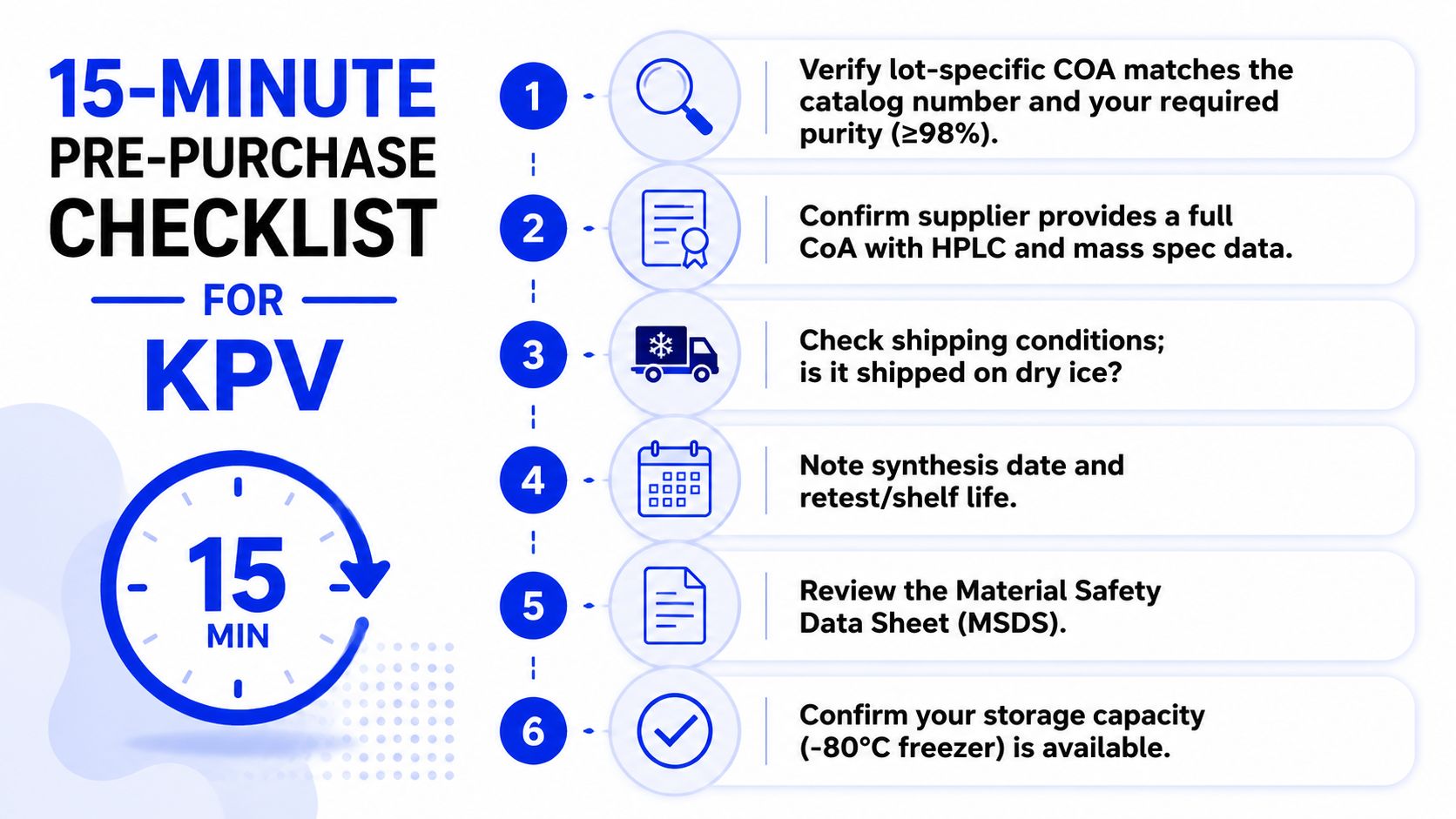
Peptide Warehouse USA lists a standalone KPV research product with COA-focused product information, along with KLOW Blend formulations containing KPV. Evaluate those listings against the same documentation, format, storage, and research-use criteria. You can review the KPV research product options and request the records required for your laboratory purchasing file.
Before ordering, confirm that the lab can receive, document, and store the material under controlled conditions. That final check connects procurement records to experimental validity and limits uncertainty after the work begins.
Peptide Warehouse USA offers KPV and related research compounds for laboratory, analytical, and preclinical applications, with product documentation intended to support lot traceability and procurement records. Review the product information and request the COA and safety documentation required by your workflow.
Leave a comment