
No products in the cart.



The most popular advice for LGD-4033 for sale searches is usually the least useful: find a cheap vendor, check a headline purity figure, and compare prices. That approach belongs to consumer marketing, not laboratory procurement. For legitimate in-vitro, analytical, and preclinical research, the important questions are different. Can the supplier identify the exact compound? Can the lot be traced to independent testing? Does the proposed use fit regulatory and institutional requirements? Can your lab defend the purchase if an auditor, safety officer, or anti-doping authority asks for documentation?
LGD-4033, also called ligandrol, isn't an FDA-approved medicine or a lawful dietary-supplement ingredient. The compound has a documented clinical-development history, but commercial pages often blur the boundary between investigational research material and products promoted for human use. This guide focuses on the practical controls that matter, including pharmacokinetics, regulatory status, certificates of analysis, identity testing, storage, and supplier qualification.
A search for LGD-4033 for sale produces several very different supply categories. Fitness forums and consumer pages often frame ligandrol as a performance product, while laboratory suppliers describe it as a research compound. Those categories aren't interchangeable. A product marketed for ingestion creates a completely different regulatory and safety problem from a material purchased under a documented research-use-only process.
The first procurement decision is therefore not price. It's intended use. A laboratory should define the project, responsible investigator, facility requirements, approval pathway, and analytical method before contacting suppliers. That record helps prevent an informal purchase from entering a controlled workflow without the right review.
A supplier page may use terms such as “research grade,” “high purity,” or “tested.” Those labels have value only when the vendor can provide supporting records tied to the specific lot. A credible file should identify the compound, lot or batch number, test date, analytical method, result, and testing laboratory. Marketing copy alone can't establish identity or suitability.
FDA enforcement has specifically included LGD-4033 and ligandrol among products marketed as SARMs for sale in the United States, which shows why promotional claims deserve scrutiny. The FDA warning letter concerning Titan SARMs illustrates the active regulatory boundary around these products.
Procurement rule: Treat an untraceable vial as an unidentified chemical until your laboratory verifies it independently.
For institutional work, retain the quotation, purchase order, invoice, shipping record, safety documentation, COA, receiving inspection, and storage entry. Confirm that the label on the received container matches the paperwork before the material reaches a study area.
Overseas sourcing can introduce additional customs, transport, communication, and jurisdictional uncertainty. A domestic supplier may simplify shipping and support, but location isn't proof of quality. The useful distinction is between a traceable supplier with responsive documentation and a seller that offers only a checkout page and a claimed purity number.
LGD-4033 entered formal clinical development in June 2009, when Ligand Pharmaceuticals announced a Phase I trial designed to assess safety, tolerability, and pharmacokinetics as a potential treatment for muscle and bone disorders. The first human study was reported in March 2010 and involved 48 healthy volunteers in a single escalating-dose, double-blind, placebo-controlled design, as described in Ligand Pharmaceuticals' clinical-development announcement.
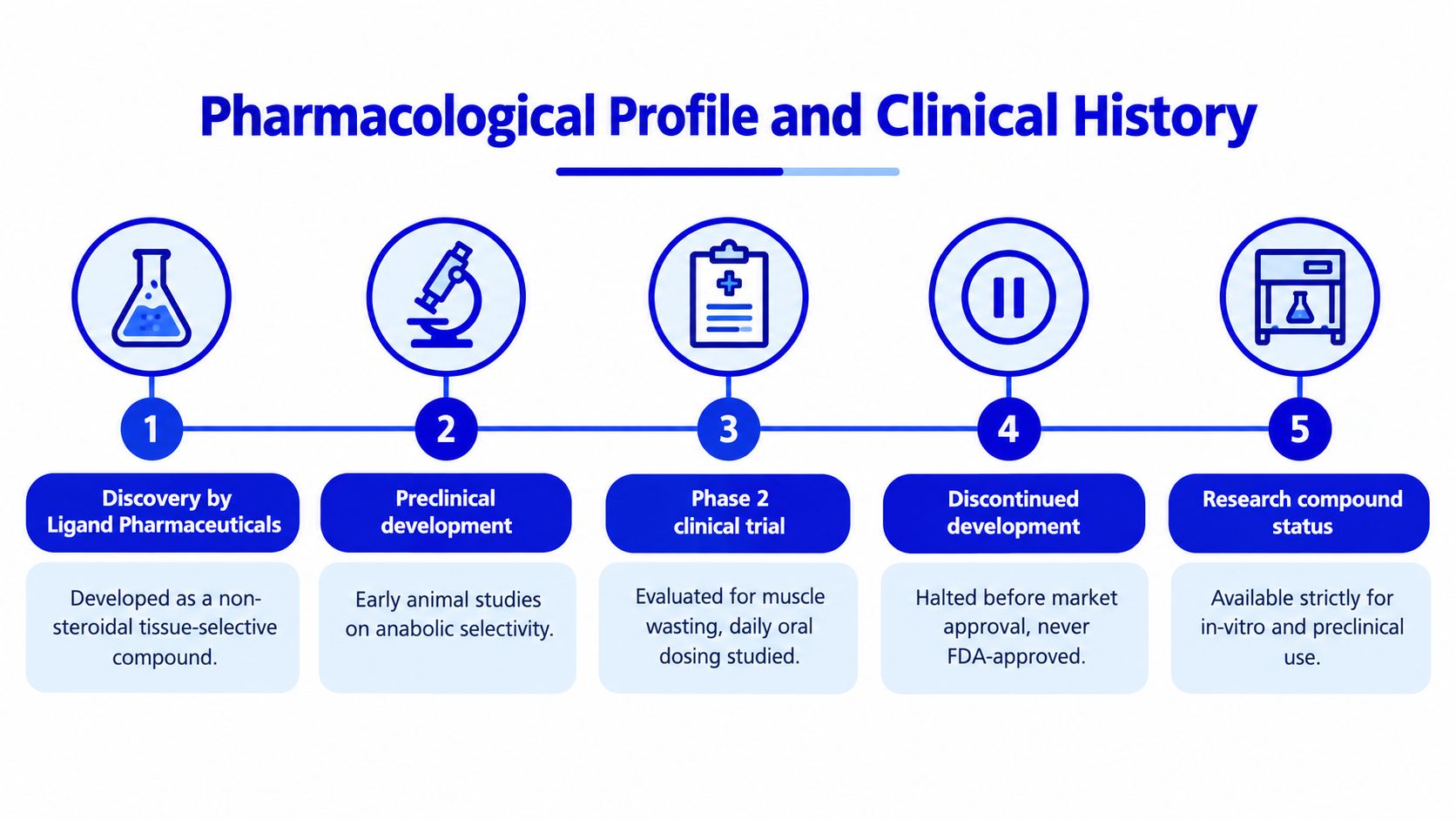
A later placebo-controlled study randomized 76 healthy men aged 21–50 to placebo or 0.1 mg, 0.3 mg, or 1.0 mg daily for 21 days. The design is useful to researchers because it demonstrates dose-dependent clinical evaluation in humans, but it doesn't establish an approved therapeutic use or justify translating clinical exposure directly into a laboratory protocol.
LGD-4033 has a prolonged elimination half-life of about 24–36 hours and showed linear, dose-proportional pharmacokinetics across 0.1–1.0 mg daily dosing over 21 days. Serum concentrations were nearly threefold higher on day 21 than day 1, indicating accumulation with repeated oral dosing. These findings are reported in the peer-reviewed study available through the National Library of Medicine.
The same study reported no clinically significant changes in liver enzymes, hematocrit, prostate-specific antigen, or electrocardiograms at the tested doses. A related multi-dose Phase I summary also reported dose-dependent increases in lean muscle mass and functional strength measures, while reporting no clinically significant dose-related adverse events and no meaningful changes in liver function tests, PSA, hematocrit, or ECG. Those observations describe the tested clinical setting, not a general safety guarantee.
For cell or tissue work, the pharmacokinetic profile supports careful attention to exposure duration, accumulation, sampling intervals, and compound identity. Researchers should define whether the study models a short exposure, repeated exposure, receptor activity, downstream transcription, or analytical detection. The clinical history can inform assay planning, but it cannot substitute for a validated concentration range or an institutional toxicology review.
Secondary development summaries report that VK5211, a later development name for LGD-4033, progressed into Phase 2 trials for muscle atrophy and hip fracture, with Phase 2 development reported as ongoing as of 2023, according to the regulatory and anti-doping context summarized by USADA's SARM resource. The compound remains investigational, not an approved medicine.
LGD-4033 isn't an FDA-approved medicine, and there is no FDA-approved medical use for it in humans. USADA states that no FDA-approved SARMs are currently available for prescription. A product sold as a “supplement” doesn't escape that boundary merely because the label uses nutrition language.
USADA also states that a dietary supplement claiming to contain LGD-4033 would be considered an unapproved new drug. That distinction matters for purchasing departments because a research-use-only label doesn't authorize human administration, clinical treatment, or consumer performance claims.
Use a written review process rather than relying on the supplier's wording:
The FDA reiterated in warning letters issued in late 2025 that SARMs may increase the risk of heart attack and stroke. That public-health warning reinforces why a laboratory must not convert research procurement into informal human-use distribution.
LGD-4033 is listed by the World Anti-Doping Agency Prohibited List as a selective androgen receptor modulator. USADA states that all SARMs are prohibited at all times for athletes, both in and out of competition. A 2021 peer-reviewed analysis reported 62 adverse analytical findings in 2019, demonstrating that ligandrol is a practical testing concern rather than a theoretical one, as reflected in the WADA reference document.
Sports-science laboratories should separate research custody from athlete access. Document who receives the material, where it's stored, which methods are used, and how waste is disposed of. Chain-of-custody records and analytical verification protect the lab, but they don't make human use permissible.
A COA is useful only when it belongs to the material in your hands. A generic PDF with no lot number, no testing laboratory, and no method isn't meaningful batch evidence. For LGD-4033, the central question is not simply whether a document displays a high purity figure. It's whether the record supports identity, composition, traceability, and fitness for the stated experiment.
| Document Type | Primary Purpose | Acceptable Threshold |
|---|---|---|
| Identity test | Confirms that the material matches LGD-4033 rather than a substitute or analog | A result consistent with the stated compound, using a method appropriate to the laboratory's risk assessment |
| Assay or purity report | Estimates the amount of target compound and records detected impurities | A result defined by the approved study specification, not a seller's unsupported headline |
| Residual-solvent report | Identifies solvent residues from manufacturing or processing | Within the laboratory's documented chemical specification |
| Heavy-metal screen | Checks for elemental contaminants | Within the laboratory's documented safety specification |
| Microbial report | Assesses microbial contamination where the material or workflow requires it | Meets the project's written microbiological acceptance criteria |
| Endotoxin report | Assesses endotoxin burden for sensitive biological workflows | Meets the assay-specific acceptance criteria established before receipt |
| Stability or retest record | Indicates whether the material remains suitable over the stated storage period | Current and linked to the lot, with storage conditions recorded |
The table intentionally avoids a universal numeric threshold. A purity result that looks acceptable for one analytical application may be inadequate for a sensitive cellular assay, and microbial or endotoxin requirements depend on the workflow. Your lab should approve specifications before reviewing supplier results.
Ask whether the testing laboratory is identified and whether the method is named. HPLC can support assay and related-substance evaluation, while mass spectrometry can help confirm molecular identity. One technique rarely answers every question, especially when an analog has a similar chemical profile.
A 2026 PubMed paper reported further insights into LGD-4033 metabolism in human urine and proposed adding a new metabolite to doping-control methods to help distinguish genuine material from black-market analogs, as described in the PubMed record on LGD-4033 metabolism. The research has an important procurement implication. Authenticity may require more than a supplier's stated composition, particularly in fragmented markets where substitutes, degraded material, or undisclosed analogs can enter the chain.
Laboratory practice: Use the supplier COA as a screening document, then apply independent identity or purity testing when the study's conclusions depend on exact composition.
Red flags include repeated COAs for different lots, mismatched dates, missing signatures, unexplained test laboratories, inconsistent compound names, and labels that don't match the invoice. A reliable supplier should answer these questions without redirecting you to fitness testimonials.
Price comparisons rarely reveal the true cost of a research compound. A low-cost vial can become expensive when the lab must repeat an assay, investigate an unexpected chromatographic peak, or explain an undocumented import. The better approach is a qualification workflow that treats every purchase as part of the study record.
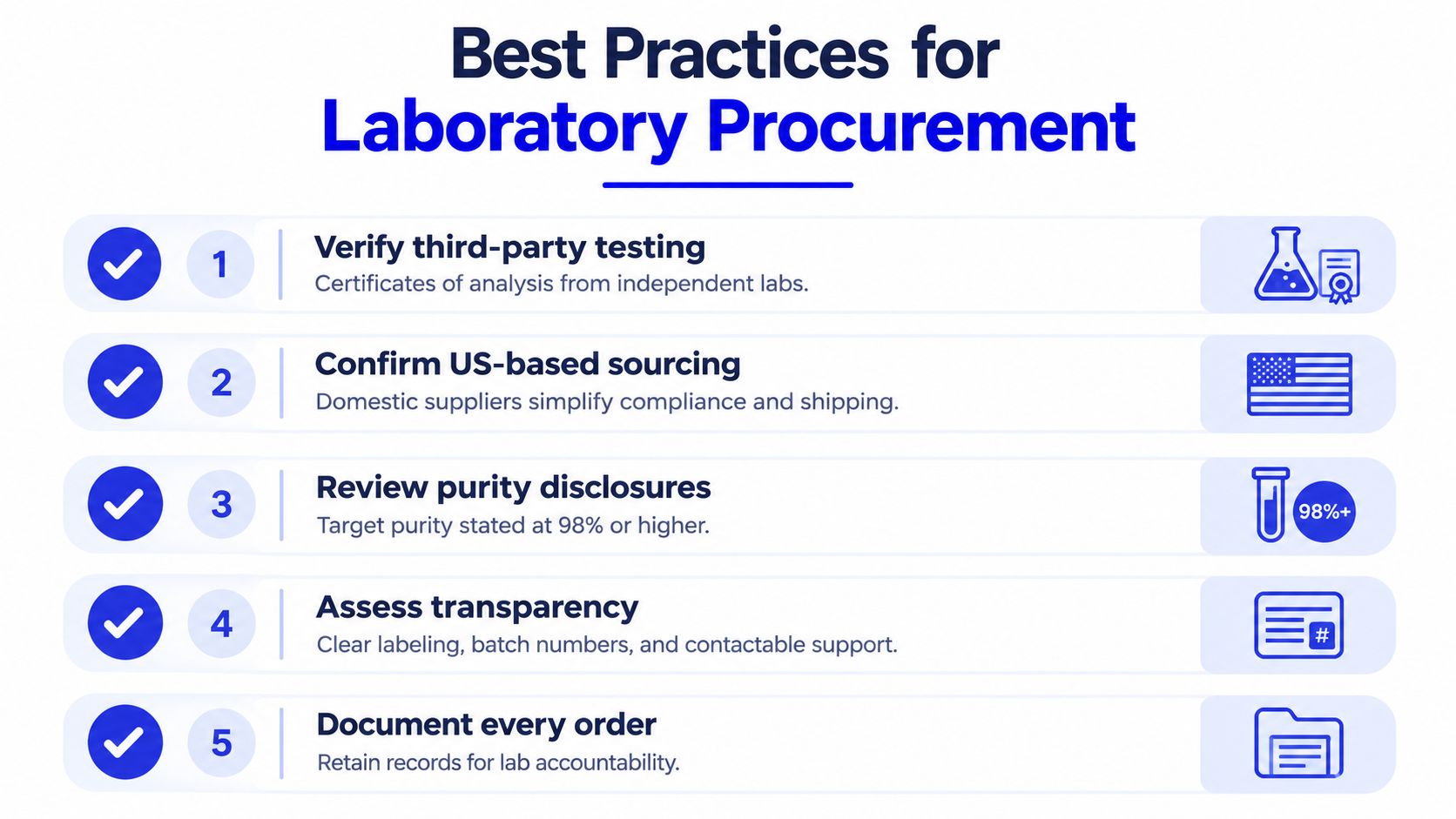
Verify third-party testing. Request a lot-specific COA and identify the laboratory that performed the work. Independent testing is more useful when the report includes methods, dates, signatures, and the exact lot number.
Confirm the legal supply model. A domestic supplier may simplify shipping and communication, but “US-based” isn't a substitute for documentation. Confirm the product is sold strictly for laboratory, analytical, or preclinical use.
Review purity disclosures carefully. A stated purity of 98% or higher may appear in procurement specifications, but it shouldn't be treated as proof of suitability without method details and impurity information. The infographic below includes that figure as a purchasing checkpoint, not as a universal acceptance rule.
Assess transparency. Look for clear labeling, batch numbers, storage instructions, responsive support, and a process for reporting damaged or mismatched shipments.
Document every order. Link the purchase order, lot, COA, receiving inspection, storage location, and experimental record. This creates accountability when multiple researchers handle the same material.
An overseas supplier may offer broader catalog access or lower listed prices, but the lab carries greater responsibility for customs, transit conditions, payment disputes, documentation gaps, and communication delays. Domestic sourcing can reduce some of those frictions, especially when the vendor maintains a US support channel and clear shipping policy.
Neither route removes the need for incoming inspection. Record the package condition, container seal, label, lot number, received quantity, and any temperature or transit concern. Quarantine the material if the shipment arrives damaged or if the identity information doesn't match the order.
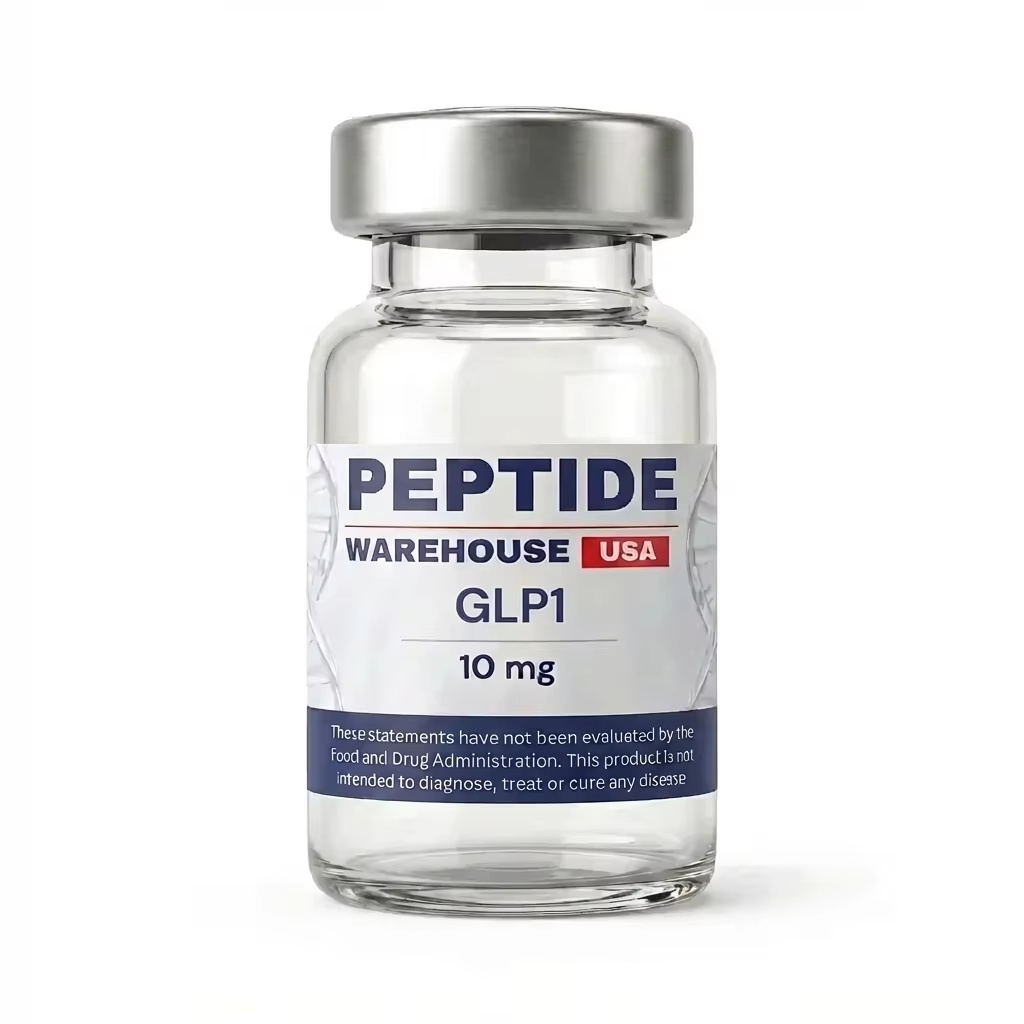
A supplier such as Peptide Warehouse USA presents a US-based research-chemical purchasing model with batch documentation, COAs, microbial and endotoxin reports, stated purity information, order tracking, and support resources. Those features can fit a laboratory workflow, but the receiving lab should still review each lot against its own specifications and intended use.
The video below provides an additional visual procurement reference.
Storage begins with the manufacturer's instructions and your institution's chemical-safety procedures. Don't invent a temperature range from a generic peptide protocol, and don't assume that a lyophilized powder and a prepared solution have identical stability. The label, COA, safety documentation, and validated laboratory SOP should control the decision.
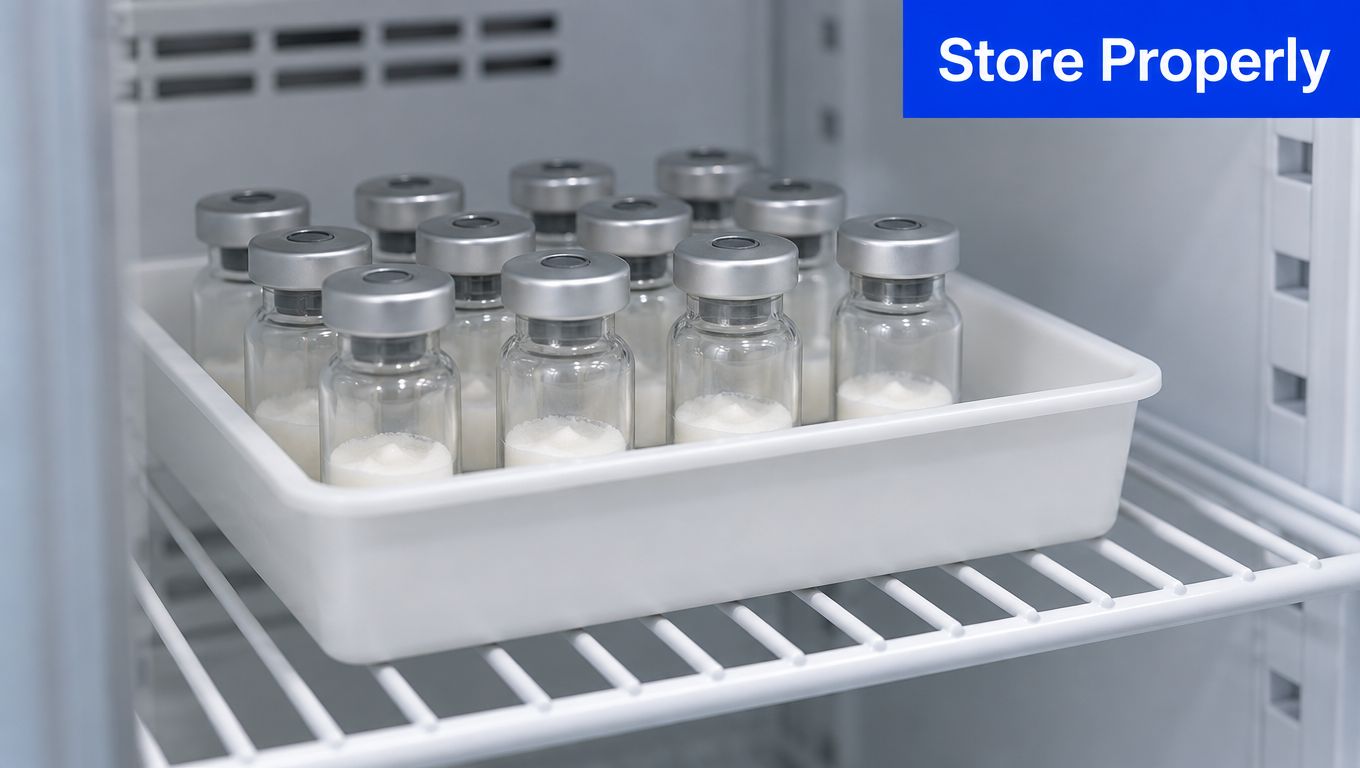
Use a designated, access-controlled storage location with clear segregation from food, medicines, and materials intended for human use. Keep containers closed, labeled, and protected from unnecessary light, moisture, heat, and repeated handling. If refrigeration is specified, use monitored laboratory equipment rather than an uncontrolled domestic refrigerator.
A practical storage SOP should define:
LGD-4033 must not be presented as a supplement, treatment, or product for human consumption. A research-use-only disclaimer isn't decorative website language. It defines the permitted commercial context and should appear consistently on purchasing records, labels, internal inventory systems, and study documentation.
Personnel should use the controls required by the institution's risk assessment, including appropriate personal protective equipment, containment, spill response, and exposure reporting. Researchers who are unsure how to classify or handle the material should consult their chemical-safety officer before opening the container.
A defensible LGD-4033 procurement decision rests on three linked controls. First, the researcher understands the compound's investigational history and pharmacokinetic behavior. Second, the institution confirms that the intended use and purchasing route fit applicable regulations. Third, the laboratory verifies each received lot with documentation and, where necessary, independent analysis.
A simple decision matrix helps reject attractive but weak offers:
Final procurement test: If your lab couldn't explain where the vial came from, what was tested, and who authorized its use, the supply chain isn't ready for regulated research.
Domestic manufacturing can simplify communication and shipping, but the decisive advantage is transparent, lot-specific evidence. Unverified discount listings, consumer claims, and generic purity graphics don't compensate for missing identity data. For a new researcher, the safest purchasing habit is to select the supplier whose records can survive technical and compliance review, then verify the material as part of the laboratory's own quality system.
Peptide Warehouse USA offers US-manufactured research peptides and related compounds for laboratory, analytical, and preclinical applications, with lot documentation that includes COAs and microbial and endotoxin reports. Review the research-use-only catalog and procurement resources at Peptide Warehouse USA to evaluate whether its documented supply model fits your laboratory's qualification process.
Leave a comment