
No products in the cart.



You're holding a peptide vial in one hand and a Certificate of Analysis in the other. The document says “high purity,” but you still need to know whether the lot is the correct compound, whether its purity suits your assay, and whether contaminants could interfere with your results. That's where peptide COA testing becomes a procurement decision rather than a paperwork exercise.
A useful COA answers four separate questions: identity, confirmed by mass spectrometry; purity, assessed by HPLC; safety-related contamination, reviewed through endotoxin and microbial testing; and documentation credibility, established through traceable methods, acceptance criteria, dates, and laboratory identification. A high HPLC percentage alone cannot answer all four.
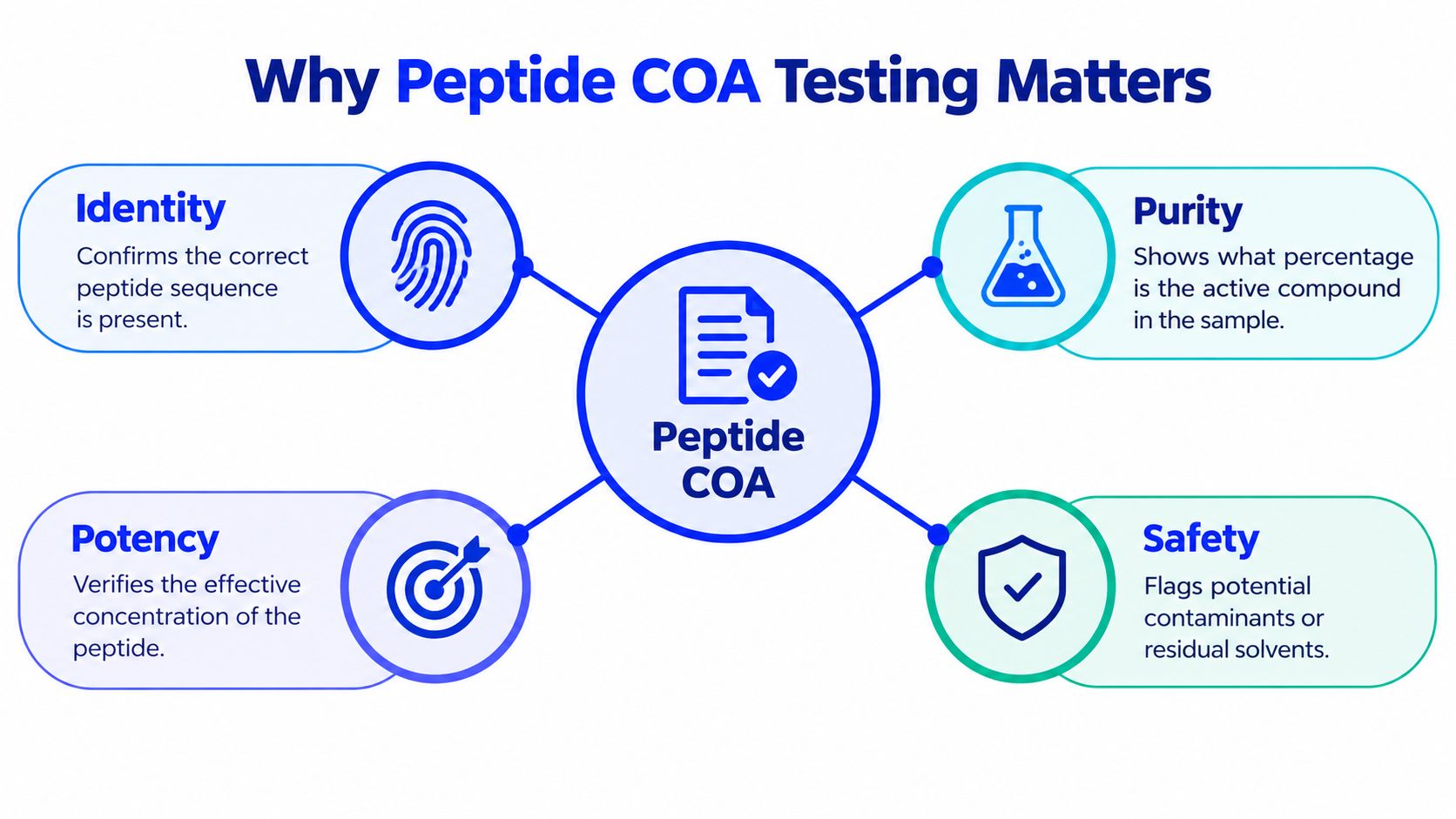
A researcher may see a purity result and assume the lot is ready for use. That shortcut can create problems because each test answers a different question. HPLC can show that the sample contains a dominant chemical species, but it doesn't independently prove that species is the peptide ordered. Mass spectrometry can support identity, but it doesn't establish how much of the sample is that peptide.
The first question is simple: is this the correct molecule? Mass spectrometry compares the observed molecular mass with the theoretical mass associated with the claimed peptide sequence. Without that comparison, a purity percentage remains incomplete evidence.
The second question is whether the material is pure enough for the planned application. A quantitative assay may need a stricter purity target than an early-stage screening experiment. The appropriate threshold depends on how sensitive the work is to impurities, concentration errors, or off-target effects.
Practical rule: Never release a peptide lot from its paperwork alone. Match the document to the vial, then match each test to the assay.
The third question concerns biological contaminants. Endotoxin and microbial data address risks that HPLC and mass spectrometry don't measure. These results matter particularly when a material will be used in cell-based or animal research, where contamination can confound observations.
Finally, ask whether the COA is credible enough to support procurement. A reliable document identifies the lot, test date, methods, laboratory, results, and acceptance criteria. The rest of this guide treats the COA as a four-part decision record, not as a marketing summary.
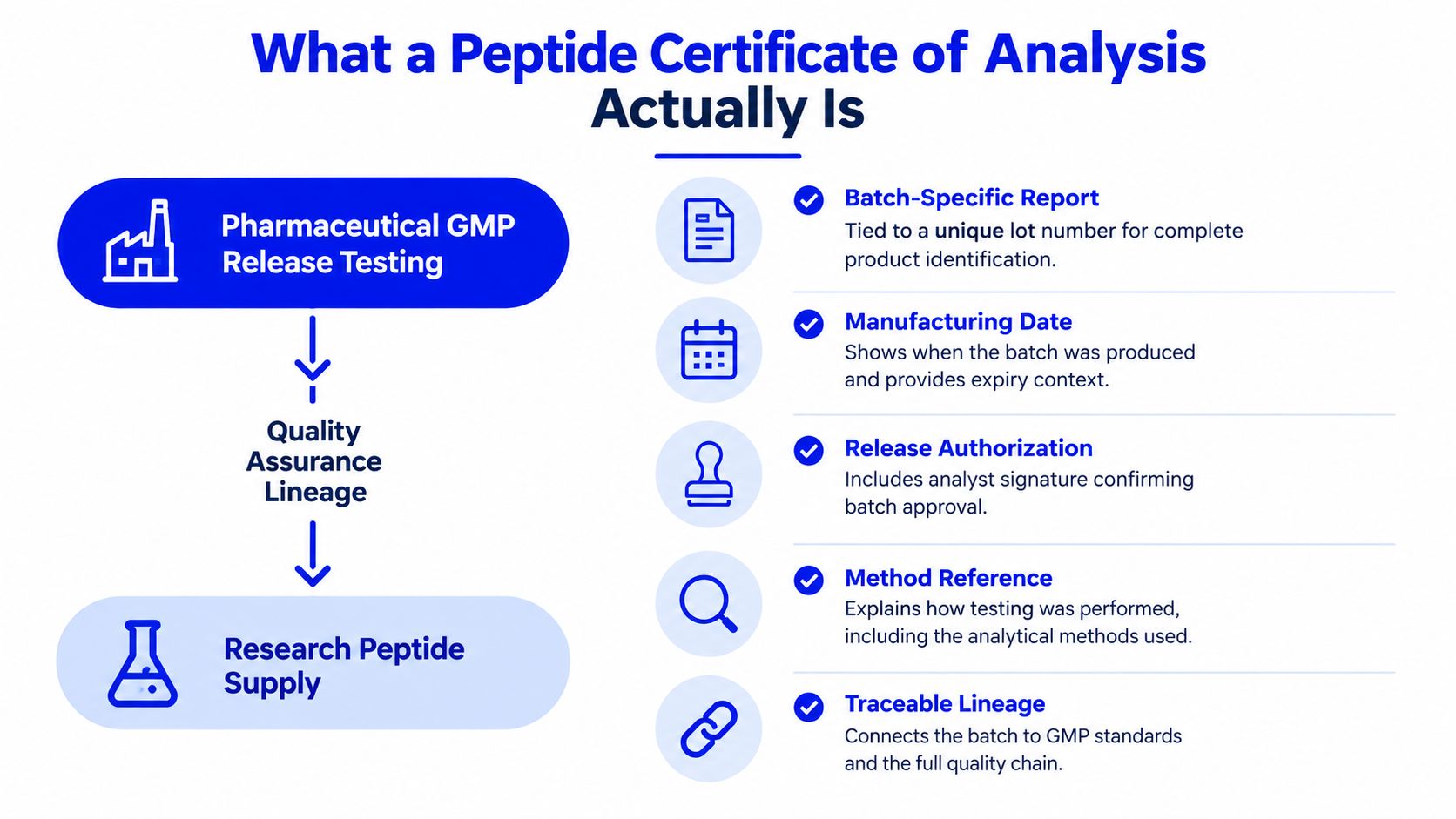
A Certificate of Analysis, or COA, is a batch-specific quality document. It records analytical results for one production lot, so it isn't a blanket guarantee for other batches. Independent guidance on how to read a peptide COA emphasizes that earlier lots may reveal useful trends, but they don't predict the quality of a future lot.
The document's pharmaceutical lineage matters. COA practices developed from GMP-style manufacturing documentation and were later adopted across research-peptide supply chains, where traceability supports reproducibility and purchasing decisions. A buyer should therefore treat the COA as a controlled record tied to a defined sample, not as a general product datasheet.
Before reviewing analytical results, check the document header. A credible peptide COA should identify:
The four central analytical pillars are HPLC purity, mass spectrometry identity, endotoxin testing, and microbial testing. Other fields, including net peptide content, water content, counterion information, and residual solvents, can become important when the research requires accurate concentration calculations or tighter material control.
A peptide COA reports HPLC purity to show how much of the detected peptide-related material appears in the main peak. Reversed-phase HPLC separates the target peptide from related substances, including truncated sequences, deletion products, and synthesis residues, then records the separation as a chromatogram. The stated percentage usually compares the integrated area of the main peak with the total integrated area of peptide-related peaks at the listed detection wavelength.
That number answers one procurement question: how much of the measured material appears in the target peak? It does not independently confirm that the peak has the ordered sequence. Mass spectrometry provides the separate identity check, so buyers should review both results rather than treat a high purity percentage as a complete quality assessment.
The peptide quality verification guide describes the following benchmark tiers, with the appropriate level depending on the assay:
| Purity Tier | Typical Research Use | Risk of Lower Material |
|---|---|---|
| 99% or higher | Highly sensitive, quantitative, or identity-critical work | Lower tolerance for related impurities that could affect interpretation |
| 98% or higher | Many quantitative biological assays and in vivo-oriented workflows | Material below this level may introduce greater impurity-related uncertainty |
| 95% or higher | Basic research where the assay can tolerate more variation | Material below this floor is commonly treated as substandard for research |
The guide identifies 99% or higher HPLC purity as a common research-grade benchmark. It also describes material below 98% as potentially substandard and material below 95% as concerning. These thresholds support purchasing decisions, but they are not universal acceptance rules. A screening assay may tolerate more related material than a quantitative or identity-sensitive workflow.
Request the chromatogram or peak table instead of accepting the percentage alone. The trace can show the main peak, secondary peaks, retention behavior, and how peaks were integrated. Ask for the method code, detection wavelength, column reference, and relevant run information. Without those details, the reported number is difficult to evaluate or compare across suppliers.
A high HPLC result establishes a purity finding. It does not replace identity, endotoxin, or microbial data when the research use requires those controls.
A peptide can pass an HPLC purity check and still be the wrong molecular species. Mass spectrometry addresses that separate procurement question: does the dominant species have the expected molecular mass? Read the COA for the theoretical mass, observed mass, and method details showing how the result was obtained. Depending on the laboratory, the report may include ESI or MALDI ionization, a spectrum, or a charge-state table.
For routine instruments, an observed mass within ±1 Da of the theoretical value is a commonly used acceptance window. High-resolution instruments may apply the tighter ±0.5 Da window.
| Instrument Class | Typical Tolerance | When Used on COAs |
|---|---|---|
| Standard mass spectrometry | Within ±1 Da of theoretical mass | Routine identity confirmation |
| High-resolution mass spectrometry | Within ±0.5 Da of theoretical mass | More demanding identity checks and analytical workflows |
The comparison between observed and theoretical mass supports identity, not purity. A sample may show the expected mass while also containing related substances that HPLC would detect. The reverse can happen too. A strong HPLC peak does not prove that the peak belongs to the ordered sequence.
Identity and purity are separate release decisions. A COA that reports only “99% purity” without an observed mass value leaves the identity question unanswered.
Check for the raw or summarized spectrum, the theoretical mass calculation, the observed value, and the instrument or method reference. Review the charge state before comparing values, since the reported ion may represent a charged form of the peptide rather than its neutral molecular mass. If the COA lists only a theoretical mass, it has documented an expectation, not laboratory confirmation that the expected molecular species was observed.
Review the COA in a fixed order. Start with the header, then move through analytical results, handling information, and release authorization. This prevents a prominent purity figure from distracting you from missing traceability details.
The header should connect the material to its production record. Check the peptide name or sequence, lot number, batch information, manufacturing date, analysis date, and testing laboratory identifier. The lot number on the vial must match the lot number on the certificate exactly, including formatting where possible.
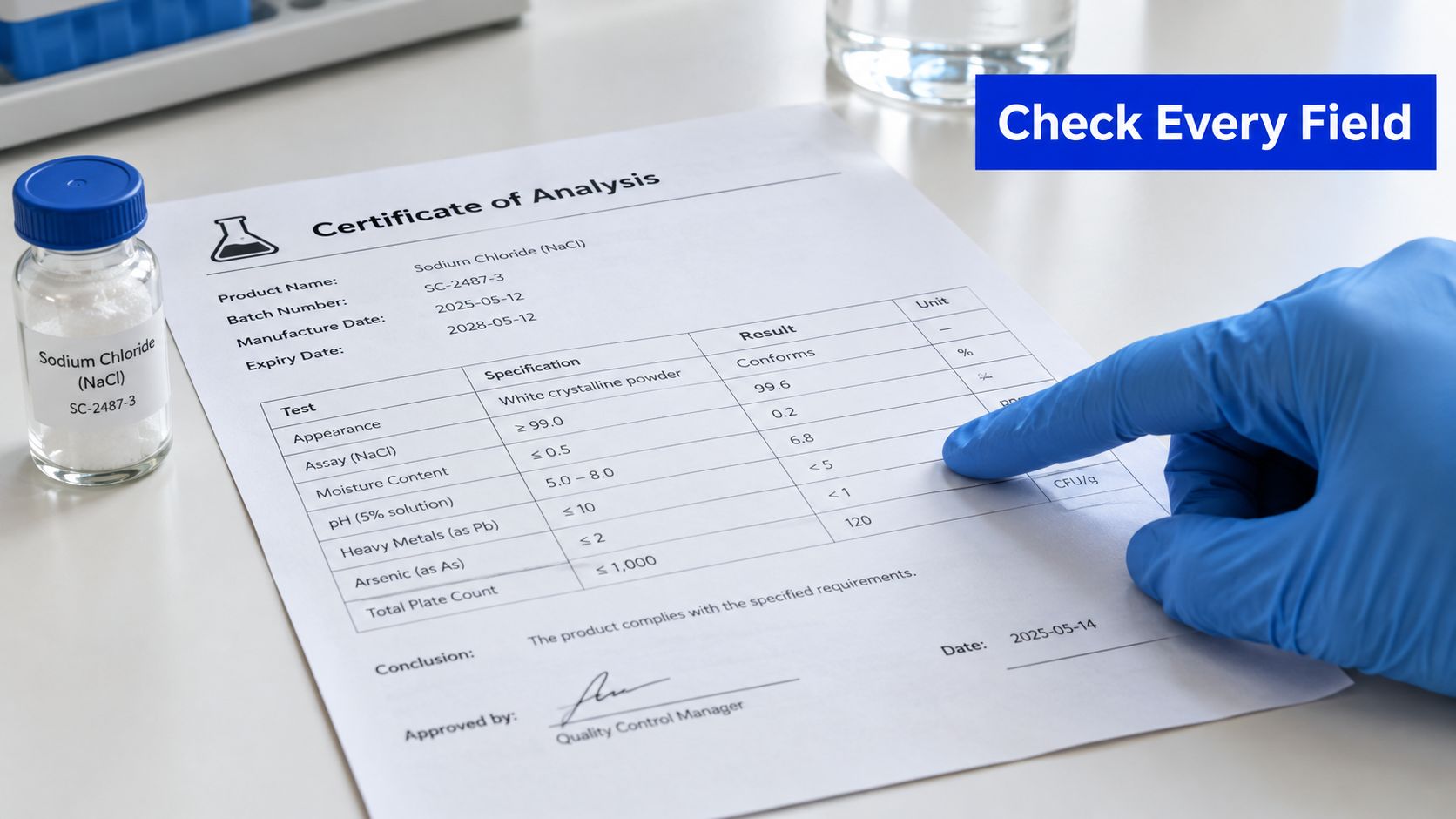
Then inspect the results block:
A strong COA gives each test a method, result, acceptance criterion, and pass or fail status. It should also state reconstitution guidance, retest or expiry context, and the analyst's signature or digital approval. The WHO Annex 10 guidance on certificates of analysis provides useful context for why test procedures, acceptance criteria, and numerical results belong together.
The video below provides another visual reference for interpreting certificate fields.
HPLC and mass spectrometry examine chemical composition and molecular identity. They don't answer whether the sample contains biological contamination that could interfere with cell culture or animal research. Endotoxin and microbial tests fill that gap.
Endotoxin testing commonly uses the Limulus Amebocyte Lysate, or LAL, method, referenced in USP <85>. Results are reported in Endotoxin Units per milligram, or EU/mg. Research guidance often uses below 5 EU/mg as a general benchmark, with tighter limits such as below 1 EU/mg or below 0.1 EU/mg for more sensitive workflows, as outlined in research standards for peptide endotoxin testing.
| Limit Tier | Endotoxin Threshold | Typical Use Case | Governing Method |
|---|---|---|---|
| General research benchmark | Below 5 EU/mg | Routine research material where the assay has moderate tolerance | LAL under USP <85> |
| Sensitive research tier | Below 1 EU/mg | More sensitive cell-based or preclinical workflows | LAL under USP <85> |
| Highly sensitive tier | Below 0.1 EU/mg | Work involving strong sensitivity to pyrogenic contamination | LAL under USP <85> |
Microbial quality is often reported separately. TAMC, or total aerobic microbial count, and TYMC, or total yeast and mold count, are associated with USP <61>. Some COAs also include sterility or no-growth statements, depending on the intended workflow. The bacterial endotoxin management tips resource offers additional background on why endotoxin control deserves separate attention from chemical purity.
Treat “ND,” or “not detected,” cautiously when it appears without a numerical reporting limit or assay sensitivity statement. A buyer needs to know what the method could detect and how that result compares with the predefined acceptance criterion.
A COA becomes useful for release decisions only when every result is tied to a predefined acceptance criterion. The document should name the test procedure, state the limit, print the observed result, and show a pass or fail decision for that specific lot.
A GMP-style review often looks for three elements:
| Element | Example Value | Why It Matters |
|---|---|---|
| Named procedure | HPLC method code, USP <85>, or USP <61> | Shows how the test was performed |
| Predefined limit | Purity ≥95% or endotoxin <5 EU/mg | Establishes the release standard |
| Observed result and verdict | Numerical result beside Pass or Fail | Makes the decision traceable |
These principles align with the documentation logic associated with ICH Q7 and FDA 21 CFR Part 211. The purpose isn't to make every research purchase equivalent to a finished pharmaceutical product. It's to ensure that a reported result can be interpreted, compared with a limit, and connected to a defined batch.
A document that says “passes testing” without showing the method or numerical result is weak evidence. The same applies to a purity percentage without a chromatogram reference, or an endotoxin result without units and a reporting threshold.
For laboratories building or improving their quality system, a trusted QMS consultancy can provide broader context on controlled documentation, procedures, and release workflows. For an individual buyer, the practical standard remains clear: every test needs a method, a limit, a result, and an identifiable lot.
The laboratory behind a COA affects how much confidence a buyer can place in the document. An in-house report is produced using equipment and procedures controlled by the supplier. That doesn't make it useless, but the buyer has less independent evidence about the method, calibration, and review process.
A third-party report comes from an external laboratory. Independent guidance identifies ISO/IEC 17025 accreditation or another qualified laboratory status as a stronger basis for verification because the lab operates within an externally assessed quality framework.
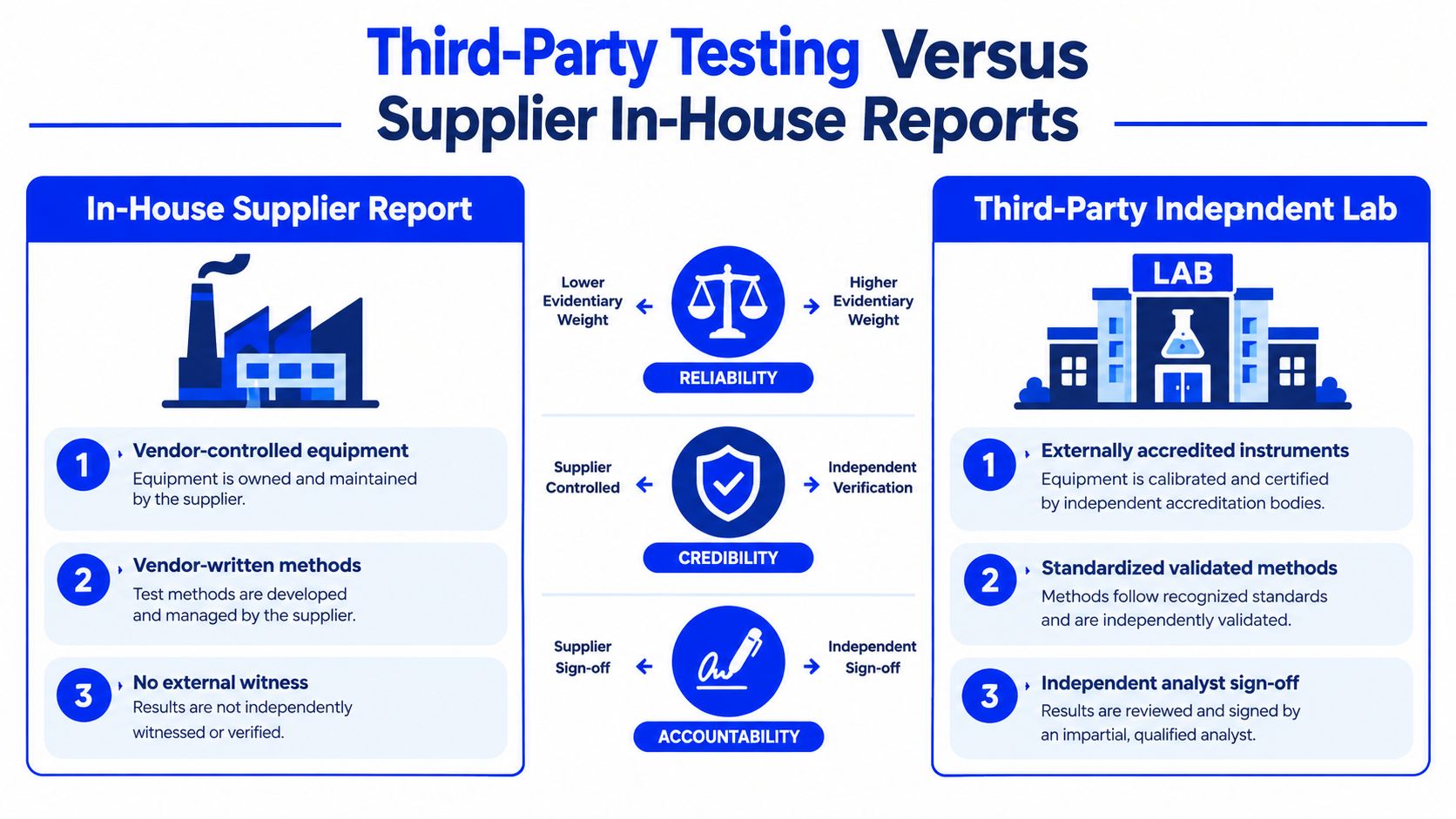
Use the distinction in proportion to the research risk:
The critical detail is transparency. “Third-party tested” should identify the external laboratory and the tests it performed. A certificate that doesn't name the lab leaves the buyer unable to assess its evidentiary weight.
A COA doesn't need identical test depth for every project. It needs the right evidence for the risks created by the intended assay.
| Research Use Case | Minimum COA Data to Request |
|---|---|
| Cell culture work | HPLC purity, mass spectrometry identity, and endotoxin data. A commonly used general research endotoxin benchmark is below 5 EU/mg. |
| In vivo rodent research | HPLC, mass spectrometry, microbial data, and a tighter endotoxin target such as below 1 EU/mg when the model requires it. |
| Quantitative bioassays | HPLC, observed-versus-theoretical mass, and net peptide content supported by amino acid analysis or another quantitative method. |
| Receptor-binding studies | Confirmatory mass spectrometry, high-quality HPLC evidence, and counterion or composition information when concentration or assay interference matters. |
| Analytical method development | Full chromatogram, mass spectrum, method details, lot traceability, and storage information so results can be reproduced. |
The peptide testing reference on purity, HPLC, and mass spectrometry describes a common framework in which 95% is a basic research floor, 98% or higher is preferred for quantitative biological and in vivo work, and 99% or higher suits more sensitive applications.
Ask one question before ordering: what failure could this test prevent? HPLC helps identify related chemical impurities. Mass spectrometry helps prevent identity mistakes. Endotoxin and microbial testing address biological contamination. Net peptide content protects concentration calculations.
Some COA problems are obvious, while others appear credible until you ask for the underlying evidence. A buyer should pause when the document contains any of these signs:
Check whether the test date makes sense for the delivery and whether the storage conditions are stated. A COA that can't be independently reconstructed by a qualified QC laboratory from the information shown should be treated as marketing material, not as complete analytical evidence.
A receiving lab can make COA review repeatable with a short workflow. Save each certificate in a peptide-specific folder named with the lot number and receipt date. Record the stated storage condition, retest or expiry information, and the date the vial entered the lab.
Before opening the vial, compare its label with the COA. Photograph the label, preserve the original PDF, and link that document to the assay notebook page where the lot was first used. Keep raw chromatograms and spectra when the supplier provides them, rather than retaining only a summary page.
A useful record should let another scientist answer four questions without contacting the supplier:
This habit turns a COA into part of the experiment's traceability record. It also makes comparisons across lots easier when an assay produces an unexpected result.
Does a COA cover future batches? No. A COA is tied to the tested lot. Each new production lot needs its own batch-specific document, even when the product name and sequence haven't changed.
How should buyers compare COAs from different suppliers? Normalize the units and terminology first. Compare purity percentages with purity percentages, mass values with the stated Da tolerance, and endotoxin results in EU/mg. Then check whether the suppliers reference comparable methods and provide equivalent raw evidence.
Is a supplier-issued COA valid? It can be valid documentation when it clearly identifies the lot, methods, results, laboratory, and approval. An independent ISO/IEC 17025 report generally carries more evidentiary weight for audits, disputes, or research records that require external verification.
Should buyers request a COA with every order? Yes. Retain the document for as long as the data it supports remain relevant, and request clarification if a vial is opened long after its original analysis date. The certificate doesn't replace proper storage or experimental controls, but it gives the lab a traceable starting point.
Peptide Warehouse USA provides batch-specific COAs and related testing documentation for research, laboratory, analytical, and preclinical procurement, including purity, microbial, and endotoxin information where available. Review the lot documentation and research-use terms, then visit Peptide Warehouse USA to explore options for your next order.
Leave a comment