
No products in the cart.



You've opened a lyophilized peptide vial, drawn up the diluent, and then watched the powder turn cloudy instead of clear. A small reconstitution error at that point can compromise an entire assay, distort concentration calculations, or leave you unsure whether the problem is the solvent, the technique, or the material itself. Choosing the right peptide reconstitution solution is not a routine dilution step. It's an analytical decision based on the molecule's charge, hydrophobicity, pH tolerance, and planned handling workflow.
This guide explains how to select a vehicle, compare bacteriostatic water with sterile alternatives, reconstitute gently, calculate concentration, and document storage decisions. The focus is laboratory and analytical research, not preparation for human or animal use.
A vial can look normal and still contain a peptide that will not behave predictably in your chosen vehicle. Sequence, hydrophobicity, charge, and pH tolerance determine whether the powder dissolves cleanly or forms haze, precipitate, or aggregates. Treat solvent selection as a decision about the molecule, not a default choice between water products.
Start with the product documentation and batch-specific certificate of analysis. Check purity, net peptide content where available, counterion information, recommended solvent, and stated pH or buffer compatibility. The mass on the vial may include counterions or residual water, so it may not equal the amount of target peptide used in concentration calculations.
Use this three-step decision process:
Sterile water, bacteriostatic water, and buffered aqueous systems are common starting vehicles. For some laboratory workflows, a mildly acidic range around pH 4.0 to 5.5 can support solubility, with acetate buffers around pH 4.5 to 5.0 often considered practical options. Confirm compatibility for the specific sequence rather than applying those ranges automatically. Reconstitution chemistry reference
Practical rule: Clarity confirms that the peptide dissolved. It does not confirm assay compatibility. Check the vehicle against the method before scaling up.
A peptide that dissolves cleanly in one vehicle can behave poorly in another. Choose the vehicle from the molecule outward: consider sequence, charge, preservative tolerance, and the requirements of the downstream assay. The right question is not which water is generally better, but which system gives your specific peptide a stable, measurable solution.
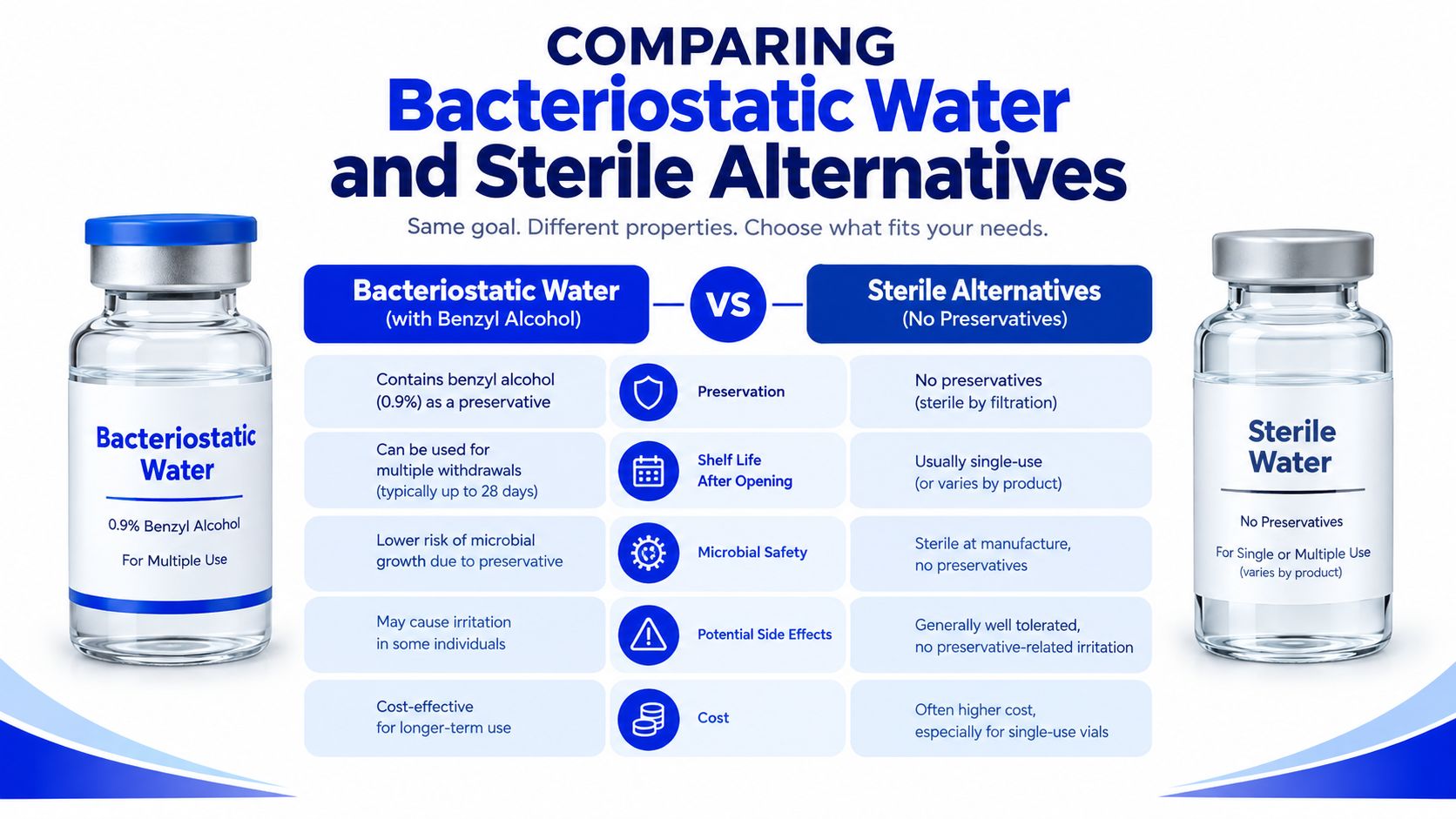
Bacteriostatic water includes a preservative and supports workflows that require repeated access. Sterile water for injection contains no antimicrobial preservative, making it a practical option for immediate, single-use preparation when the solution will not be stored or accessed repeatedly. The preservative may still affect peptide behavior or assay response, so confirm compatibility before using it as a default.
Distilled water is different from both. Low mineral content does not establish sterility, preservation, or suitability for a research sample. Evaluate the documented properties of the vehicle, not its appearance.
| Vehicle | Preservative | Typical pH range | Best use case |
|---|---|---|---|
| Bacteriostatic water | Benzyl alcohol | Near-neutral to mildly acidic | Repeated-access research workflows |
| Sterile water for injection | None | Product and batch dependent | Immediate or single-use reconstitution |
| Buffered aqueous system | Depends on formulation | Defined by the buffer | Assays requiring controlled pH and ionic conditions |
Bacteriostatic water offers a convenient workflow when several withdrawals are planned, but the preservative can be unsuitable for a sensitive sequence or analytical method. Sterile water removes that preservative variable, though it provides less protection once the container is accessed. A defined buffer may be the better choice when peptide charge, solubility, or assay conditions require controlled ionic strength.
Use the sequence and method to choose between these options. A charged peptide may respond differently from a hydrophobic one, even at the same nominal concentration. Your laboratory's approved reconstitution comparison chart can help organize the decision, while product documentation and the assay protocol determine the final choice.
The video below demonstrates the general context of sterile vial preparation.
A fast jet aimed at the lyophilized cake can create foam, drive peptide onto the stopper, and leave material stuck to the vial wall. The handling decision starts before the syringe enters the vial: sequence, charge, hydrophobicity, and the selected solvent determine how gently the material must be treated.
Allow the peptide vial and diluent to reach room temperature. Cold components can behave inconsistently, and opening a chilled vial may cause condensation. Do not apply direct heat or use a hot solvent to force dissolution.
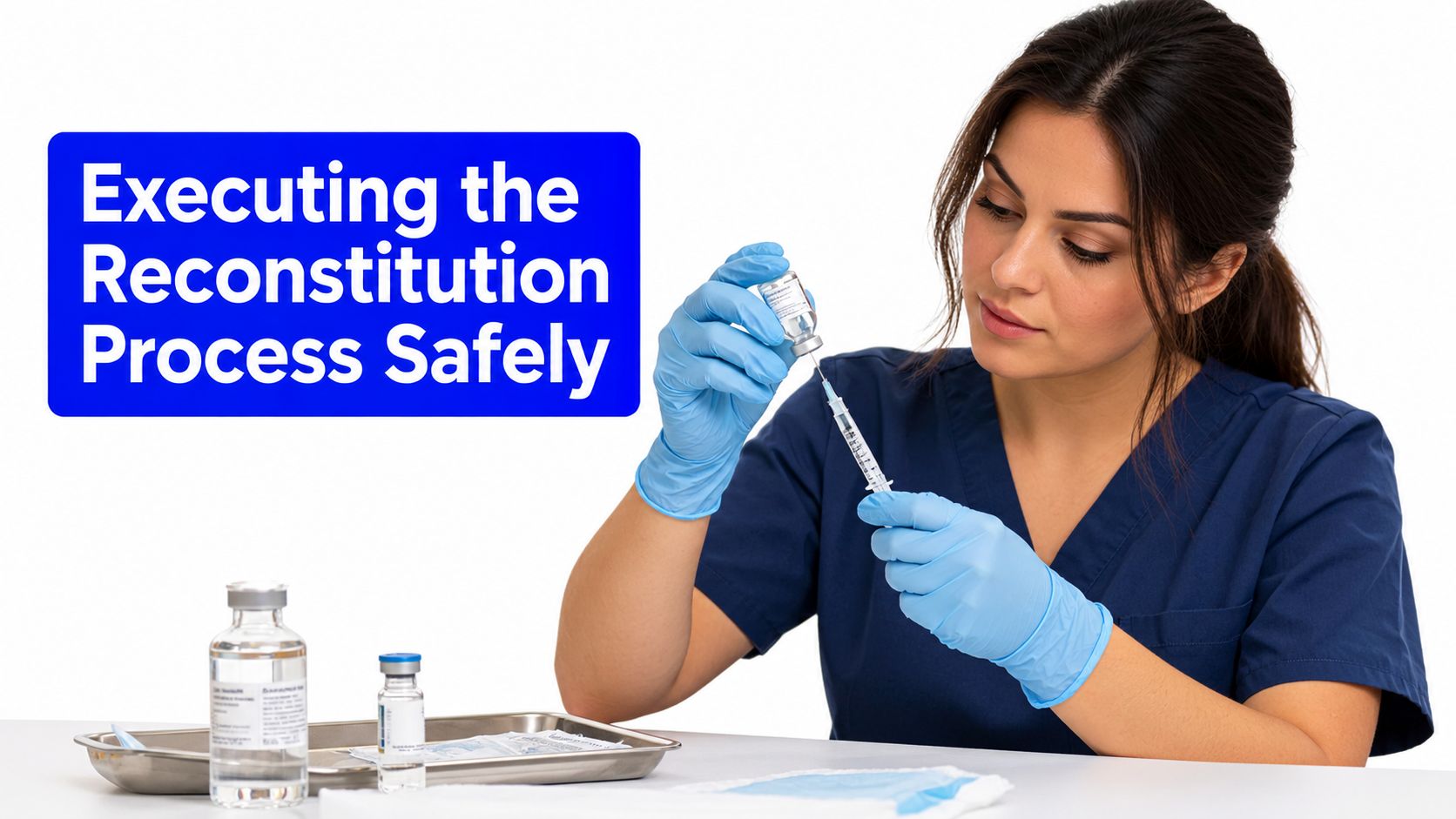
Before drawing liquid, clear and disinfect the work area, confirm the vial identity, review the chosen vehicle, and record the intended final volume. Clean both stoppers with an appropriate alcohol swab, then let them dry fully. A touch to a disinfected stopper or a contaminated syringe path can compromise the sample.
Calculate the required volume from the peptide mass and target concentration. Draw it with a suitable sterile syringe and verify the marking carefully. A small volume error changes the stock concentration, which can affect every later dilution.
Inject slowly against the inner glass wall, allowing the solvent to run down beside the cake rather than striking it directly. Let the powder wet passively before using gentle swirling, if needed. Avoid vigorous shaking and vortexing, particularly when the sequence is aggregation-prone or the solvent was selected for limited solubility.
Inspect the preparation under appropriate lighting. Check for clarity, visible particles, persistent foam, and undissolved material. Cloudiness is a reason to pause and review solvent compatibility, concentration, and handling rather than increasing agitation.
Bench observation: Failures often start with a vehicle that does not suit the peptide, a direct solvent jet, or excessive mixing. Correct the solvent decision and technique before applying more force.
Technical guidance recommends a controlled approach: test a small amount where appropriate, use the simplest effective solvent, prepare a homogeneous stock, dilute into the final system, monitor for precipitation, and store the preparation consistently. Detailed reconstitution protocol guidance from Alan Scientific supports this general handling sequence.
Once dissolved, label the vial with the peptide identity, solvent, reconstitution date, calculated concentration, operator initials, and storage condition. That record makes the preparation traceable and helps separate a formulation problem from a handling error.
A clear vial can still produce bad assay data. If the peptide mass, molecular weight, solvent volume, or net content is wrong, every downstream dilution inherits that error. Treat reconstitution as a calculation and compatibility problem, not just a choice between sterile and bacteriostatic water.
The sequence still determines the starting solvent. Hydrophobic residues, charge distribution, the counterion, and the final assay buffer affect whether the material dissolves completely or forms a suspension. Use the product documentation and a small-scale compatibility check where appropriate. A vehicle that works for one peptide may produce precipitation or adsorption with another.
Acidic or basic conditions can change solubility by altering the peptide's net charge. Choose a buffer that supports the specific molecule and remains compatible with the downstream assay. Acetate, dilute acetic acid, or another approved system may help some poorly soluble preparations, while salts can reduce solubility for particular sequences. Oxidation-sensitive material also requires limited exposure and adherence to its documented stability requirements.
These are screening options, not universal recipes. Check the peptide's sequence, charge, counterion, and assay conditions before committing the full vial to a vehicle. A solution that becomes cloudy after dilution may be incompatible with the final buffer even if the initial stock looked clear.
For mass concentration:
Concentration in mg/mL = peptide mass in mg ÷ solvent volume in mL
For molar concentration:
Molarity in mol/L = [mass in g ÷ molecular weight in g/mol] ÷ volume in L
For example, dissolving 5 mg of peptide in 2 mL gives 2.5 mg/mL. If the molecular weight is 3000 Da, the nominal molarity is approximately 0.83 mM.
Use the COA when the material includes a stated net-peptide-content value. A vial labeled 5 mg may include counterion or residual water, so applying the COA correction can produce a lower actual peptide mass. If the COA reports 80% net peptide content, the calculation uses 4 mg rather than the full labeled mass, giving 2 mg/mL in 2 mL.
The added solvent volume may not equal the final solution volume, especially in concentrated stocks. Record the measured volume and retain the calculation with the sample record.
Analytical checkpoint: A clear solution with uncertain concentration is not ready for quantitative assay.
Peptide reconstitution chemistry data
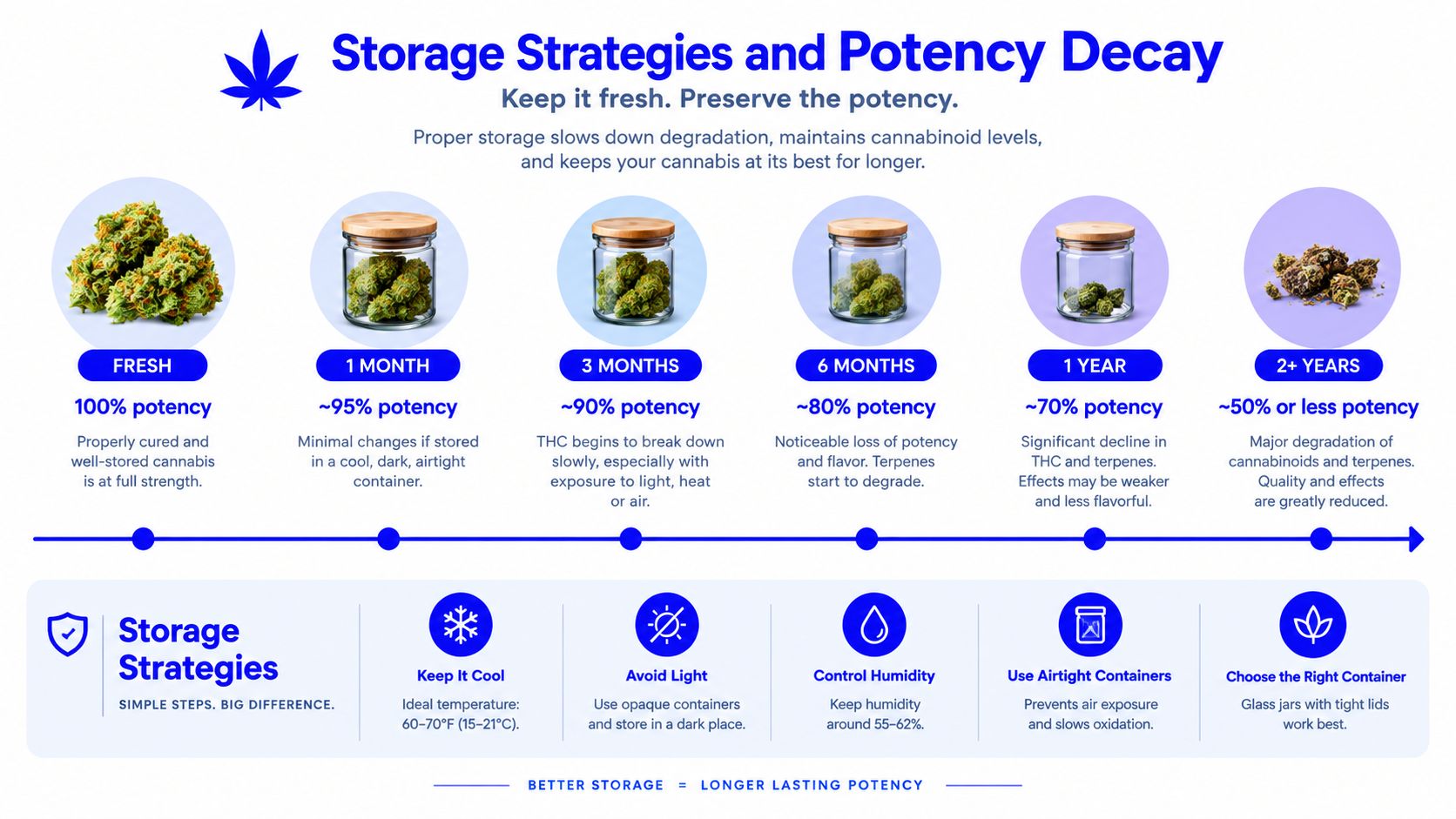
A vial that was stable as a dry cake can become unstable within hours of reconstitution. The liquid form is exposed to temperature, light, repeated access, microbial contamination, oxidation, and aggregation. Storage therefore depends on the peptide's sequence, charge, concentration, solvent, and assay requirements, not on a universal holding rule.
Bacteriostatic water is often chosen for multi-use workflows because its 0.9% benzyl alcohol preservative helps inhibit bacterial growth. Sterile water has no comparable preservative protection, so use it for immediate handling only when that approach matches the laboratory's approved procedure. The vehicle decision should follow the molecule and intended workflow, rather than defaulting to the same diluent for every peptide.
A technical summary reports that reconstituted peptides stored in bacteriostatic water retained 94% potency at 28 days, compared with 71% potency for sterile saline, a non-preserved aqueous vehicle analogous to sterile water for injection in this context, over the same period. Potency comparison for bacteriostatic water and sterile saline
That comparison supports bacteriostatic water as a practical short-term refrigerated vehicle under the tested conditions. It does not establish a universal expiration date. Sequence, concentration, buffer, container, assay method, microbial controls, and vial-entry frequency can all alter the usable holding period.
Store the preparation at 2 to 8 °C when that range matches the product documentation and approved research protocol. Limit light exposure and avoid repeated temperature cycling. If longer holding is necessary, aliquoting can reduce withdrawals from the primary vial and limit repeated freeze-thaw exposure.
A defensible discard policy records:
A clear solution may have lost potency. Cloudiness may reflect incomplete dissolution, precipitation, or degradation. Appearance is an inspection point, not validated stability data.
A peptide can look cloudy after gentle mixing, foam after forceful handling, or precipitate only after dilution. Treat each symptom as a troubleshooting decision, beginning with the molecule's sequence, charge, and solvent compatibility rather than changing several variables at once.
Record the failed vehicle, concentration, pH, mixing method, and visible changes. Repeat a small-scale test with a solvent matched to the peptide's chemistry, then confirm compatibility with the intended assay.
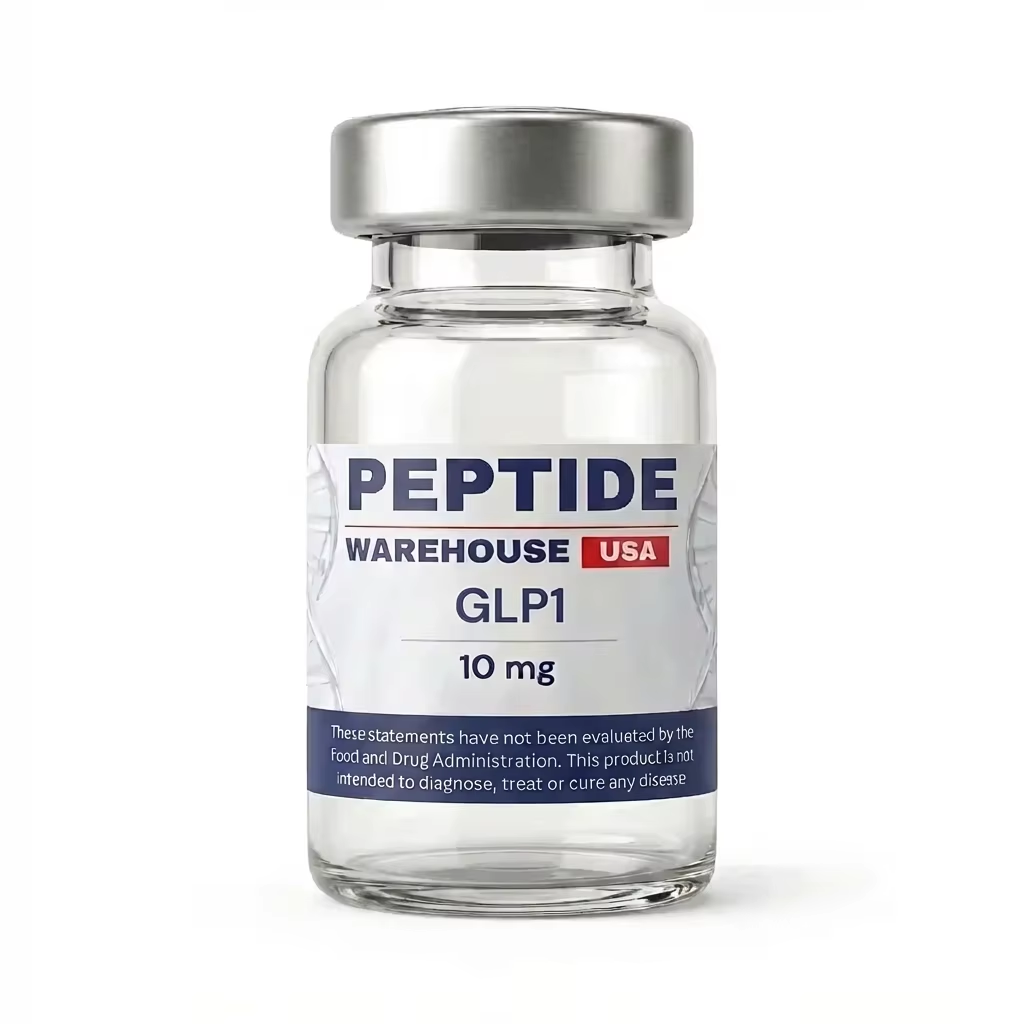
Peptide Warehouse USA offers research peptides and reconstitution solution for laboratory workflows, with product documentation and batch records available for procurement review.
Leave a comment