
No products in the cart.



GHK-Cu often appears in a product description or research discussion as if it were a simple formula: a peptide plus copper, followed by a list of impressive biological effects. A closer look reveals a more useful and more complicated story. The compound's behavior depends on how copper binds to the peptide, how the formulation is controlled, and whether the material that reaches a cell is still the intact complex.
That distinction matters when a result looks convincing in a cell culture dish but becomes difficult to reproduce in another laboratory. This guide to peptide science GHK-Cu separates molecular structure from marketing language, explains what preclinical studies measured, and shows how researchers can evaluate formulation and batch data more critically.
A researcher may begin with a familiar result. One GHK-Cu treatment is associated with collagen-related changes in an experiment, while another laboratory reports a different gene-expression pattern or a weaker response. The easy explanation is assay noise or cell-line differences, but a more basic issue is whether the starting material was characterized well enough.
GHK-Cu is a copper(II)-binding tripeptide complex formed from glycyl-L-histidyl-L-lysine. In preclinical studies, it has been linked with extracellular matrix activity, wound-model responses, and changes in fibroblast behavior, yet most of that evidence comes from cell and animal work rather than approved human therapeutic studies. That separation matters, because a research signal is not the same as a validated human application.
The main question is not whether GHK-Cu has activity. Researchers need to ask which chemical species is present, at what concentration, under which formulation conditions, and for how long. Copper content, pH, peptide-to-copper stoichiometry, purity, and storage stability can each shift reproducibility, as described in the review of GHK-Cu coordination chemistry and biological activity.
That same framework helps advanced buyers read product documentation with more care. A label may list a nominal GHK-Cu concentration, but that number does not tell you the full exposure seen by cells or tissues.
The name GHK-Cu combines two components, but the complex isn't just a loose mixture. GHK is the tripeptide glycyl-L-histidyl-L-lysine, and copper(II) coordinates with specific nitrogen atoms within that peptide.
A useful analogy is a clamp. The peptide provides several contact points that help hold the copper ion in a defined coordination environment:
These contacts don't behave identically in every solution. The charge state of the peptide changes with pH, other molecules may compete for copper, and the ratio between peptide and copper can influence which species dominate. Researchers who assume that every vial labeled GHK-Cu contains one chemically identical form may therefore overlook a major source of variation.
Think of nominal concentration as the number written on a recipe, not a complete description of the finished dish. Two preparations can contain the same stated amount of GHK-Cu yet differ in pH, free copper, competing ligands, degradation products, or the proportion of intact complex.
That's why a serious analytical record should identify more than peptide mass. A practical characterization package should address:
This chemistry doesn't prove a clinical benefit. It explains why formulation controls are necessary before researchers interpret biological results or compare materials from different sources.
A fibroblast culture can respond to GHK-Cu through several connected pathways, so collagen alone is an incomplete readout. In human adult dermal fibroblast experiments, 0.01, 1, and 100 nM increased elastin and collagen production across a broad concentration-response range, according to the dermal fibroblast and wound-model review.
The gene-expression pattern was selective rather than uniform. All tested concentrations increased TIMP-1, while the lower concentrations increased expression of MMP-1 and MMP-2. At first, this may seem inconsistent with repair, because MMPs are often associated with matrix breakdown. Their activity can also support controlled turnover, however, while TIMPs help limit and regulate that activity.
A construction site provides a useful comparison. Damaged material must be cleared before new material can be placed and organized. MMPs can contribute to that clearing and turnover phase, while TIMPs act more like braking controls. A response affecting both groups may therefore indicate regulated matrix remodeling, not a simple command to produce more collagen.
Classical cell and wound-repair studies described approximately 1 to 10 nM as a low, non-toxic concentration range associated with stimulation of collagen and glycosaminoglycan synthesis. These studies also reported changes in matrix metalloproteinases and their inhibitors, including TIMP-1 and TIMP-2. The findings are mechanistic and preclinical, not an approved human therapeutic dose, as described in the GHK-Cu research review.
A useful laboratory panel should measure several endpoints rather than depend on one colorimetric assay:
The chemical form of the test material also matters. GHK-Cu is a coordination complex, so pH, competing molecules, and the balance between peptide and copper can affect the species present in solution. A nominal concentration may therefore describe the amount added without fully describing the biologically available complex. Researchers should record formulation conditions alongside cell responses before comparing results between experiments.
Wound models have also associated GHK-Cu with wound contraction, granulation tissue formation, antioxidant-enzyme activity, and blood-vessel growth. Reports of increased basic fibroblast growth factor and VEGF expression support further investigation, but they do not show that a larger amount will produce a proportionally larger or better response.
Practical rule: Treat concentration and formulation state as experimental variables that can change the observed mechanism, not merely the strength of one fixed effect.
The phrase “collagen booster” is easy to understand, but it leaves out much of the evidence. A more accurate description is matrix-remodeling regulator. GHK-Cu has been studied in systems where researchers measured both the accumulation of new extracellular-matrix material and the enzymes involved in replacing damaged material.
A 1993 rat wound-chamber study found that GHK-Cu increased dry weight, DNA, total protein, collagen, and glycosaminoglycan content in a concentration-dependent manner. Collagen synthesis increased approximately twice as much as noncollagen protein synthesis, while messenger RNA for type I and type III collagen also rose. Messenger RNA for transforming growth factor beta did not increase, which argues against describing the result as a nonspecific increase in every protein pathway. The findings are reported in the animal wound-chamber study of GHK-Cu.
Another rat subcutaneous wound-chamber model, summarized in a recent surgical review, used sequential injections of 2.0 mg GHK-Cu. By day 29, researchers reported increases compared with vehicle controls of:
The same report described statistically significant effects across doses from 0.5 to 2.0 mg, as detailed in the surgical review of GHK-Cu wound-chamber findings.
Those figures describe a localized animal model with an injected research protocol. They don't establish a standardized human-use dose, and they don't show that the same exposure would occur after a topical, oral, or nasal preparation.
The more useful lesson concerns measurement. Researchers can use dry weight, total protein, glycosaminoglycans, collagen, messenger RNA, MMPs, and TIMPs to distinguish matrix accumulation from generalized cellular activity. That distinction prevents a common interpretive error: assuming that a larger amount of one structural protein automatically means better-organized repair.
A cell experiment tells researchers what happens when a defined concentration reaches cells under controlled conditions. It doesn't automatically reveal how much intact GHK-Cu reaches tissue after administration through skin, the digestive tract, or another route.
GHK-Cu's pharmacokinetics and route-specific exposure remain largely unknown. A recent scientific review reports that formal absorption, distribution, metabolism, and excretion studies tracking the intact GHK-Cu complex, while separately tracking peptide and copper, haven't been published. The review of GHK-Cu pharmacokinetics and bioavailability identifies this as a central translational gap.
A filter analogy helps clarify the problem. Suppose an assay detects copper in tissue after administration. That result indicates that copper is present, but it doesn't prove that the original GHK-Cu complex crossed the biological barrier intact. The peptide could have separated, degraded, or followed a different route.
The same caution applies when an assay detects total peptide. Total peptide signal doesn't establish that the copper-bound form reached the target tissue or remained chemically stable long enough to produce the response seen in culture.
Dermal research also indicates that only a few percent of applied peptide may be retained or transported, while permeability varies depending on whether the model uses isolated stratum corneum, viable epidermis, or another system. The result is a strong reason to avoid broad statements such as “GHK-Cu is absorbed” or “GHK-Cu isn't absorbed.” Exposure depends on the formulation, skin model, barrier condition, delivery device, and analytical method.
Future pharmacokinetic work should include:
Until those experiments are available, in-vitro concentration shouldn't be presented as equivalent to tissue exposure in a living organism.
A strong biological protocol can still produce weak conclusions if the test material is poorly documented. Researchers evaluating GHK-Cu should look for records that connect a specific batch to its identity, composition, handling, and release testing.
The most useful starting point is a Certificate of Analysis, but a CoA is only meaningful when it identifies the batch and reports the methods used. Ask whether the documentation describes peptide identity, purity, copper content, and relevant storage conditions rather than providing only a product name and a nominal amount.
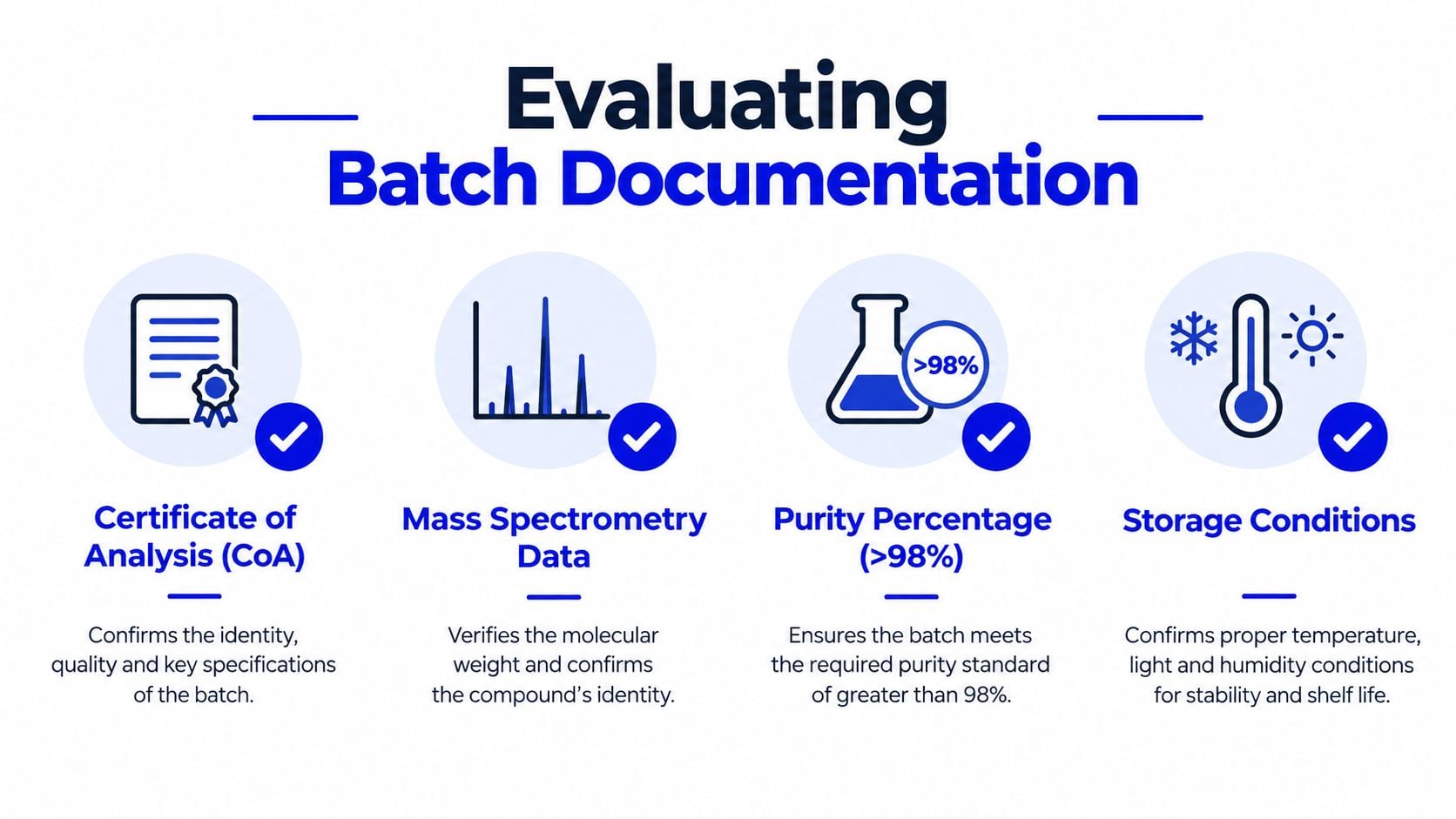
Use the following questions before a batch enters a comparative experiment:
Documentation principle: A purity number is not a complete quality profile. Identity, copper content, formulation conditions, stability, and traceability belong in the same evaluation.
Researchers should also compare the supplier's documentation with their own analytical plan. If the study depends on intact GHK-Cu, the laboratory may need independent verification rather than relying only on a general CoA. This is especially important when comparing topical formulations, powders, or other preparations that may create different exposure conditions.
GHK-Cu deserves attention in peptide science because its research record supports a coherent mechanistic question. The complex can influence extracellular-matrix biology, and preclinical studies have reported changes in collagen, elastin, glycosaminoglycans, MMPs, TIMPs, wound-model measures, and angiogenic signals.
The chemistry explains why researchers need to look beyond the label. GHK-Cu is not defined only by its nominal concentration. Copper coordination, pH, peptide-to-copper stoichiometry, purity, and storage stability can affect what cells encounter and how reproducibly another laboratory can repeat the experiment.
The biological data also favors a remodeling model over a simplistic stimulation model. Controlled studies reported matrix accumulation and collagen-related activity, while fibroblast experiments showed concentration-dependent differences in MMP and TIMP expression. That combination suggests coordinated turnover, but it doesn't establish an approved human therapeutic effect.
The largest unresolved issue is exposure. Formal ADME studies tracking intact GHK-Cu, peptide, and copper separately remain absent from the cited review literature. Researchers therefore need route-specific analytical methods before translating a cell-culture concentration into a claim about topical, injectable, oral, or nasal performance.
A responsible research program should:
For laboratories sourcing research material, Peptide Warehouse USA offers GHK-Cu and related research products with batch documentation, including Certificates of Analysis and laboratory testing records. Review the available documentation, compare it with your protocol's requirements, and choose a material that supports traceable, properly controlled peptide research.
Leave a comment