No products in the cart.



You’ve got a vial of lyophilized peptide on the bench, a syringe in hand, and one question that matters more than most new researchers expect. What exactly should you mix it with, and how do you do it without ruining the sample?
That moment is where good lab habits start. A peptide can be high purity on paper, but poor reconstitution can still lead to foaming, contamination, incomplete dissolution, and unreliable research outcomes. The reason for looking into peptides bacteriostatic water is usually to avoid a simple mistake that can affect everything that follows.
Done properly, peptide reconstitution is straightforward. Done casually, it introduces problems that are hard to spot until the work is already underway. The details matter: the right diluent, the right technique, the right storage conditions, and just as important, the right source.
A new researcher usually notices the peptide first. It looks valuable, dry, stable, and easy to mishandle.
The trouble starts when the powder leaves its freeze-dried state. Once you reconstitute it, you’re no longer just storing a peptide. You’re managing a solution that can be affected by microbes, rough handling, bad math, and poor storage discipline. That’s why the choice between bacteriostatic water, sterile water, and saline isn’t just a preference. It changes how usable the vial is over time.
A common bench mistake looks harmless. Someone draws up liquid, injects it straight onto the peptide cake, shakes the vial to hurry things along, and assumes clear liquid means everything is fine. Sometimes they get away with it. Sometimes they create foam, stress a delicate compound, or set up contamination that isn’t obvious until later.
Practical rule: Treat reconstitution as part of the experiment, not as prep work that happens before the experiment.
If you’re trying to build confidence with peptides bacteriostatic water, keep the process simple and deliberate. Use the correct diluent. Add it gently. Mix without force. Label everything. Store it properly. If anything about the vial or liquid seems off, stop and investigate rather than guessing.
This guide walks through the full workflow in plain language:
Researchers often focus on peptide purity and forget the diluent. In practice, both matter. A quality peptide mixed with poor bacteriostatic water is still a compromised preparation.
Bacteriostatic water is not just clean water in a vial. It is sterile water for injection that contains 0.9% benzyl alcohol (9 mg/mL) as a bacteriostatic preservative, and it is manufactured under USP standards to keep endotoxin levels below 0.25 EU/mL while maintaining pyrogen-free status, as described by Apex Laboratory’s overview of bacteriostatic water.
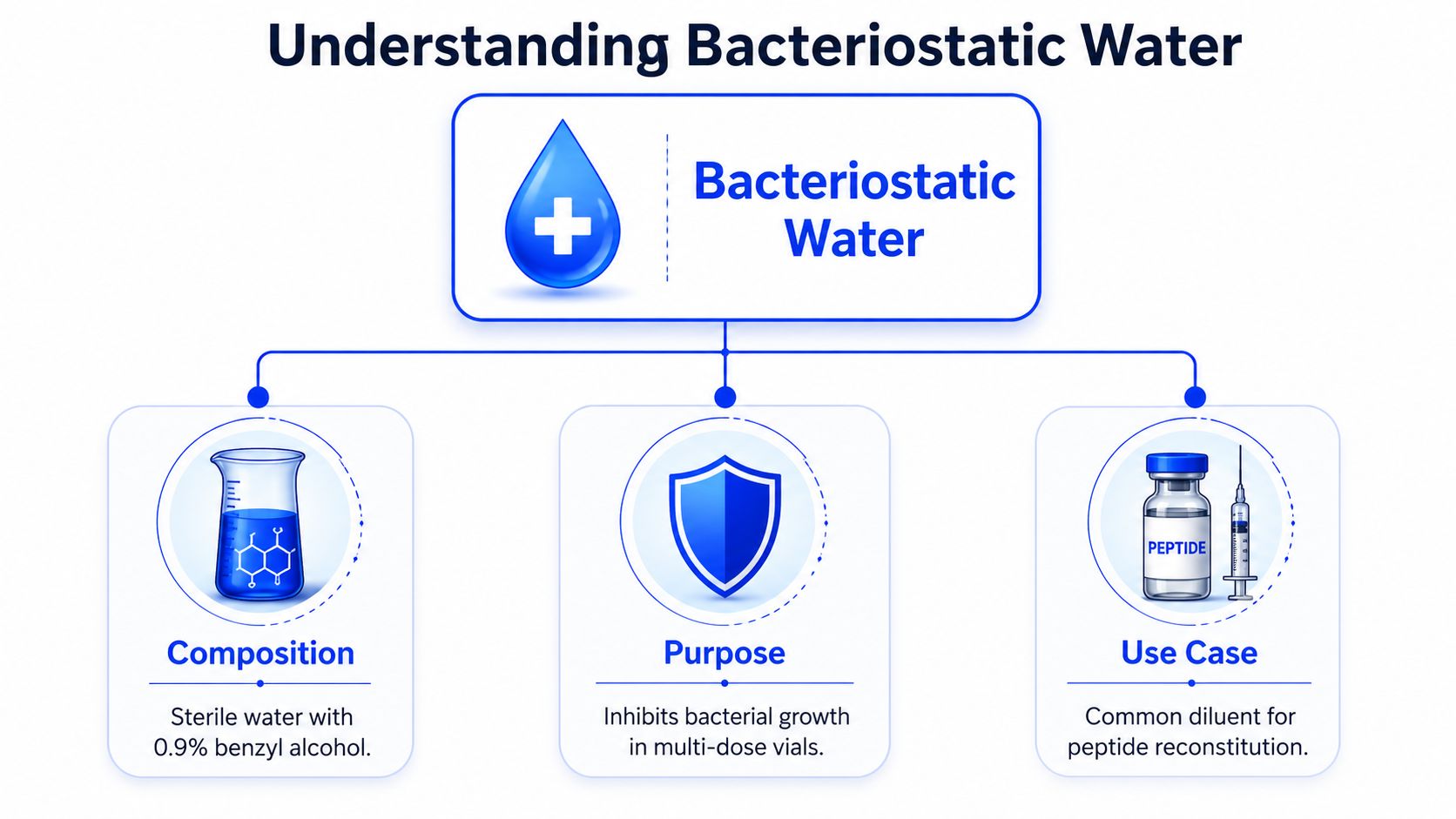
That formulation is why the vial can be punctured more than once without turning into a contamination problem under proper handling. The same source notes that the solution maintains a pH of 5.7, within a 4.5 to 7.0 range. In practical terms, that gives researchers a controlled, consistent diluent rather than an improvised one.
Think of bacteriostatic water as a prepared lab tool, not a generic liquid. It’s designed for repeated access and predictable behavior.
People often hear “bacteriostatic” and assume it means bacteria are killed on contact. That’s not what the term means. Benzyl alcohol acts more like a pause button than a kill switch. It inhibits microbial growth rather than functioning as a broad wipeout agent.
That distinction matters because it explains why sterile technique still matters. The preservative helps keep a multi-use vial workable, but it doesn’t excuse sloppy handling. If you touch stoppers, reuse equipment, or leave vials uncapped, you’re still inviting problems.
A beneficial way to understand it is:
The best reconstitution setup is boring. Clean bench, clean stopper, clean syringe, slow injection, gentle mixing.
In peptide work, that predictability is the reason bacteriostatic water is commonly chosen as a diluent. It supports repeated withdrawals from the same vial and gives researchers a practical way to maintain solution integrity over a multi-session workflow.
A lot of confusion comes from the names. All three liquids may sound interchangeable when you’re new to peptide work. They aren’t.
The key difference is preservation. Bacteriostatic water contains 0.9% benzyl alcohol (9 mg/mL), described as the threshold used to inhibit bacterial growth while remaining compatible with a wide range of peptide sequences in this review on peptide stability and reconstitution. Sterile water does not contain that preservative. Saline changes the solution environment by adding salt, which may not be desirable for general peptide reconstitution.
If your work involves multiple withdrawals from the same reconstituted vial, bacteriostatic water is usually the product people mean when they talk about practical peptide prep. Sterile water fits single-use thinking much better. Saline belongs in protocols that specifically call for it.
| Characteristic | Bacteriostatic Water | Sterile Water | Bacteriostatic Saline |
|---|---|---|---|
| Preservative content | Contains benzyl alcohol | No preservative | Contains preservative plus sodium chloride |
| Typical use pattern | Multi-use workflows | Best suited to immediate or single-session use | Protocol-specific use where saline is appropriate |
| Peptide compatibility | Broad compatibility for many peptide workflows | Can be used when preservative is not needed | May alter solubility behavior because of ionic content |
| Repeated vial access | Better suited for repeated punctures under aseptic handling | Less forgiving for repeated access | Depends on protocol and peptide characteristics |
| General research choice | Often preferred | More limited in practical use | More specialized |
Researchers usually get tripped up by one assumption: “sterile” must mean “good enough.” Sterile only describes one part of the picture. Once a vial is opened and punctured, preservation becomes part of the decision.
Here’s the plain-language version:
That’s why the phrase peptides bacteriostatic water shows up so often in research discussions. It reflects a practical pairing, not just a popular search term.
A good procedure removes guesswork. The less improvisation at the bench, the fewer problems later.
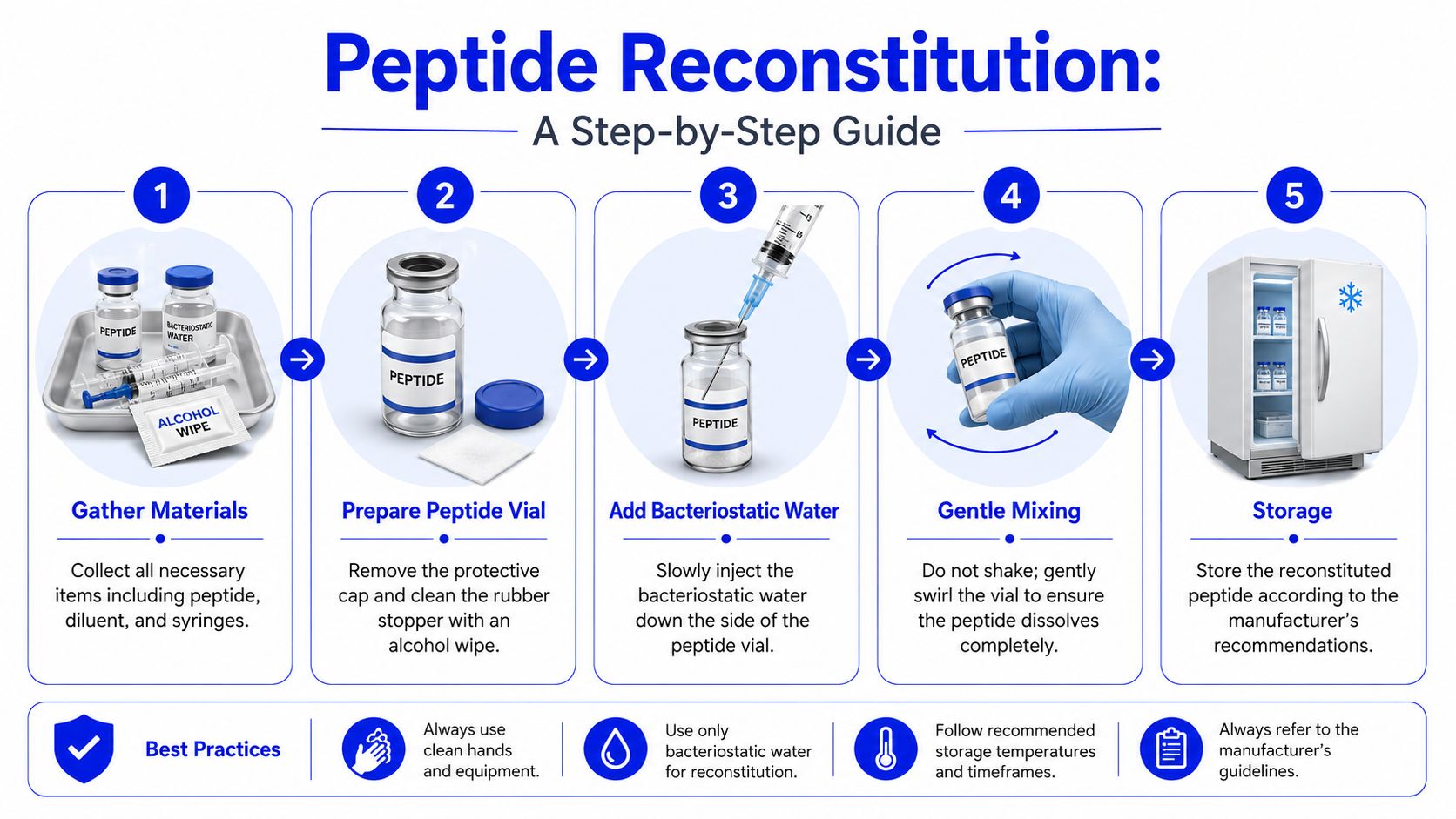
Set out everything first so you’re not reaching across the bench halfway through. That usually means the peptide vial, the bacteriostatic water vial, sterile syringes, alcohol wipes, and labels for date and concentration.
Wipe the stoppers before the first puncture. Let them dry. Don’t touch the cleaned rubber after that.
A calm setup prevents rushed movements. Most handling errors happen when someone tries to save a few seconds.
The standard operational protocol for peptide reconstitution is to add 1 to 2 mL of bacteriostatic water to a 5 mg peptide vial, producing working concentrations of 2,500 to 5,000 mcg/mL, according to Palmetto Peptides’ peptide reconstitution guidance. That same guidance says the water should be added slowly along the inside glass wall, not sprayed directly onto the lyophilized powder, and that a properly prepared reconstituted peptide remains stable for up to 28 to 30 days at 4°C.
Confirm the target concentration
Decide how concentrated you want the final solution to be before you draw any liquid. Don’t pick a volume at random and try to fix the math afterward.
Draw the bacteriostatic water
Use a sterile syringe and withdraw the exact amount you plan to add. Keep the needle steady and avoid repeated unnecessary punctures.
Inject down the glass wall
Insert the needle into the peptide vial and angle it so the liquid runs slowly down the inside wall. This is one of the most important habits in the entire process.
Avoid force
Don’t blast the liquid directly onto the powder. That can cause foaming and can interfere with smooth dissolution.
Mix gently
Roll or swirl the vial gently. Don’t shake it.
Inspect the solution
You’re looking for a clean, fully dissolved appearance. If particles remain, give it a little more time with gentle rolling.
This visual walkthrough helps reinforce the handling sequence:
Bench note: If you feel tempted to shake the vial, that usually means you added the liquid too aggressively or you’re trying to rush dissolution.
Some peptides dissolve easily. Others don’t cooperate.
If the peptide does not dissolve within 5 minutes of gentle rolling after adding bacteriostatic water, the protocol described in the same Palmetto guidance calls for switching to an acetic acid solution for compounds with different solubility behavior. That doesn’t mean the peptide is necessarily bad. It means bacteriostatic water has limits as a solvent for certain compounds.
A few practical responses help here:
When researchers say reconstitution is “simple,” this is usually the part they leave out. The steps are simple. The judgment still matters.
Math is where many new researchers lose confidence, but the basic idea is simple. You’re only tracking how much peptide is in the vial and how much liquid you added to it.
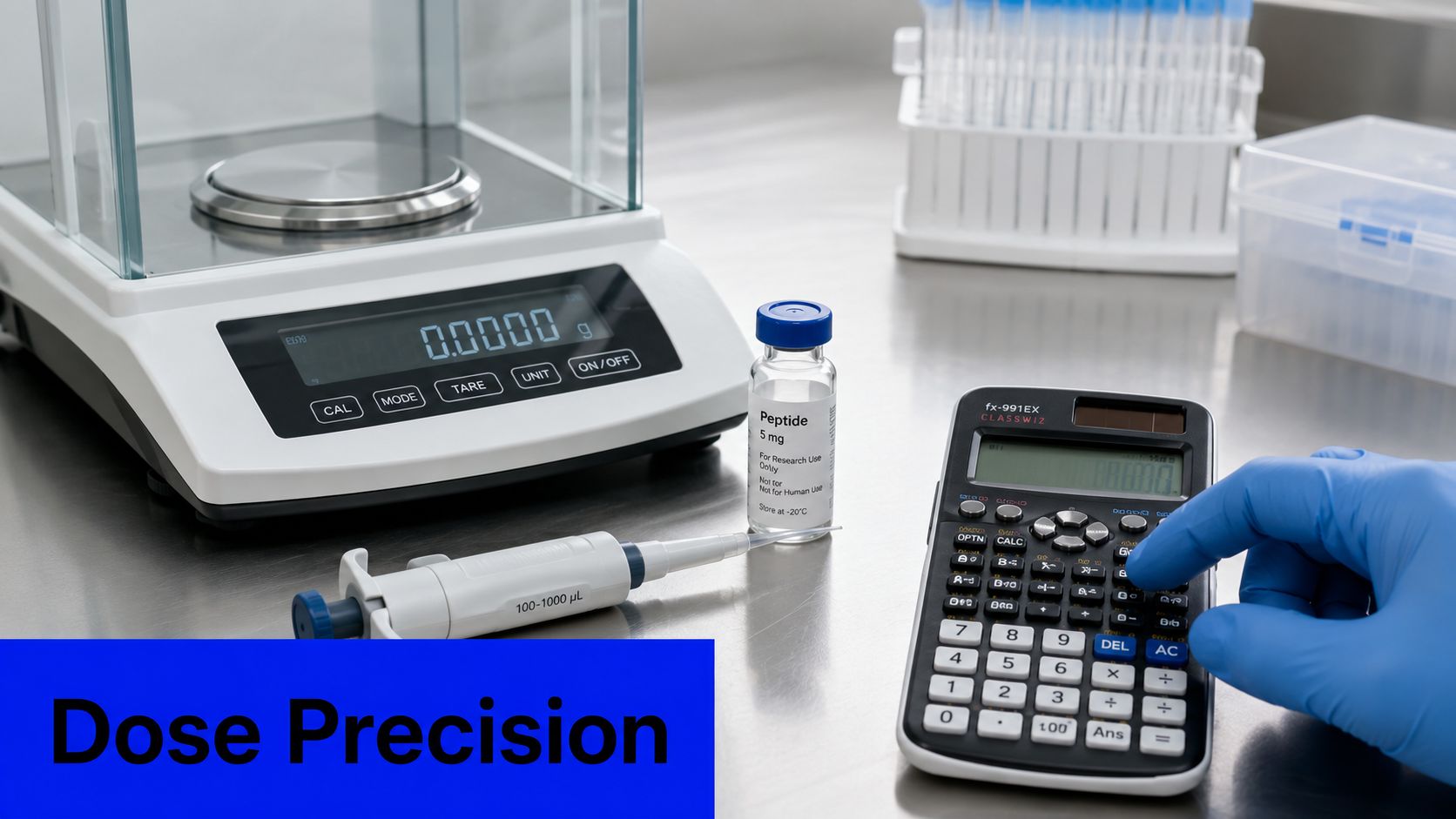
Concentration is just:
Total peptide amount ÷ total liquid volume
If you start with a peptide vial labeled in milligrams and add liquid measured in milliliters, the result tells you how much peptide is present per milliliter.
A few unit reminders help:
The trick is to stay consistent with units. Don’t switch between mg and mcg halfway through the same calculation unless you intentionally convert.
These examples use the standard peptide reconstitution pattern already discussed.
You have a 5 mg peptide vial and add 1 mL of bacteriostatic water.
That gives you a concentration of 5 mg/mL, which is the same as 5,000 mcg/mL.
If you need a 250 mcg portion from that vial, you’d draw the volume that corresponds to one-twentieth of a milliliter. The safest habit is to write out the fraction on paper before drawing anything.
You have a 5 mg peptide vial and add 2 mL of bacteriostatic water.
That gives you 2.5 mg/mL, which is the same as 2,500 mcg/mL.
This lower concentration can make smaller measured portions easier to read and repeat, especially if you want more visual room for precise syringe measurement.
Write the final concentration on the vial immediately after reconstitution. People trust memory right up until they mix up two similar vials.
A practical dilution workflow looks like this:
This is also where the benefits of peptides in research can be undermined by sloppy prep. A well-made compound still depends on correct concentration if the goal is repeatable lab work.
The work doesn’t end when the peptide dissolves. Reconstituted solutions need calm, consistent handling if you want the vial to remain usable across the intended research window.
Refrigeration is the standard habit after reconstitution. Keep the vial in a stable, clean location and avoid unnecessary temperature swings. Repeated warming and cooling creates avoidable stress and invites handling errors.
Light protection is also a good practical habit. Even when a peptide looks unchanged, there’s no advantage in exposing it to extra light or bench heat.
A reliable handling routine looks like this:
A good reconstituted solution should look normal for that peptide and remain consistent from one use to the next. If the appearance changes unexpectedly, stop and evaluate rather than continuing out of habit.
Watch for issues such as:
When in doubt, treat uncertainty as a problem, not as an inconvenience. In peptide work, contamination often starts as a small oversight that doesn’t look dramatic.
Storage discipline matters because every puncture, every draw, and every minute on the bench affects the usable life of the preparation. Good technique isn’t complicated. It’s repetitive, careful, and consistent.
Many articles explain how to mix a peptide, but skip the part that can subtly ruin the whole process. The label on the bacteriostatic water has to be true.
Recent independent lab testing in 2025 found that grey-market vials marketed as bacteriostatic water often contained 0% benzyl alcohol or levels exceeding 1.5%, instead of the expected 0.9%, according to this video summary of independent testing on grey-market bacteriostatic water. The same reporting warns that without the exact preservative concentration, the expected multi-use sterility window becomes unreliable and can lead to endotoxin contamination and peptide degradation.
That changes the conversation completely. A vial can look professional, arrive sealed, and still fail the basic requirement that makes bacteriostatic water useful in peptide workflows.
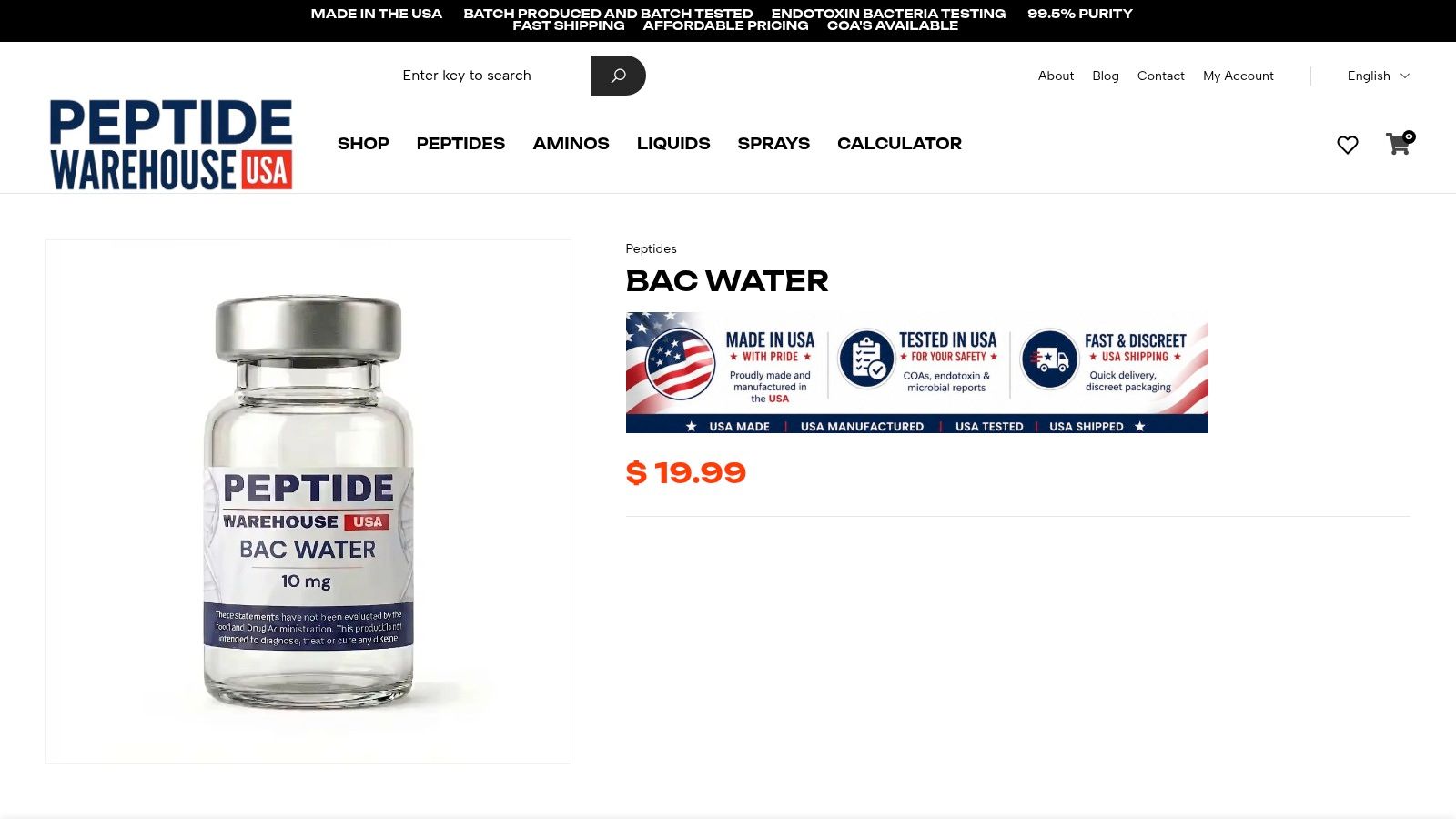
The hidden problem is simple. If the product is plain sterile water, the preservative protection people assume they have isn’t there. If the benzyl alcohol level is too high, you’ve got a different quality problem. In both cases, the peptide gets blamed for failures caused by the diluent.
A counterfeit diluent doesn’t just waste the water. It can compromise the peptide, the data, and the confidence you place in both.
Researchers should treat diluent sourcing with the same seriousness they apply to peptide sourcing.
Look for signs of controlled quality practices such as:
For labs trying to tighten procurement controls, this short guide to ensuring product integrity is useful because it explains why chain-of-custody thinking matters when products move through multiple hands before reaching the bench.
This is also where compliance matters. Research peptides and related diluents should be handled within a clear research-use-only framework. They are not a substitute for medical guidance, and they shouldn’t be treated casually because they are easy to order online.
A strong peptide workflow starts before the vial is opened. It starts when you decide what you trust enough to bring into the lab.
Don’t shake it aggressively and don’t assume more force will fix it. Give it a little time with gentle rolling. If it still resists dissolving, check the compound-specific handling guidance because some peptides have different solubility behavior and may need another solvent approach.
Yes, the vial size of the bacteriostatic water product isn’t the main issue. What matters is using a verified product and drawing the exact volume needed for your target concentration. The calculation depends on how much liquid you add to the peptide vial, not on the total size of the diluent vial you purchased.
Yes. While bacteriostatic water is commonly used for peptide reconstitution, some compounds don’t dissolve well in it or may require a different solvent system. If a peptide stays stubbornly undissolved with proper gentle handling, don’t keep forcing the same approach. Check the protocol for that specific sequence.
The main warning signs are cloudiness, floating particles, unexpected color change, or anything about the vial that makes sterility uncertain. A damaged stopper or a vial with unclear handling history is enough reason to stop using it.
If you’re comparing options for peptides bacteriostatic water, keep the priority list simple. Use a verified diluent, follow a clean reconstitution technique, calculate carefully, and store the finished solution like it matters. Because it does.
If you need a dependable source for research-use peptide supplies, Peptide Warehouse USA offers USA-made research peptides and related products backed by batch documentation, COAs, and a clear research-only framework. Learn more, explore options, and choose materials that support consistent lab work from the first puncture to the last draw.