No products in the cart.


Peptides for longevity don’t fit the usual anti-aging story. The strongest signal in the field isn’t a vague promise of “slowing aging.” It comes from compounds that influence specific biology, especially metabolic pathways linked to insulin sensitivity, A1c, and visceral fat in clinical longevity-oriented programs focused on GLP-1 receptor agonists such as semaglutide and tirzepatide, as discussed by Cenegenics in its overview of precision longevity medicine.
That’s a useful reality check. If you’re trying to understand peptides for longevity, the right question isn’t “Which peptide is best?” It’s “Which peptide is being studied for which aging-related pathway, and how strong is the evidence?”
The field has matured enough that researchers now treat it as a real category rather than a loose collection of wellness trends. If you’re also looking at clinical perspectives on solutions for age-related wellness concerns, it helps to keep that distinction in mind: some peptides sit closer to established metabolic medicine, while others remain early-stage research tools.
Peptide longevity research is gaining attention for a simple reason. It asks a better question than older anti-aging models asked.
Instead of starting with visible outcomes like wrinkles, fatigue, or changes in body composition, current research starts further upstream. Scientists are examining the signaling systems that help tissues repair damage, regulate metabolism, coordinate endocrine activity, and maintain function over time. Peptides matter in that setting because they can act like short biological instructions. They let researchers test whether a specific signal changes a specific process.
That difference is easy to miss. A cream, supplement, or clinic claim may package peptides as broad solutions for age-related wellness concerns. Research does not treat them that way. In the lab, peptides are usually studied as narrow tools for probing one pathway at a time, which is a much stricter standard than a marketing label.
The field has expanded enough that peptide research can no longer be treated as one vague anti-aging category. Researchers now sort candidates by function and evidence quality, much like a mechanic sorts tools by the job they do. A wrench, a voltmeter, and a pressure gauge may all be useful, but they answer different questions. Longevity peptides are similar. One may be studied for tissue repair, another for metabolic signaling, and another for neurobiological effects.
That framing helps separate hype from evidence.
A peptide with a plausible mechanism is not the same as a peptide with reliable animal data. Strong animal data is not the same as controlled human evidence. And human evidence from one narrow use case should not be stretched into a claim about slowing aging as a whole. Readers who keep those distinctions in view are much less likely to confuse experimental interest with established benefit.
Researchers often group longevity-related peptide work into a few recurring areas:
Main takeaway: Peptides for longevity make the most sense as a set of targeted research tools. The central question is not whether a peptide sounds promising, but what pathway it affects, what evidence supports it, and how carefully that evidence has been interpreted.
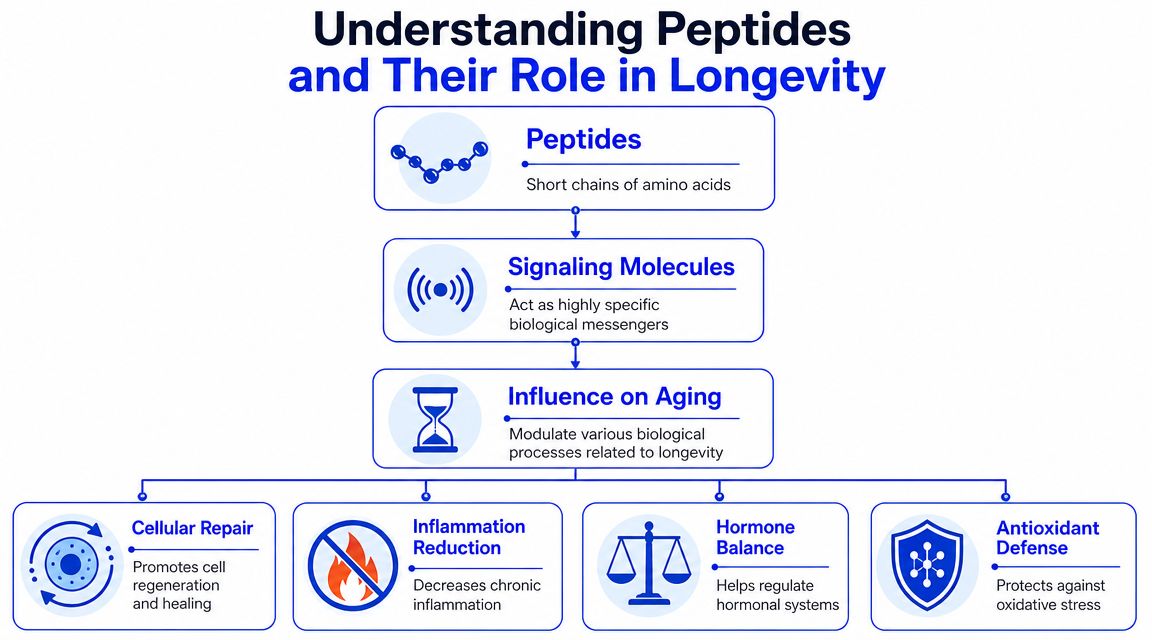
Peptides are short chains of amino acids. If proteins are long, complex machines, peptides are more like short instructions. Their small size helps them act as focused biological messengers.
A simple way to think about them is the key-and-lock model. The peptide is the key. A receptor or target on a cell is the lock. If the fit is right, the cell receives a specific signal and changes its behavior.
For a broader primer on peptide basics, this comprehensive guide to peptides for optimal use is a useful companion read.
Many drugs act across several pathways at once. That can be useful, but it can also make cause and effect harder to interpret. Peptides are often studied because they can trigger more specific responses.
That specificity matters in aging research. Aging isn’t one process. It’s a network of changes in repair, inflammation, metabolism, signaling rhythms, and resilience. A targeted molecule is often more useful for studying one part of that network than a broad intervention with many unrelated effects.
Here’s the practical distinction:
Aging often looks like signal drift. Cells don’t communicate as well. Repair responses become less coordinated. Metabolic feedback becomes less efficient. Rhythms that once stayed tightly regulated become noisier.
Peptides for longevity are interesting because they may help researchers probe those communication failures. Instead of overwhelming the whole system, a peptide may let a lab examine one defined message and one defined biological response.
In peptide research, precision is the point. A narrow signal can teach you more than a broad effect.
That doesn’t mean every peptide is equally meaningful. It means the class itself is biologically plausible. Some peptides are natural. Some are synthetic. What matters most is whether the signaling target is clear, the molecule is well characterized, and the evidence matches the claims being made.
One of the clearest signs that the field is becoming more disciplined is that recent review work has narrowed attention to a relatively small set of recurring candidates. A 2026 review in Frontiers in Aging screened peer-reviewed articles, clinical trials, regulatory documents, and preclinical studies, then selected 20 primary sources to identify 9 peptides with distinct gerontology applications, as outlined in the Frontiers in Aging review.
The review highlighted these peptide categories and examples:
This is an important change in how people should read the market. The most discussed longevity peptides aren’t interchangeable. They’re being mapped to different aging hallmarks and functional domains.
| Peptide | Primary Research Focus | Key Biological Target |
|---|---|---|
| Tirzepatide | Metabolic restoration | Metabolic signaling |
| Epitalon | Telomere biology | Cellular aging pathways |
| GHK-Cu | Dermal regeneration | Skin and connective tissue biology |
| BPC-157 | Tissue repair | Healing-related pathways |
| TB-500 | Tissue repair | Regenerative responses |
| Semax | Neuroprotection | Neural signaling |
| CJC-1295 | Growth hormone modulation | Endocrine signaling |
| Ipamorelin | Growth hormone modulation | Endocrine signaling |
| Bremelanotide | Sexual function | Central signaling pathways |
A product label doesn’t tell you whether a peptide fits your research question. The category label “longevity peptide” can hide major differences in purpose.
For example, a lab interested in skin regeneration might examine GHK-Cu. A lab interested in tissue repair might compare BPC-157 and TB-500. A group focused on metabolic aging will care more about peptides studied in glucose and body-composition contexts.
That’s why researchers should organize peptide decisions around the biological target first, then the sourcing question second.
If you’re comparing growth-hormone-related options in the broader peptide space, clinical service pages discussing affordable Sermorelin treatment can be helpful for understanding how adjacent compounds are framed in practice, even though research use and clinical care should never be treated as the same thing.
The critical question isn’t whether a peptide is popular. It’s whether its studied role matches the pathway you care about.
Mechanism is the fastest way to separate serious research from marketing noise. Two peptides can both be sold under the label “longevity,” yet act on entirely different biological systems and carry very different levels of evidence. If you sort them by pathway instead of by popularity, the field becomes much easier to evaluate.
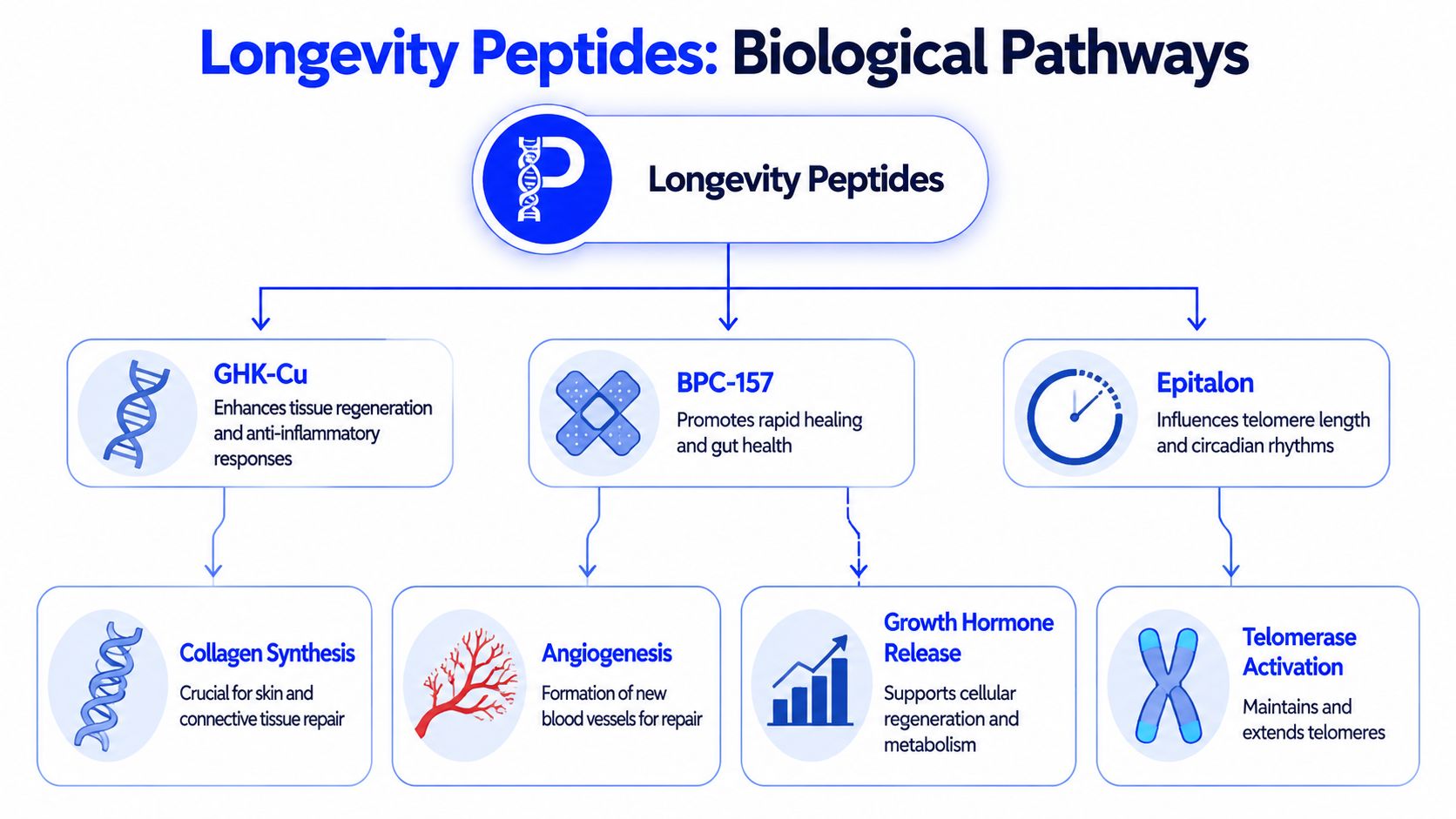
One major group of peptides is studied for how it affects tissue maintenance and repair. Aging does not only mean “getting older” in a general sense. It also means slower wound healing, less organized extracellular matrix turnover, and reduced capacity to restore normal structure after stress or injury.
GHK-Cu sits in this category because researchers often examine it in skin and connective tissue biology. BPC-157 and TB-500 are usually discussed in repair-focused models as well. The common thread is not that they “reverse aging.” It is that they may influence processes such as cellular signaling, matrix remodeling, and recovery dynamics that become less efficient with age.
A useful comparison is home maintenance. If a building’s repair crew responds slowly, small problems spread. In biology, weaker repair systems can turn minor damage into lasting functional decline. That is why regeneration pathways attract so much attention in aging research.
A second cluster centers on metabolic control and hormone-related signaling. This category tends to matter more for aging research because metabolism affects many downstream systems at once, including body composition, glucose handling, inflammation, and physical function.
Some peptides are studied for whether they alter endocrine rhythms rather than solely raising a hormone level. That distinction matters. CJC-1295 and ipamorelin are often grouped together because they are discussed in relation to growth hormone signaling patterns. Researchers care about those patterns because timing, pulse structure, and downstream response can shape effects on recovery and body composition.
This is also where readers need to be careful. A plausible endocrine mechanism does not automatically translate into a meaningful longevity outcome. Mechanistic interest is a starting point for research, not proof of healthier aging.
Another branch of the field focuses on the nervous system and on cellular maintenance markers linked to aging. Semax is typically placed on the neuroprotection side because it is studied for effects on neural signaling and brain-related function. Epitalon is more often discussed in connection with cellular aging questions, including telomere-related research.
These topics get attention for an obvious reason. Long-lived organisms do not benefit much from extra years if neural function declines early, and cells cannot preserve tissue function indefinitely if maintenance systems break down. Researchers therefore ask a narrower question than marketers usually do. They ask which pathway is being altered, in which model, and whether that change is measurable in a way that could matter for aging biology.
Earlier in the article, AagingBase was cited as an example of how broad this research area has become. The larger point is more important than the exact count. Anti-aging peptide research includes many short, targeted molecules designed to influence specific signaling tasks rather than act as broad anti-aging compounds. That is another reason to be skeptical of any source that treats all peptides as one class.
Practical rule: Classify a peptide by the pathway it is meant to affect, then ask how strong the evidence is for that pathway in aging. That approach is far more reliable than starting with the label “anti-aging.”
A peptide can look impressive in a pathway diagram and still have weak support as a longevity intervention. That gap between mechanistic plausibility and outcome evidence is where much of the confusion begins.
A useful way to read this field is to separate three questions that often get blurred together. First, does a peptide change a biological signal in cells or animals. Second, does that effect carry into humans. Third, does the human effect relate to aging in a meaningful way, rather than improving a narrow short-term marker that gets stretched into a broad anti-aging claim.
Preclinical work includes cell experiments, animal studies, and mechanistic models. Those studies matter because they help researchers identify targets, estimate dose ranges, and test whether a pathway is worth pursuing at all. But they are the beginning of the evidence ladder, not the top of it.
Human evidence carries more weight because aging is not a single endpoint. It is a long process involving metabolism, inflammation, tissue repair, immune function, and neurological change. A peptide that improves one laboratory signal in mice may still fail to produce a meaningful effect in people, or may affect a marker that has little proven connection to long-term aging outcomes.
That is why the strongest evidence-backed signal in this area currently comes from peptide-related drug classes with large clinical programs rather than from compounds promoted mainly through forums or product catalogs. One example is GLP-1 receptor agonists such as semaglutide, which have been discussed in precision longevity medicine because they show human effects on metabolic health measures such as insulin sensitivity and visceral fat reduction.
The problem is not only exaggeration. It is category error.
Compounds with very different purposes often get grouped under the single label of “longevity peptides,” as if they all had comparable evidence. A repair-focused peptide, a metabolic signaling peptide, and a neuroactive peptide may each be interesting. They should not be judged by the same claims or by the same standards of proof.
A good comparison is drug development versus a parts catalog. In a serious research setting, each peptide is treated like a distinct tool built for a specific job. In hype-driven marketing, many peptides are treated like interchangeable entries under one anti-aging umbrella. The first approach asks, “What pathway, what model, what endpoint, what uncertainty?” The second asks, “What is the biggest claim this mechanism could support?” Those are very different habits of thought.
Use a simple ranking system when reading claims about longevity peptides:
This hierarchy helps prevent a common mistake. Readers often treat repeated enthusiasm as accumulating evidence. It is not. Ten retellings of one uncertain claim still leave you with one uncertain claim.
Before accepting a longevity claim, press on a few points:
One sentence is worth keeping in mind throughout this section. Promising does not mean proven.
That distinction is the clearest way to separate evidence-backed research from sales language. In longevity science, the hardest step is often not finding a plausible mechanism. It is showing that the mechanism leads to a measurable, reproducible human benefit that justifies the claim being made.
The peptide itself is only half the story. The other half is whether the vial contains what the label says it contains, at the stated purity, with documentation that allows a lab to verify consistency.

For research use, quality standards shouldn’t be treated as optional marketing language. They’re part of experimental validity.
Look for these basics:
One factual example from the supplier side is that Peptide Warehouse USA states that its research catalog is supported by third-party documentation, including COAs, microbial and endotoxin reports, and stated purity levels up to 99.5% for laboratory, analytical, and preclinical use only.
A Certificate of Analysis should answer a few plain questions.
A good COA doesn’t guarantee that a peptide is appropriate for your project. It does tell you whether you’re starting from a documented material rather than a blind purchase.
For a quick visual walkthrough of what careful peptide handling and evaluation can involve, this video is a helpful reference:
Researchers often focus on the compound name first. Procurement teams should focus just as hard on documentation quality. If batch records are weak, the entire downstream experiment gets harder to trust.
That’s especially true in peptide categories associated with longevity, healing, fat loss, muscle growth, or anti-aging interest, because demand can attract inconsistent suppliers. For research, the safest approach is simple: prioritize traceability, transparent testing, and clear research-use-only positioning.
If a supplier makes bold claims but provides thin documentation, trust the paperwork, not the pitch.
Peptides for longevity are best understood as precision research tools. Some are being studied for metabolic regulation. Others for tissue repair, neuroprotection, dermal regeneration, endocrine signaling, or telomere-related biology. That diversity is a strength, but it also means no single peptide can stand in for the whole field.
The most useful distinction is between hype and evidence. Some peptide categories already sit closer to strong clinical relevance, especially in metabolic health. Others remain early, interesting, and worth watching, but still largely preclinical in the longevity context.
For researchers, the practical lesson is straightforward. Match the peptide to the pathway. Match the claim to the evidence. Match the supplier to the documentation.
If you’re sourcing compounds for laboratory or analytical work, keep the standard high and the expectations realistic. That’s how peptide research becomes more credible, more reproducible, and more useful over time.
If you’re evaluating research-use compounds for peptide studies, Peptide Warehouse USA offers a catalog focused on laboratory, analytical, and preclinical applications, with batch documentation designed to support traceability and sourcing review. Learn more and explore options based on your specific research goals.