
No products in the cart.


You've found a supplier listing, seen a high purity claim, and now you're wondering whether the product can be traced to a specific batch, tested for contamination, and purchased for a lawful research purpose. That's the challenge behind searching for peptides for sale USA. A product page can look polished while leaving important procurement questions unanswered.
This guide treats peptide buying like a lab manager would. You'll learn how to separate research materials from products marketed for human use, read a Certificate of Analysis, distinguish peptide-related impurities from microbial or endotoxin contamination, assess shipment and storage information, and compare suppliers by traceability rather than headline claims alone.
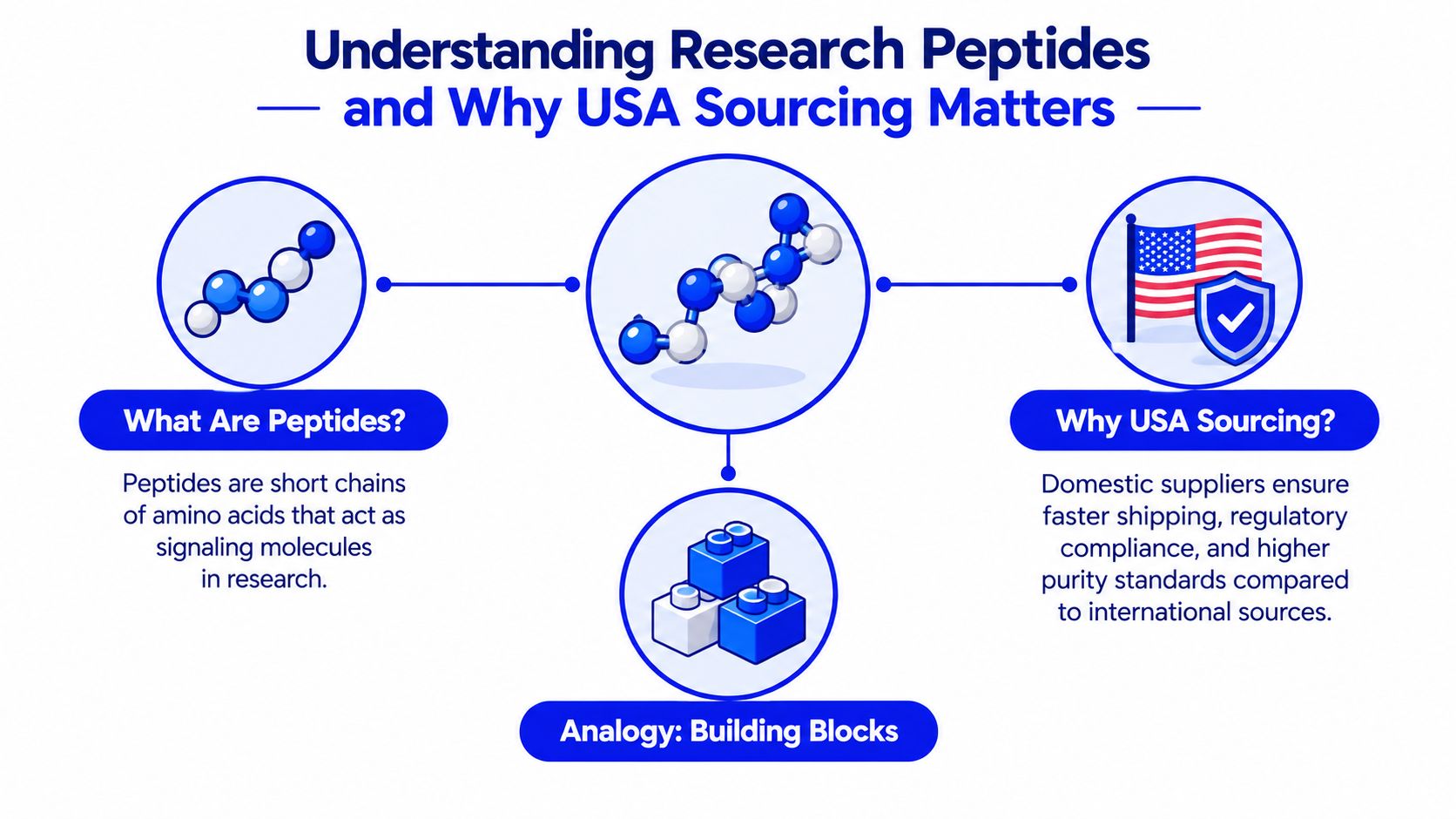
Peptides are short chains of amino acids. In laboratory work, researchers use them as defined chemical materials in analytical, biochemical, and preclinical investigations. A useful analogy is a set of molecular building blocks. The order and identity of the blocks affect the resulting chain, so the exact sequence, handling history, and testing record matter.
The label research use only describes the intended category of the material. It doesn't turn an unapproved product into a medicine, and it doesn't authorize human consumption. Buyers should evaluate a peptide as a research reagent with a documented identity and lot history, not as a treatment with implied outcomes.
Peptides have moved well beyond a narrow research niche. A 2020 industry summary reported more than 800 peptide drugs in the clinical pipeline and 197 peptide-based drugs commercially available, showing how developed the class had become by that point. The industry summary on the peptide therapeutics pipeline also helps explain why demand reaches pharmaceutical development, institutional research, and laboratory procurement.
Market estimates vary because analysts count different product categories. One 2026 report estimated the global peptide therapeutics market at USD 140.9 billion in 2025 and projected USD 294.6 billion by 2033, while another estimated USD 49.7 billion in 2025 growing to USD 100 billion by 2034, as reported through the Grand View Research peptide therapeutics market analysis. The disagreement doesn't make the category irrelevant. It shows that the commercial footprint depends heavily on whether an estimate includes only therapeutics or broader retail, obesity, and GLP-1-driven demand.
A USA-based supplier may offer a simpler domestic shipping route, clearer customer support, and documentation written for U.S. buyers. Those are useful procurement advantages, but location alone doesn't prove quality. You still need a lot number, batch-specific records, stated testing methods, and a clear intended-use policy.
Think of the supply chain as a chain of custody:
A domestic address can reduce logistical uncertainty, but it doesn't replace document review.
The central compliance question isn't whether a website uses the phrase research use only. Regulators can examine the total evidence of intended use, including product descriptions, testimonials, dosing language, before-and-after claims, social media, and the way a catalog is organized.
Third-party coverage of FDA enforcement quotes the agency's position that disclaimers such as “research use only” and “not for human consumption” don't automatically control classification when surrounding marketing suggests human use. A compliant buyer should therefore review the entire listing, not just the disclaimer at the bottom.
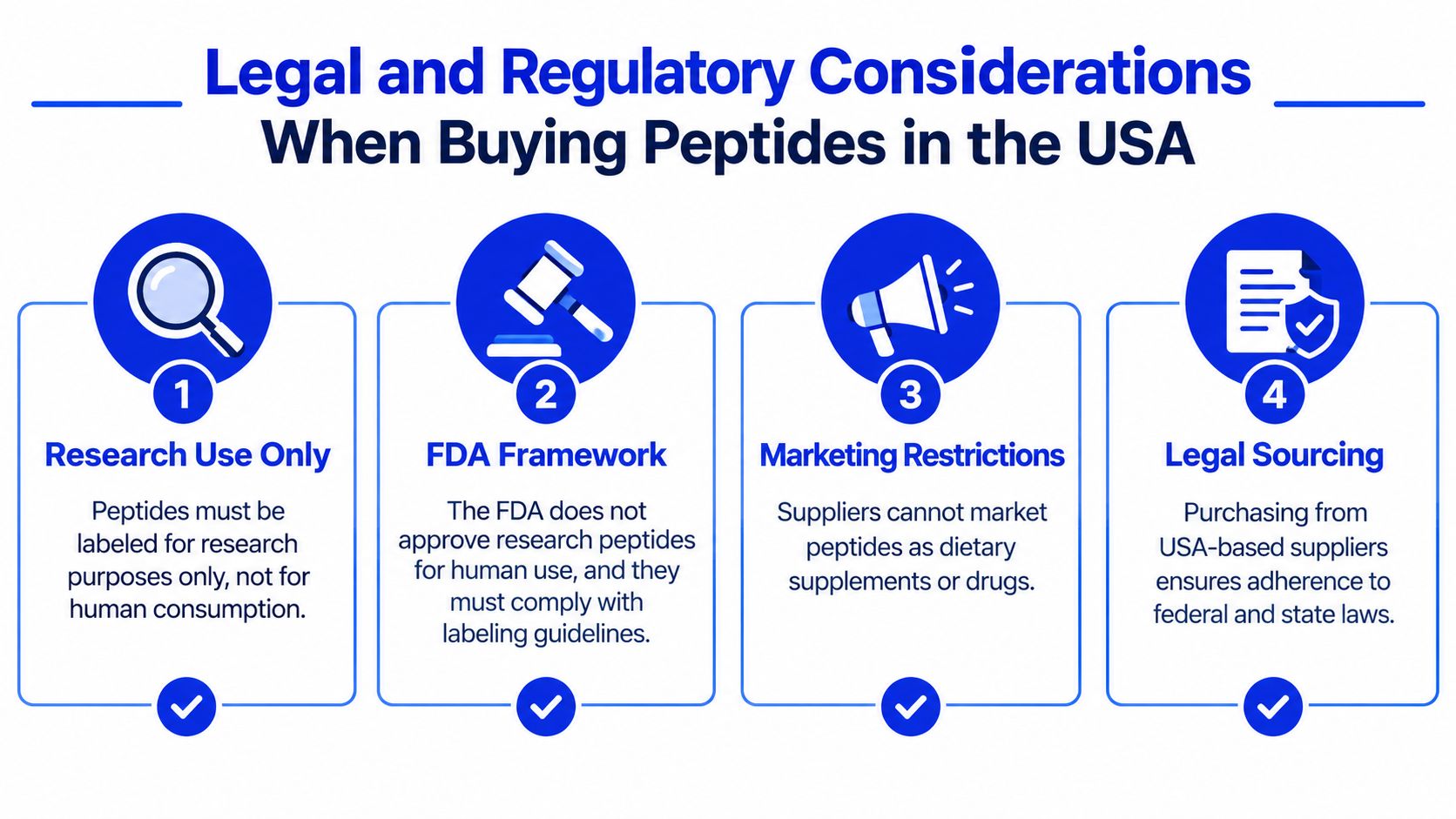
A research product page should describe the material in terms of laboratory investigation, analytical work, or preclinical research. It shouldn't present the product as a dietary supplement, drug, cosmetic treatment, or therapy.
That distinction matters especially for compounds associated with weight management, recovery, body composition, or other consumer health interests. Buyers shouldn't rely on a familiar product name to determine legality. They should assess the product's stated purpose, documentation, seller identity, and marketing context.
FDA enforcement has become a major procurement concern. One analysis reported more than 50 warning letters in September 2025 and discussed import controls including the GLP-1 Green List and Import Alert 66-80. The analysis of FDA warning letters and peptide enforcement provides context for why online listings deserve closer review in 2026.
A research chemical supplier isn't automatically a compounding pharmacy or an outsourcing facility. FDA information explains that outsourcing facilities can qualify for exemptions from FDA approval requirements and from labeling products with adequate directions for use, but they still must comply with current good manufacturing practice, risk-based inspections, adverse-event reporting, and product information submissions. The FDA overview of outsourcing facilities outlines those responsibilities.
FDA guidance also says that only facilities intending to comply with all provisions of section 503B of the FD&C Act, meet CGMP requirements, and compound sterile human drug products should register as outsourcing facilities. The FDA questions and answers on outsourcing-facility registration gives buyers a practical threshold for evaluating business descriptions.
Compliance checkpoint: A research listing should not imply that a product is approved, prescribed, compounded for a patient, or suitable for human use.
A purity percentage is only one part of a peptide procurement file. A strong audit asks what was tested, which batch was tested, which method was used, and whether separate tests address contamination risks that HPLC purity doesn't measure.
A Certificate of Analysis, or COA, should connect the result to a named product, lot number, testing date, and laboratory or testing organization. A generic certificate that lacks batch identity is difficult to use for release decisions because it may describe a product category rather than the vial in your order.
A 99.5% HPLC purity result describes peptide-related impurities. It doesn't measure endotoxin burden or microbial contamination. For laboratory materials used in cell-based or preclinical assays, separate endotoxin testing under USP <85> and microbial-limit testing under USP <61>/<62> provide different information. The COA and testing explanation for research peptides describes why those tests should be considered separately.
FDA comparative-assessment guidance for peptide-related impurities calls for identifying individual peptide-related impurities at levels of at least 0.10%, and for ensuring impurities aren't greater than those in the reference product. The FDA guidance on peptide-related impurities shows why a single rounded purity number can conceal details relevant to analytical comparability, bioactivity interpretation, and shelf-life behavior.
| Documentation Element | What It Proves | What to Look For |
|---|---|---|
| Product identity | The material tested corresponds to the listed compound | Clear compound name, format, and lot reference |
| Batch-specific COA | The report applies to a defined production batch | Lot number matching the vial or invoice |
| HPLC result | Peptide-related composition was assessed | Method, result, and testing laboratory |
| Endotoxin report | Endotoxin burden was assessed separately | Reference to USP <85> or an equivalent documented method |
| Microbial report | Microbial limits were assessed separately | Reference to USP <61>/<62> or an equivalent documented method |
| Impurity detail | Individual peptide-related impurities can be reviewed | Results that aren't hidden behind a single rounded figure |
| Traceability record | The supplier can connect product, batch, and documentation | Consistent identifiers across label, COA, and order record |
Ask the supplier for the COA before placing a larger order. Then compare the lot number on the document with the lot number on the product label when the shipment arrives.
For broader laboratory procurement, buyers can also review directories of bulk commodity suppliers as a separate sourcing resource. The same audit principle applies, whether you're buying a small research lot or evaluating a larger materials channel.
Procurement doesn't end when the payment clears. A peptide can have excellent documentation and still be mishandled if the buyer doesn't understand the shipment route, storage conditions, light exposure, or preparation requirements.
Lyophilized materials are commonly supplied as freeze-dried powder. The product page and accompanying documentation should explain the recommended storage environment and any restrictions that apply to that specific compound. Buyers shouldn't assume that every peptide has identical stability characteristics.
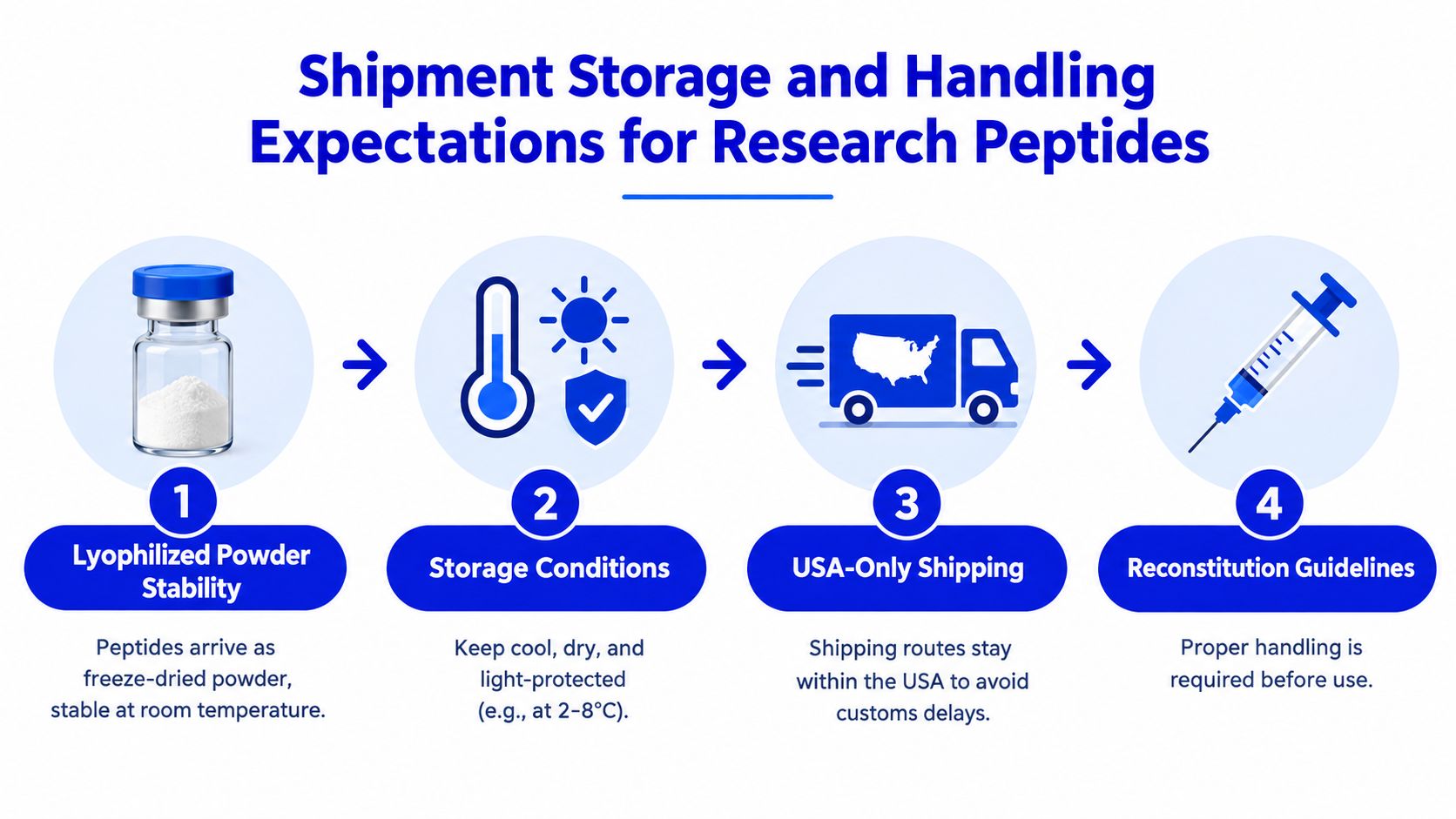
Treat shipment handling as a process flow:
Some supplier pages describe USA-only shipping, which can reduce customs-related uncertainty. That doesn't guarantee a shipment will arrive in perfect condition, so clear tracking and responsive support remain important.
A lab manager can use a short receiving record:
Avoid making assumptions from a generic storage statement. If the documentation is unclear, request clarification in writing and retain the response with the purchasing record.
A trustworthy peptide supplier makes it possible to answer a simple question: Which exact batch did this vial come from, and what evidence supports its release? If the answer requires repeated emails or depends on a generic certificate, the procurement risk is higher.
Traceability includes more than a lot number. It connects the lot to production records, testing, labeling, shipment history, and customer support. That connection helps researchers investigate unexpected analytical results without guessing which material entered the workflow.
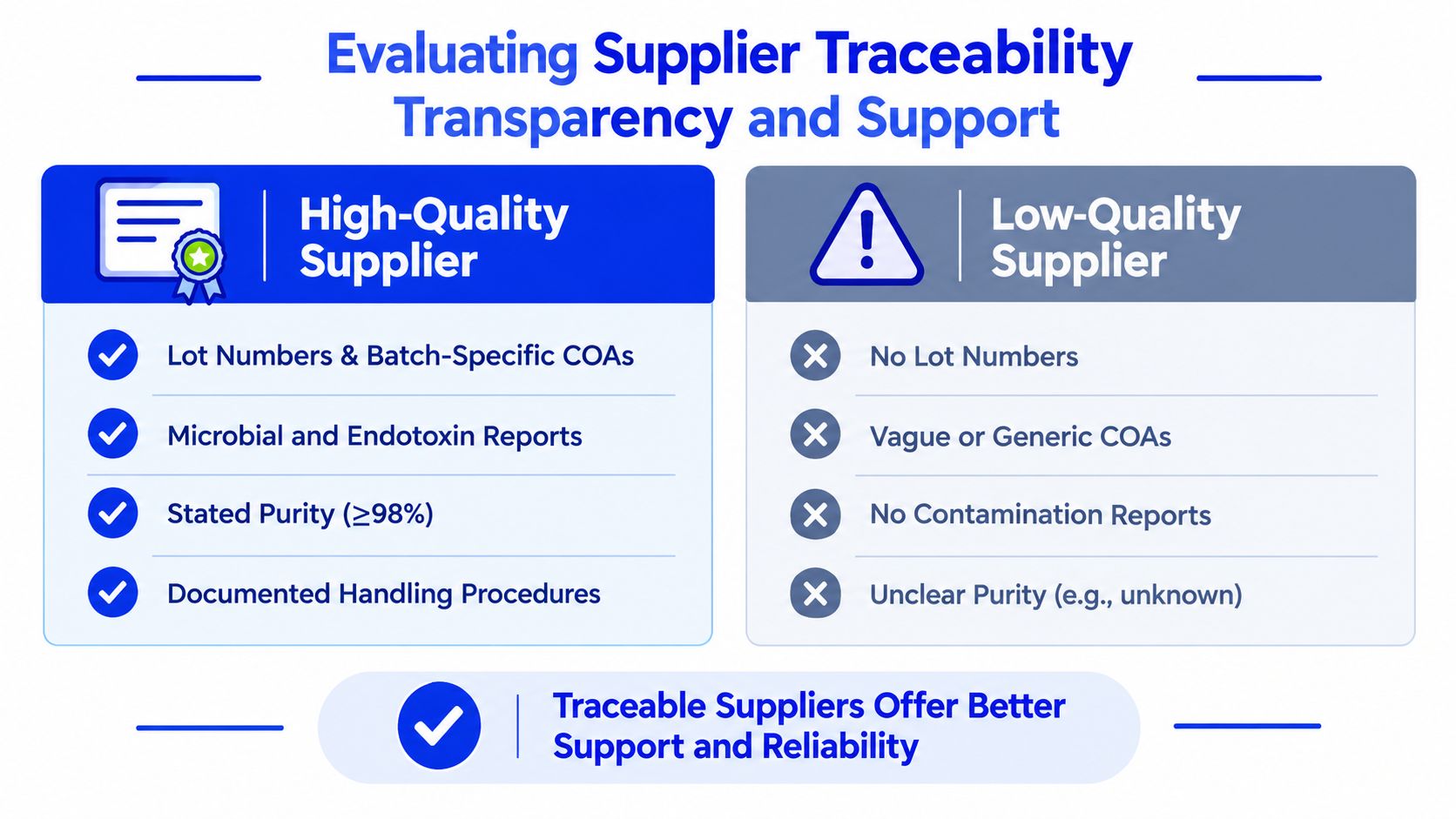
Instead of judging a vendor by design or price alone, record evidence under three headings.
Documentation quality includes batch-specific COAs, analytical methods, stated purity, microbial testing, and endotoxin testing. The supplier should explain what each document covers and what it doesn't cover.
Manufacturing and handling clarity includes the stated production location, batch practices, storage guidance, packaging information, and shipping route. “Made in the USA” is useful context, but buyers should still ask how the claim relates to the actual product and documentation.
Operational support includes account management, order tracking, returns information, shipping policies, and a help desk that can answer technical document questions. Support becomes especially valuable when a lab receives a damaged package or finds a mismatch between a label and a COA.
Online seller coverage often emphasizes purity while giving little attention to contamination controls, batch identity, or intended use. Independent literature notes that 2025 included at least one new peptide approval and roughly 130 marketed peptides total, while also highlighting the continued growth of legitimate pharmaceutical peptide activity. The review of marketed and approved peptide development helps place online research procurement within a much larger scientific and commercial context.
Warning signs include:
A supplier that offers products such as BPC-157, TB-500, GHK-Cu, CJC-1295, Ipamorelin, Semax, and Selank should present each item with the same procurement discipline. Product variety doesn't reduce the need for traceability.
A careful search for peptides for sale USA should end with a documented purchasing decision, not a quick reaction to a purity number. Start by confirming the intended research use and checking that the product page avoids human-use claims. Then review the lot-specific COA, analytical method, impurity information, microbial report, and endotoxin report.
Shipment information deserves the same attention. Confirm how the material will be handled, how tracking works, what storage conditions apply, and what you should do if the package arrives damaged or the documents don't match.
The most useful supplier comparison is evidence-based:
Researchers should also remember that online availability doesn't establish approval for human use. Independent reporting on peptide restrictions in 2026 states that certain peptides “can't be made in the U.S., except for research purposes,” which helps explain why research-only labeling remains central to domestic procurement. The reporting on FDA peptide restrictions is useful context, but your organization should apply its own compliance review before ordering.
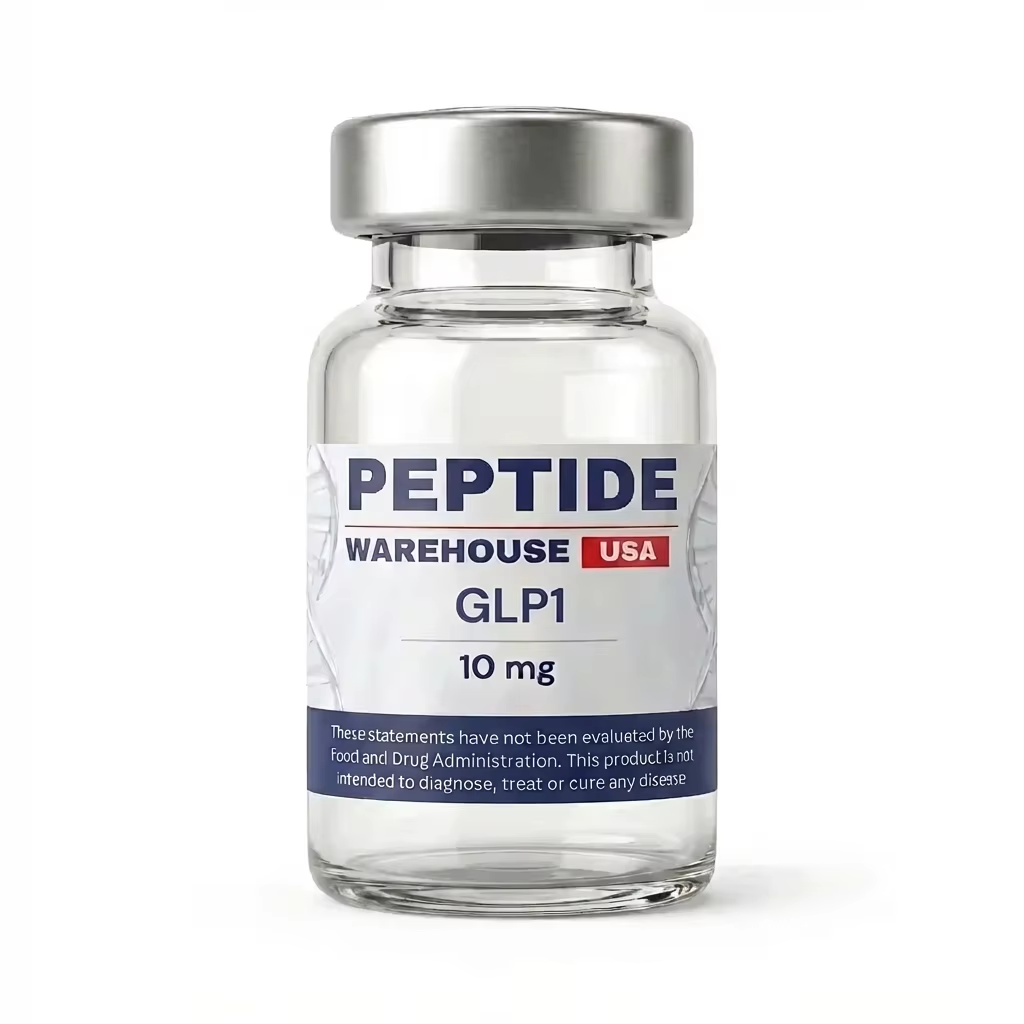
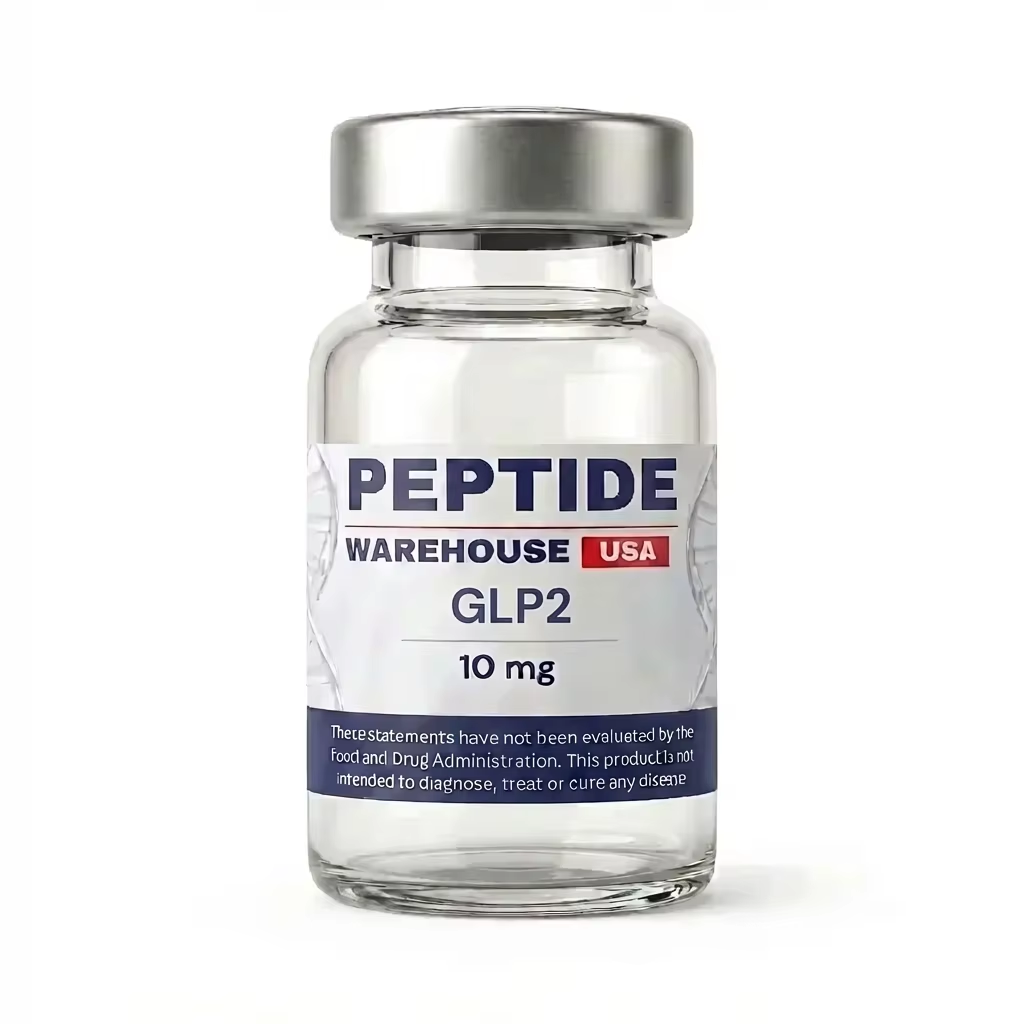
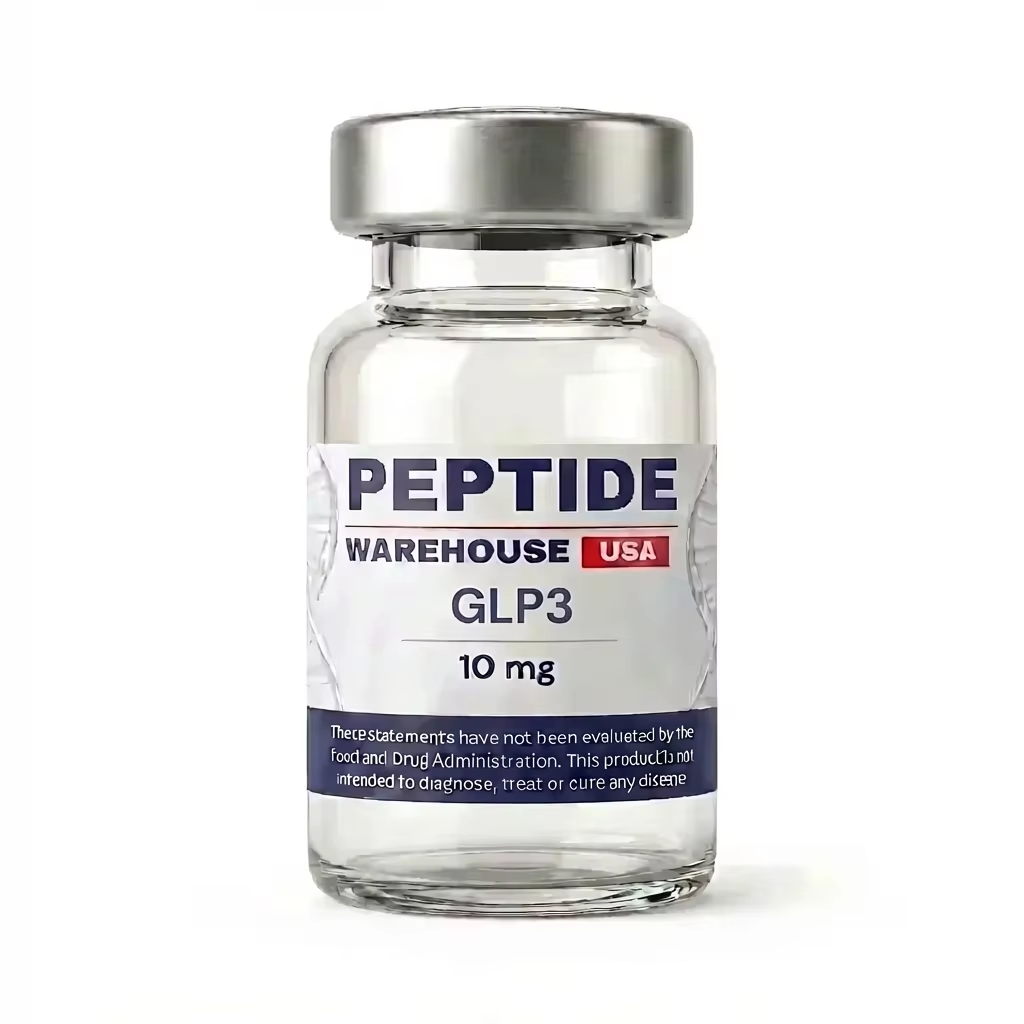
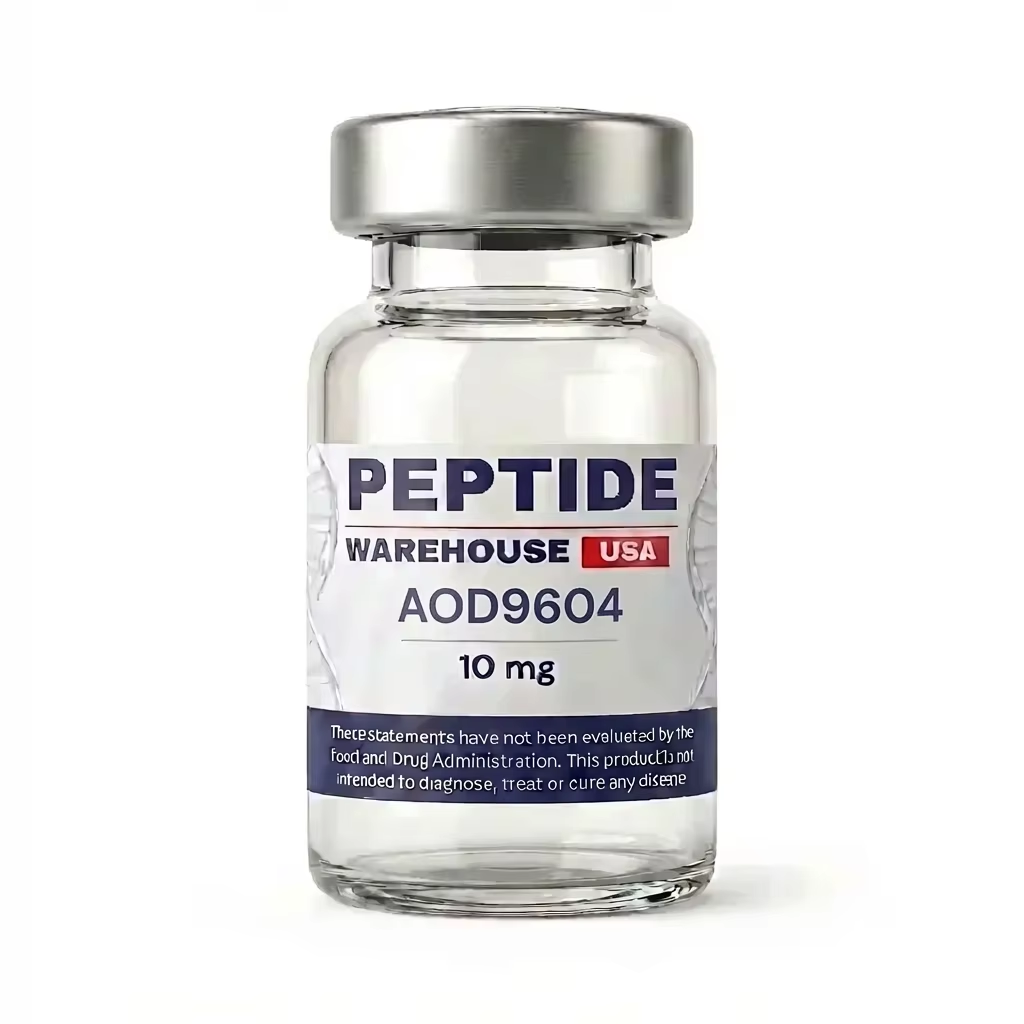
Peptide Warehouse USA offers U.S.-made research peptides and related compounds with batch documentation, including COAs, microbial and endotoxin reports, and stated purity information. Visit Peptide Warehouse USA to review available options, shipping details, and support resources before your next documented procurement decision.
Leave a comment