
No products in the cart.



Searching for PP 332 peptide usually leads to one of the most important corrections in this topic: PP 332 is not a peptide. The compound commonly described this way is SLU-PP-332, a synthetic small molecule that activates estrogen-related receptors, or ERRs, and was created as a research tool for studying metabolic signaling.
That distinction matters. A peptide has an amino-acid backbone and peptide bonds, while SLU-PP-332 has a different chemical structure, different characterization requirements, and a different research profile. This guide explains its identity, mechanism, preclinical findings, receptor potency, and the documents researchers should review before considering any research supply.
The discussion is limited to laboratory, analytical, and preclinical research. SLU-PP-332 hasn't completed human clinical trials as of 2026, so findings from mouse models shouldn't be interpreted as evidence of human safety, effectiveness, or suitability for personal use.
The search term PP 332 peptide points toward the wrong buying checklist. Researchers evaluating this material need to verify chemical identity, assay results, batch traceability, and analytical records, rather than rely on peptide-style product language.
SLU-PP-332 is a small-molecule ERR pan-agonist studied as an exercise-mimetic research compound. Preclinical mouse studies have examined pathways associated with energy expenditure, fat oxidation, endurance, and mitochondrial metabolism. The published preclinical research describes its use as a tool for investigating exercise-related metabolic programs. These findings remain experimental and do not establish clinical use.
Online listings can place peptides, small molecules, metabolic compounds, and research chemicals under similar search terms. The wording “PP 332 peptide” may help people find a product, but it does not determine the material's chemistry or the evidence supporting it.
A practical evaluation starts with four checks:
The later potency table helps readers compare reported activity across ERR targets and understand what an EC50 value can, and cannot, show. The COA checklist then turns that information into a procurement screen: match the lot, confirm identity testing, inspect the analytical data, and check whether the supplier's records are specific rather than generic.
Research boundary: A promising mouse result supports further study, not treatment.
The useful question is therefore practical: what does this small molecule do in a controlled research model, and can a laboratory verify the material it received?
The name PP 332 peptide points to a product label, not a complete chemical description. The compound's chemical name is 4-Hydroxy-N′-(naphthalen-2-ylmethylene)benzohydrazide, and its research identity is SLU-PP-332, a synthetic small-molecule pan-agonist of estrogen-related receptors. Bio-Techne's compound reference lists it as a research small molecule and describes its activity in metabolic syndrome models.
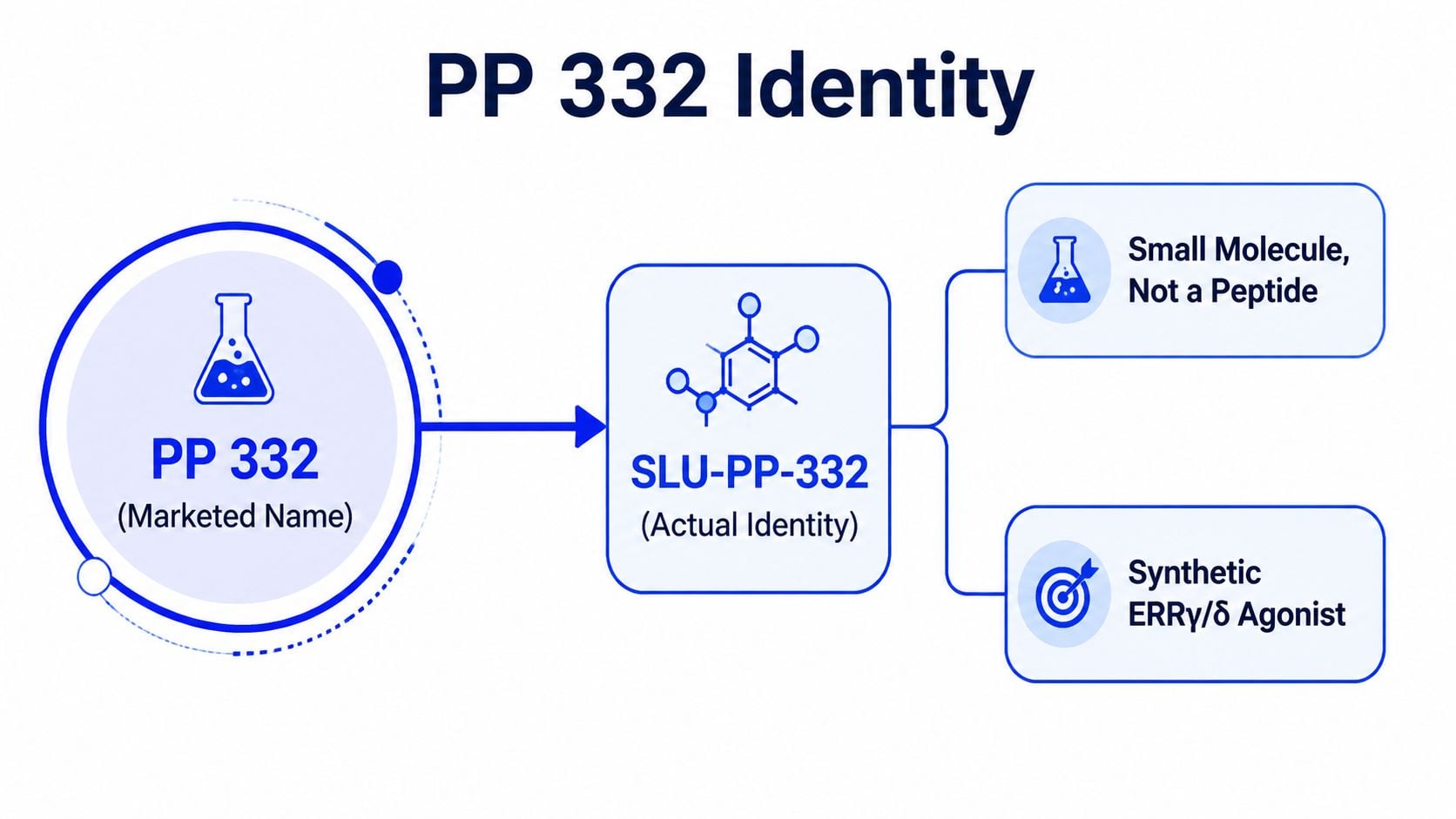
A useful way to vet this material is to start with the name and structure shown on the product record, then compare them with the supplier's COA and characterization data. A peptide is described through an amino-acid sequence, chain length, or modification pattern. SLU-PP-332 is described through its defined molecular structure and analytical identity. A research-focused explanation of the mislabel makes the same distinction and identifies the compound as a synthetic small molecule without peptide bonds.
| Feature | Peptide | SLU-PP-332 |
|---|---|---|
| Basic structure | Amino-acid chain | Defined synthetic small molecule |
| Chemical description | Peptide sequence and modifications | 4-Hydroxy-N′-(naphthalen-2-ylmethylene)benzohydrazide |
| Relevant research language | Peptide stability, sequence, and formulation | Receptor agonism, chemical identity, purity, and assay characterization |
| Correct classification | Peptide compound | ERR research tool compound |
The table is more than a terminology exercise. It tells a laboratory what evidence to request. A sequence-focused certificate would address a peptide, while SLU-PP-332 should be supported by chemical identity testing, purity data, and an assay suited to the compound.
ERR means estrogen-related receptor. Despite the name, ERRα, ERRβ, and ERRγ are distinct from estrogen receptors. Researchers study these receptors as regulators of gene programs associated with cellular energy use and oxidative metabolism.
The receptor family works like a control panel for parts of the cell's energy-management system. A pan-agonist is intended to activate several members of that family, although each isoform can show different biological roles and measured activity. Researchers should therefore record which ERR targets were tested, which assay was used, and how the compound performed.
A peptide ERR assay workflow can help organize those questions around assay selection, controls, and interpretation. Its wording reflects the market label, while the workflow remains useful for planning receptor research.
Calling SLU-PP-332 an exercise-mimetic research compound can mislead if the label is taken at face value. The compound does not reproduce every physical, neurological, cardiovascular, or mechanical feature of exercise. In preclinical work, the term refers to activating ERR-linked gene programs associated with oxidative metabolism and cellular energy use.
SLU-PP-332 is a small-molecule ERR pan-agonist, not a peptide. Its proposed mechanism is easier to follow as a chain of experimental questions: which ERR isoforms are activated, which transcriptional programs change, and which metabolic readouts follow?
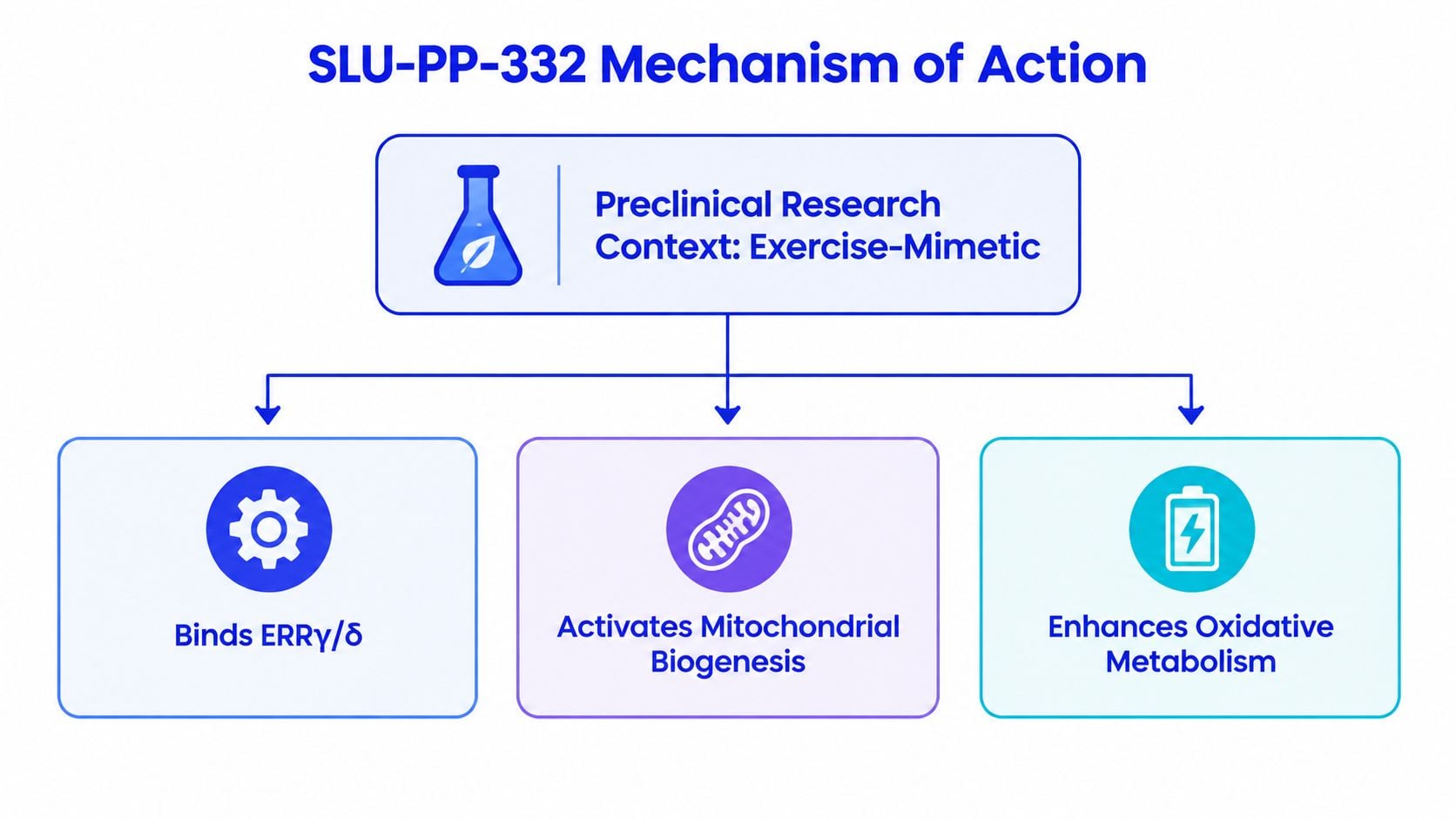
The research logic generally follows four stages:
The primary publication describes mouse experiments in which treatment was administered over a defined study period and across experimental dosing conditions. Those details matter because a result reflects the tested dose, route, schedule, animal model, and endpoint. They should appear in a methods review rather than being treated as a general-use instruction. The primary research publication
The key word is model. An animal response can support a biological hypothesis, but it cannot establish that the same response will occur in people. It also cannot establish an appropriate dose, route, duration, safety profile, or clinical use.
A neutral compound description can help place SLU-PP-332 within this preclinical research context, while the primary paper remains the stronger source for experimental interpretation. The neutral product description from Bio-Techne
A short visual explanation can make the receptor-to-metabolism relationship easier to review:
ERRα is relevant to studies of mitochondrial oxidative programs. Researchers use compounds such as SLU-PP-332 to examine how receptor activation may influence cellular systems involved in energy processing.
No completed human clinical trials had been reported as of 2026. The compound therefore remains a tool for early translational metabolic research, not an accepted medical treatment or clinically established product.
Receptor potency data helps researchers move beyond broad marketing terms. For SLU-PP-332, reported EC50 values differ across the three ERR isoforms. EC50 is the concentration associated with a half-maximal response in a specified assay, so it should be interpreted alongside the assay design, cell system, controls, and experimental conditions.
A neutral R&D Systems product reference reports the following values:
| ERR Isoform | Reported EC50 | Research Relevance |
|---|---|---|
| ERRα | 98 nM | Strongest reported activity among the listed isoforms, relevant to oxidative metabolism studies |
| ERRβ | 230 nM | Supports evaluation of activity across the ERR family |
| ERRγ | 430 nM | Provides a broader pan-ERR receptor comparison |
The values show that the reported activity is not uniform. ERRα has the lowest listed EC50, meaning the strongest functional activity among these measurements appears in the isoform most closely associated with mitochondrial oxidative programs. That pattern can help researchers decide which receptor readouts deserve particular attention.
A lower EC50 doesn't automatically mean a compound is safer, more effective, or clinically useful. It only describes potency within a particular assay. Researchers should ask:
The comparison also reinforces why small-molecule classification matters. A true peptide comparison would focus on different structural and analytical questions. For SLU-PP-332, the relevant evaluation centers on chemical identity, receptor activity, purity, and reproducibility.
Interpretation rule: EC50 data helps describe receptor activity. It doesn't convert preclinical potency into a human-use recommendation.
A Certificate of Analysis, or COA, should do more than display a purity number. For a compound marketed as “PP 332 peptide,” the first quality question is whether the documentation correctly identifies SLU-PP-332 as a small molecule.
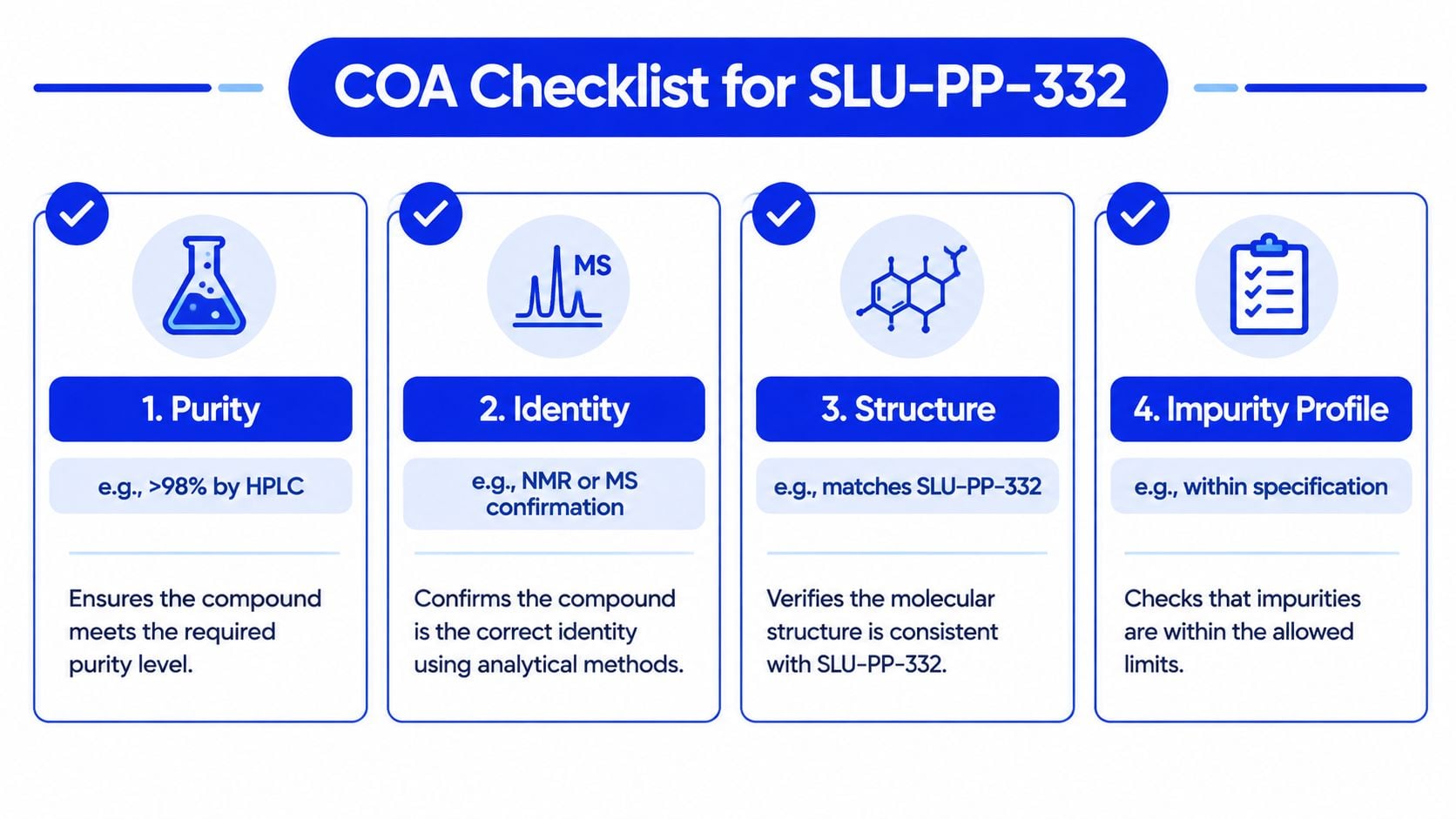
A useful COA should connect the material in your hands to a specific production batch. Look for a product name, lot or batch identifier, test date, and clear relationship between the document and the container label.
Identity confirmation should use an appropriate analytical method. Depending on the laboratory's testing program, that may include mass spectrometry, nuclear magnetic resonance, chromatography, or another documented approach suitable for the compound.
Researchers should avoid treating “high purity” as a complete quality assessment. A meaningful report should identify the method used, the specification applied, and the result for the tested lot.
Use this review sequence:
A missing test method can matter as much as a missing result. If a supplier lists purity without explaining how it was measured, the buyer has less information for assessing comparability between batches.
Practical rule: A COA is useful only when the document, lot, method, and material all connect clearly.
Supplier evaluation should combine the COA review with a broader procurement check. A document can look polished while still leaving important questions unanswered, so researchers should examine the entire supply chain.
Begin with transparency. Does the supplier state whether the material is for research use only? Does it provide an age gate and an FDA disclaimer? Does the company clearly distinguish a research chemical supplier from a compounding pharmacy or outsourcing facility?
Then review operational details:
Price should be considered alongside traceability. A lower listed cost may be less useful if the supplier can't provide a lot-specific report or answer basic identity questions. Conversely, detailed documentation doesn't eliminate the need for independent institutional review.

A vendor's educational page may help explain a compound, but it shouldn't replace technical documentation. Researchers should compare the product description with the COA, chemical identity, assay information, and intended use statement.
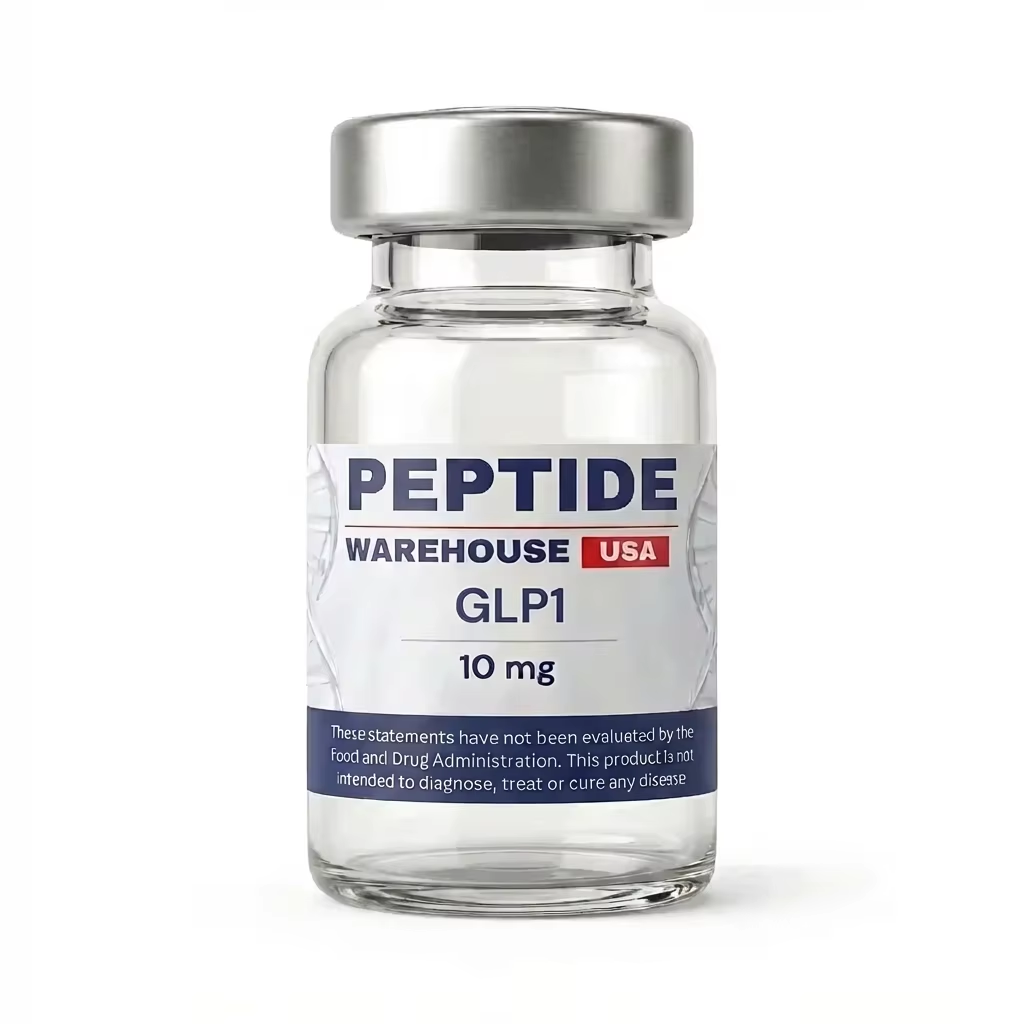
Peptide Warehouse USA is one research supplier that describes its catalog as including peptides and related compounds for laboratory, analytical, and preclinical applications. Its stated materials include batch documentation, third-party reports, and research-use-only positioning. Researchers can still apply the same independent checklist to any supplier before placing an order.
The marketplace label PP 332 peptide refers to SLU-PP-332, a synthetic small molecule identified as 4-Hydroxy-N′-(naphthalen-2-ylmethylene)benzohydrazide. Its research role is as a pan-agonist of ERRα, ERRβ, and ERRγ, so product language should not substitute for chemical identification.
Preclinical work has connected the compound with exercise-mimetic metabolic signaling in mice, including changes related to energy expenditure, fatty acid oxidation, endurance, fat mass, and insulin sensitivity. These findings remain animal research, with no completed human clinical trials reported as of 2026. The earlier preclinical publication supplies the relevant research context.
Use the following checklist before interpreting results or ordering material:
This process helps researchers evaluate SLU-PP-332 as a research chemical and separate documentation from peptide marketing. Review primary literature and institutional requirements before purchase or experimental use.
Peptide Warehouse USA lists peptides and related compounds for laboratory, analytical, and preclinical use, with stated batch documentation, COAs, microbial reports, and endotoxin reports. Peptide Warehouse USA provides research supply and purchasing information.
Leave a comment