
No products in the cart.



Why is a compound discussed as a libido treatment often mistaken for a blood-flow enhancer? That question gets to the heart of the confusion around the PT-141 peptide. PT-141, also known as bremelanotide, belongs to the melanocortin family and acts primarily through central nervous system pathways, not through the same vascular mechanism associated with PDE5 inhibitors.
This guide separates the science from the loose language used in consumer and research discussions. You'll learn what PT-141 is, how its melanocortin receptors shape arousal signaling, what the clinical evidence established, why the FDA-approved product differs from research-use material, and how formulation, storage, documentation, and tolerability affect research quality.
PT-141 draws unusual interest because it sits at the intersection of peptide science, sexual-health research, and regulatory medicine. Many compounds discussed online remain at an early research stage, while bremelanotide reached a defined regulatory milestone when the U.S. FDA approved it under the brand name Vyleesi for acquired, generalized hypoactive sexual desire disorder, or HSDD, in premenopausal women on June 21, 2019. That history gives PT-141 a clearer clinical identity than many research peptides.
The name can still create confusion. PT-141 peptide, bremelanotide, and Vyleesi may appear in the same conversation, but they don't always refer to the same regulatory context. Bremelanotide is the active compound, Vyleesi is the FDA-approved branded product, and research-market PT-141 products are separate materials that must be evaluated according to their labeling, documentation, and intended use.
The mechanism also deserves careful framing. PT-141 is a nonselective melanocortin receptor agonist. Mechanistic descriptions emphasize central MC3R and MC4R signaling in hypothalamic circuits, which means researchers study it as a neurogenic modulator of arousal rather than as a conventional agent intended to increase genital blood flow.
The central distinction: PT-141 is best understood as a melanocortin research compound with a central arousal mechanism, not as a generic performance enhancer.
The sections ahead move from identity to receptor biology, then from human evidence to practical research considerations. Formulation choices, storage, batch documentation, and adverse-event patterns all matter because a scientifically interesting compound still requires disciplined handling and careful interpretation.
This article is educational, not medical advice. Approved treatment decisions belong with qualified clinicians, while research-use materials must remain within appropriate laboratory, analytical, or preclinical settings.
A peptide is a chain of amino acids arranged in a sequence that gives the molecule its biological behavior. PT-141 is a synthetic cyclic heptapeptide analogue associated with melanocortin research and derived from melanotan-related research. A simple way to think about its classification is to separate the molecule's family resemblance from its functional role. Sharing a relationship with melanocortin compounds doesn't mean every compound produces the same research outcome.
PT-141 is also known as bremelanotide. Its identity matters because the same short name can appear in different settings, including an FDA-approved medicine, clinical literature, and research-supply listings. Those settings shouldn't be blended together.
The compound is a melanocortin receptor agonist. In plain language, it binds to melanocortin receptors and activates signaling. That places it in a different category from PDE5 inhibitors, which are generally discussed in relation to vascular mechanisms. It also distinguishes PT-141 from tanning-focused melanocortin compounds, even though the compounds may share aspects of their broader receptor family.
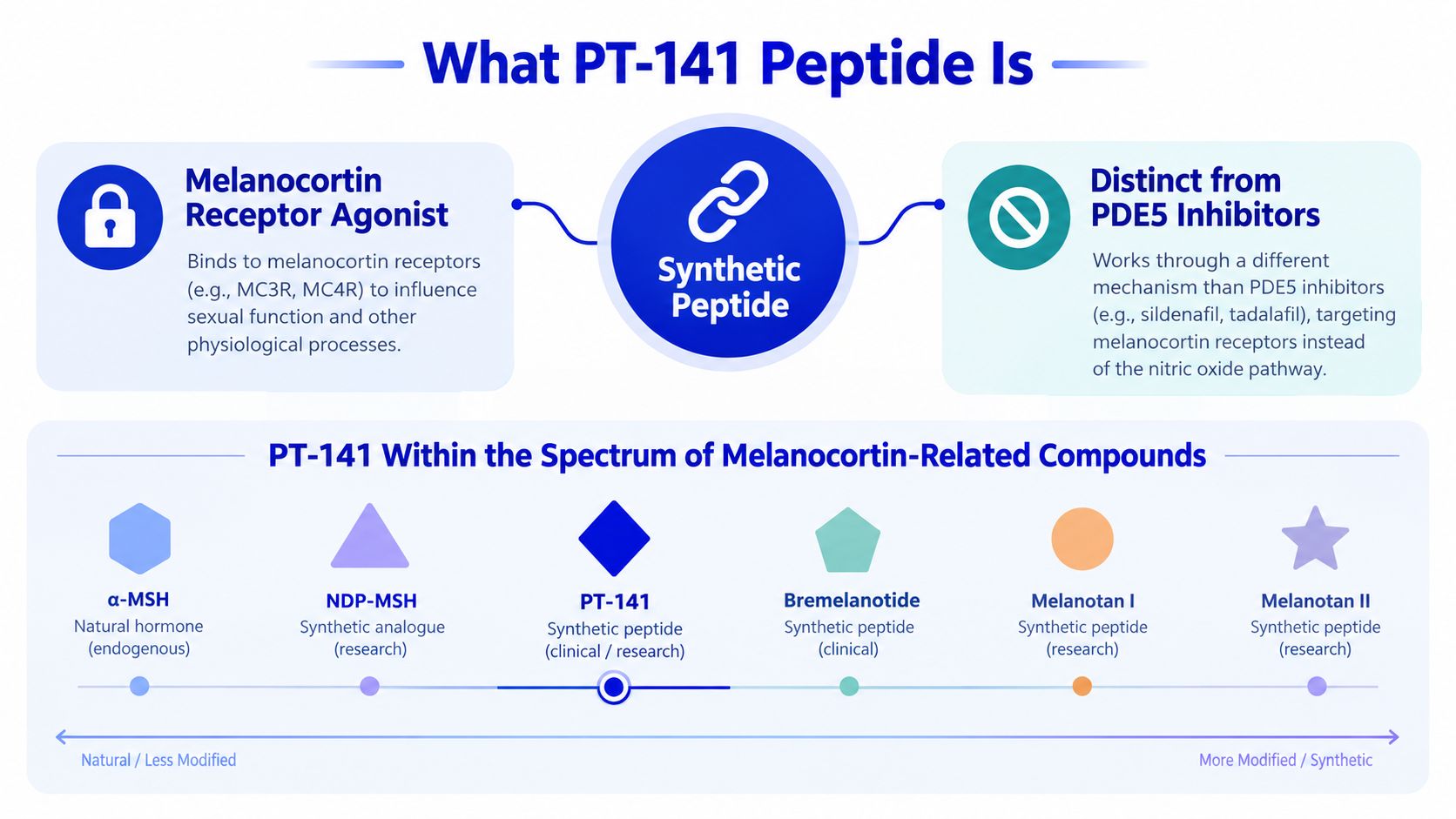
Researchers and buyers can avoid many misunderstandings by asking three questions:
The structure helps explain why PT-141 is discussed as a peptide, but structure alone doesn't establish a use case. Researchers still need receptor data, study design, formulation information, and quality documentation.
That distinction is especially important in buyer-aware searches. A page promising broad “benefits of peptides” may group unrelated compounds together, while a responsible PT-141 evaluation asks whether the material's identity, assay data, storage requirements, and intended application are clear.
PT-141's pharmacology becomes easier to understand when the receptor profile is separated from the downstream interpretation. The FDA label reports the potency order as MC1R > MC4R > MC3R > MC5R > MC2R. Mechanistic reviews place particular emphasis on central MC3R and MC4R signaling in hypothalamic circuits involved in sexual motivation and arousal. The result is a compound whose primary research interest is neurogenic signaling.
When PT-141 binds to these receptors, it activates a Gs-coupled pathway that increases intracellular cyclic adenosine monophosphate, or cAMP. You don't need to memorize the full signaling cascade to understand the practical point. Receptor binding changes how central arousal circuits communicate, rather than relying on nitric-oxide-dependent vascular augmentation as the main mechanism.
Mechanism in one sentence: PT-141 is studied as a central melanocortin agonist, while PDE5 inhibitors are associated with vascular signaling and blood-flow support.
That difference changes how researchers frame endpoints. A vascular compound might be evaluated around blood-flow measures, while PT-141 research may focus more heavily on arousal response, motivation-related behavior, receptor engagement, and the timing of acute effects. These categories can overlap in a broader physiological response, but they shouldn't be treated as identical mechanisms.
Controlled human studies of PT-141 for erectile response reported statistically significant erections at doses above 7 mg, compared with placebo, with the first erection occurring at approximately 30 minutes. The PubMed record for that controlled study supports the importance of onset timing and dose-response interpretation in translational planning.
The practical implication is a short, acute pharmacodynamic window rather than a slow cumulative effect. Researchers therefore need to define administration timing, observation periods, endpoint selection, and acute safety monitoring before interpreting results.
PT-141 has a rare combination of research relevance and established regulatory history. On June 21, 2019, the U.S. FDA approved bremelanotide under the brand name Vyleesi for acquired, generalized HSDD in premenopausal women. The approval made it the first melanocortin receptor agonist approved for sexual dysfunction and the second FDA-approved treatment for HSDD. The PT-141 regulatory overview provides that context.
The clinical foundation came from the RECONNECT phase 3 program. It included two identical randomized controlled trials, studies 301 and 302, enrolling 1,267 premenopausal women with acquired, generalized HSDD over 24 weeks. In the integrated analysis, bremelanotide 1.75 mg as needed produced a +0.35 improvement in the Female Sexual Function Index desire-domain score versus placebo and a -0.33 reduction in desire-related distress on FSDS-DAO item 13. Both findings were statistically significant at P<.001. These figures are reported in the clinical research summary for PT-141.
| Outcome Measure | Result in Bremelanotide Group |
|---|---|
| RECONNECT population | 1,267 premenopausal women with acquired, generalized HSDD |
| Study duration | 24 weeks |
| FSFI desire-domain difference versus placebo | +0.35 |
| FSDS-DAO item 13 difference versus placebo | -0.33 |
| Statistical significance | P<.001 for both reported outcomes |
| Open-label extension | 684 women over 52 weeks |
| Common drug-related adverse events | Nausea 40.4%, flushing 20.6%, headache 12.0% |
A later 52-week open-label extension enrolled 684 women and reported sustained benefit without new safety signals. The same clinical summary identified nausea, flushing, and headache as common drug-related adverse events. Those findings don't make tolerability a footnote. Nausea, in particular, is central to understanding why some users stop treatment or struggle with persistence.
The FDA-approved indication is specific. It applies to premenopausal women with acquired, generalized HSDD, not to every form of low desire, every age group, or every product sold under a PT-141 label. Male use remains investigational and doesn't have a clear regulatory path, so consumer discussions that blur approved treatment, off-label curiosity, and research-only material can mislead readers.
For a broader reading list and research context, Pt 141 peptide research Australia can help readers locate additional discussion, but it shouldn't replace regulatory labeling or professional review.
Researchers commonly encounter PT-141 in three broad presentations: lyophilized powder, reconstituted liquid, and nasal spray. The right choice depends less on convenience alone and more on study design, absorption questions, storage controls, and how precisely the laboratory needs to define the material being evaluated.
Lyophilized powder offers a dry format that can be useful when a study requires storage before preparation. Reconstituted liquid reduces preparation work at the point of use, but it introduces a liquid-handling and stability question. Nasal spray formats shift the administration route and may be relevant when a protocol is specifically evaluating intranasal delivery or a non-injectable presentation.
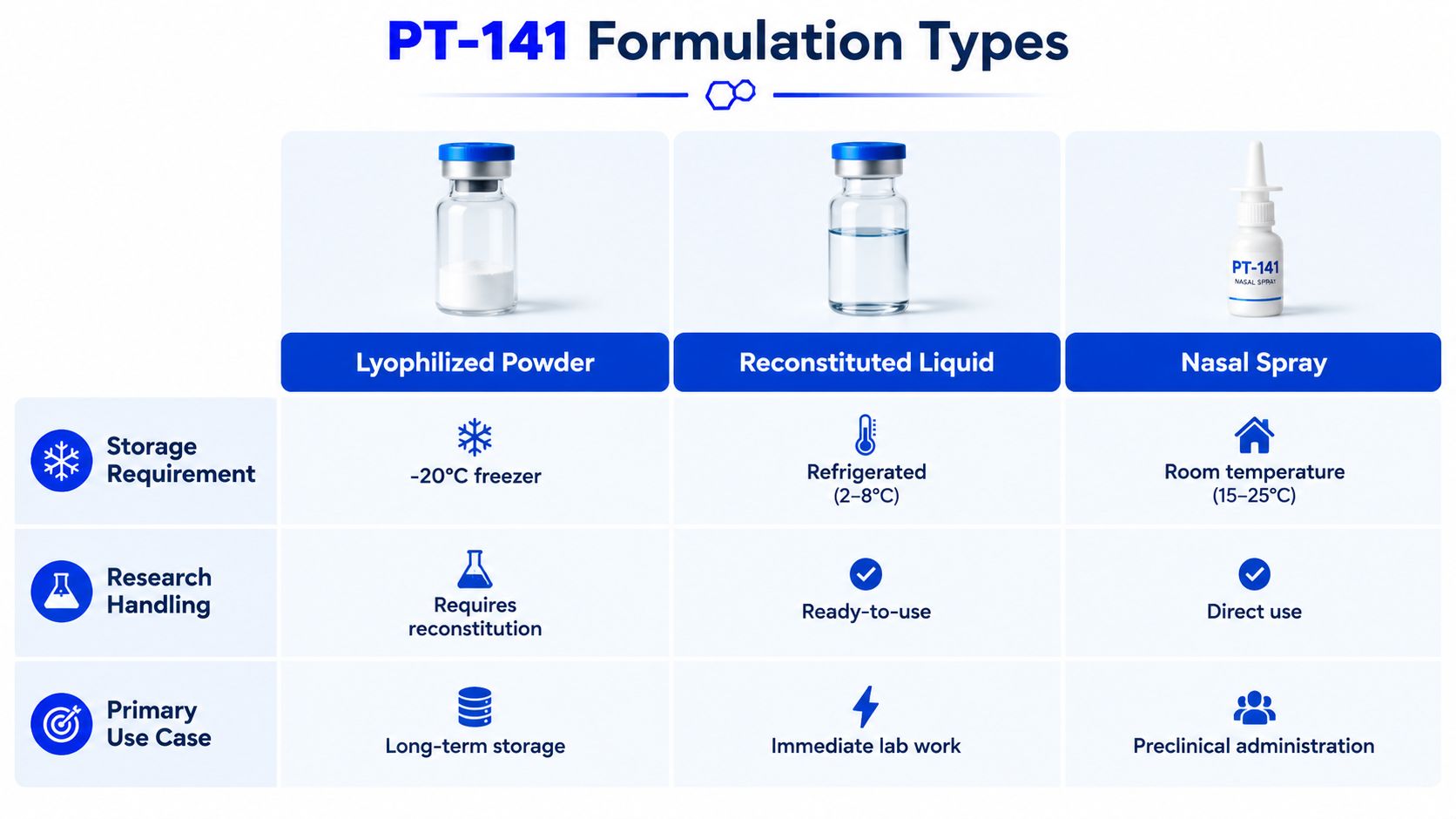
| Format | Main research consideration | Typical fit |
|---|---|---|
| Lyophilized powder | Requires controlled preparation before study use | Longer-term material storage and laboratory preparation |
| Reconstituted liquid | Ready for immediate laboratory work, with liquid stability to document | Studies where preparation has already been standardized |
| Nasal spray | Changes the delivery route and introduces device-related variables | Preclinical administration or intranasal delivery research |
Nasal delivery attracts interest because it may support rapid delivery through the nasal route and can simplify handling compared with a powder that requires preparation. That doesn't automatically make it superior. Researchers must account for spray-device consistency, formulation composition, absorption variability, and whether the model answers the intended biological question.
A lyophilized product may suit a laboratory that prioritizes controlled preparation and documented storage. A ready-to-use liquid may suit an immediate workflow. A nasal spray may be appropriate when the delivery route itself is part of the research question.
Research planning rule: Choose the formulation that matches the endpoint, not merely the format that appears easiest to handle.
No formulation should be treated as interchangeable without reviewing its documentation. The label, lot information, assay, and intended research application should guide the comparison.
Research integrity depends on more than obtaining a vial. Peptides can lose value as experimental materials when laboratories overlook temperature, moisture, light exposure, preparation records, or lot traceability. A well-designed study needs a handling process that another researcher could understand and reproduce.
A practical quality review should begin before purchase. Researchers can ask whether the supplier identifies the compound clearly, provides a lot-specific Certificate of Analysis, and explains what testing supports the stated specification. Documentation isn't decorative. It connects a physical sample to an analytical record.
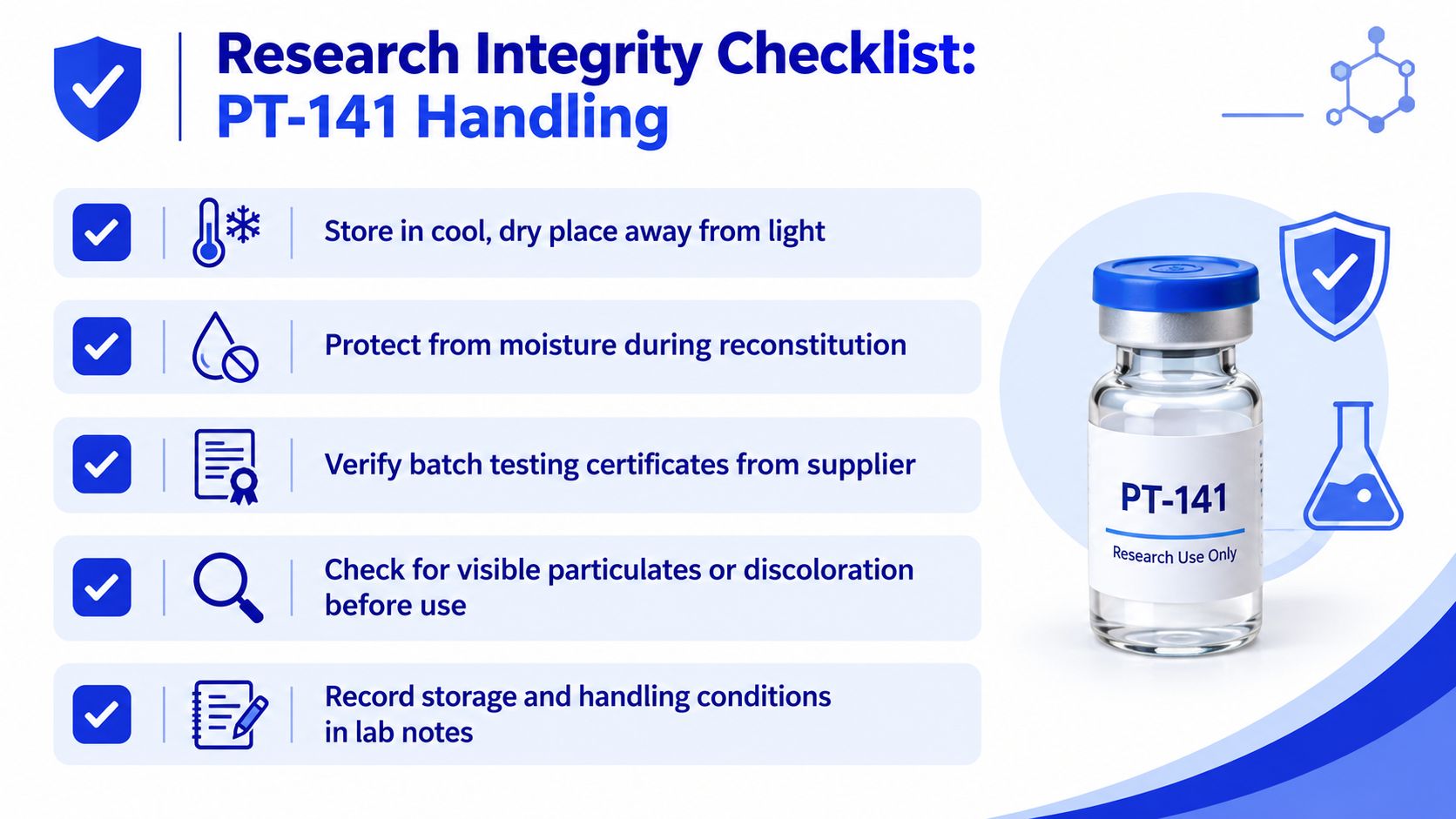
Purity statements also require context. Peptide Warehouse USA describes catalog materials with stated purity levels up to 99.5%, alongside third-party documentation such as COAs and microbial and endotoxin reports. That information can support traceability, but researchers should still review the certificate for the specific lot rather than relying on a general product-page statement.
US manufacturing and batch testing can be useful sourcing markers because they help laboratories establish a documented supply chain. They aren't substitutes for independent review, appropriate storage, or study-specific controls.
PT-141 is easiest to understand when three ideas stay connected. First, bremelanotide is a melanocortin receptor agonist whose research interest centers on central MC3R and MC4R signaling. Second, its FDA history is specific to Vyleesi for acquired, generalized HSDD in premenopausal women. Third, research-market products must remain clearly separated from approved medical use.
The evidence also shows why tolerability deserves equal attention beside efficacy. The RECONNECT program produced statistically significant improvements in desire and desire-related distress, while the longer extension reported sustained benefit without new safety signals. At the same time, nausea, flushing, and headache were common drug-related adverse events, making persistence and study-participant experience important endpoints.
For laboratory planning, the most useful questions are practical:
Researchers comparing PT-141 with other compounds should also avoid assuming that all peptides belong to the same functional category. BPC-157 and GHK-Cu, for example, raise different research questions and shouldn't be treated as interchangeable components of a generic peptide stack.
A sound next step is a documented comparison, not an impulse purchase. Define the research question first, then select the formulation and supplier whose records support that question.
Explore the available scientific background, review the regulatory distinction carefully, and consult qualified professionals for any human-health decision. Research materials should remain within their stated intended use.
Peptide Warehouse USA offers research-use PT-141 in formats that include lyophilized powder and nasal spray, with product documentation such as COAs and microbial and endotoxin reports. Visit Peptide Warehouse USA to review the available research-grade options, lot information, and sourcing details for your laboratory or preclinical work.
Leave a comment