
No products in the cart.



What if the most important question about PT-141 isn't whether it can increase sexual arousal, but whether the material in your vial is properly identified, characterized, and suitable for the experiment you want to run? Online discussions often collapse an approved drug, a research peptide, and an off-label marketing claim into one product. That shortcut creates confusion for buyers and weakens otherwise careful laboratory work.
This guide treats PT-141, also known as bremelanotide, as a research compound. It separates receptor pharmacology from promotional language, distinguishes the FDA-approved indication from investigational male applications, reviews the known phase 3 tolerability profile, and gives you a practical framework for checking certificates of analysis before procurement. The discussion is strictly research-only and non-clinical. It isn't medical advice, and research material must not be used in humans or animals outside an appropriately reviewed protocol.
What exactly is PT-141 when a laboratory buyer evaluates it? It is a synthetic cyclic peptide analog of α-melanocyte-stimulating hormone, or α-MSH. Palatin Technologies developed it through melanocortin research, and it later became the active compound in Vyleesi, an FDA-approved drug for acquired, generalized hypoactive sexual desire disorder in premenopausal women. A regulated drug product and a lyophilized research peptide may share an active sequence or chemical identity, yet they differ in regulatory status, manufacturing presentation, labeling, and permitted use.
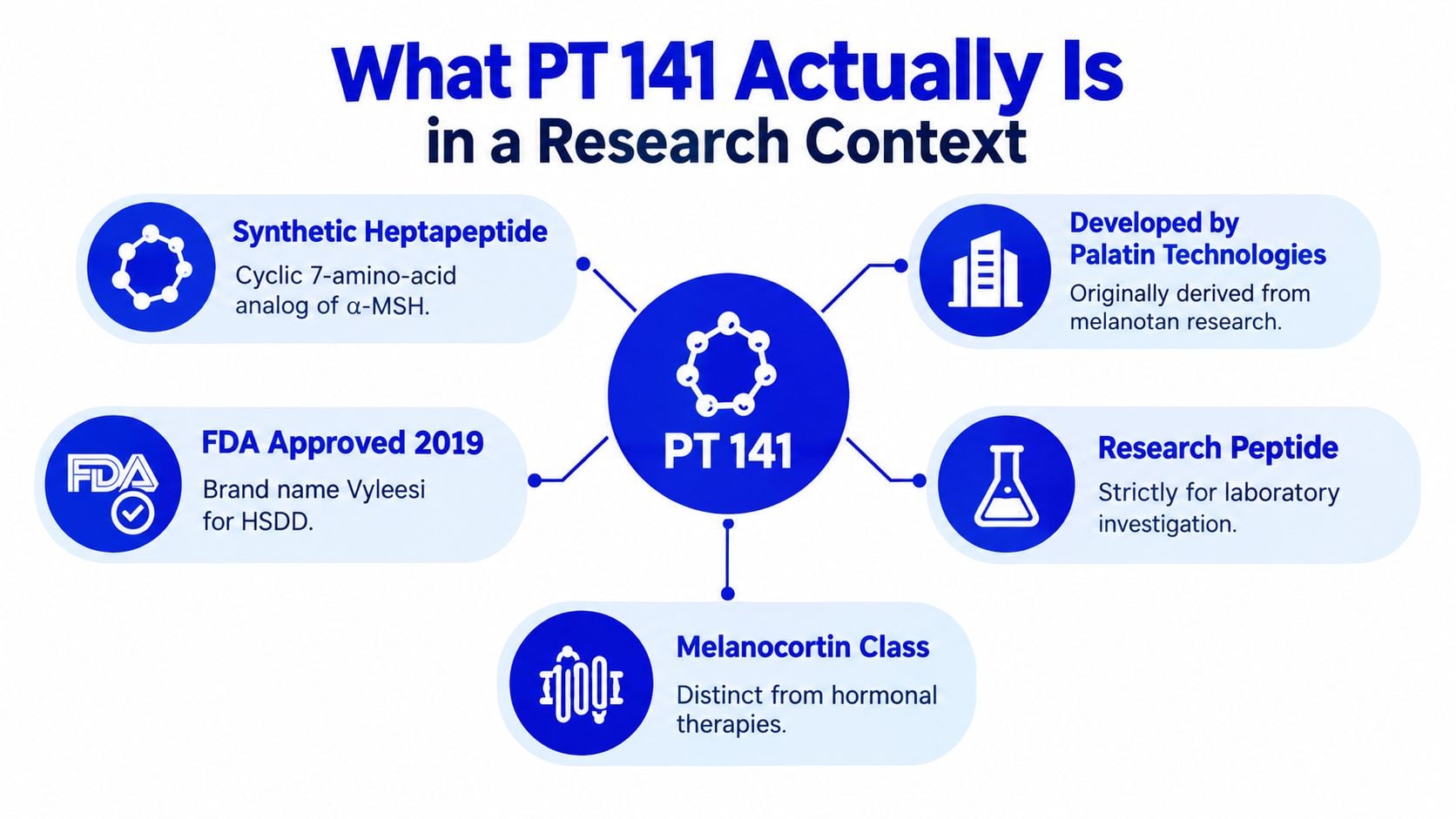
Before ordering, a lab buyer should answer four separate questions:
The FDA-approved product is a regulated pharmaceutical formulation with defined labeling and clinical-use requirements. A research peptide is supplied for laboratory, analytical, or preclinical investigation. Identical naming does not make a research vial a substitute for the approved product, and it should not be presented as a treatment.
The distinction also limits how results should be interpreted. Peer-reviewed receptor studies can support a mechanistic hypothesis, but they do not by themselves establish safety, efficacy, or an approved use for a particular population. The FDA prescribing information for Vyleesi identifies PT-141 as a nonselective melanocortin receptor agonist, with the highest reported potency at MC1R, followed by MC4R and MC3R. In central nervous system research, MC4R and MC3R signaling provides a relevant framework for examining behaviors associated with sexual desire. Receptor subtype activity still requires careful interpretation because assay results do not automatically establish a behavioral effect.
A catalog name is a starting point for verification, not proof of identity, purity, or assay suitability.
For procurement, that means treating regulatory context and material qualification as separate checks. Confirm what the compound is, determine which receptor questions the study addresses, and then inspect whether the specific lot has documentation appropriate to the planned experiment. A COA is useful only when it identifies the tested batch and reports methods and results that match the risks of the work, including purity, identity, microbial status, and endotoxin information.
Start with the receptor family, not the marketing label. Melanocortin receptors are a group of G protein-coupled receptors that respond to melanocortin peptides. PT-141 is a nonselective agonist, meaning it can activate multiple receptor subtypes rather than binding exclusively to one target.
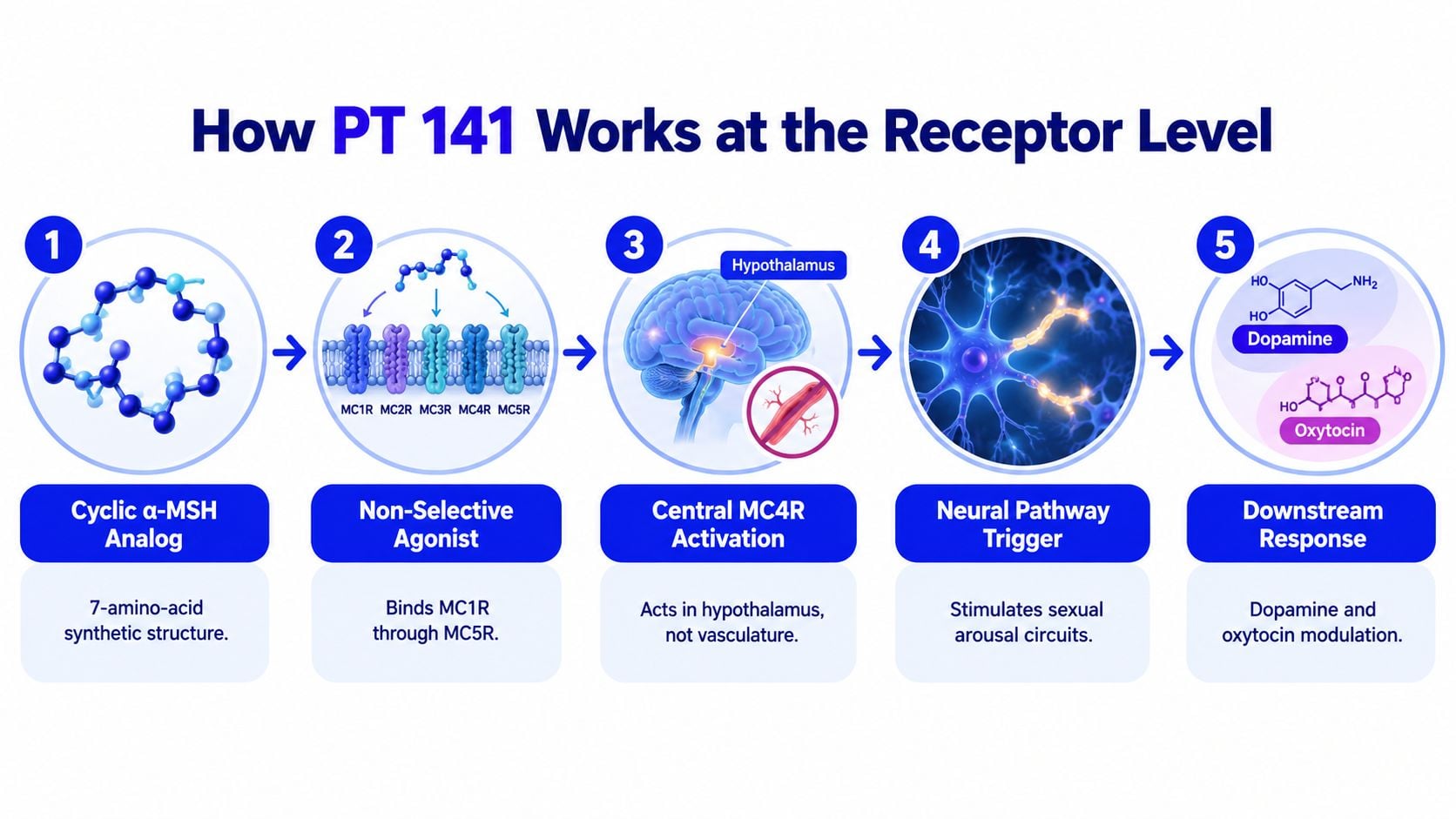
The receptor profile is central to experimental design. The FDA label reports the highest potency at MC1R, followed by MC4R and MC3R, with activity also described across the broader melanocortin receptor family. Yet potency at a receptor in a binding or functional assay isn't the same as proving that the receptor causes a behavioral outcome. In central nervous system studies, MC4R and MC3R signaling provides the more relevant mechanistic lens for behaviors associated with sexual desire.
MC4R is expressed in brain regions involved in energy balance, motivation, reward processing, and autonomic regulation. MC3R also participates in central melanocortin signaling. This doesn't mean that activating either receptor produces a uniform response in every model. Cell type, brain region, species, route of administration, exposure profile, and assay design all influence the observed result.
A useful way to frame the mechanism is as a chain:
That chain also explains why PT-141 shouldn't be described as a hormone replacement compound. Its primary research interest is receptor-mediated neural signaling, not the direct replacement of estrogen, testosterone, or another endocrine factor.
Melanotan II is often discussed as a parent compound in the historical development of melanocortin research. PT-141 retains a cyclic melanocortin-peptide framework, but its modified pharmacophore was developed to focus research interest on sexual arousal pathways while reducing the emphasis on pigmentation-related activity at intended therapeutic exposure.
The comparison is useful, but it shouldn't become an overstatement. A modified structure doesn't eliminate off-target pharmacology. A buyer still needs receptor profiling, purity data, and a study design that can distinguish the intended pathway from activity at other melanocortin receptors.
For receptor-focused work, the strongest interpretation comes from combining a PT-141 treatment group with appropriate controls, such as a vehicle group, a dose-response series, and, where scientifically justified, a selective receptor antagonist. The point isn't to force a preferred mechanism. It's to test whether the observed phenotype depends on the receptor pathway you think you're studying.
What does “approved use” establish for PT-141? The answer is narrower than many product pages imply. FDA approval covers acquired, generalized hypoactive sexual desire disorder in premenopausal women. It does not establish an indication for men, erectile dysfunction, general performance enhancement, or unspecified low libido.
Male applications remain investigational and require separate evidence from the approved female HSDD indication. The research-focused discussion of PT-141 and the male evidence gap describes why clinicians and researchers continue to treat the male evidence base as incomplete rather than as a settled clinical use.
Earlier studies examined bremelanotide in men with erectile dysfunction and sexual desire complaints. Some used intranasal formulations, and their endpoints included measures related to desire. These findings can support further study, yet they do not amount to a completed large phase 3 male HSDD or erectile dysfunction program, and they have not changed the approved label.
The appropriate description for male research is hypothesis-generating. An animal finding, an early human signal, or an off-label clinical anecdote may guide a protocol. None, by itself, proves a male therapy.
| Population | Indication | Regulatory Status | Evidence Strength | Dose Studied |
|---|---|---|---|---|
| Premenopausal women | Acquired, generalized HSDD | FDA-approved indication | Phase 3 clinical evidence supports the labeled use | The approved drug product uses a subcutaneous 1.75 mg dose on demand, as stated in the FDA label (2019) |
| Men | Erectile dysfunction or reduced sexual desire | Off-label or investigational | Earlier studies provide signals, but no completed formal male indication supports a proven claim | Formulations and protocols varied across investigations, so a single clinically established male dose should not be inferred |
For a laboratory, the implication is practical. A protocol examining male sexual behavior, erectile function, or motivational endpoints should define its model, controls, and outcomes without presenting the experiment as validation of a clinical indication. The research question may be sound while the clinical conclusion remains unsupported.
Human-subject work requires institutional review and the appropriate approved drug product. A research peptide does not replace those requirements. Procurement records should also keep the material's intended research use separate from claims about human treatment, so the study design and the resulting interpretation remain within the evidence available.
Could a behavioral response be partly a tolerability response? With PT-141, that question belongs in the protocol from the start. Nausea, flushing, cardiovascular changes, and handling stress can alter activity, feeding, autonomic tone, and general behavior. A study that records only its primary behavioral endpoint may mistake those effects for a specific pharmacological outcome.
The phase 3 safety profile is summarized in the peer-reviewed safety analysis indexed by PubMed. Nausea occurred in about 40% of participants, flushing in about 20%, and headache in about 11%. The analysis also reported small but statistically significant, temporary increases in blood pressure. These clinical findings should not be transferred directly to another species, formulation, route, or dose.
Acute and cumulative effects need separate observation plans. Nausea, flushing, headache, and temporary blood-pressure elevation may occur near exposure and influence short-window measurements. Hyperpigmentation represents a different concern. It appeared uncommon with labeled use but increased sharply with repeated daily dosing. The FDA label precaution on hyperpigmentation also describes darkening of the gums and skin.
The cause of each observed effect may differ. Receptor activity can contribute, while formulation, injection method, exposure rate, or baseline physiology may also shape the response. A subcutaneous bolus produces a different concentration-time profile from an infusion or another route. Define an observation window for autonomic and blood-pressure effects instead of treating them as incidental notes.
| Adverse Event | Reported Frequency | Mechanism | Design Implication |
|---|---|---|---|
| Nausea | About 40% in phase 3 data, PubMed 35147466 | May reflect central melanocortin activity and exposure response | Record onset, duration, relevant food status, and behavioral disruption |
| Flushing | Around 20%, PubMed 35147466 | Consistent with autonomic or vascular signaling | Include temperature, activity, and visible-skin observations where appropriate |
| Headache | Around 11%, PubMed 35147466 | May accompany central and vascular effects | Do not interpret reduced activity as a specific sexual-behavior result without monitoring |
| Transient blood-pressure increase | Small but statistically significant increases reported, PubMed 35147466 | Acute autonomic and vascular response | Add cardiovascular observations and define stopping criteria |
| Hyperpigmentation | Uncommon with labeled use but increased with repeated daily dosing, FDA label precaution on hyperpigmentation | Repeated melanocortin receptor stimulation | Separate acute studies from repeated-exposure studies and document pigmentation findings |
Clinical trials excluded participants with relevant cardiovascular disease or hypertension. Animal findings do not translate one-to-one to humans, yet the screening logic remains useful. Characterize the model, establish baseline cardiovascular observations, and avoid selecting the upper exposure level solely to maximize behavioral output.
A sound PT-141 protocol plans around the tolerability ceiling, not the maximum dose a subject can technically receive.
For in-vitro work, assay quality depends on confirming peptide solubility, vehicle compatibility, aggregation risk, and concentration accuracy before assigning a cell response to receptor pharmacology. For in-vivo studies, monitor the intended phenotype alongside physiological effects that could distort it. These controls keep research observations separate from clinical treatment claims.
PT-141 appears in several experimental settings, but each model answers a different question. A rodent sexual-behavior assay can show a behavioral response. It can't, by itself, prove the same mechanism, dose relationship, or clinical meaning in humans.
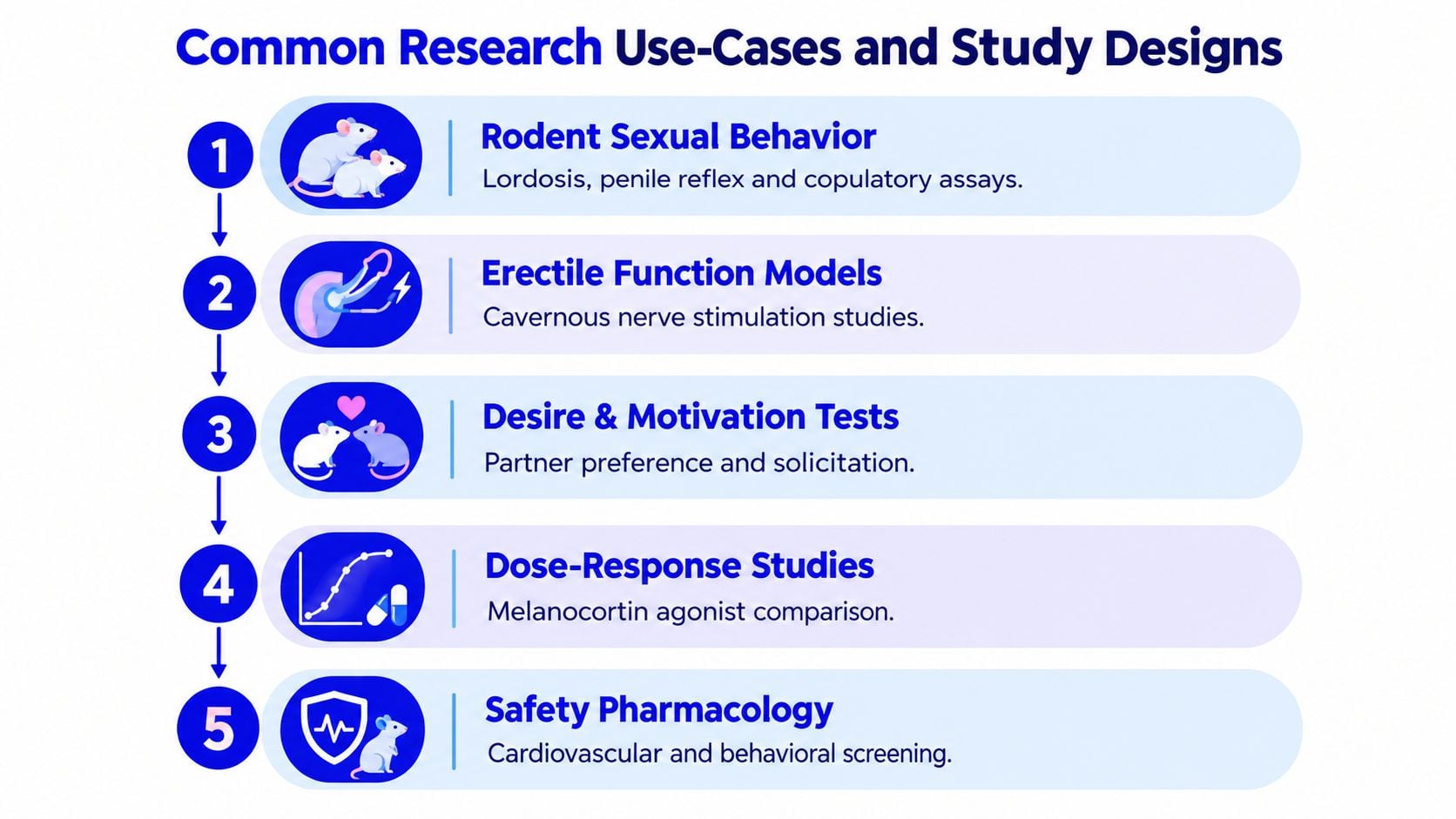
Common models include female lordosis assays, male ex-copula penile reflex measurements, and broader copulatory-behavior tests. Researchers may also examine partner preference, solicitation, or motivation-related behavior when the question concerns desire rather than erection alone.
A useful design maps each endpoint to its interpretation:
Dose-response and time-course studies can then examine when the response begins, how long it persists, and whether increasing exposure produces a larger signal or more adverse effects. Express doses according to the species and protocol, commonly on a per-kilogram basis, but don't import a number from one model into another without pharmacokinetic and tolerability justification.
Combination studies with PDE5 inhibitors can explore whether central melanocortin signaling interacts with pathways involved in erectile physiology. A selective MC4R antagonist can serve as a mechanistic control when the protocol is designed to test MC4R involvement. Vehicle controls, blinded scoring, randomized group allocation, baseline behavior, and an exposure-matched control group strengthen causal interpretation.
The translational bridge to HSDD is indirect. Animal reward-circuitry assays can support a biological hypothesis, while human studies require validated clinical endpoints, appropriate oversight, and a regulated drug product. A lyophilized research peptide belongs in laboratory or preclinical work, not in unsupervised human-subject experimentation.
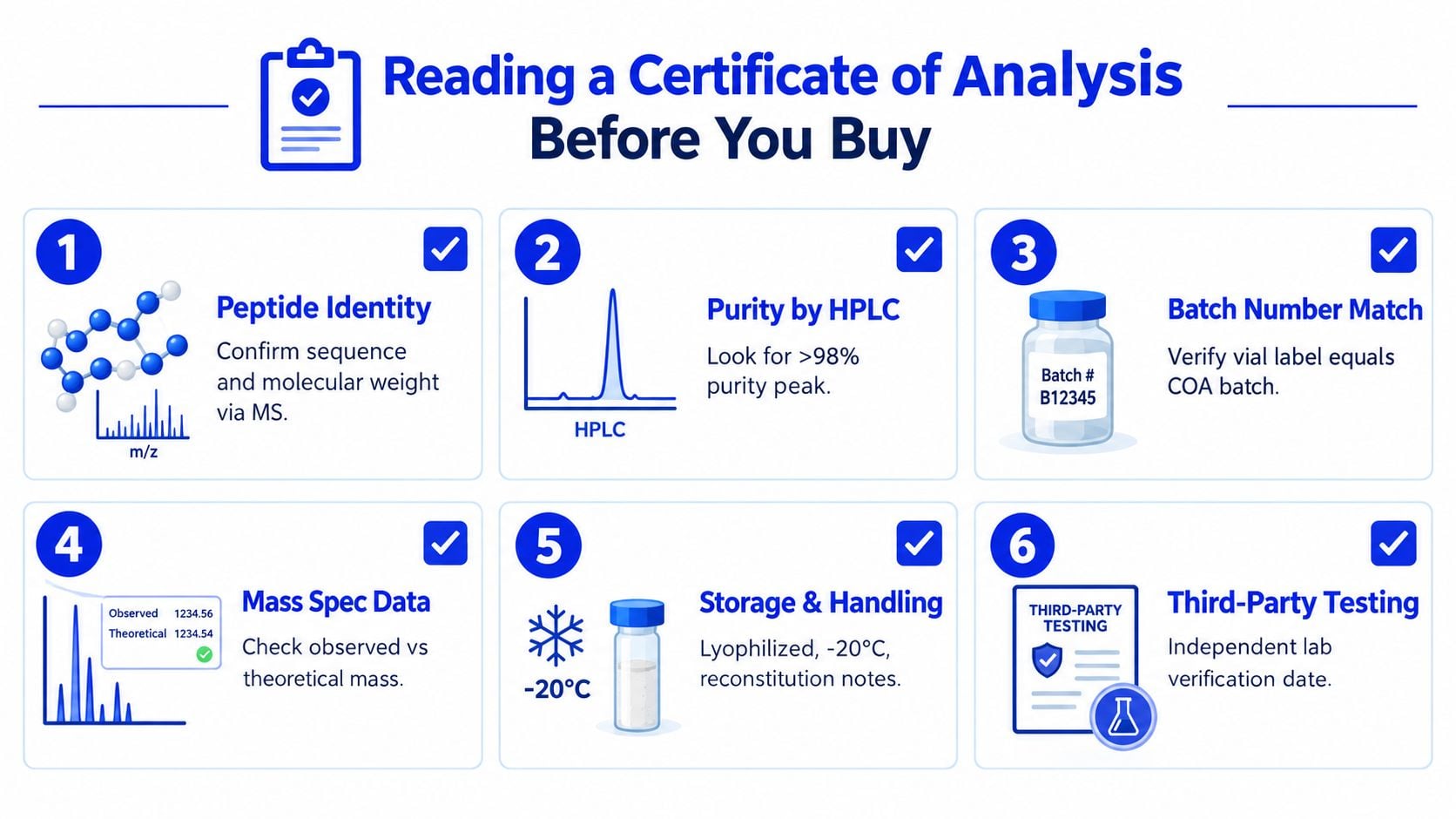
A Certificate of Analysis, or COA, is a batch-level quality document. It should connect the material in your vial to a defined lot, analytical methods, test results, and release information. A generic catalog statement such as “high purity” isn't enough for reproducible research because it doesn't show whether the specific batch was identified and tested.
Identity comes first. Look for amino-acid analysis, LC-MS, or another method that confirms the expected peptide. Mass spectrometry should show observed molecular weight alongside the theoretical value, with enough information to evaluate whether the result is consistent with the intended structure.
HPLC data needs context. A reported purity percentage is more useful when the COA includes the chromatogram, method conditions, column information, and integration details. The supplied infographic uses greater than 98% purity as a buyer checkpoint, but a threshold alone doesn't reveal whether unidentified peaks, degradation products, or excluded regions were handled appropriately.
Endotoxin and microbial testing matter most for in-vivo work. Ask whether the report includes an LAL endotoxin result, the units, the sample basis, and the laboratory's stated action threshold. Don't accept a vague “passes” statement when your protocol requires a defined limit such as an endotoxin limit expressed per kilogram of subject body weight.
Traceability closes the loop. The vial label, COA, manufacturing date, and master production record should identify the same lot. Storage conditions should state how the lyophilized material is handled and whether reconstitution instructions are available.
Reject the lot when the document can't answer three questions: What is it, which batch was tested, and who independently verified the result?
Red flags include:
A COA isn't a guarantee of experimental success. It is the evidence that lets you decide whether the material is sufficiently characterized for the intended study.
Could a low-cost vial compromise an entire assay? Yes, if its identity, handling history, or test results cannot be verified. A failed result might then reflect biology, degradation, contamination, or the material itself. Supplier selection is therefore part of experimental design, not a pricing decision.
Begin with the manufacturing and documentation trail. Look for a US-based operation with documented quality systems, lot-specific third-party COAs, named analytical methods, clear synthesis or sourcing information, and technical support that answers practical questions. A catalog may state purity up to 99.5%, but that figure is a product claim, not proof of the lot in your shipment. The lot report should carry the decision.
A practical procurement screen includes:
Reject vague purity language, missing batch numbers, absent endotoxin or microbial results, and unusually low pricing without a transparent explanation. A lower price may fit a lab budget, but identity, traceability, and analytical evidence determine whether the material can support the planned study.
For researchers comparing options, Peptide Warehouse USA lists PT-141 research material with lot documentation, third-party COA support, microbial and endotoxin reporting, US manufacturing information, and stated purity levels up to 99.5%. The products are presented for laboratory, analytical, and preclinical research only, not for human consumption.
Use a fixed purchasing workflow. Define the assay, list the required release tests, request lot-specific documents, compare the results with the protocol, and retain the records in the study file. If the paperwork cannot support the experiment, keep looking.
Peptide Warehouse USA offers research-grade PT-141 products with batch-specific documentation intended to help laboratories evaluate identity, purity, microbial status, and endotoxin results before use. Visit Peptide Warehouse USA to review available PT-141 options and compare their supporting documentation with your lab's procurement requirements.
Leave a comment