No products in the cart.


You search for pure peptides labs, open five tabs, and within minutes every supplier starts to look the same. Clean website. Big purity claim. Stock photos. A few technical terms. Maybe a COA thumbnail that’s too small to read. That’s where most researchers get stuck.
The problem isn’t finding a peptide seller. The problem is figuring out whether you’re buying a usable research reagent or a liability that will contaminate your workflow, distort assay results, or waste weeks of work. A polished storefront doesn’t prove much. Documentation does.
That’s why I don’t treat this as a simple review of pure peptides labs. I treat it the way a lab director would treat any new vendor onboarding decision. You need a repeatable screening process that works whether you’re ordering a common compound, comparing multiple peptide suppliers, or trying to confirm that a company understands research use requirements.
A reliable supplier should make your job easier before the vial even arrives. That means batch traceability, readable Certificates of Analysis, realistic handling guidance, and a product catalog that looks built for researchers rather than impulse buyers. If those things are missing, price and marketing copy won’t save the order.
Practical rule: If a supplier makes it hard to verify what’s in the vial, don’t assume the product is fine. Assume your due diligence is incomplete.
Use the framework below to vet pure peptides labs or any other online peptide source with the same standard.
You place an order, the vial arrives on time, and the label looks clean. Two days later, you are still trying to answer the questions that should have been settled before checkout. What lot did this come from? Where is the batch data? Does the paperwork match the material in hand?
This is the fundamental problem behind a search for pure peptides labs. The name itself is less important than the process you use to judge any peptide supplier. A supplier becomes part of your experimental chain the moment its material enters your freezer, your records, and your assay plan. Weak sourcing creates avoidable uncertainty in reconstitution, storage, method consistency, and result interpretation.
This article uses Pure Peptides Labs as a practical example, but the goal is broader. The useful question is not whether a site looks professional. The useful question is whether it gives a researcher enough evidence to verify product identity, handling expectations, and batch-level quality before placing an order.
I tell new researchers to treat supplier review as part of method control. If you would not accept an unlabeled reagent bottle from inside your own lab, do not relax that standard because the label came from an online storefront.
Early screening should focus on information quality, not marketing polish. Price, package size, and fast shipping do not tell you whether the material is suitable for research use.
Start with four checks:
A supplier that handles these basics well is easier to audit and easier to trust. A supplier that avoids them forces the buyer to fill in gaps, and those gaps usually show up later as wasted samples, repeated prep, or results you cannot defend with confidence.
The best suppliers do not ask for trust up front. They provide enough documentation for verification first.
That standard applies to Pure Peptides Labs, and it applies to every other vendor in the category.
A researcher places an order, the vial arrives on time, and the label looks clean. The substantive evaluation starts after that. Can the product page, the vial, and the batch record all be matched without filling in blanks yourself? If not, the supplier has already failed a basic quality test.

The standard is simple to state and harder to meet. A credible peptide supplier should operate in a way that allows independent verification at each step of procurement.
Start with manufacturing discipline and batch control. The company should present products as research materials with stable naming, clear identifiers, and lot-level records. If the same peptide appears under inconsistent names, or if documentation looks generic across multiple lots, that usually points to weak internal controls.
Next, look for verifiable testing connected to the exact batch being sold. A broad claim that every product is tested has little value on its own. What matters is whether the analytical record can be tied to the vial in hand through a lot number, test date, and product identity that all agree.
Then check post-purchase handling support. Inexperienced buyers often underestimate risk related to this. A peptide can meet its stated purity target and still create poor experimental results if storage instructions are vague, reconstitution guidance is incomplete, or technical questions go unanswered. Good suppliers help protect the material after shipment, not just before payment.
This framework matters beyond any single company. Pure Peptides Labs is useful as an example, but the method is broader. The goal is to evaluate whether a vendor behaves like a controlled chemical supplier under audit, not whether its homepage makes the right promises.
Here is the standard I use when screening a vendor:
| Supplier trait | Why it matters in a lab setting |
|---|---|
| Lot-specific documentation | Lets you match the vial you received to the records for that batch |
| Consistent research-use language | Reduces ambiguity around intended use and internal handling |
| Technical support with real answers | Helps resolve storage, solubility, and preparation issues before they affect results |
| Orderly, consistent product records | Shows process control rather than improvised catalog management |
A supplier does not need polished branding. It needs traceable records, disciplined labeling, and enough transparency for a researcher to verify claims before material reaches the bench.
When I review a vendor for a new project, I ask one question first: does this company behave as if its materials, records, and handling practices could be audited tomorrow? That is the gold standard.
A product catalog reveals more than many buyers realize. Before you read a COA, the catalog already tells you whether the supplier understands how researchers evaluate materials.
One of the first signals is formulation discipline. For many research workflows, peptides offered in lyophilized powder form are easier to evaluate and handle than ready-mixed liquids with sparse detail. A dry format keeps the starting point clearer. You know reconstitution is part of your own SOP instead of an opaque step completed somewhere else under unknown conditions.
That doesn’t mean liquid products are automatically a problem. It means they require stronger documentation. If a supplier sells liquids, look for concentration details, storage instructions, and enough technical context to understand what you’re receiving.
A clean catalog should also show that the company knows the difference between broad consumer browsing and real lab procurement. Researchers need specifics, not slogans.
Look for listings that include technical identifiers and plain language at the same time. The best catalogs let a new buyer confirm they’re ordering the correct item without forcing them to decode everything from memory.
Useful signals include:
If a catalog gives you marketing adjectives but not enough technical identifiers to verify the item, treat that as missing data.
A deeper catalog can also suggest operational competence. When a supplier carries common research compounds alongside more specialized items, that often indicates familiarity with varied sourcing and documentation demands. It’s not proof of quality by itself, but it’s a useful signal when paired with strong batch records.
On the other hand, catalog clutter is a warning sign. If product pages copy the same generic description across unrelated compounds, or if every listing reads like a sales page with no technical backbone, assume the company built the site for conversion first and verification second.
A new researcher usually opens a COA, sees a purity number in the high nineties, and assumes the vetting work is done. That is how weak suppliers slip through. A COA is only useful if it ties a specific vial to specific test results and gives enough detail for you to judge whether the material fits your work.
For supplier review, including any assessment of pure peptides labs, I treat the COA as a screening tool, not a marketing attachment. The goal is simple. Verify identity, verify batch traceability, and check whether the reported tests answer the risks that matter for your assay.
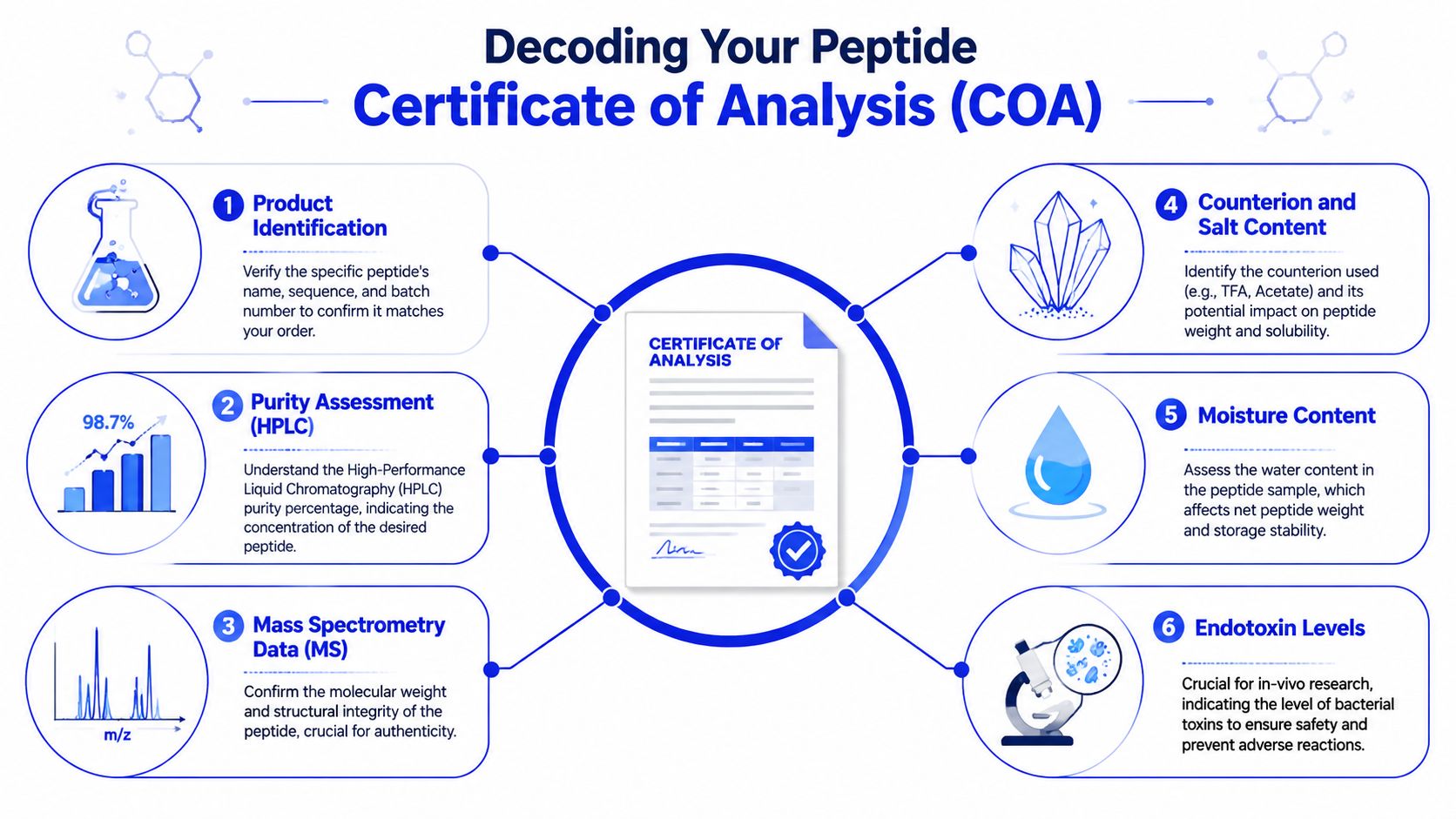
This visual is a useful mental checklist while reviewing a document:
Start with traceability. If the product name, lot number, concentration claim, or internal item code does not line up across the listing, vial, and COA, stop there and ask questions before you use the material.
The lot number carries the most weight. A generic COA can show that a company tested something at some point. It does not show that your vial was tested. Date fields matter for the same reason. A current batch record should look current, with issue dates and identifiers that fit live inventory rather than a recycled PDF attached to every product page.
Check these fields first:
Purity is only one line on the page. What matters is how that purity was established.
HPLC, or high-performance liquid chromatography, separates the sample into component peaks. A strong result usually shows one dominant peak for the target peptide and smaller peaks for impurities. That still requires judgment. A single purity percentage without a chromatogram, method reference, or retention-time context gives you less confidence than many buyers realize.
Public materials from Peptides present batch-style analytical examples and make purity claims tied to lot-level reporting. These examples show the sort of analytical presentation a buyer should expect to review instead of accepting a slogan.
Identity testing closes the loop. Mass spectrometry checks whether the observed molecular weight matches the expected peptide. In practical terms, purity addresses how clean the sample appears. Identity testing addresses whether the main component is the compound named on the label.
Here’s a practical explainer if you want a quick walkthrough before reading more COAs:
The overlooked fields are often the ones that explain why a peptide behaves differently at the bench than the headline purity number suggested.
Bench note: Counterion content, moisture, and endotoxin information can alter reconstitution calculations, solubility, and assay background, especially in sensitive systems.
Review these carefully:
| COA field | Why it matters |
|---|---|
| Counterion or salt form | Affects reported mass and can change solubility behavior |
| Moisture content | Changes true net peptide content and can influence storage stability |
| Endotoxin result | Matters when contamination can distort biological readouts |
| Appearance or physical description | Provides a basic check that the material matches the expected form |
A strong COA does not need to impress you. It needs to let you verify the batch, understand the methods used, and decide whether the material is fit for purpose. That is the standard to apply to any online peptide supplier.
A peptide arrives with a strong-looking purity number, the vial label matches the order, and the COA appears clean at a glance. The critical test starts after that. Before any material goes into an assay, a careful buyer needs to ask whether the supplier can show disciplined manufacturing, lot control, and contamination management, not just a polished product page.
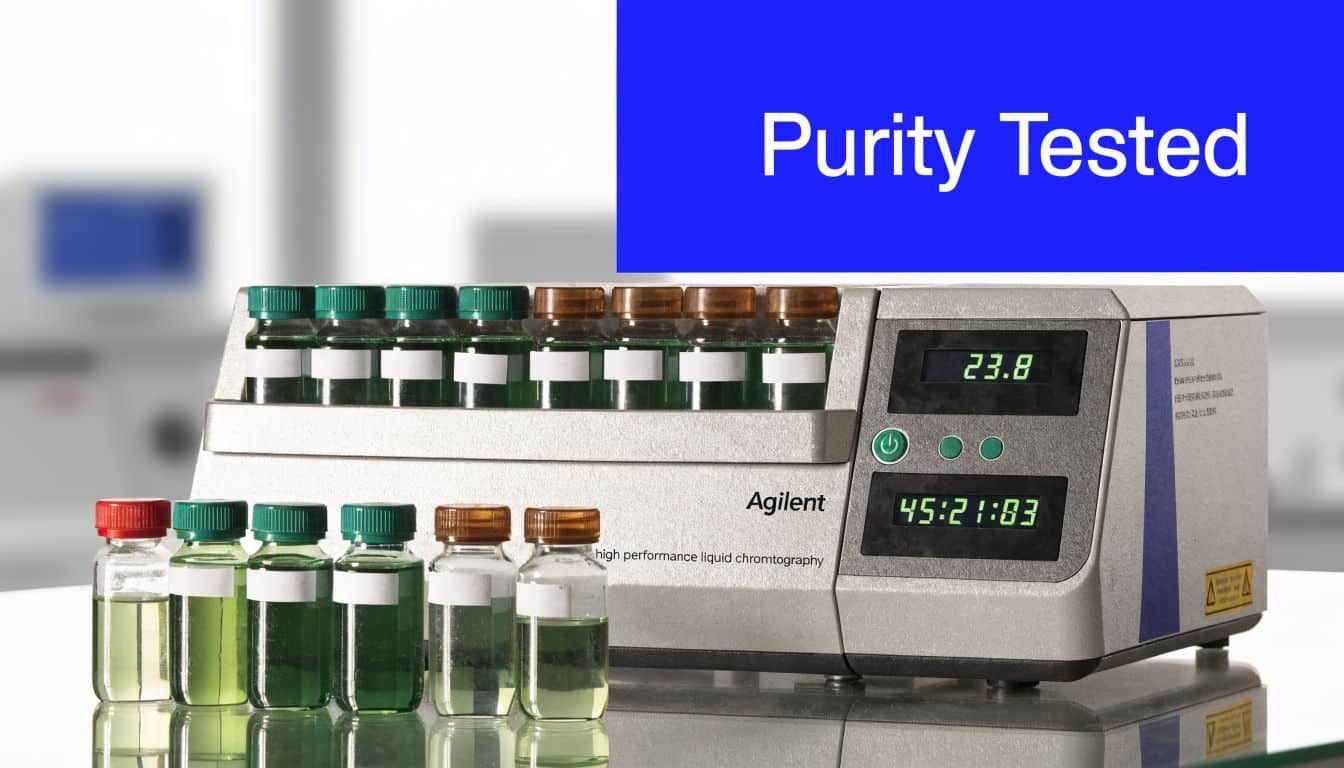
Researchers new to online sourcing often stop at the headline number. That is a mistake. A high purity result can still sit inside a weak process if synthesis controls are inconsistent, purification is poorly documented, or storage and packaging introduce avoidable risk after the batch leaves production.
The better question is simple. Can the supplier connect the final number to a repeatable process?
That process should include controlled synthesis, defined purification methods, documented batch records, and handling practices that protect the material from moisture, contamination, and labeling errors. Those details matter because experimental failure often starts outside the assay itself. It starts with a batch that looked acceptable on paper but was prepared or handled without enough discipline.
I look for evidence that the company treats peptide production as a traceable laboratory workflow, not a storefront transaction. A reliable supplier usually shows this through consistent lot numbering, method-specific test records, storage guidance, and a clear separation between marketing language and analytical documentation.
Three areas deserve close attention:
For buyers who want a broader view of how outside verification fits into product quality claims, this article on commissioning lab tests for ecommerce brands is useful context. The setting is broader than peptides, but the core standard is the same. Quality claims carry more weight when testing can be checked independently.
Purity and identity were covered in the prior section. The next layer is whether the supplier tests for problems that can distort results even when the main peak looks clean.
For sensitive cell work, contamination controls can matter as much as chromatographic purity. Endotoxin, bioburden, residual solvents, and handling contamination can all interfere with readouts. A supplier does not need to present every test for every peptide, but the documentation should match the product type and the likely research use. If the company sells into workflows where contamination would clearly matter, silence on those controls is a warning sign.
I also check whether the company’s documentation is lot-specific and current. Old template reports, cropped chromatograms, or recycled PDFs usually indicate weak record control. In a lab, that is enough reason to pause the purchase.
Strong suppliers show how a batch was made, how it was checked, and how it was protected after testing. That is the standard. Anything less leaves too much room for avoidable error.
Use Pure Peptides Labs, or any similar vendor, as a case study rather than a special case. The goal is not to decide whether one company sounds credible. The goal is to build a repeatable way to judge every supplier by the same criteria: process control, test quality, traceability, and fitness for your actual research conditions.
A purchase order often fails before the vial arrives. It fails when a researcher treats the supplier page like marketing instead of a lab record.

I train new staff to run the same screening process on every online peptide vendor, including Pure Peptides Labs. The point is consistency. If one supplier gets extra trust because the site looks polished or the price is attractive, procurement discipline breaks down fast.
Confirm the company operates like a research supplier
Read the site with an operations mindset. Check for clear research-use positioning, real contact details, posted policies, and product pages that look maintained over time. A vendor does not need an elaborate website, but it should show basic control of records, labeling, and communication.
Match the batch paperwork to the item you may buy
Ask for lot-specific records before ordering if they are not already posted. The batch number on the document should match the batch shipped, or the supplier should explain exactly how that handoff is handled. If that answer is vague, stop there.
Audit the product page for identification details
A usable product page helps you verify what is being sold. Check the peptide name, salt form if relevant, fill amount, storage language, and any handling notes. Generic quality claims are less useful than simple, specific identifiers.
Check whether the supplier supports correct preparation
Handling errors can ruin an otherwise sound material. Tools that help researchers calculate dilution and reconstitution steps can reduce avoidable mistakes.
Test support before money changes hands
Send one practical question. Ask for a document, clarification on labeling, or storage guidance. The reply shows you how the supplier works under light pressure. Fast but vague support is less useful than a slower reply that addresses the question.
Useful support protects your data. It should help you confirm batch identity, get the right document version, understand storage limits, and determine whether the package format fits your workflow.
I also look for restraint. A careful supplier answers technical questions directly and stays inside research-use boundaries. That matters as much as speed.
Use this pass-fail screen before approving any order:
This process is simple on purpose. A good checklist should catch problems early, before they reach your bench and contaminate your results.
Most poor suppliers expose themselves quickly if you know where to look. The mistake is assuming every issue deserves the benefit of the doubt.
The biggest red flag is missing or non-specific documentation. If the seller can’t provide a readable lot-specific COA, you’re being asked to buy on faith.
Another serious problem is vague manufacturing language. Phrases like “lab tested,” “premium grade,” or “high quality” don’t mean much without records attached. If the company won’t say how batches are documented, what testing accompanies them, or how products are identified, the risk sits with the buyer.
Watch for these issues:
Be careful with suppliers that lean into implied medical positioning. A research peptide seller should stay disciplined about laboratory and analytical use. When a site drifts into consumer promise language, it often signals poor compliance judgment.
Low price doesn’t rescue a bad supplier. It only lowers the cost of making an expensive mistake in your research.
I’m also cautious when every product has the same description, every claim sounds absolute, and nothing on the site suggests batch variability is even possible. Real chemical supply involves records, limits, and details. When a company acts like none of that matters, believe the signal.
Choosing a supplier like pure peptides labs shouldn’t come down to who wrote the most convincing homepage copy. It should come down to whether the company can support your work with verifiable data, lot traceability, and practical handling guidance.
Good sourcing protects more than a budget. It protects your methods, your timelines, and your confidence in the results you generate. That means reading the catalog closely, treating the COA like a decision document, asking direct questions about testing, and walking away when the documentation doesn’t hold up.
The strongest buyers aren’t the ones who know the most peptide jargon. They’re the ones who follow a consistent procurement standard every time. If you apply that standard carefully, you’ll make better decisions not just for this order, but for every supplier review after it.
If you want a supplier that aligns with the documentation, traceability, and research-use standards outlined above, learn more from Peptide Warehouse USA and explore options that support careful laboratory procurement.