No products in the cart.

If a vial says 99% pure, what exactly is in the other 1%? That’s the question most buyers skip, and it’s where a proper Pure Peptides Review starts. A high number on a product page can look reassuring, but research quality depends on more than a purity claim. It depends on what test produced that number, whether the batch was independently verified, and whether the product is also clean from a biological safety standpoint.
Researchers are buying into a market that keeps expanding. The global research peptide market is projected to reach USD 12.8 billion by 2030, with a 14.2% CAGR from 2023 to 2030, and over 99% purity has become a standard benchmark, with some suppliers reporting stated purity up to 99.5% backed by third-party Certificates of Analysis, according to PureLab Peptides market overview. Growth is useful. Noise is not. What matters is knowing how to separate polished marketing from documentation that can support reproducible work.
This guide focuses on the audit process serious buyers need. That includes reading a COA, checking analytical methods, verifying lot traceability, and spotting the overlooked warning signs around endotoxins, sterility, and vague RUO language.
Every peptide site looks confident. Almost all of them use the same language. High purity. Premium grade. Third-party tested. Research quality. The problem is that those phrases often appear long before a buyer sees any batch data.
That gap creates the core sourcing dilemma. A product page can claim a clean peptide, but your experiment depends on evidence attached to the exact lot in your hands. If the lot number on the vial doesn’t connect to a batch-specific record, the claim isn’t very useful.
The peptide category attracts both careful suppliers and opportunistic sellers. Some understand that analytical documentation is part of the product. Others treat documentation as decoration.
A serious buyer should assume three things:
Practical rule: If a supplier makes it easier to add a vial to cart than to inspect batch documentation, slow down.
The most reliable buying process is simple, even if it takes more discipline.
Use this order of operations:
That sequence cuts through most of the confusion. It also changes how you think about the benefits of peptides in a research setting. The useful question isn’t which peptide sounds most promising. It’s whether the material is documented well enough to support valid analytical or preclinical work.
“Pure” gets used as if it means one thing. In practice, it refers to several separate quality questions. A peptide can look strong on paper chemically and still be a poor choice for sensitive research if the wider safety profile is unclear.
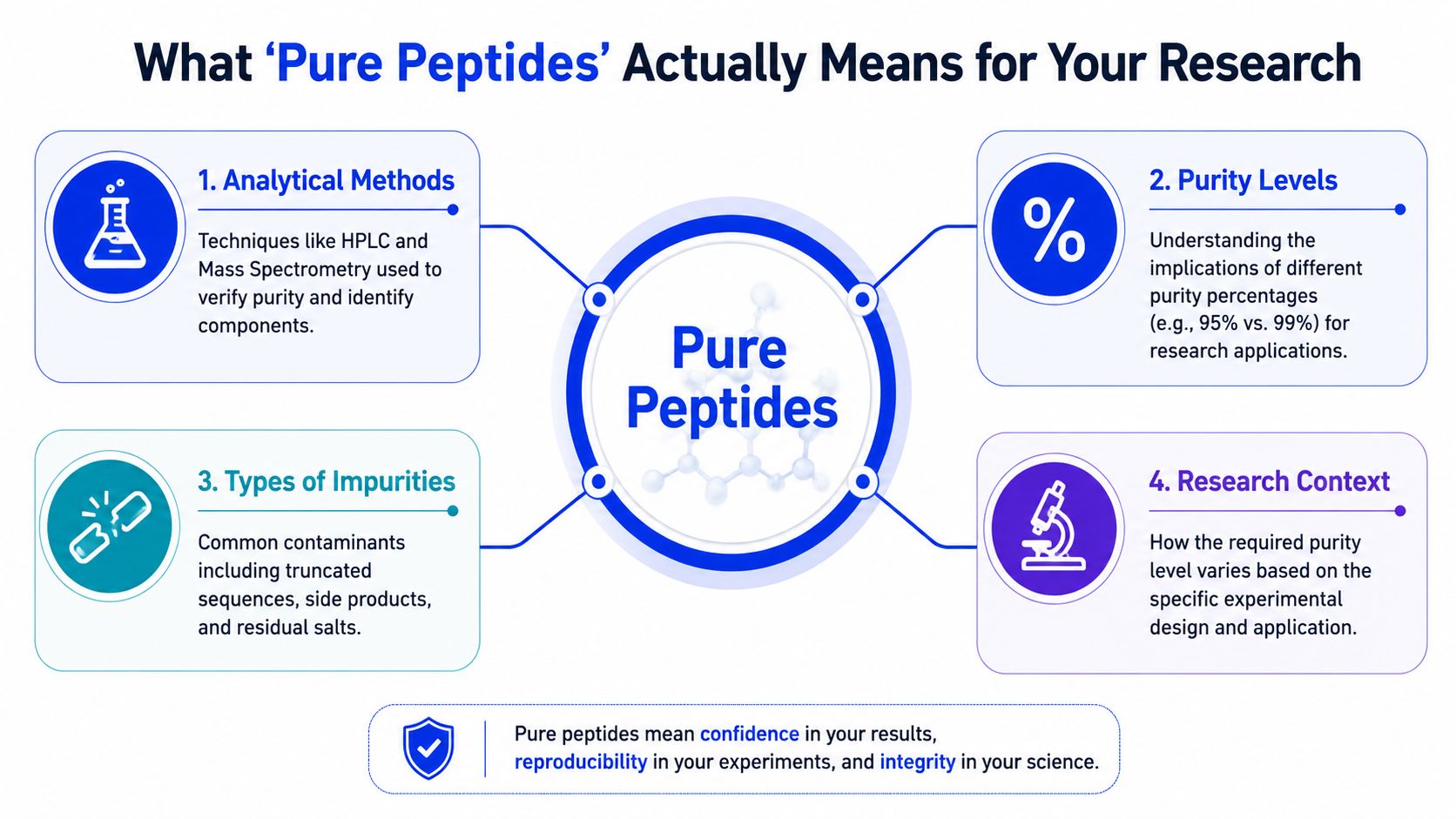
Chemical purity usually refers to how much of the target peptide sequence is present compared with other detectable components. Labs commonly verify that through methods such as HPLC, with mass spectrometry used to confirm identity. That matters because impurities aren’t abstract. They can include truncated sequences, synthesis side products, residual salts, or related fragments that affect assay behavior.
Independent testing shows meaningful spread even among products that sound similar in marketing. In one review of pharmaceutical-grade peptide testing, examples ranged from 98.7% purity to 99.6%, which is why a claim needs COA support rather than a headline alone, as described in Burick Center’s discussion of peptide quality testing.
A practical way to think about it is this: chemical purity tells you whether you likely received the right molecule in the stated concentration range. It doesn’t automatically tell you whether the vial is suitable for every research context.
This is the part many buyers miss. Chemical purity and biological safety are not the same thing. A vial can test well for peptide identity and still create problems if endotoxins, microbial contamination, or poor handling entered somewhere in production or packaging.
For critical work, these questions matter:
A 99% number answers one narrow question. It doesn’t answer every question that matters.
When I evaluate a supplier, I don’t treat purity as a sticker. I treat it as a file set.
That file set should include:
| Quality layer | What you want to see | Why it matters |
|---|---|---|
| Identity | Mass spectrometry confirmation | Verifies the peptide matches the intended molecule |
| Chemical purity | HPLC result with batch-specific data | Shows the dominant peptide relative to detectable impurities |
| Contamination controls | Endotoxin and microbial reporting | Reduces the chance of invalid research due to hidden biological contaminants |
| Manufacturing discipline | Clear standards and traceability | Supports consistency across orders and repeat work |
That broader definition is what turns a basic supplier check into a real pure peptides review.
Once you move past marketing terms, peptide evaluation becomes a documentation exercise. Good suppliers make that easy. Weak suppliers make you chase basic answers.
The minimum standard has shifted upward. As of 2025, about 72% of research-grade peptide suppliers in North America provide independent COAs for every batch, using HPLC and LC-MS as standard analytical protocols, and over 90% of compliant suppliers also offer microbial and endotoxin reports, according to this overview of supplier documentation practices. That doesn’t mean every seller meets the mark. It means buyers now have reason to expect more than a one-page purity claim.
If a supplier can’t provide the basics, that’s not a small operational issue. It’s a quality signal.
Look for these items as a package:
The strongest peptide vendors usually share one trait. They behave like documentation-first operators rather than retail marketers.
That shows up in several ways:
Non-negotiable point: Generic COAs are weak evidence. Batch-specific records are the standard.
Buyers often use GMP as a shortcut term for quality, but it’s more useful to ask what controls are evident in the supplier’s documentation and handling process. A supplier may discuss controlled manufacturing, but your procurement decision should still come back to what can be verified per lot.
That’s why broad claims like “lab tested” don’t help much. A complete paperwork trail does. For institutions and careful independent researchers, reproducibility starts with the ability to document what was purchased, how it was tested, and whether the same standard can be maintained on the next order.
A COA only helps if you can read it critically. Many buyers stop at the purity percentage and miss the rest of the document, which is often where the useful information sits.

Read the header first, not the result box.
Check for:
If the lot number is missing, incomplete, or impossible to cross-reference, the COA loses much of its value. The same is true if the document looks generic and could apply to any batch.
After that, move to the analytical section. A useful COA should show what method was used and what result came from that method. For peptides, the key items are typically purity by chromatography and identity by mass confirmation.
Use this quick read sequence:
Purity result
Review the reported purity and make sure it is tied to the specific batch, not a template.
Method used
HPLC for purity and MS for identity are strong signs that the supplier understands standard analytical expectations.
Identity confirmation
The observed mass should align with the expected peptide identity.
Supporting material
Chromatograms, method details, or additional batch notes add confidence because they show the result didn’t appear from nowhere.
If a COA gives you a percentage without method context, it’s giving you less information than it appears to.
Some problems are easy to miss because the document still looks technical.
Watch for:
A good COA reduces uncertainty. A weak one performs certainty.
A quality audit matters even more when buyers are comparing popular compounds. The stronger the interest in a peptide, the more often weak sellers try to ride that demand with vague claims and thin documentation.
Several compounds come up repeatedly in peptide sourcing conversations because they’re commonly discussed in tissue, signaling, neurobiology, and repair-related research.
The benefits of peptides in research depend heavily on match quality between compound, assay, and documentation. A peptide that fits one experimental model well may be a poor fit for another if impurity sensitivity, storage stability, or handling conditions differ.
Buying by popularity is a bad shortcut. The right question is whether a peptide’s quality profile suits the work you’re doing.
For example:
| Peptide | Common research area | What buyers should verify first |
|---|---|---|
| BPC-157 | Tissue and repair-related pathways | RUO compliance and full batch documentation |
| TB-500 | Recovery and cellular activity models | Identity data and contamination controls |
| GHK-Cu | Skin and regenerative signaling research | Stability handling and analytical specificity |
| Selank | Neurobiology-related studies | Batch consistency and traceability |
The point isn’t that one peptide is universally better. It’s that each one places slightly different demands on your procurement standards, storage discipline, and interpretation of analytical paperwork.
One of the biggest mistakes in peptide buying is assuming “research use only” automatically signals a responsible supplier. It doesn’t. RUO language can reflect compliance, or it can be used as cover for poor quality control.
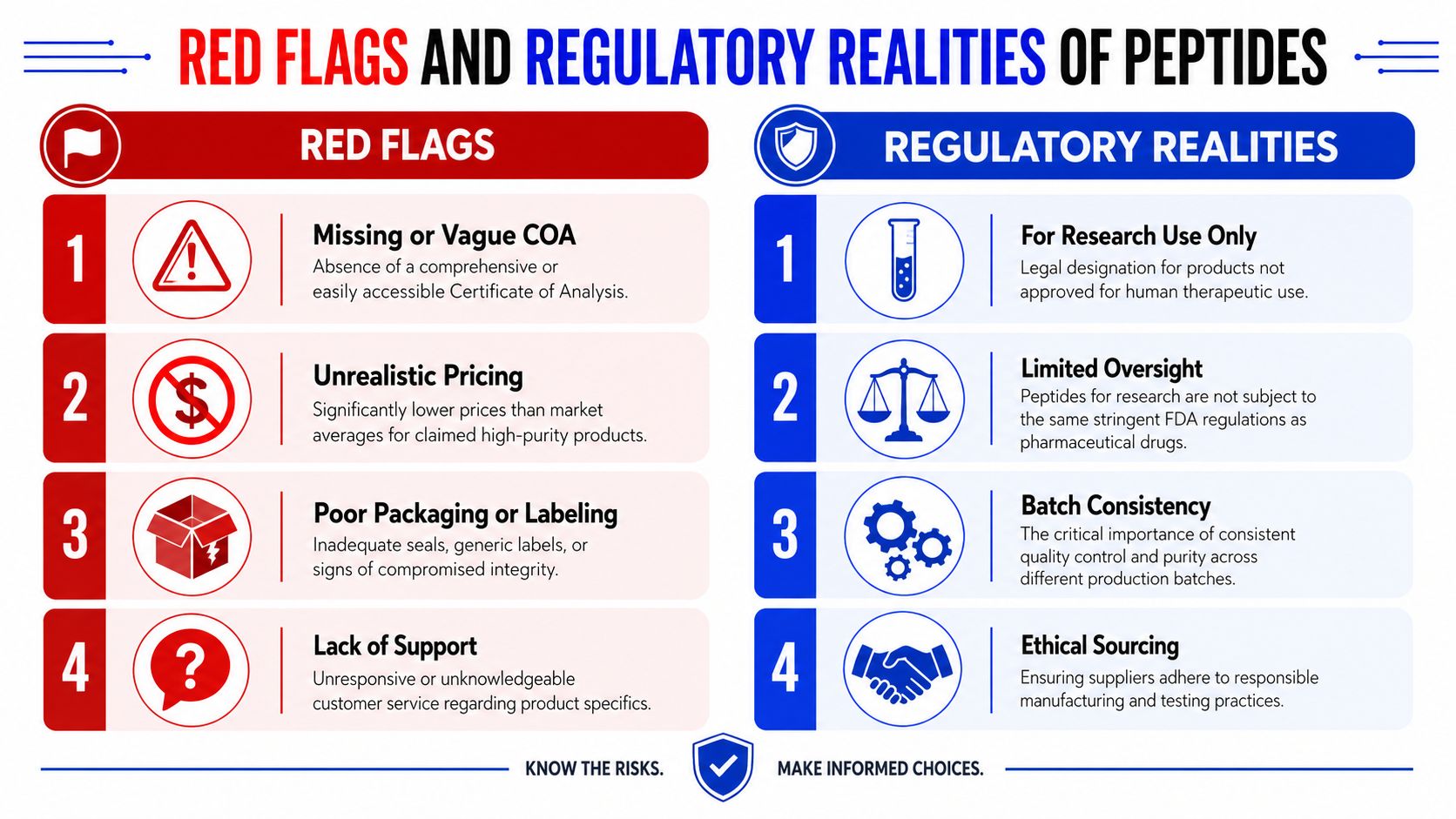
Responsible RUO sellers are usually consistent. They use clear disclaimers, avoid human-use claims, maintain age-gates where appropriate, and keep product language aligned with laboratory procurement rather than therapeutic positioning.
That kind of restraint matters because some peptides are widely discussed despite lacking established human evidence. A 2024 review found zero human clinical trials for BPC-157, and the FDA’s Category 2 classification for it prevents legitimate pharmacies from compounding it, a shift discussed in Hillary Lin MD’s analysis of gray-market peptide labeling. When legitimate pharmacy channels close, weak gray-market inventory tends to fill the gap.
The most overlooked issue isn’t usually identity. It’s the false assumption that chemical purity equals safety.
That assumption fails for two reasons:
A separate concern is the online free-for-all around unapproved peptides. In that environment, products may be impure, incorrectly dosed, or contaminated, while buyers still see “99%+” language and assume quality. The stronger view is more skeptical. In an unregulated setting, batch-level COA documentation is the most objective proof available, as discussed in this review of peptide quality and safety concerns.
The phrase “99% pure” can be technically accurate and still leave the most important risks unanswered.
These warning signs deserve immediate scrutiny:
Regulatory reality is simple. RUO status doesn’t excuse weak quality systems. It makes careful buyer due diligence more important.
A good supplier audit should be repeatable. If your process changes every time you shop, you’ll miss things. The easiest fix is to use the same checklist before each order, regardless of peptide type.
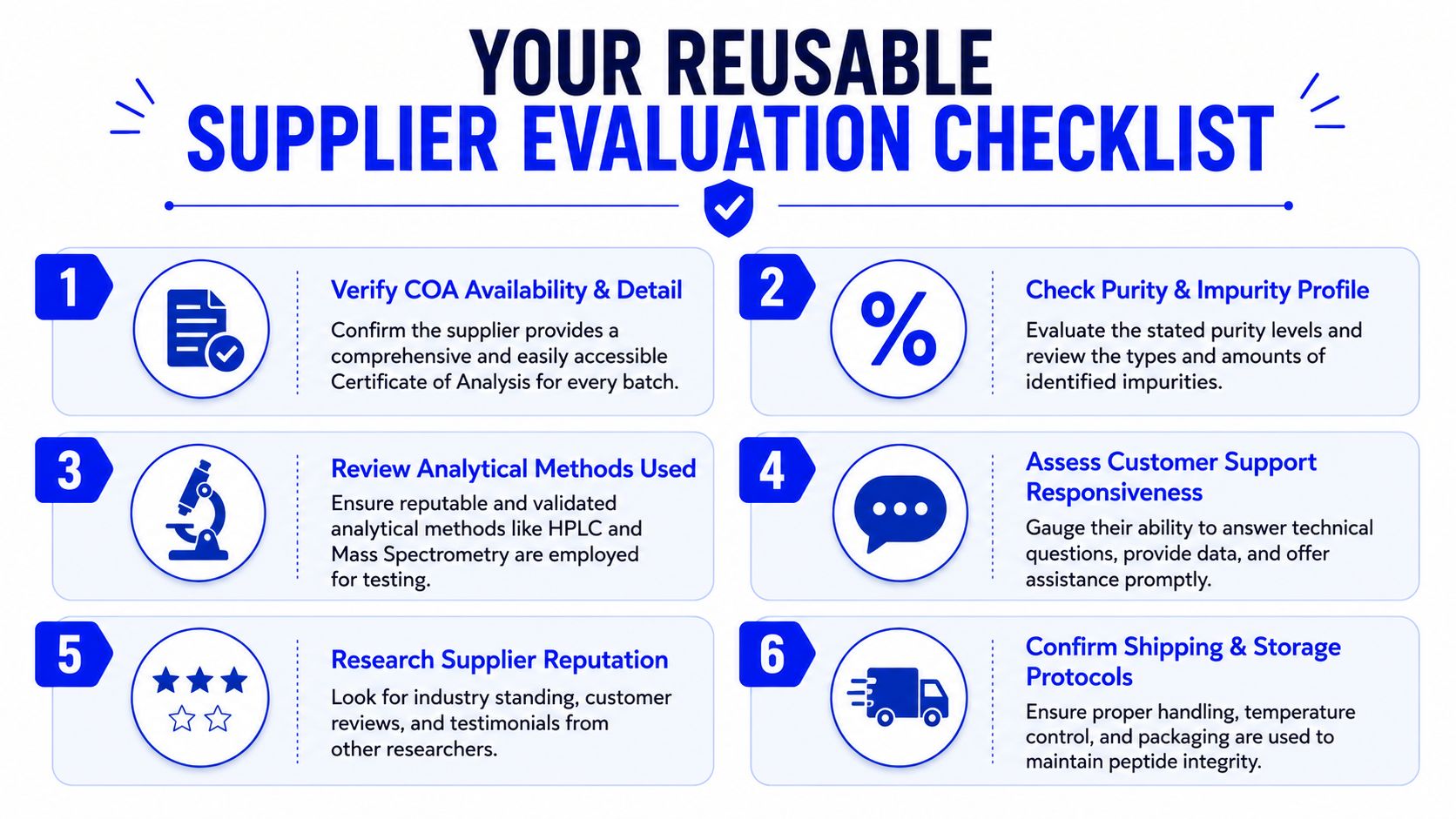
Run through these questions in sequence:
Verify COA availability and detail
Ask whether the exact batch COA is available before purchase and whether it includes lot number, method, and result.
Check purity and impurity profile
Don’t stop at the top-line percentage. Review whether the document gives enough analytical context to interpret what “pure” means for that batch.
Review analytical methods used
HPLC and mass-based identity confirmation are strong signs. Vague “tested in-house” language isn’t.
Assess support responsiveness
Send a technical question. Good suppliers answer clearly and without evasion.
Research supplier reputation
Look for consistency in how they present documentation, handling standards, and RUO compliance across the site.
Confirm shipping and storage protocols
Packaging, handling, and storage instructions should reflect that peptide integrity can be lost after manufacturing if fulfillment is sloppy.
A supplier passes when the story on the site matches the paperwork in the file and the label on the vial. That means no gaps between claims, lot records, and support responses.
Use this short decision rule:
| If you see this | Treat it as |
|---|---|
| Batch-specific COA plus microbial and endotoxin records | Strong signal |
| Clear lot traceability | Strong signal |
| Strict research-only language | Positive compliance sign |
| Representative COA only | Caution |
| Purity claims without method detail | Caution |
| No contamination reporting | Serious concern |
A careful pure peptides review doesn’t reward the supplier with the loudest purity claim. It rewards the one that can prove what’s in the vial, how it was tested, and whether the lot was handled with the consistency your research requires.
Choosing well protects your data first. That’s the standard worth keeping.
If you want a supplier built around batch documentation, transparent testing, and research-only compliance, learn more at Peptide Warehouse USA. You can explore options, review available compounds, and evaluate whether the documentation standard fits your lab’s procurement process.