
No products in the cart.



A semaglutide paper can look straightforward until you try to compare diabetes, obesity, and cardiovascular outcomes side by side. One headline says glucose control, another says weight loss, and a third points to heart protection, so the challenge in semaglutide research is not finding data, it's knowing how to read it in the right order.
A good researcher starts with the mechanism, then checks the assay, then weighs the trial design, and only after that looks at the headline result. That sequence matters because semaglutide is not just a single outcome drug, it's a GLP-1 receptor agonist whose effects, tolerability, and measurement all connect. This guide follows that workflow in plain language, so you can understand what the studies show, what the lab methods can prove, and where the evidence still has gaps.
Researchers often get pulled in three directions at once. One paper frames semaglutide as a diabetes therapy, another treats it as a weight-management compound, and a third focuses on cardiovascular risk. The harder problem is deciding whether those studies can be compared at all, because endpoint mismatch can make a meta-analysis look cleaner than it really is.
Read semaglutide as a system, not a headline. Mechanism, formulation, assay method, storage, and endpoint choice all shape what a study can legitimately show. If the compound is measured poorly, stored badly, or tested in the wrong population, the result may still look impressive while remaining difficult to interpret.
Practical rule: the question is never just “did semaglutide work?” The better question is “what was measured, in whom, with what method, and under what handling conditions?”
Semaglutide research also shows how a peptide program matures. Early diabetes studies established once-weekly GLP-1 receptor agonism, oral delivery expanded the platform, and obesity and cardiovascular trials widened the evidence base. Like reading a lab notebook, the value comes from connecting each page to the one before it, not from isolating a single endpoint.
This article keeps one focus throughout, how to interpret semaglutide like a researcher. It ties trial design, lab characterization, and stability handling together so you can judge findings in context rather than in isolation. If you are evaluating research materials, planning a study, or sorting through conflicting results, that is the workflow that holds up.
Semaglutide works like a key that fits a specific lock, the GLP-1 receptor. Once that lock opens, the body changes how it handles glucose, appetite, and gastric emptying. The point isn't a single dramatic switch, it's coordinated signaling across several pathways that reinforce one another.
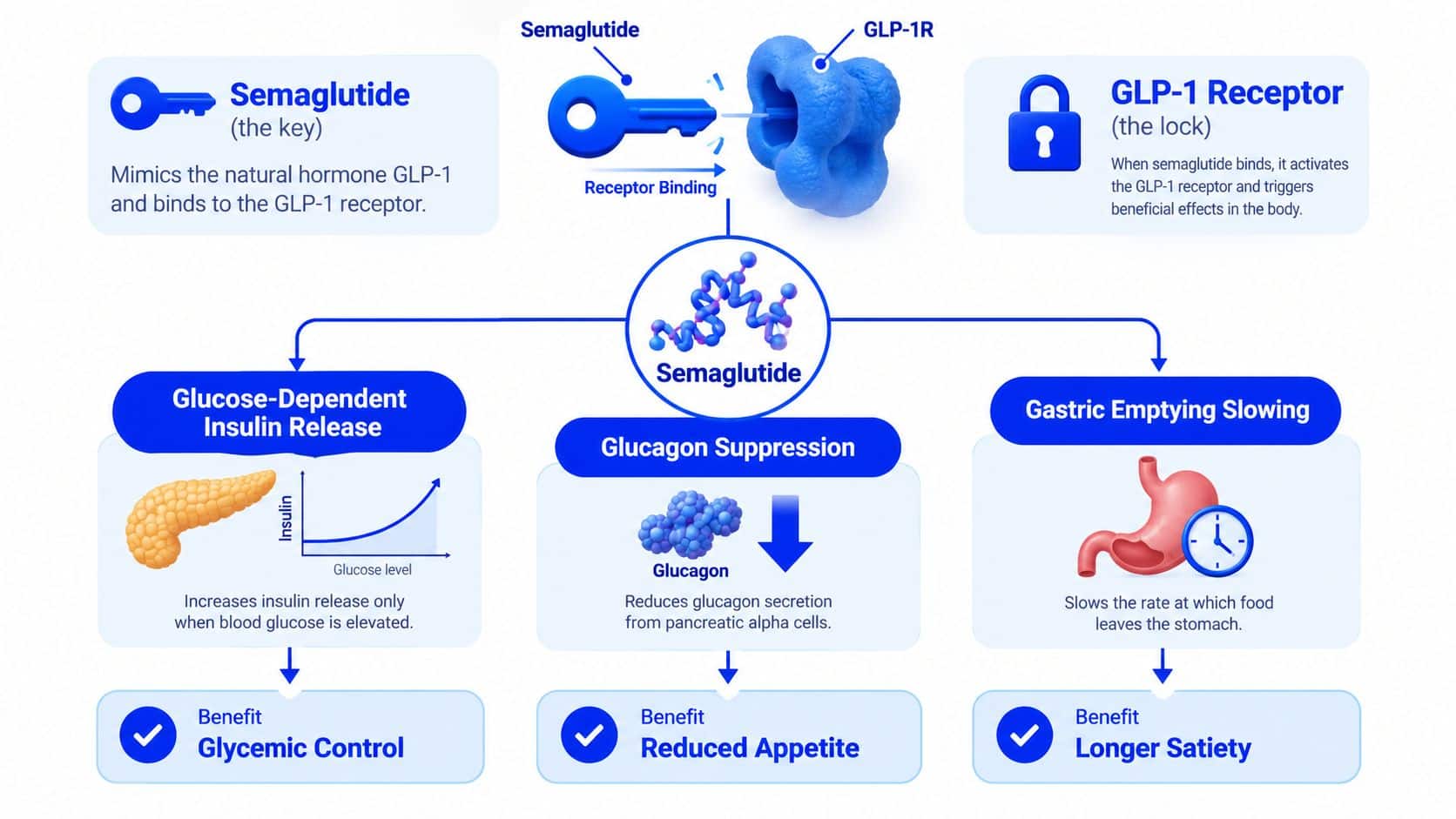
Semaglutide promotes glucose-dependent insulin secretion and reduces glucagon release, which is why its metabolic effects are tied to the body's current glucose state. That's an important distinction because it explains why the drug behaves differently from therapies that push insulin more directly. In practical terms, the receptor signal helps the pancreas respond more appropriately instead of forcing the same response in every situation.
The other major effect is behavioral and digestive. Semaglutide acts centrally and peripherally to increase satiety, lower appetite, and slow gastric emptying, so people tend to eat less because they feel full sooner and longer. The literature repeatedly links its weight effect to reduced caloric intake, not to a major rise in energy expenditure.
That same biology also explains why gastrointestinal adverse events are so common in the semaglutide literature. The pathway that helps reduce intake can also create nausea or related GI effects, so efficacy and tolerability are dose-related and mechanism-linked. Researchers shouldn't treat side effects as random noise, because they're often part of the same pharmacology that drives the benefit.
Semaglutide's best-supported translational readout is sustained reduction in intake and body mass, not a short-lived appetite shift.
The chronic-exposure part matters too. In obesity studies, benefit builds with ongoing treatment and behavioral co-intervention, then stabilizes rather than rising indefinitely. That makes semaglutide a useful example of why peptide pharmacology can't be judged by a single early time point. The body adapts, and the study design has to capture that adaptation.
For translational work, the most useful paired endpoints are body weight and glycemic markers. Semaglutide's dual profile means one endpoint alone can miss part of the signal, especially if you're comparing different populations or doses. The drug's mechanism makes that pairing logical, not optional.
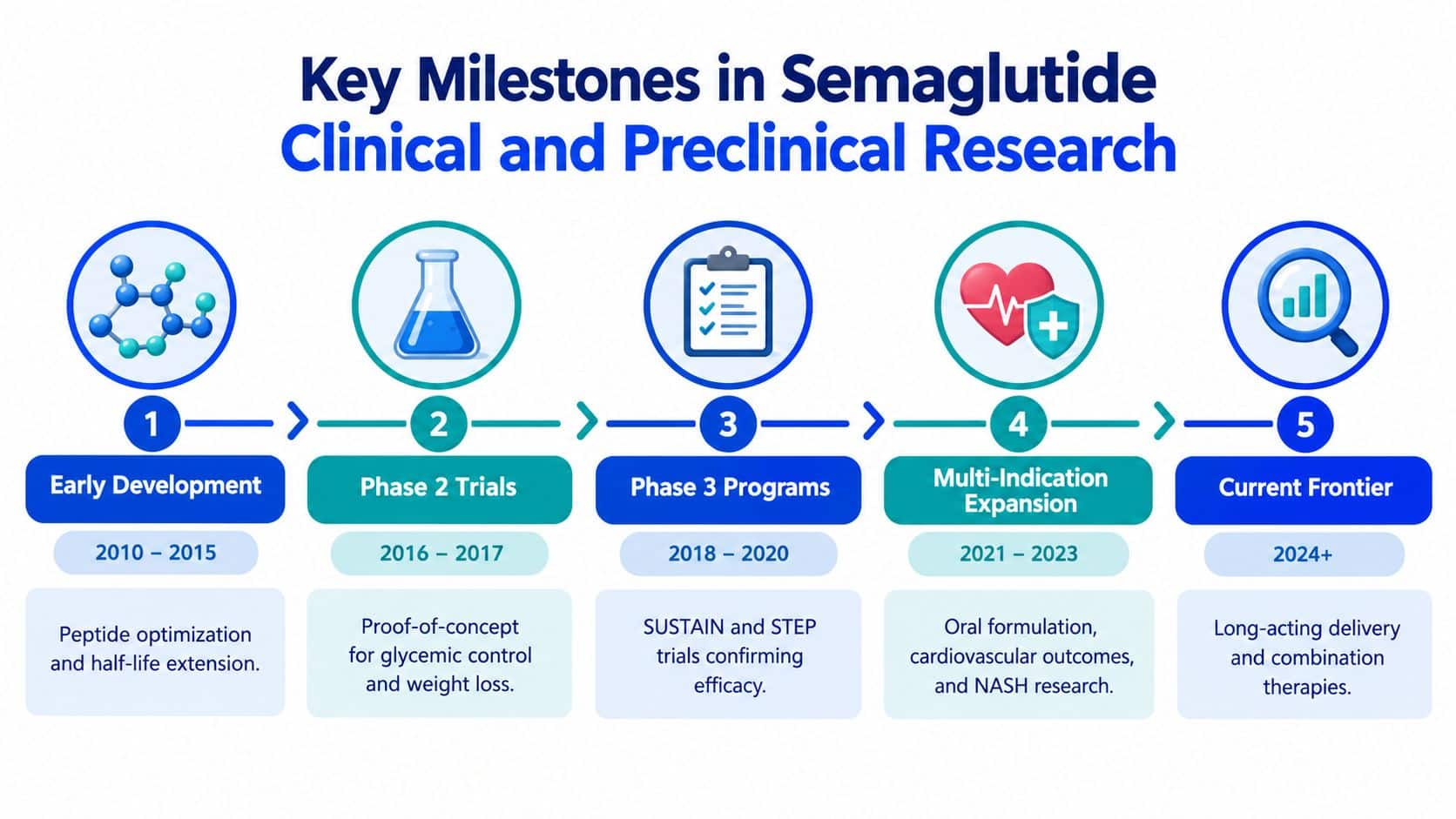
How did semaglutide move from a diabetes candidate to a broader metabolic tool? The clearest way to see it is to follow the research sequence. Early work established the core GLP-1 profile, then later studies tested whether that same pharmacology could support oral delivery, weight management, and cardiovascular benefit. For researchers, the value of that sequence is practical. Each milestone helps explain what a study is really measuring, whether the question is mechanism, efficacy, or translation into a new setting.
The FDA approved injectable semaglutide, Ozempic, in 2017 after a development program that included 8 clinical trials across 45 countries and about one-third of participants from the United States (FDA review). That global trial base gave the program breadth before it moved into other indications. It also established semaglutide as a once-weekly GLP-1 receptor agonist with clear glycemic activity.
In 2019, oral semaglutide, Rybelsus, marked the next step. It showed that a peptide GLP-1 therapy could be adapted into a tablet form without changing the core target biology. By 2021, semaglutide 2.4 mg became Wegovy, the first GLP-1 receptor agonist approved specifically for chronic weight management. These milestones show a shift from glucose control to a wider metabolic platform, while keeping the same pharmacologic backbone.
The obesity-era turning point was STEP 1 in 2021. It enrolled 1,961 adults with obesity but without diabetes and tested once-weekly semaglutide 2.4 mg plus lifestyle intervention for 68 weeks, producing a mean weight change of -14.9% versus -2.4% with placebo (STEP 1 summary). For many readers, that result is easier to understand as a comparison of two paths. One path relied on lifestyle support alone. The other added a GLP-1 signal that changed appetite regulation enough to produce a much larger shift in weight.
The cardiovascular milestone came with SELECT in 2023. It enrolled 17,604 adults with established cardiovascular disease and overweight or obesity but no diabetes, and over a mean follow-up of 39.8 months reduced the primary three-point MACE endpoint from 8.0% to 6.5%, a 20% relative risk reduction. That finding matters because it moved semaglutide research beyond surrogate markers and into hard outcomes, which is a different level of evidence for any metabolic therapy.
Semaglutide's development path shows how one peptide can answer different questions without losing its mechanistic thread. Diabetes studies defined dose, exposure, and glycemic effect. Obesity studies showed how appetite control translated into body-weight change. Cardiovascular studies asked whether those shifts carried into fewer events.
For researchers, that makes semaglutide more than a clinical success story. It is a useful model for reading study design, assay choice, and handling practices as part of the same workflow, because the biological signal only means something when the compound, the trial, and the measurements all line up.
A trial result is only as credible as the material behind it. For semaglutide, that means the lab has to confirm what the compound is, how pure it is, and whether it behaves the way the study assumes. Different methods answer different questions, so one assay by itself rarely tells the full story.
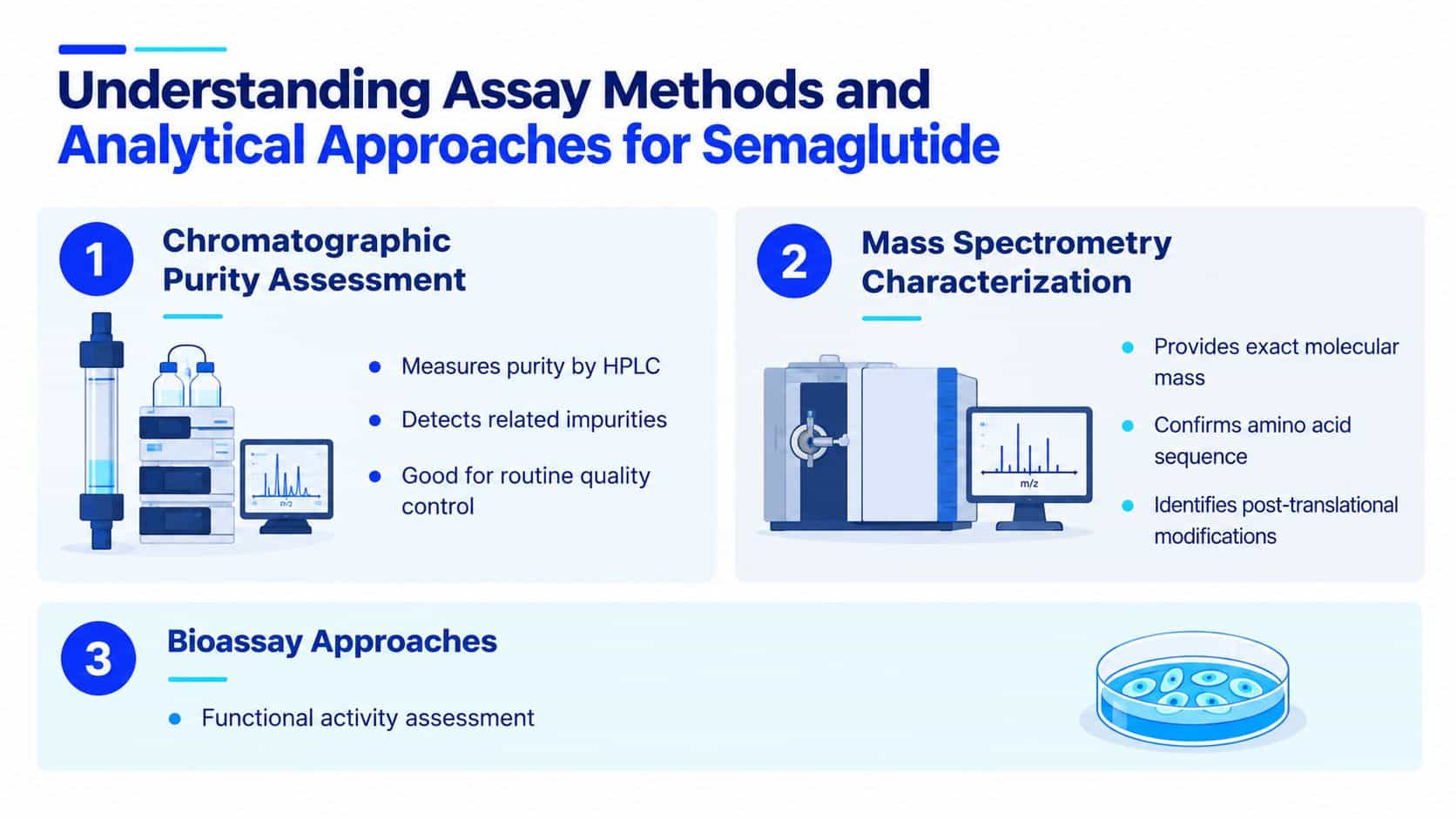
Chromatographic purity assessment is the routine first pass. It measures purity by HPLC, can detect related impurities, and works well for quality control when you need a quick read on whether the sample looks consistent. It does not, by itself, prove functional activity.
Mass spectrometry answers a different question. It provides exact molecular mass, helps confirm amino acid sequence, and can identify post-translational modifications. That makes it valuable when identity matters more than a simple purity percentage, especially if you're comparing batches or checking for unexpected variants.
Bioassay approaches add a functional layer. Instead of asking only what the molecule is, they ask what it does in a cell system. That's useful when you want to know whether the sample still behaves like a GLP-1 receptor agonist under biological conditions.
A useful rule is to match the method to the claim. If the claim is “this sample is clean,” chromatographic assessment is relevant. If the claim is “this sample is semaglutide,” mass spectrometry is the stronger identity check. If the claim is “this sample still produces the expected biological response,” a functional assay matters more.
Researcher's note: a Certificate of Analysis is only persuasive when the method behind it matches the question you're asking.
The evidence gap around non-branded or non-regulated semaglutide versions makes this even more important. Published coverage notes there's no head-to-head pharmacokinetic proof of dose equivalence to branded Wegovy or Ozempic, and these products don't feed the same adverse-event surveillance systems as regulated supply chains (report on reporting gaps). For that reason, traceability and validated methods matter as much as the label on the vial.
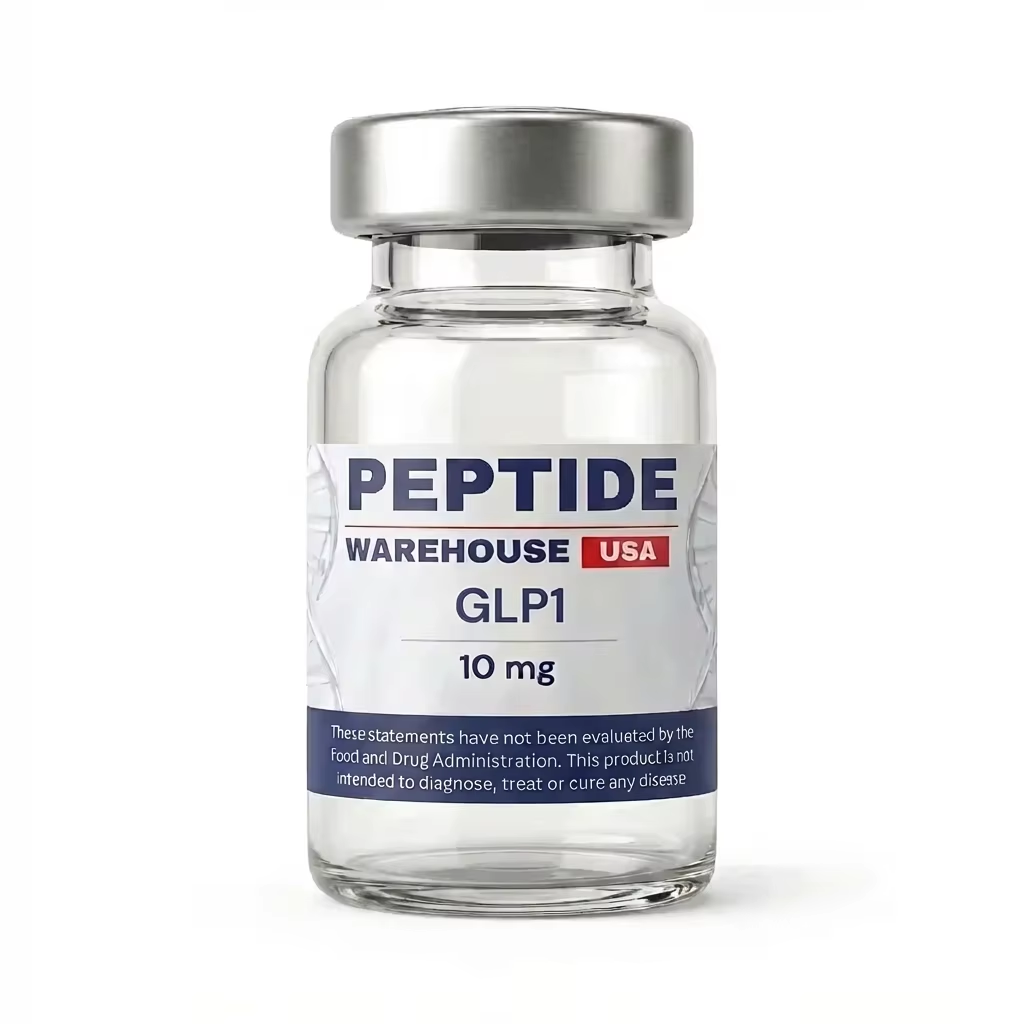
If your workflow needs a documented research supply, one option is Peptide Warehouse USA, which lists GLP-1 semaglutide for laboratory and analytical use with third-party analytical verification. That doesn't replace assay work, but it can fit a research pipeline that starts with documentation and then moves into lab confirmation.
Semaglutide can only be interpreted cleanly if the sample is handled cleanly. Poor storage doesn't just risk degradation, it can create artifacts that look like biological variability. In a lab setting, that means stability handling is part of data quality, not a side issue.
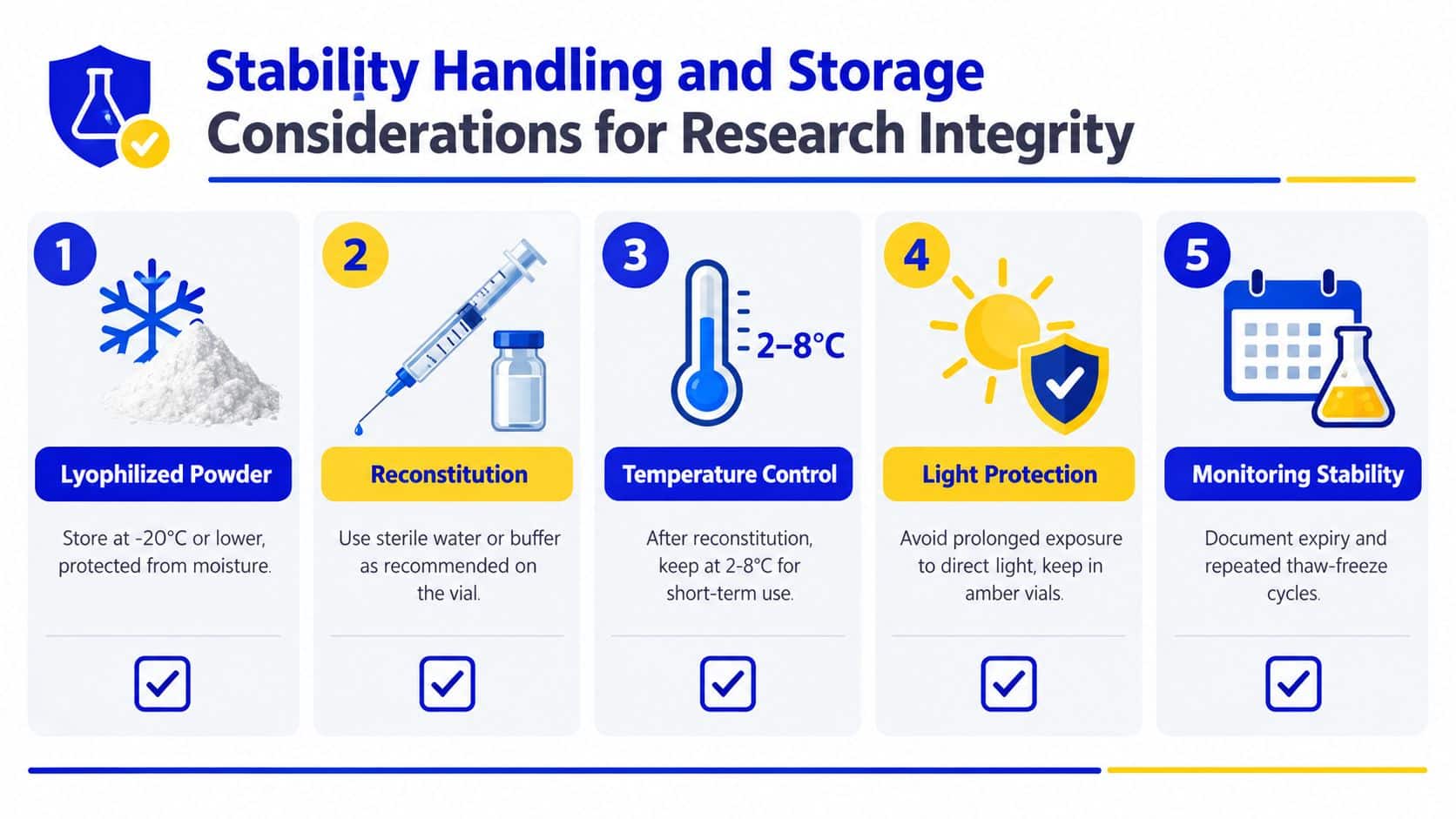
Start with the lyophilized powder in cold, dry conditions. The recommended lab-style handling on the visual is -20°C or lower, protected from moisture, because exposed peptide material can drift before the experiment even begins. After that, reconstitute using sterile water or the buffer specified for the vial, then keep the solution under controlled temperature for the short window you need.
Temperature and light matter more than many new researchers expect. Once reconstituted, the material should stay at 2-8°C for short-term use, and it should be protected from prolonged direct light, ideally in amber containers. Repeated freeze-thaw cycles also need to be tracked because they can alter consistency across runs.
A simple paper or electronic log prevents a lot of confusion later. Record the reconstitution date, storage condition, visible changes, and each thaw cycle. If two experiments give different readouts, those notes help distinguish a handling problem from a biology problem.
For research workflows, supply quality and assay quality meet. A well-documented material can still fail if it's mishandled, and a carefully run assay can still mislead if the sample history is unclear.
What does a semaglutide paper prove, and what is it only suggesting? The answer depends on more than the headline result. Weight change, glycemic control, adverse events, follow-up length, population, assay quality, and sample handling all shape how much confidence a researcher should place in the findings.
A trial is like a lens. If the lens is set for one outcome, it can give a sharp view of that question while blurring others. STEP 1 is a good example because it focuses on weight change in adults with obesity but no diabetes, so it tells you about that population's response rather than every possible semaglutide use. The useful question is not just whether the result is positive, but whether the trial design matches the research question you are asking.
SELECT needs a different reading strategy because the main endpoint is cardiovascular, not weight loss alone. If you treat it like an obesity study, you miss the purpose of the trial. If you read it like a pure safety study, you miss the outcome structure. Endpoints work like a contract, they define what the paper is allowed to claim.
Absolute and relative effects tell different parts of the story. A relative reduction can sound large even when the absolute change is modest, so both views matter. The practical move is to ask what changed, in whom, over what time frame, and against what comparator.
| Evaluation Criteria | What to Look For | Why It Matters |
|---|---|---|
| Population | Diabetes status, obesity status, cardiovascular disease status | Shows whether the result fits your question |
| Duration | Short-term versus long-term follow-up | Shows whether the effect persists or fades |
| Endpoint choice | Weight, HbA1c, MACE, tolerability, or a combination | Shows what kind of benefit the study can support |
| Comparator | Placebo, lifestyle intervention, or another active agent | Changes how hard the result is to interpret |
| Dosing context | Once-weekly exposure, oral delivery, or higher-dose obesity regimen | Helps explain efficacy and adverse-event patterns |
| Handling and assay quality | Material traceability, purity, and validated measurement | Affects whether the findings are reproducible |
A careful reader checks whether the same trial supports several claims at once, or only one. If weight, glycemic markers, and adverse events all move in a direction that fits the mechanism, the result is easier to trust. If the assay method is weak or the sample history is unclear, the biology can look cleaner than the material really is.
That same caution matters for claims beyond metabolic disease. The current evidence base for long-term use outside approved contexts is still incomplete, especially for anti-aging or wellness claims, and approval does not extend to those uses (ADA 2025 review on safety gaps).
The safest interpretation is the narrow one. Call an obesity result an obesity result. Call a cardiovascular result a cardiovascular result. Keep the assay and handling notes in view, because they tell you whether the paper reflects the molecule, or only the paperwork around it.
What should you check first when reading semaglutide research? Start with the study question, then follow the molecule through the workflow. Semaglutide's mechanism helps explain why glucose, appetite, and gastric emptying can shift together, but that is only the first filter. A solid read also depends on whether the trial design, assay method, and storage history support the claim being made.
Use a simple checklist before you cite a paper or handle a sample. First, verify that the COA method matches the research claim. Second, confirm traceability, purity, and whether the material stayed within the documented storage range, including thaw cycles. Third, check whether the population and endpoint line up with the conclusion. A STEP 1 obesity result should not be treated like a cardiovascular outcome, and a diabetes trial should not be stretched into a different setting.
The same discipline applies in the lab. Body mass and glycemic markers belong together because semaglutide links them biologically, but the assay must still fit the question you are asking. Clean documentation keeps the molecule from being confused with paperwork.
For a next step, compare assay approaches, review handling notes, and read the mechanism again before using any single paper to support a broader claim.
Peptide Warehouse USA supplies research-use semaglutide and related peptide materials with documentation that supports analytical and preclinical workflows. If you're evaluating semaglutide research materials for the lab, visit Peptide Warehouse USA to review research-only options and related product information.
Leave a comment