
No products in the cart.


If you've been searching tesamorelin peptide where to buy, you've probably seen two very different answers on the same page. One result points to prescription medicine and specialty pharmacy access, while another looks like a research listing with technical language and no clear clinical pathway. That split is exactly why procurement teams, lab managers, and researchers end up pausing, because the buying decision isn't just about availability, it's about regulatory status, documentation, and whether the product matches the intended use.
Tesamorelin isn't a casual supplement purchase. The molecule sits in a regulated drug category in the United States, and its approved history matters because it shapes what counts as a legitimate source, what paperwork should exist, and how the product is handled after purchase. For teams comparing vendors, that means the question is less “who has it?” and more “which channel is appropriate for the use case?”
This guide breaks the topic into practical pieces. You'll see what tesamorelin is in research terms, why its FDA status changes the buying path, how to separate approved pharmacy access from research sourcing, and what documentation should be on file before anything is ordered. You'll also get a vendor vetting checklist and a storage workflow that helps protect both product integrity and experimental consistency.
Practical rule: if the listing doesn't make the channel obvious, treat that as a documentation problem, not a shopping problem.
A procurement lead searching for tesamorelin usually runs into two different buying paths. One path leads to a branded prescription product through a regulated pharmacy channel. The other leads to research listings that use scientific language but do not always make the use case obvious. That split is where sourcing questions begin, because tesamorelin is tied to a clinical history, not a general retail shelf.
The U.S. approval history is the anchor. Tesamorelin first received FDA approval as Egrifta in November 2010, and the FDA label lists “Initial U.S. Approval: 2010”. Later product-history summaries note the original formulation was followed by Egrifta SV in 2019 and Egrifta WR in 2025 (FDA history summary). That timeline helps explain why the molecule is treated as a regulated therapeutic product rather than an open-market commodity.
For buyers, that regulatory footprint changes the sourcing decision. A lab, clinic, or analytical team should first decide whether the product is being sought through a prescription distribution route or for non-clinical research handling. Those channels are not interchangeable, and mixing them creates documentation and handling problems before the order is even placed.
A clean procurement process separates the approved medicine pathway from the research-use pathway, then checks documentation, storage, and fit for purpose. The infographic below shows the mechanism context used in research settings.
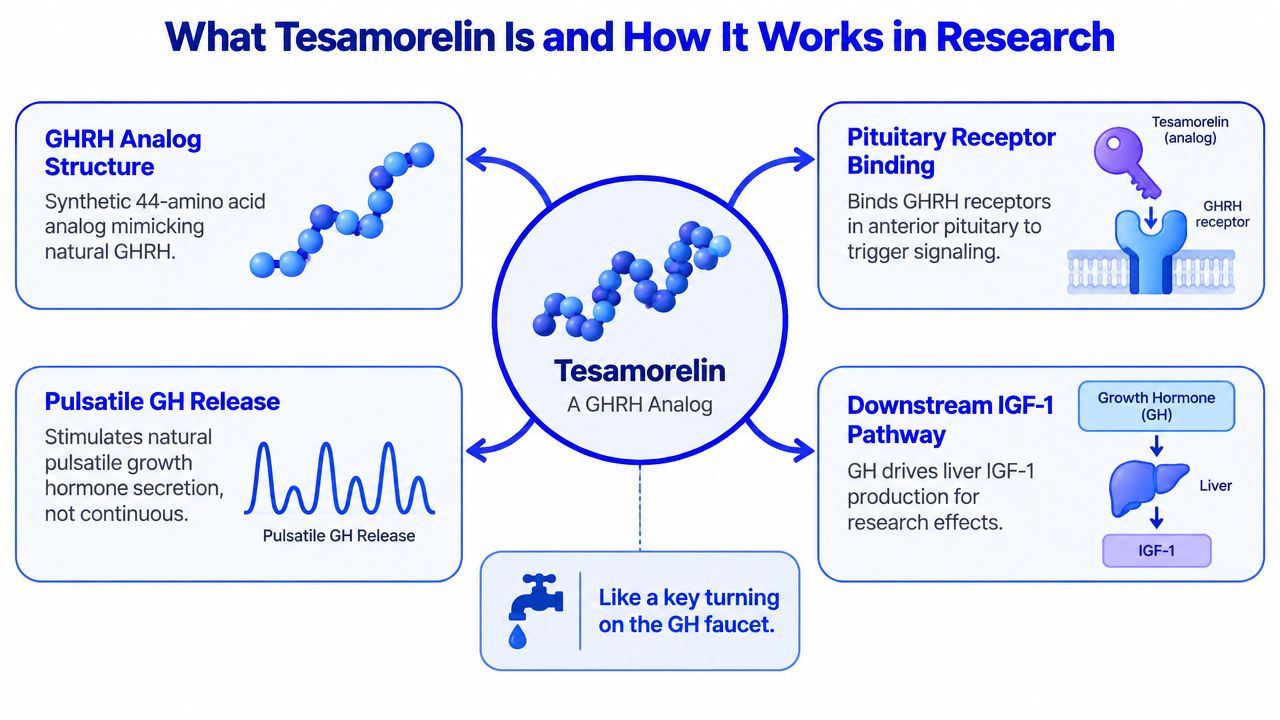
A lab team reading a tesamorelin label is not just seeing a peptide name. They are seeing a growth hormone–releasing hormone analog, a molecule that works upstream in the growth hormone pathway instead of replacing growth hormone itself. In practical terms, it tells the body to begin its own signaling cascade. The FDA label describes tesamorelin as binding human GRF receptors with potency similar to endogenous GRF and increasing downstream growth hormone signaling, including rises in IGF-1 and IGFBP-3 (FDA labeling).
That mechanism is the reason procurement teams need more than a product name. A vial marked “tesamorelin” can still be the wrong material for a study if it has degraded, been substituted, or been stored poorly. In that case, receptor-level activity can shift, and the resulting data become hard to trust.
The easiest way to picture the pathway is as a faucet in a controlled lab sink. Tesamorelin does not add output directly. It turns the signal that prompts the body to release growth hormone in pulses, which then affects downstream markers such as IGF-1. For buyers, that means sequence integrity, identity verification, and storage conditions are part of the experimental setup, not just the shipping checklist.
Plain-language takeaway: if you are buying tesamorelin for a study or lab workflow, you are not buying a generic powder. You are buying a signaling molecule whose value depends on structure, handling, and traceability.
Tesamorelin also appears often in body-composition research because its main evidence base sits in HIV-associated lipodystrophy. Pooled randomized-trial data showed a mean visceral adipose tissue reduction of 27.71 cm² versus control, along with a 1.61 cm decrease in waist circumference and a 1.42 kg increase in lean body mass (pooled trial summary). Earlier FDA-reviewed studies reported 19.6% and 11.7% placebo-adjusted visceral fat reductions at 26 weeks, with waist improvements of 1.8 cm and 1.3 cm, respectively (NCBI review).
Those findings explain the molecule's narrow research role. They do not turn it into a general retail item. They point to a specialized research and prescription compound that needs a clearly defined procurement path.
A procurement team can know the molecule and still choose the wrong channel. Tesamorelin's approval status determines the buying path, and the earlier history already shows why this is not a generic vendor search. The approved U.S. product is a prescription medicine with a narrow label, focused on reducing excess abdominal fat in adults with HIV-associated lipodystrophy (FDA label).
That label matters operationally. Prescription products move through licensed prescribers and controlled pharmacy distribution, so the listing must match the legal category of the item. A specialty pharmacy works more like a regulated dispensing chain, with prescription verification, fulfillment records, and medication instructions. A research-use source works like a laboratory supply channel, with lot-level documentation, identity data, and handling notes for non-clinical use.
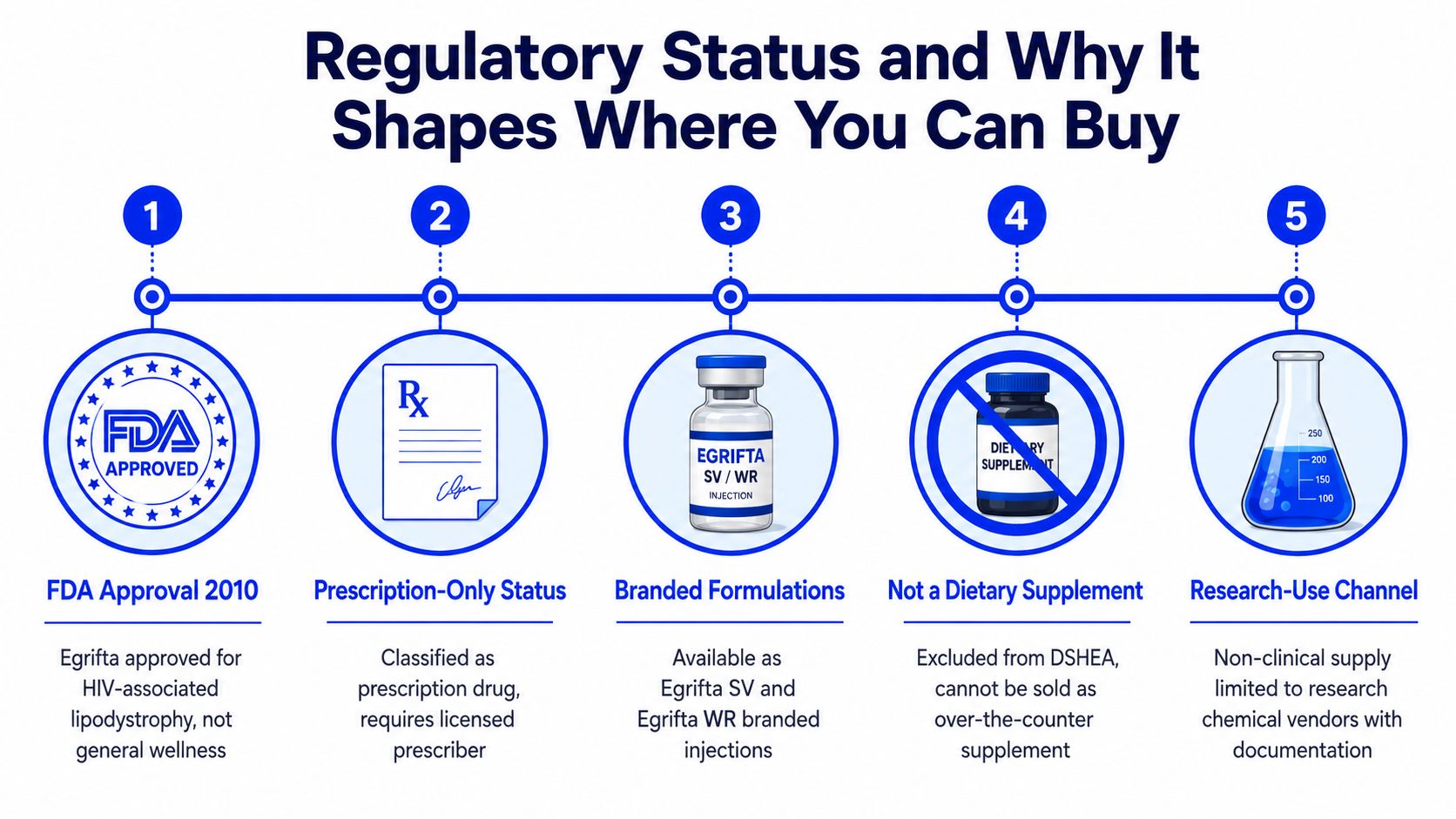
FDA approval does not mean open retail sale. It means the product has a regulated medical identity, a specific label, and a dispensing model built around prescription control.
For buyers, that usually splits into two practical paths.
The key confusion point is that search results often blur clinical language and research-chemical language. A research-use-only listing does not become a pharmacy product because the active ingredient name is the same. The channel determines the compliance rules, the paperwork, and the intended use.
A procurement checklist helps separate the two. Ask whether the seller can identify the product category plainly, provide the right documentation for that category, and explain how the item is stored, shipped, and received. If the answer shifts between prescription wording and research wording, the listing needs more review before anyone places an order.
Compliance insight: if a supplier cannot state whether the item is prescription-grade or research-use-only, the team should treat the listing as incomplete.
For regulated markets outside the U.S., the same logic usually applies. Prescription status shapes access, and access shapes where the product can be bought. That is why tesamorelin should be treated as a regulated therapeutic with distinct buying paths, not as a commodity peptide.
The fastest way to reduce confusion is to compare the two real buying paths side by side. One path is the FDA-approved medicine route, where tesamorelin appears as a prescription product tied to branded formulations. The other is research sourcing, where the listing is meant for laboratory or analytical use and isn't presented as a medical product.
| Sourcing Path | Best For | Requirements | Documentation to Expect |
|---|---|---|---|
| FDA-approved pharmacy access | Prescription use under a licensed prescriber | Medical evaluation, prescription, specialty pharmacy fulfillment | Prescription records, pharmacy fulfillment details, product labeling, storage instructions |
| Research-use-only sourcing | Laboratory, analytical, preclinical workflows | Internal research justification, supplier qualification, site policies | CoA, lot number, purity statement, handling guidance, research-use disclaimer |
| Telehealth-prescribed pharmacy access | Buyers who need a clinical evaluation before pharmacy dispensing | Virtual consult, prescription approval, formal dispensing workflow | Prescriber notes, order confirmation, medication guide, shipping documentation |
| Non-approved research listing | Controlled bench work where a research peptide is the intended material | Vendor review, documentation check, internal compliance signoff | Batch-specific testing, identity data, invoice, storage and receipt records |
The practical distinction is easy to miss online because both channels can use similar product names. A pharmacy page may list a branded injection with patient-oriented language, while a research page may emphasize batch data and analytical support. The language itself usually tells you which side you're on.
That matters for teams handling compliance, insurance, and internal approvals. If the goal is a prescription medicine, the route should flow through licensed care and specialty dispensing. If the goal is bench work, the purchasing file should reflect research-use-only status, not clinical intent.
Compounding questions also come up a lot, especially when buyers hear that a product is unavailable or assume a shortage changes everything. The more useful question is whether the current channel is aligned with the law, the indication, and the documentation needed for your organization. The FDA shortage list does not currently list tesamorelin, which helps explain why access discussions tend to center on approved channels and non-clinical research sourcing rather than shortage-driven substitution (regulatory overview).
Decision rule: if you need a medication workflow, buy like a medication buyer. If you need a research workflow, buy like a research buyer. Blending the two creates avoidable risk.
Vendor vetting starts with documents, not prices. A real supplier should make it easy to verify the lot, the testing, and the storage conditions before shipment. If those items are missing or vague, the purchase should slow down immediately.
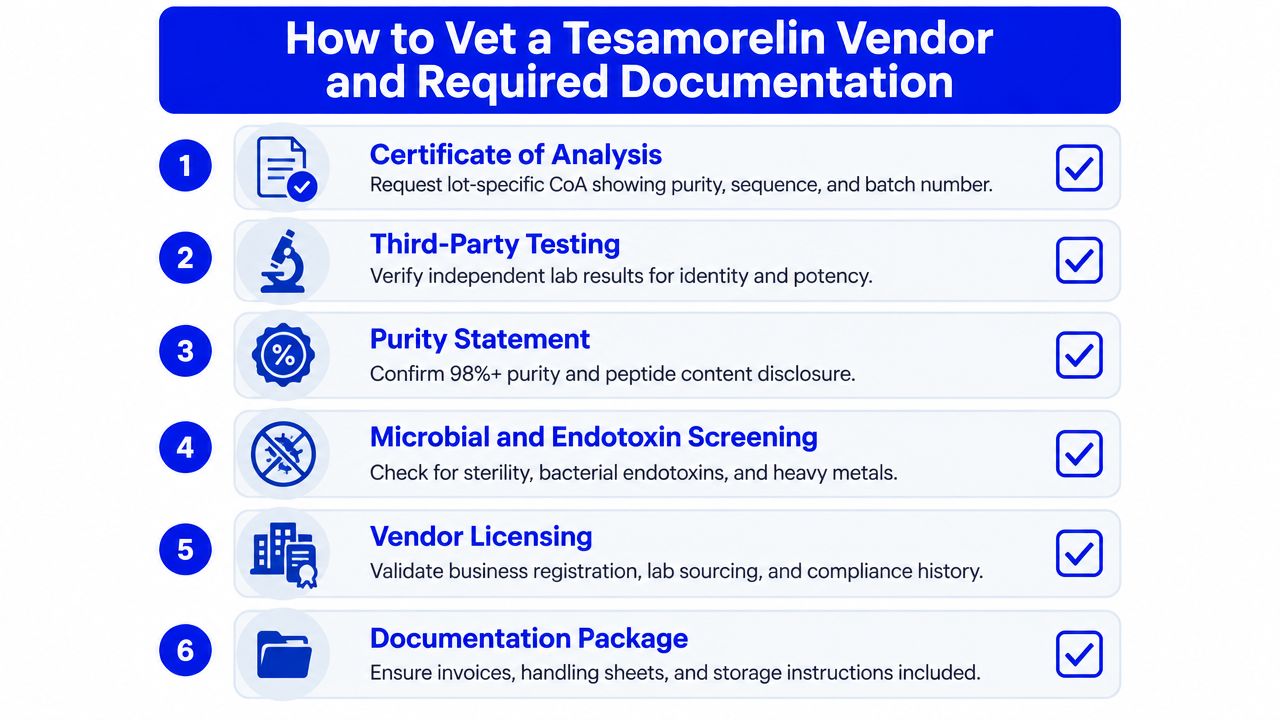
Start with a lot-specific Certificate of Analysis. The document should tie the product to a batch number and show identity and purity testing. If the lot number on the vial, invoice, and CoA don't match, that's a problem.
Next, ask for third-party testing. Independent verification helps confirm the supplier isn't relying only on in-house claims. For a peptide like tesamorelin, that matters because sequence fidelity and purity affect downstream results.
Then check the rest of the package:
If you're reviewing a broader procurement workflow, a useful internal reference is the onboarding to the MSC vendor portal, which shows how structured vendor intake can support cleaner approval records. The lesson applies here even if the platform is different, the buying team still needs a repeatable intake process.
A supplier doesn't need flashy branding to be credible. It needs clarity. Be cautious if you see any of these:
The broader reason for this caution is simple. Tesamorelin is a signaling peptide, and the active ingredient's effect depends on intact structure and verified identity. If the documentation is thin, experimental reproducibility becomes harder to defend.
The video below is useful if your team wants a quick visual refresher on vendor qualification and document flow.
Documentation rule: if the supplier can't show you what's in the vial, when it was made, and how it should be stored, you're not looking at a complete procurement file.
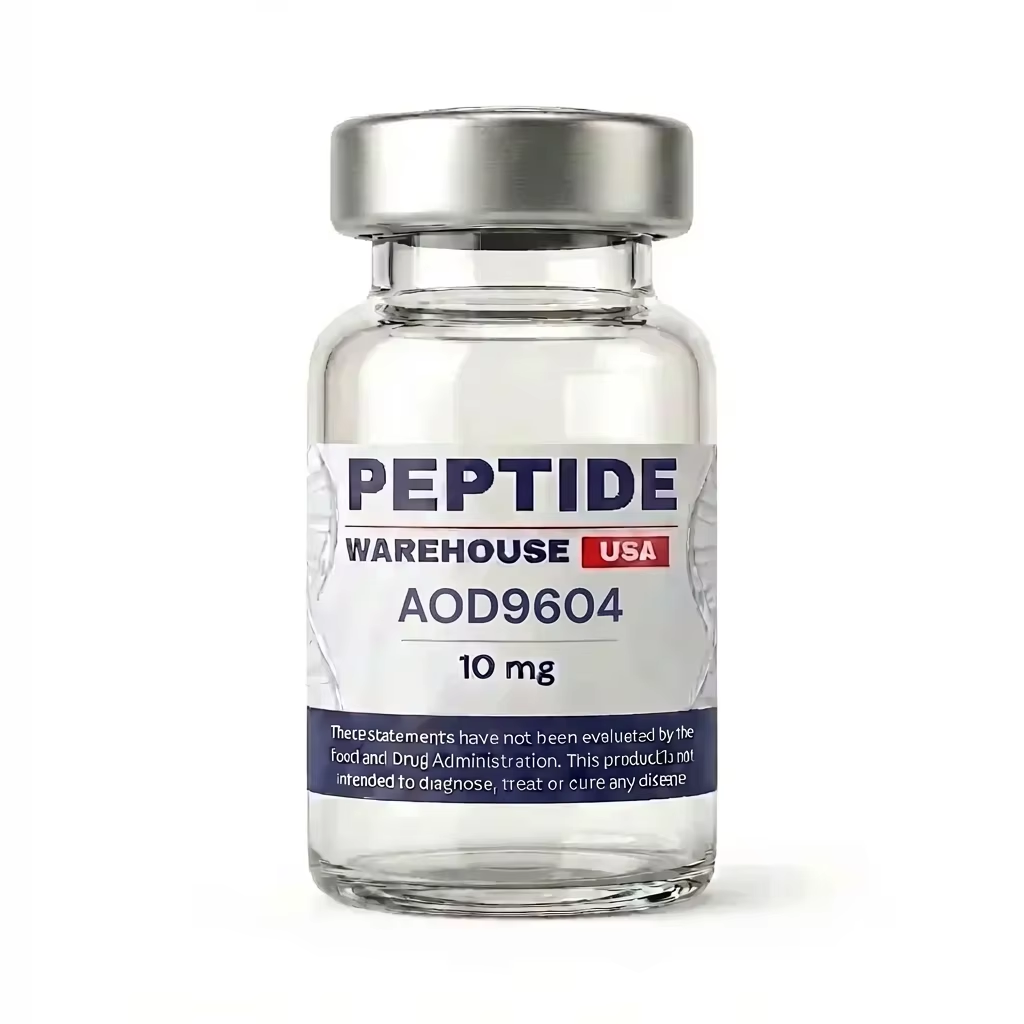
For teams comparing options, Peptide Warehouse USA is one example of a U.S. research supplier that presents tesamorelin in a research-only catalog with supporting documentation and handling information. That doesn't replace your internal review, but it does show what a documented research-use pathway can look like when a supplier is organized around batch traceability and lab use.
Storage details should be treated as part of the buying decision, because a well-sourced peptide can still become a weak input if it's handled badly. Tesamorelin's label gives clear handling rules, and those rules translate into practical lab controls. The current FDA prescribing information for EGRIFTA SV 2 mg vials says to store at 20°C to 25°C (68°F to 77°F) with excursions permitted to 15°C to 30°C (59°F to 86°F), and to protect the product from light (current label).
The original EGRIFTA formulation also allowed refrigerated storage at 2°C to 8°C (36°F to 46°F) and permitted storage below 25°C (77°F) for up to 3 months or until expiration, whichever came first (original label). That creates a concrete benchmark for teams that need to think about receipt, transport, and storage discipline.
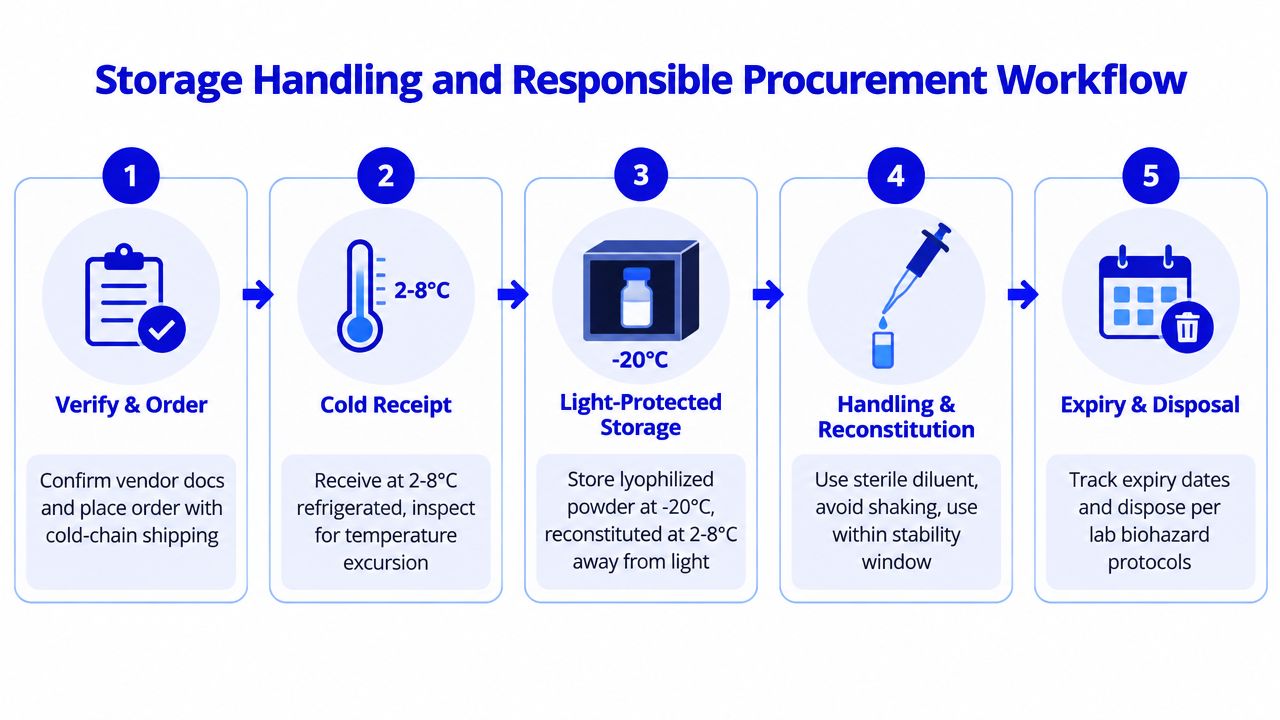
Use the same sequence every time:
The best workflow is boring. It forces the same checks every time and leaves a paper trail that supports internal review. That's especially important when the product is part of a research-use-only purchase, because the documentation should show that the item never left its intended compliance lane.
A few practical habits help keep the workflow tight:
Responsible procurement isn't only about compliance. It protects the integrity of the work. If a lot has been mishandled or substituted, any downstream comparison becomes harder to trust.
The cleanest way to answer tesamorelin peptide where to buy is to start with the use case, then follow the channel that matches it. Tesamorelin has a real FDA-approved history, a specific clinical indication, and storage rules that support careful handling. That makes it a regulated therapeutic in pharmacy settings and a documentation-sensitive material in research settings.
For procurement teams, the smartest move is to separate the options before comparing vendors. Prescription access belongs with licensed care and specialty dispensing. Research sourcing belongs with transparent lot-level documentation, clear research-use labeling, and storage practices that preserve integrity from receipt to use.
A vendor checklist keeps the process grounded. Ask for the CoA, batch traceability, testing detail, and storage guidance before you approve anything. If those pieces are missing, the product file isn't ready, even if the listing looks polished.
If you're building a research supply list, the next step is to review suppliers that present tesamorelin with clear documentation, handling instructions, and research-use-only positioning. Learn more, compare options carefully, and make the purchase decision from a compliance-first lens rather than a search-result shortcut.
Peptide Warehouse USA offers tesamorelin as part of a U.S.-based research peptide catalog, with batch-focused documentation and research-use-only positioning that fits lab procurement workflows. If you're evaluating a sourcing path for analytical or preclinical work, visit Peptide Warehouse USA to review their tesamorelin listing and compare it against your internal documentation standards.
Leave a comment