
No products in the cart.


You're comparing two peptide listings that look almost identical. Both display a familiar compound name, both mention high purity, and both promise research-use-only material. Yet one supplier provides a batch-linked Certificate of Analysis, mass spectrometry data, endotoxin results, and a clear U.S. manufacturing record, while the other offers only a product page and a purity claim.
That difference is the core meaning of US-made research peptides. "Made in the USA" shouldn't function as a decorative badge. It should lead you to verifiable evidence about origin, manufacturing control, testing, documentation, and the chain of custody from production to your laboratory.
A purchasing decision can become difficult when the label gives you less information than the experiment requires. You may need a peptide for analytical work, cell-based research, or a preclinical workflow, but the listing may not tell you who produced the lot, which laboratory tested it, or whether the attached document belongs to the vial you're ordering.
That uncertainty creates a practical problem. If an experiment produces an unexpected result, you need to separate biological variation from material-related variables. Without traceable sourcing and lot-specific records, investigating the cause becomes much harder.
US-made research peptides offer a useful starting point, but domestic origin alone doesn't prove quality. A credible procurement review should connect the origin claim to:
The U.S. peptide therapeutics market was estimated at USD 73.0 billion in 2025, projected to reach USD 78.48 billion in 2026, and projected to reach USD 150.46 billion by 2035, implying a 7.5% CAGR from 2026 to 2035, according to Peptides Explorer's 2026 peptide market overview. That market scale makes domestic manufacturing and batch traceability especially relevant when laboratories procure materials in North America, identified repeatedly in industry forecasts as the largest regional market.
This guide treats U.S. sourcing as a verification checklist, not a marketing shortcut. You'll learn what manufacturing evidence matters, why purity requires more than one assay, how to read a peptide COA, and how shipping records support the identity of the lot that arrives at your lab.
Practical rule: Treat “US-made” as a question to verify, not a conclusion to accept.
A documented supply chain resembles a labeled path through a laboratory. You can identify the starting materials, the production step, the testing stage, the lot number, and the final shipment. An opaque supply chain resembles a box passed between unknown handlers. The package may arrive intact, but you can't confidently reconstruct what happened before delivery.
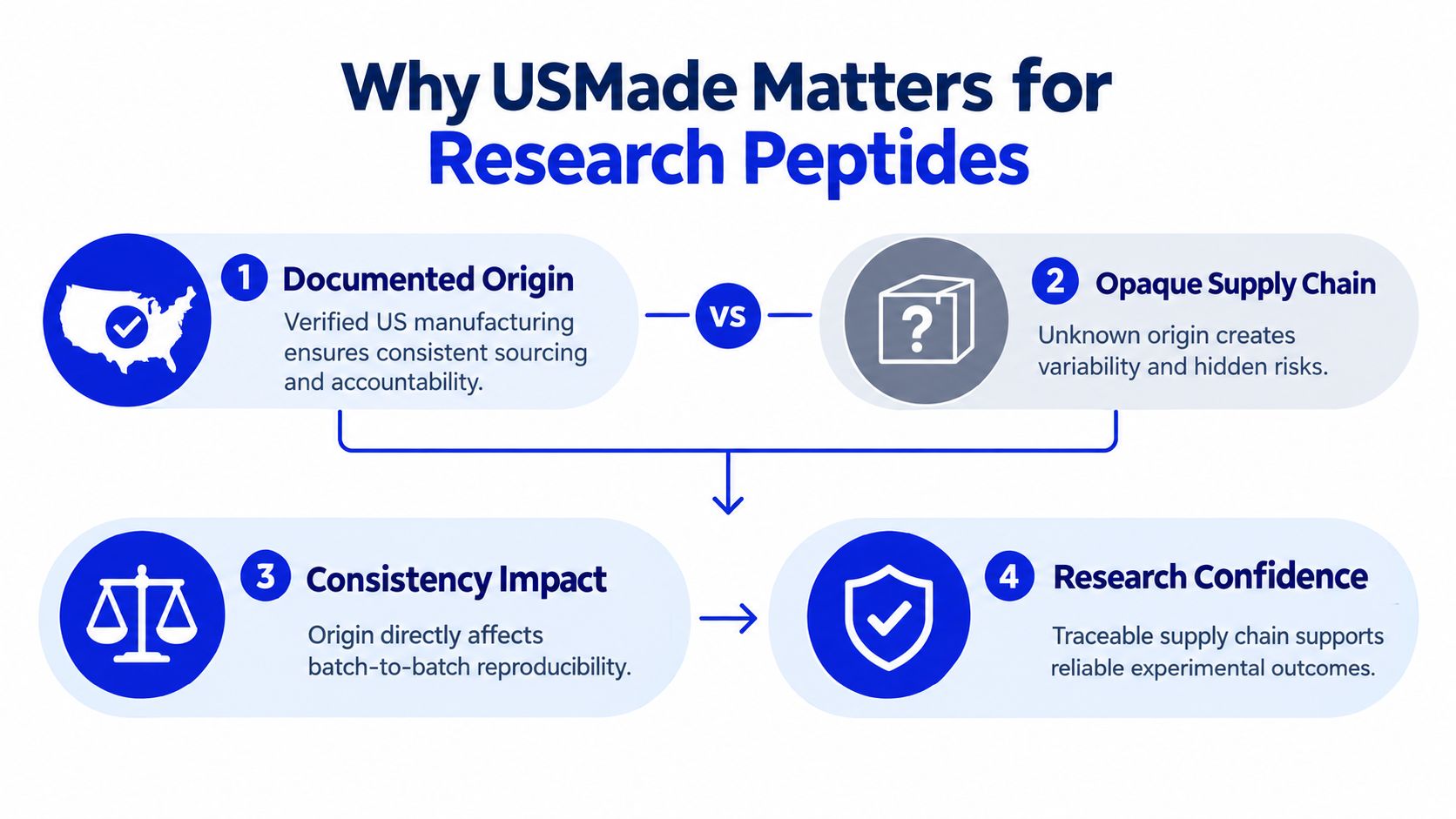
For a research buyer, domestic production can simplify several questions. You can ask where the material was synthesized, which organization released the lot, how the supplier stores its records, and who can respond if the label and documentation don't match.
That doesn't mean every overseas product is unsuitable, or that every U.S. product is automatically reliable. The useful distinction is evidence density. A supplier with a transparent domestic operation may make it easier to connect manufacturing, testing, inventory, shipping, and customer support within one accountable commercial environment.
Domestic sourcing can also support repeat procurement. If your lab needs to reorder a compound, a consistent supplier record gives you a clearer basis for comparing lot documents and asking whether the same production profile is available. That's valuable for laboratories trying to reduce unexplained changes between experimental runs.
The FDA issued its Clinical Pharmacology Considerations for Peptide Drug Products guidance on December 14, 2023. The framework defines peptide drug products in a context that includes polymers composed of 40 or fewer amino acids.
Research-use-only materials aren't automatically pharmaceutical products, but the guidance reflects a more formal U.S. development environment for peptide identity, characterization, and testing. Buyers should respond by demanding clearer production records, analytical results, and third-party support rather than relying on a country-of-origin statement alone.
A sensible evaluation sequence looks like this:
US-made research peptides matter most when the origin claim becomes part of this complete record. The benefit isn't a flag on the website. It's the ability to follow the material's history and make a defensible procurement decision.
“High purity” describes one dimension of a peptide lot. It doesn't, by itself, prove that the sequence is correct, that the stated amount is present, or that the material is free from biologically relevant contamination.
A strong quality program uses orthogonal methods, meaning different tests examine different failure modes. The approach is similar to checking a shipment by reading its label, weighing the package, inspecting the contents, and testing for contamination. One check can support the others, but it can't replace them.
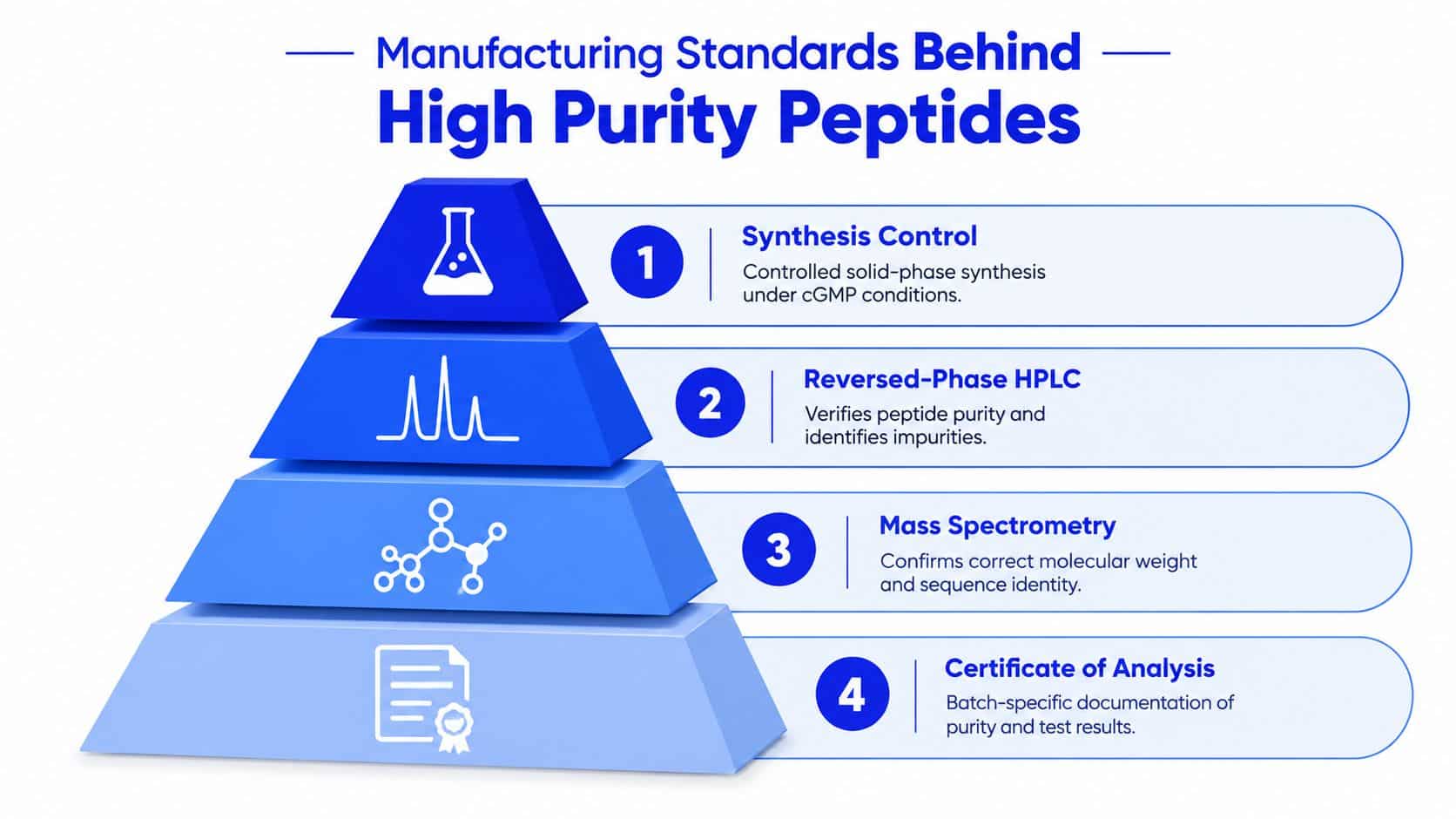
Reversed-phase HPLC separates components in the sample and provides a chromatographic view of purity. It can show whether the target peak dominates the profile and whether additional peaks require investigation. HPLC is important, but it can overstate quality if truncation products, counterions, or non-peptidic residues aren't separately assessed.
Mass spectrometry supports identity by measuring molecular mass. A major HPLC peak could still represent a structurally related impurity, so mass spectrometry provides an independent check that the material corresponds to the intended peptide.
The standard analytical stack commonly extends beyond those two tests. A broader panel may examine:
The IJSRA discussion of peptide quality control describes this combined approach, emphasizing that HPLC and mass spectrometry answer different questions and that a broader panel strengthens analytical confidence.
Endotoxin and microbial testing address risks that HPLC and mass spectrometry can't detect. A chemically clean sample can still create problems if it contains pyrogenic material or microbial contamination.
USP-aligned quality expectations commonly include bacterial endotoxin testing under USP <85>, along with sterility or microbial-limit testing. Peptide CMC materials also discuss residual solvents, elemental impurities, water content, and counterion assessment as separate quality considerations. The USP CMC regulatory presentation provides context for these controls.
Independent quality programs may also reference USP <61> and USP <62> for microbial enumeration and specified microorganisms, as described by Peptide Express's quality documentation. The important procurement lesson is simple:
A purity percentage is one result, not a complete quality system.
For a lot to be defensible, the supplier should be able to connect synthesis controls, analytical identity, chromatographic purity, contamination testing, and batch documentation. A useful overview of peptide manufacturing and QC expectations can help teams visualize how these controls fit into a production workflow.
A Certificate of Analysis should function like a passport for a specific lot. It doesn't guarantee that a research result will succeed, but it gives you the information needed to identify the material, understand the tests performed, and investigate questions later.
Start with the lot number. The number on the vial or package should match the number on the COA. A generic certificate with no batch linkage provides much less confidence because it may describe a different production run.
Check the product name and molecular description next. The document should identify the compound clearly and report relevant molecular characteristics. Then look for the analytical methods used to support the identity and purity claims.
A useful COA commonly includes:
The peptide COA guide from Real Peptides describes a COA as a batch-specific document covering identity, purity, molecular characteristics, and contamination checks. That combination is more informative than a single headline purity value.
A COA can be complete yet still require context. Ask whether the stated method fits your application, whether the reported result has a clear acceptance criterion, and whether the laboratory or analyst is identifiable. If the supplier won't provide supporting data before purchase, you have less opportunity to evaluate the lot in advance.
One cited acceptance threshold for research-grade RUO peptides is below 0.25 EU/mL for endotoxin, as explained in Lotilabs' COA reading resource. That threshold shouldn't be copied blindly into every protocol. Your laboratory should confirm the applicable specification for its intended research use.
| Document Field | What Good Looks Like |
|---|---|
| Batch number | The identifier matches the vial, order, and shipment records. |
| HPLC purity | A reported result is supported by a method, chromatogram, or laboratory record. |
| Mass spectrometry | The expected molecular mass or identity is independently confirmed. |
| Endotoxin | The method and result are stated, with a relevant acceptance criterion. |
| Microbial testing | Microbial limits or screening are reported when appropriate to the workflow. |
| Test laboratory | The testing organization and analytical method are identifiable. |
| Release approval | The document is dated or approved for the specific lot. |
A useful COA answers three questions: What is this material, how pure is it, and what contamination checks were performed?
The label research use only doesn't fill in those blanks. It identifies a use category, not a testing outcome.
A peptide can meet its release specifications and still create procurement problems if the shipment is delayed, poorly tracked, or difficult to reconcile with the original order. Shipping is therefore part of traceability, not merely a convenience feature.
U.S. sourcing can offer 1-2 day shipping windows, according to the supplier comparison context provided for this guide. Shorter domestic transit may reduce administrative delays, simplify tracking, and make it easier for a lab to confirm who handled the package before arrival. It can also make communication more direct when a shipment needs clarification.
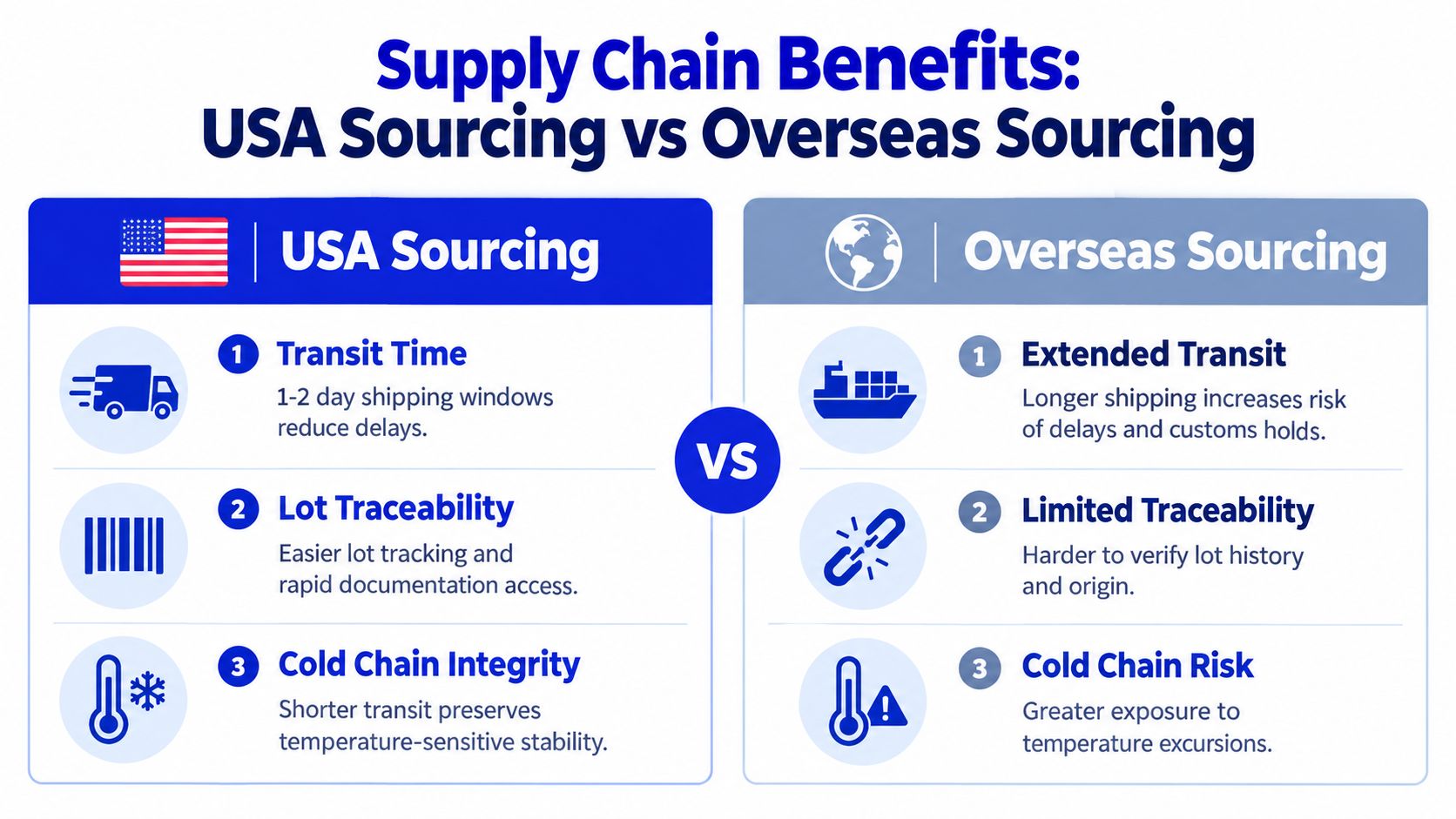
| Procurement factor | U.S. sourcing | Overseas sourcing |
|---|---|---|
| Transit | Domestic delivery can reduce delays and simplify planning. | Longer routes can introduce more handoffs and customs-related uncertainty. |
| Lot tracking | The supplier may provide a more direct link between inventory, documentation, and delivery. | Buyers may need to reconcile records across more intermediaries. |
| Communication | Questions can often be handled within a familiar commercial and legal environment. | Time zones, intermediaries, and import processes can complicate resolution. |
| Reordering | A clear domestic record can make lot comparison and repeat procurement easier. | Reconstructing the same chain of custody may require additional documentation. |
This comparison isn't a claim that overseas sourcing always fails. It means the buyer should ask more questions about custody, relabeling, storage, and retesting when more supply-chain stages sit outside the buyer's immediate visibility.
Temperature-sensitive materials deserve particular attention. Review the supplier's packaging, shipping schedule, tracking process, and instructions for documenting damage or suspected exposure. Keep the delivery record with the COA so the lot history remains intact.
For a broader framework on logistics, resilience, and chain-of-custody planning, consult this guide to biobank supply chains. Its value lies in treating biological-material logistics as a systems issue, rather than separating purchasing from storage and delivery.
A reliable procurement file should contain the order confirmation, lot number, COA, shipping record, receiving notes, and any communication about the shipment. That simple habit gives your team a stronger foundation for reordering or investigating an unexpected result.
The phrase research use only, or RUO, is often misunderstood. Independent coverage characterizes RUO as a legal disclaimer rather than a quality standard, and notes that research-grade products may not carry the sterility, endotoxin, or GMP controls expected of pharmaceutical products, as discussed in coverage of research-grade peptide contamination risks.
That distinction matters because a label can describe how a product is marketed without proving how it was made or tested. A buyer still needs to review identity, purity, contamination controls, and traceability before introducing a material into a research workflow.
In the U.S. regulatory framework, peptides marketed for human consumption or therapeutic purposes are treated as drugs under federal law. FDA enforcement focuses on preventing therapeutic claims and improper consumer marketing, while research-use materials remain in a different category, as explained in this overview of U.S. research peptide status.
That framework doesn't remove the buyer's responsibility. It clarifies why laboratories should:
The ChemVerify explanation of peptide COAs and research risks emphasizes that purity alone doesn't establish contamination risk or biological suitability. That's the practical compliance connection: responsible sourcing requires both appropriate product positioning and sufficient evidence for the laboratory's own quality decisions.
A transparent supplier should make the use limitation clear, provide documentation without disguising it as a medical guarantee, and support traceability from the product page to the released lot. Buyers should apply the same discipline to every compound, whether it's an established catalog item or a new material being evaluated.
Choosing US-made research peptides becomes much easier when you stop treating origin as the final answer. Use it as the first checkpoint in a broader review that connects manufacturing location, lot identity, analytical testing, contamination controls, documentation, and shipping records.
Before placing an order, confirm that the supplier can explain where the peptide was produced and provide a batch-specific COA. Check for reversed-phase HPLC, mass spectrometry, endotoxin, and microbial information, then match every identifier to the vial and delivery record. Finally, review how the supplier handles storage, shipment tracking, questions, and documentation requests.
The benefits of peptides in laboratory research depend on material quality and experimental design, not on promotional language. Catalog compounds such as BPC-157, GHK-Cu, and PT-141 should be evaluated by the same evidence-based process as any other research material. Explore options, learn more about the available documentation, and request the relevant records before purchase.
Apply this checklist to your next order. A supplier that can connect U.S. manufacturing, batch testing, third-party documentation, and domestic fulfillment gives your lab a clearer procurement record and a more defensible starting point for research.
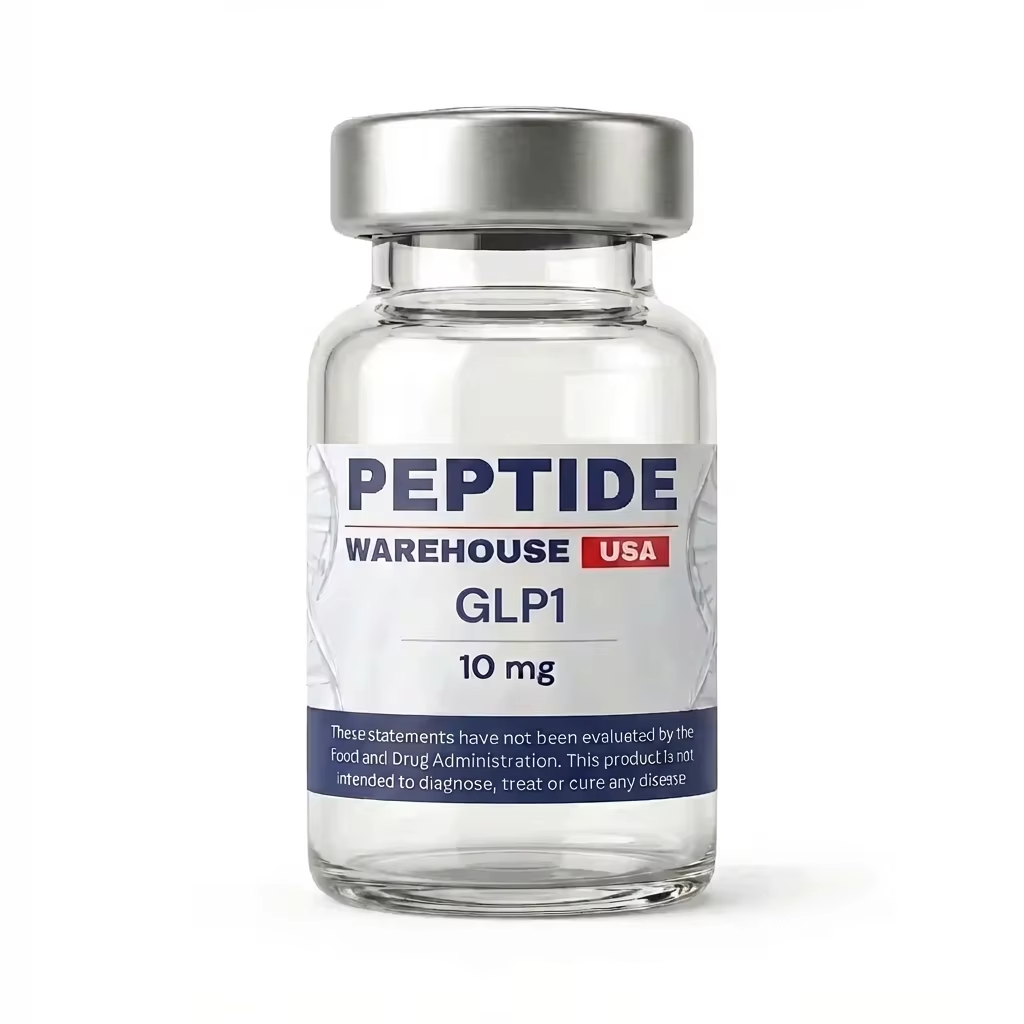
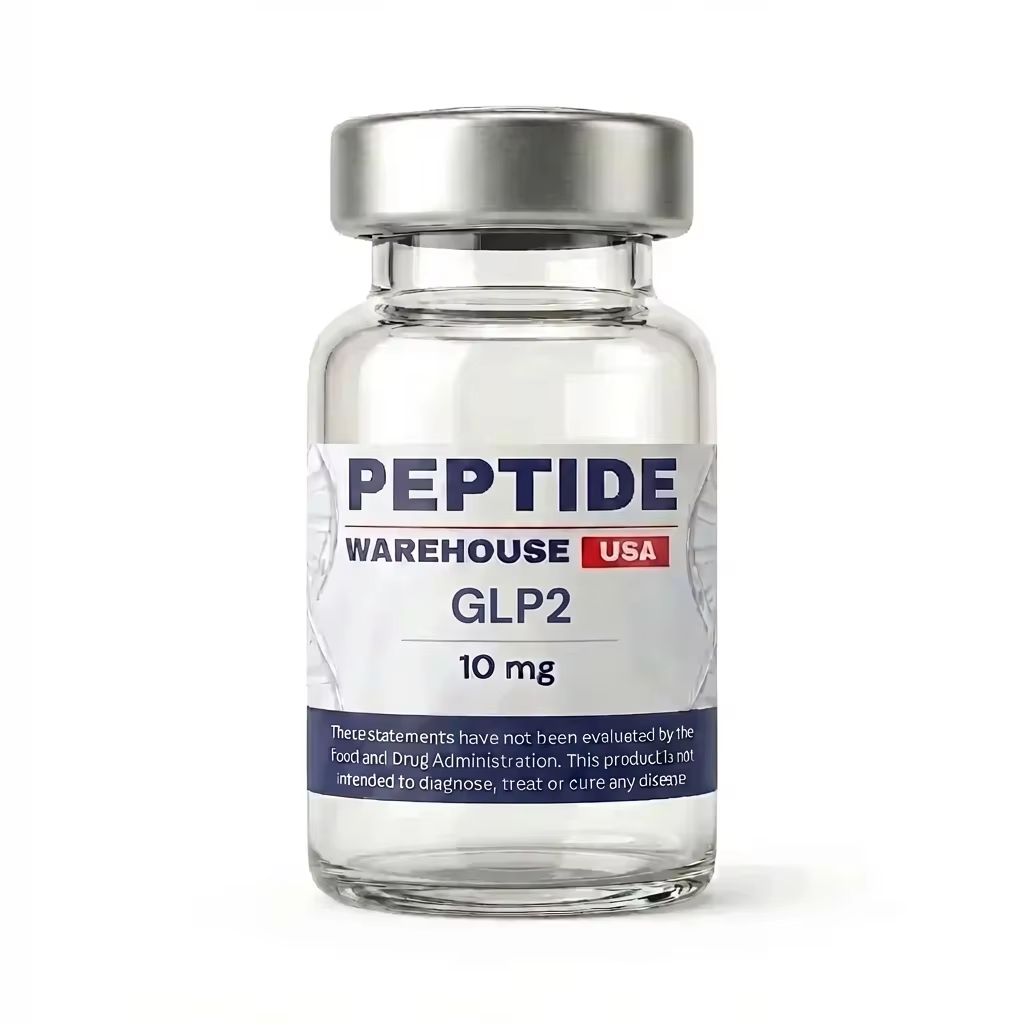
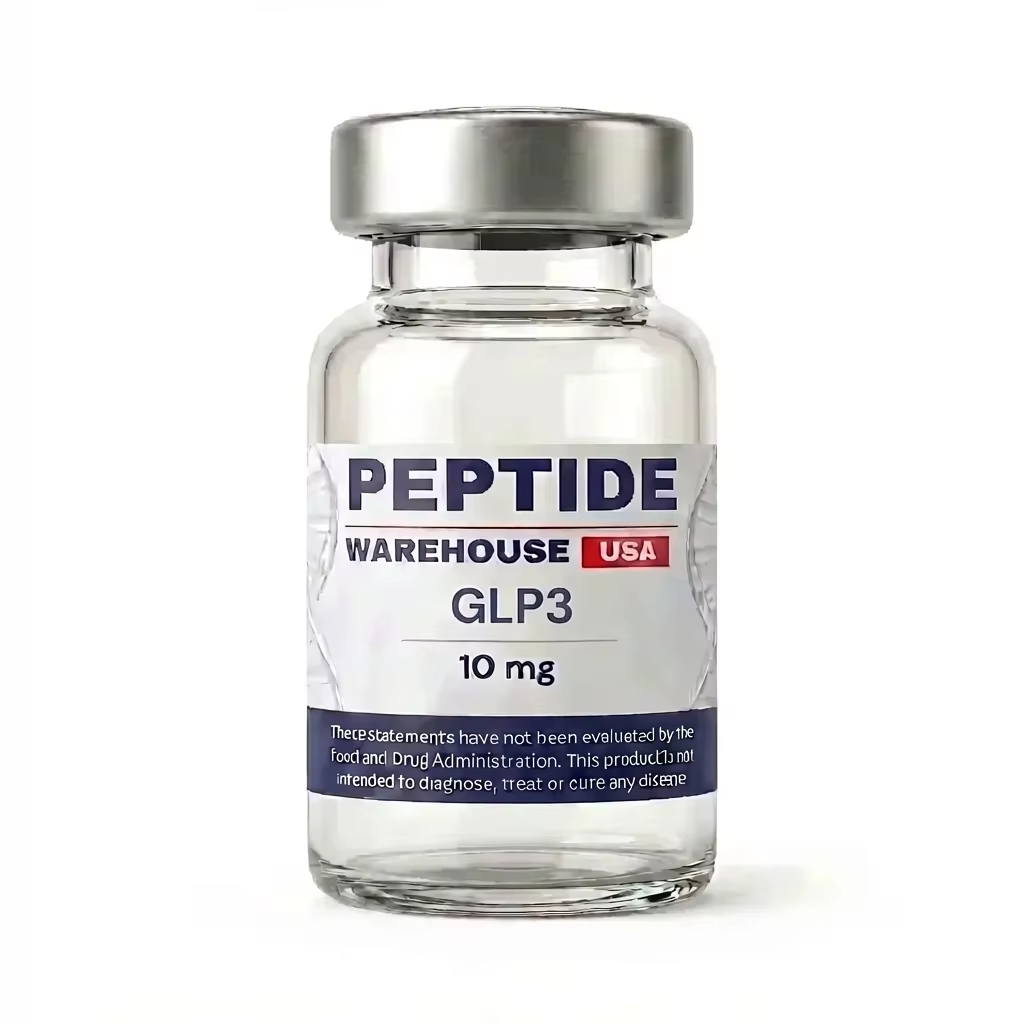
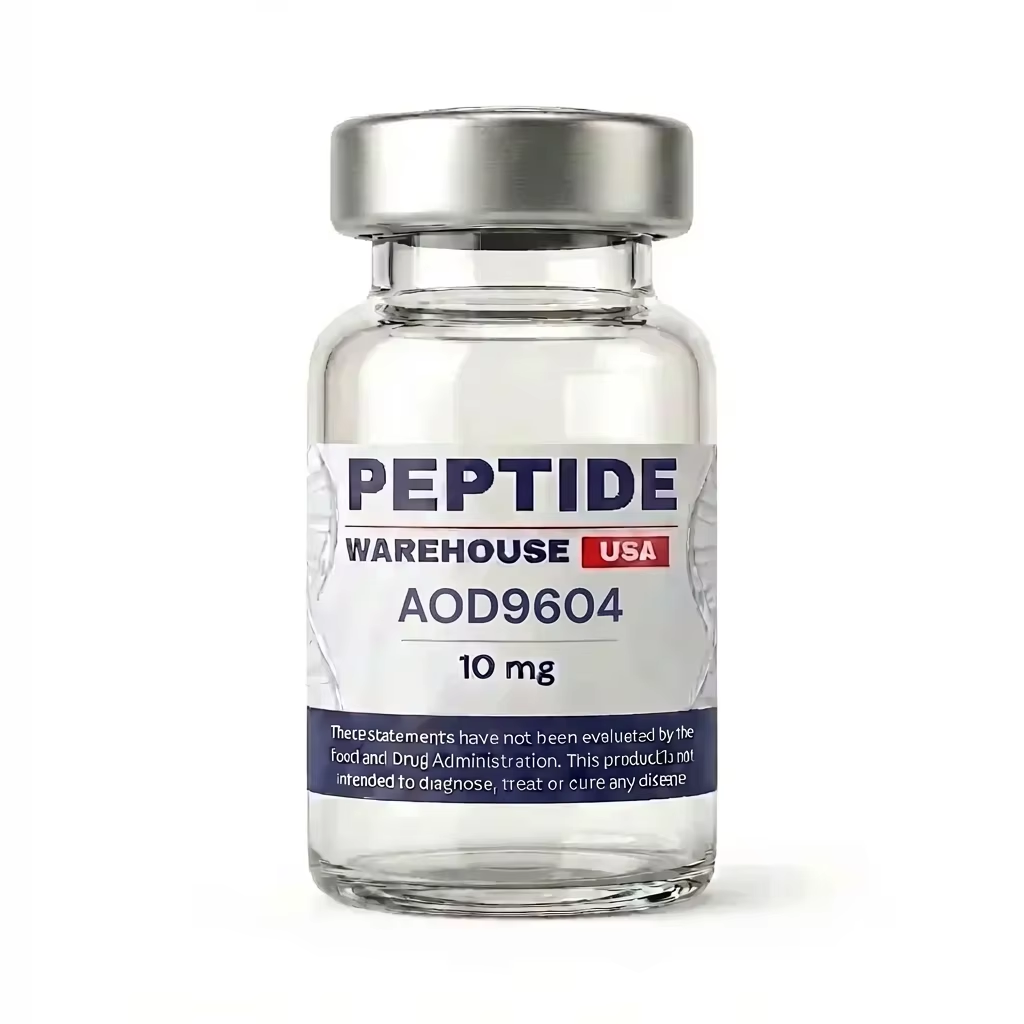
Peptide Warehouse USA offers U.S.-made research peptides and related compounds for laboratory, analytical, and preclinical applications, with product documentation that includes COAs, microbial information, and endotoxin reporting where provided. Visit Peptide Warehouse USA to explore available options, review sourcing information, and request the batch records you need before ordering.
Leave a comment