No products in the cart.



If Vesugen is often described as a vascular anti-aging peptide, what exactly supports that claim, and what belongs more to marketing than to science?
That's the right starting question. Interest in peptide bioregulators has expanded because they offer a different conceptual model from symptom-focused compounds. Vesugen stands out because the published discussion around it centers on vascular tissue, endothelial cell longevity, and gene-level regulation rather than a single receptor-mediated effect.
The evidence, however, needs careful handling. Most of what people cite about Vesugen comes from Russian research traditions and from secondary summaries of those studies, not from large modern regulatory-grade clinical programs. That doesn't make the peptide irrelevant. It means the most credible way to evaluate Vesugen peptide benefits is to separate mechanistic plausibility, small-study signals, and unresolved regulatory gaps.
Vesugen has become part of a broader conversation about the benefits of peptides in aging and tissue-specific research. Unlike broad wellness claims, the Vesugen literature points toward a narrower idea. Researchers discuss it as a vascular peptide bioregulator with possible relevance to endothelial maintenance, circulation, and age-related vascular decline.
That narrowness is important. A peptide aimed at the vascular wall is easier to evaluate than a compound advertised as helping everything at once. It gives researchers a concrete biological target, which in this case is the endothelium and the gene expression patterns associated with vascular regeneration and cellular longevity.
Several features explain the interest:
Practical rule: When a peptide appears to influence many outcomes, ask whether those effects are primary or whether they're downstream of one central tissue target.
The promise of Vesugen doesn't erase the limits of the record. The strongest claims online often move far beyond what the underlying evidence can support. The more responsible reading is that Vesugen is a peptide of legitimate research interest, but one still defined by a thin evidence base, limited standardization, and uneven translation into Western regulatory frameworks.
For readers evaluating vesugen peptide benefits, the useful question isn't whether the peptide is “real.” It is. The useful question is whether the current evidence justifies confidence, and where that confidence should stop.
What, exactly, is Vesugen claiming to do at the cellular level, and how much of that mechanism is supported by evidence rather than marketing language?
Vesugen is a tripeptide made of Lys-Glu-Asp, often abbreviated KED. Its small size is not the main reason researchers discuss it. The interest comes from a specific hypothesis: KED may act as a peptide bioregulator, a class of short peptides studied in Russian gerontology and vascular research for possible effects on gene expression and tissue maintenance.
That framing needs caution. Much of the mechanistic discussion around Vesugen comes from a narrow literature base, largely Russian publications and secondary summaries, not from FDA-reviewed drug development programs or widely replicated Western clinical research. Readers looking for certainty will not find it here.
A more defensible description is that Vesugen has been studied as a short signaling peptide with possible affinity for vascular cell regulatory processes. A review indexed in PubMed on short peptides and gene expression in aging research discusses the broader concept that some low-molecular-weight peptides may influence transcriptional activity and protein synthesis in specific tissues. That does not prove Vesugen produces clinically meaningful vascular repair in humans, but it does explain why the peptide is framed in epigenetic and regulatory terms rather than only as a receptor agonist.

In this context, “bioregulator” refers to a proposed ability to influence cell behavior upstream of visible tissue changes. The idea is not that Vesugen rewrites DNA. The hypothesis is narrower. Short peptides may interact with nuclear or chromatin-associated processes in ways that alter which genes are more actively expressed.
The vascular endothelium isn't passive lining. Endothelial cells regulate vessel tone, barrier integrity, inflammatory signaling, and repair responses. If KED affects endothelial gene expression, even modestly, the relevant downstream outcomes would be vascular first: nitric oxide handling, vessel relaxation, and endothelial resilience under age-related stress.
Researchers generally describe the mechanism in four steps:
That sequence remains a model, not an established clinical fact.
Some mechanistic summaries connect Vesugen with endothelial signaling pathways involved in vasorelaxation, including nitric oxide and prostacyclin-related effects, as well as intercellular communication proteins such as connexins. Those ideas are biologically coherent. They are also a long way from proving broad anti-aging effects in routine medical use.
A useful way to interpret Vesugen is as a research peptide aimed at vascular aging biology, not as a validated multi-system therapy. That distinction is central for anyone reading polished promotional copy or evaluating tools for Generating MLR-ready pharma content using AI. The scientific question is whether a small peptide can produce reproducible endothelial benefits under controlled conditions. The marketing question often skips ahead to outcomes the published evidence has not firmly established.
What can the published research on Vesugen actually support without drifting into marketing language? A narrower set of claims than many sales pages suggest, and nearly all of them trace back to a limited Russian literature rather than large, independently replicated international trials.
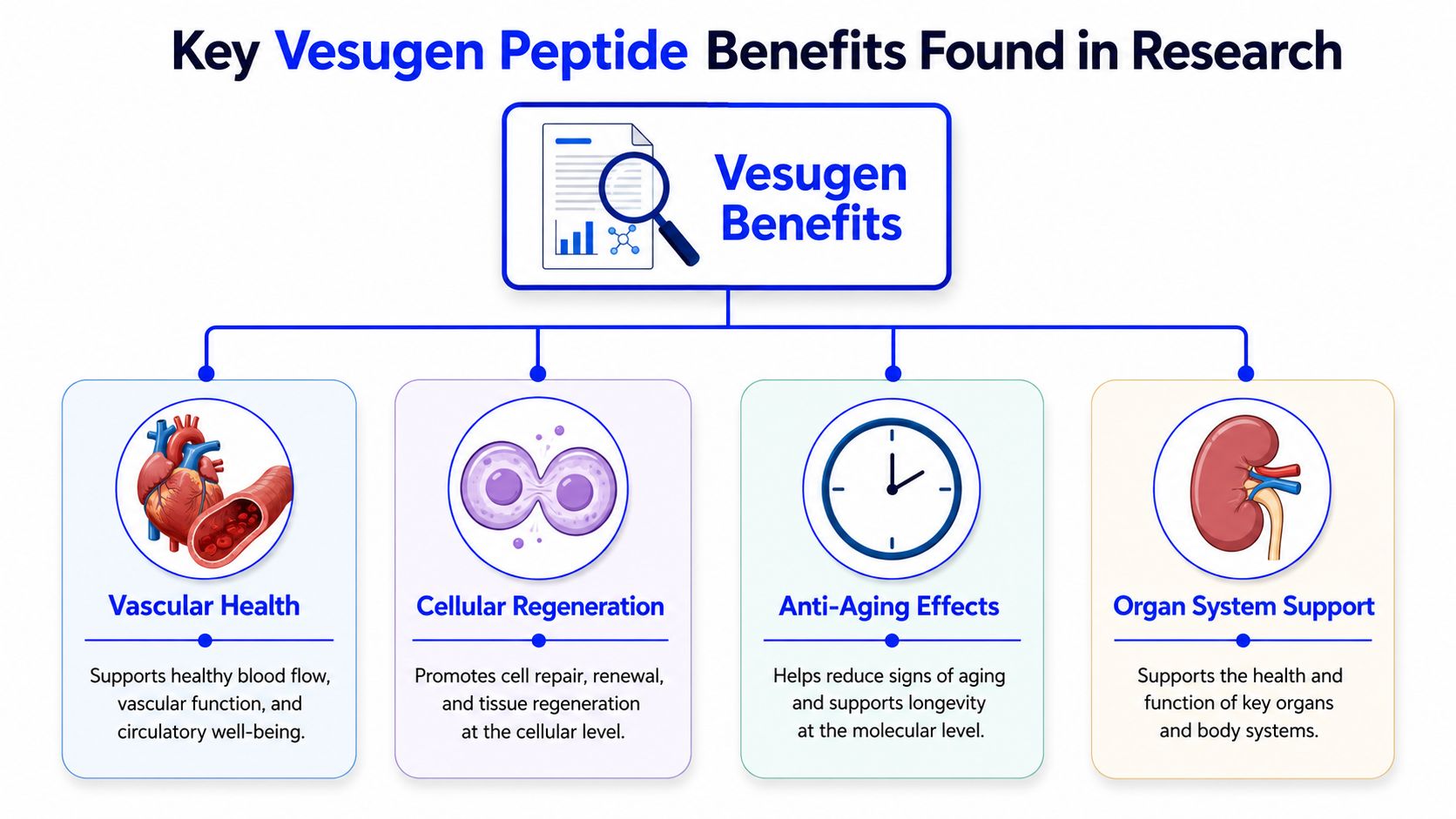
The most defensible benefit category is vascular function in older patients with ischemic disease. A clinical summary discussing Vesugen benefits describes a small study in elderly patients with lower extremity ischemia and reports increases in systolic blood flow velocity in penile arteries alongside improvements in sexual function scores and sleep quality after several months of treatment.
This is significant for two reasons. The reported endpoint includes a physiological measure rather than relying only on self-reported symptom change. The pattern of change also fits the proposed biology. If endothelial performance or regional blood flow improves, downstream effects on sexual function and sleep are at least plausible.
A second industry summary, reviewing blood flow findings in lower limb arterial insufficiency, describes a similar direction of effect in ultrasonic blood flow parameters. That kind of consistency can justify scientific interest, but it should not be confused with confirmation. The underlying evidence base remains small, regionally concentrated, and methodologically hard to audit from the outside.
That distinction affects how responsible teams communicate emerging data. In regulated settings, processes such as Generating MLR-ready pharma content using AI are used to keep mechanistic claims, outcome summaries, and compliance language aligned. Vesugen is a good example of why that discipline matters. A preliminary vascular signal can be described accurately, or it can be overstated into a claim the evidence does not carry.
A brief visual explainer can help situate the literature:
The aging-related discussion around Vesugen is more credible at the level of cellular and biochemical observations than at the level of broad anti-aging promises. A review article indexed in CyberLeninka on peptide bioregulators and age pathology summarizes work from the Khavinson research tradition and describes associations between short peptides and gene expression changes relevant to senescence, tissue maintenance, and age-related dysfunction.
Some reports from that literature describe changes in biological age indicators, membrane stability in aged cells, and oxidative processes involving lipoproteins or other cellular structures. Those are potentially interesting findings, but they are surrogate observations. They do not establish that Vesugen produces clinically meaningful slowing of human aging in the way consumers often infer from promotional language.
As noted earlier, some mechanistic summaries also connect Vesugen with markers linked to cell renewal and longevity pathways. That hypothesis is biologically coherent. It still sits several steps away from a validated therapeutic outcome.
Claims about memory, mental performance, or neuroprotection deserve the most caution. The same Russian bioregulator literature often discusses central nervous system effects in older adults or in people exposed to adverse environmental conditions, but the evidentiary chain is weak by modern clinical standards.
A vascular explanation is the more conservative reading. Better endothelial function or microcirculatory support could affect cognition indirectly, especially in older populations where vascular compromise contributes to mental decline. That interpretation requires fewer assumptions than claiming a direct nootropic or neuroregenerative effect.
The problem is not that these hypotheses are impossible. The problem is that the published record does not yet separate them cleanly.
A careful interpretation leads to a narrower conclusion than the one usually presented in peptide marketing.
| Research area | What the evidence supports most clearly | What remains uncertain |
|---|---|---|
| Circulation | Small studies and summaries suggest possible vascular effects in older ischemic populations | Reproducibility, study quality, and relevance to broader patient groups |
| Aging biology | Preclinical and geriatric reports suggest possible effects on cellular stability and age-related biomarkers | Whether those signals translate into meaningful anti-aging outcomes in humans |
| CNS support | Some reports describe possible cognitive or neurobiological relevance | Whether any effect is indirect through circulation, direct at the neuronal level, or not reproducible |
The practical takeaway is restrained but useful. Vesugen is best viewed as an investigational vascular bioregulator with possible gerontology relevance, not as a proven anti-aging therapy. That framing matches the evidence more closely and also acknowledges a central fact often omitted in promotional content. There are no FDA-approved Vesugen protocols, and much of the cited literature comes from a narrow Russian study base rather than the kind of multinational evidence normally expected for confident clinical claims.
The most important thing to understand about Vesugen isn't a mechanism. It's the absence of standardized regulatory footing.

The cleanest statement of the issue appears in this review of recommended Vesugen dosage and treatment cycle questions, which says: There are no established FDA-approved dosing protocols or treatment cycles for Vesugen. The available evidence consists solely of small Russian research studies with methodological limitations, making current 'best practice' advice purely speculative and potentially unsafe for researchers.
That single point changes how every benefit claim should be interpreted. Even if the mechanistic and small-study signals are promising, there is no approved framework defining validated dose, duration, cycle spacing, or risk management in major Western regulatory systems.
A common pattern in peptide content is false precision. Websites often present dosing schedules with confident language, as if they reflect settled pharmacology. In Vesugen's case, that confidence isn't warranted by the evidence base.
Several limitations should stay front of mind:
Research caution: A peptide can be scientifically interesting and still be operationally underdefined. Vesugen fits that description.
“For research use only” shouldn't be treated as boilerplate. It should shape how investigators think about study design, procurement, storage, documentation, and interpretation.
That means keeping the focus on preclinical, laboratory, and analytical contexts. It also means resisting the temptation to treat anecdotal protocol sharing as evidence. With Vesugen, the gap between online confidence and validated protocol science is one of the most important facts a careful reader can learn.
When the evidence base is already narrow, material quality matters even more. A peptide with uncertain sourcing can distort every downstream observation, from assay behavior to reproducibility.
Researchers evaluating suppliers should look for documentation that supports both identity and consistency. The exact format can vary, but strong sourcing standards usually include:
A seller that can't provide clear lot-level documentation asks the researcher to absorb unnecessary uncertainty.
With Vesugen, quality isn't just a purchasing issue. It's a scientific control issue. If the peptide is low purity, degraded, mislabeled, or inconsistently handled, any claimed effect becomes much harder to interpret.
That's particularly important for compounds discussed in epigenetic and vascular terms. Small differences in composition or contamination can alter cell behavior in ways that look mechanistic but aren't attributable to the intended peptide.
A simple decision framework helps:
| Sourcing question | Why it matters |
|---|---|
| Is the batch documented? | Undocumented lots weaken traceability |
| Is purity stated clearly? | Ambiguous purity clouds interpretation |
| Are supporting reports available? | Without them, you can't assess material confidence |
| Is the supply chain transparent? | Hidden sourcing increases variability risk |
Good research starts before the first assay. It starts with verified material.
Could Vesugen affect neural tissue directly, or are reported cognitive effects better explained as downstream consequences of vascular change?
The current literature does not settle that question. Human-oriented discussions still center on vascular aging and endothelial function, while preclinical work raises the possibility of broader biological activity. That distinction matters because mechanism and clinical relevance are not interchangeable.
One review of peptide bioregulators discusses KED in the context of gene expression, aging, and tissue-specific regulation, including possible effects beyond the vascular compartment (review available via PubMed). Reviews of this kind are useful for mapping the hypothesis space, but they do not establish clinical efficacy. The stronger claim, at present, is that Vesugen remains a research-stage compound with mechanistic signals that have not yet been confirmed in large, independently replicated trials.
A cautious reading leads to a narrower conclusion. Vesugen may have effects that extend beyond vascular support, including possible relevance to neuronal maintenance, but the evidence base is too limited to treat those possibilities as established therapeutic outcomes.
The clearest comparison is by mechanism, not branding.
Some peptides are studied as receptor agonists. Others are framed as repair mediators, immunologic signals, or broad tissue-response modifiers. Vesugen is usually presented in a different category. It is described as a short bioregulatory peptide associated with vascular aging biology and with possible effects on gene expression in target tissues.
That framing gives it a specific research profile:
This is also where marketing can overstate the science. A mechanistic concept can sound highly developed long before the supporting human evidence reaches that standard. With Vesugen, that gap is hard to ignore because much of the published discussion traces back to a relatively small Russian research base, and there are no FDA-approved protocols that define validated clinical use.
Three filters help.
First, identify the primary tissue and endpoint. If a paper discusses cognition, sleep, or sexual performance, ask whether the proposed effect is direct or whether improved vascular function could account for the observation.
Second, separate mechanistic plausibility from evidence tier. Epigenetic regulation is a plausible line of investigation. It is not the same as reproducible clinical benefit in well-controlled human studies.
Third, examine the provenance of the evidence. Small studies, geographically concentrated publication patterns, and limited independent replication all increase uncertainty. For Vesugen, those constraints are central to any honest interpretation.
The most credible discussions of Vesugen define where the evidence is suggestive, where it is preliminary, and where no validated protocol exists.
That is often more useful than promotional certainty. It helps readers distinguish an interesting peptide hypothesis from a clinically established intervention.
Researchers who want dependable supply chain documentation for laboratory and preclinical peptide work can learn more at Peptide Warehouse USA. The company focuses on research-use-only materials, USA-based manufacturing, batch testing, COAs, and transparent lot documentation, which are the basics you want in place before evaluating any compound as nuanced as Vesugen.