
No products in the cart.



Synthetic peptides are short chains of amino acids assembled by chemical synthesis rather than produced inside a living organism, and the category covers both research materials and approved peptide drugs. The important distinction is that synthetic describes how a molecule is made, not whether it works in humans or has regulatory approval.
So, what are synthetic peptides when you're looking at a vial, a paper, or a supplier catalog? They're chemically assembled amino-acid chains designed for a specific research purpose, such as studying receptor binding, cell signaling, molecular structure, or biological activity. Some chemically made peptides eventually become medicines. Others remain laboratory materials with no established human use.
A useful way to understand the subject is to make four mental shifts:
The word “peptide” itself also needs a boundary. The FDA commonly treats polymers made from 40 or fewer alpha amino acids as peptides rather than proteins, a distinction that can affect pharmaceutical classification and regulatory discussions in this overview of the peptide-versus-protein boundary. It's a useful rule of thumb, not a complete description of every molecule's behavior.
The chemistry matters because it explains what a supplier can offer. The documentation matters because it tells you whether the vial contains what the label says. The regulatory line matters because an approved peptide drug and a research peptide belong to very different evidence categories.
A peptide is a chain of amino acids joined by peptide bonds. A synthetic peptide is that chain made through a controlled chemical process, usually by adding amino acids one at a time to create a selected sequence.
Think of the sequence as a molecular instruction string. Change one amino acid, reverse the order, remove a residue, or alter a chemical group, and you may change the molecule's shape, stability, binding behavior, or biological activity. That precision is one reason researchers use synthetic chemistry instead of relying only on material extracted from a biological source.
The history of synthetic peptides began long before today's automated instruments. Emil Fischer introduced the concept of peptides and early synthesis protocols in the early 1900s, and the first synthetic dipeptide, glycyl-glycine, was reported in 1901. In 1953, Vincent du Vigneaud's team completed the first total synthesis of the biologically active peptide hormone oxytocin, a 9-amino-acid peptide with a disulfide bridge. In 1963, R. Bruce Merrifield introduced solid-phase peptide synthesis, the method that made repetitive chemical assembly much more practical. Merrifield later received the 1984 Nobel Prize in Chemistry for this contribution. The timeline of peptide discovery from insulin to GLP-1 places those milestones in context.
This is the point that prevents most confusion. A lab can confirm that a vial contains the intended sequence, and that sequence can still lack convincing evidence in humans. Conversely, some synthetic peptides are part of approved medicines because they went through the required development and regulatory process.
The category now includes both research materials and established therapeutics. Market estimates illustrate the scale of the field, although estimates differ by definition and methodology. One estimate places the global synthetic peptides market at USD 3.8 billion in 2025, with a projection of USD 8.33 billion by 2033 at a 7.03% CAGR. Another places the peptide synthesis market at USD 1.79 billion in 2025 and USD 2.59 billion by 2031 at a 6.39% CAGR in its market analysis.
That growth doesn't turn every peptide into a medicine. It shows that the same chemistry supports several worlds, including drug development, diagnostics, assay development, and basic research.
Start with one amino acid. Each amino acid has an amine group, a carboxyl group, and a side chain, often written as an R group, that gives it distinctive chemical behavior.
Now use a beaded bracelet as a working analogy. Each bead is an amino acid. The string joining two beads represents the peptide bond. A short bracelet is a peptide, while a much longer chain may be described as an oligopeptide or polypeptide.
A peptide sequence has direction. Chemists read it from the N-terminus, the end with the free amine group, toward the C-terminus, the end with the free carboxyl group. Writing a sequence in the opposite direction is not a harmless formatting difference. It describes a different molecule.
When the carboxyl group of one amino acid reacts with the amine group of another, the new peptide bond forms through a condensation reaction. Water is released during the bond-forming process. Repeat the operation, and the chain grows residue by residue.
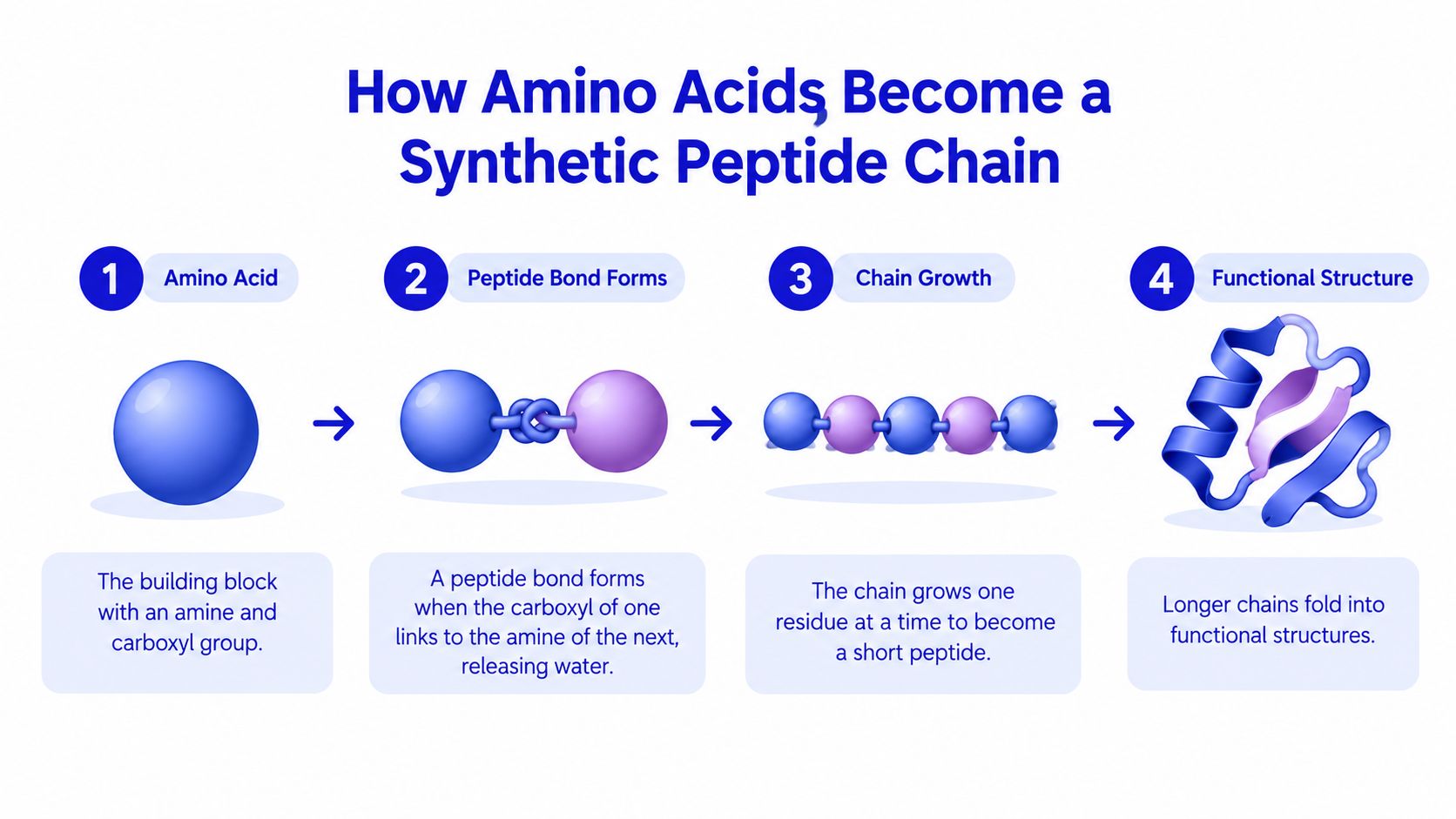
The order of the beads controls more than the chain's name. Side chains can carry charge, repel water, attract water, form hydrogen bonds, or participate in disulfide formation. Once the chain leaves the synthetic vessel, those chemical features influence how it folds and interacts with its surroundings.
Biology builds peptides with ribosomes. A ribosome reads messenger RNA and selects amino acids according to that genetic template. Chemical synthesis takes a different route. A chemist supplies protected amino acids and directs the order of assembly in a reaction vessel.
That difference gives synthetic chemistry useful freedom. It can incorporate D-amino acids and other non-proteinogenic amino acids, as well as backbone modifications that are not normally produced through recombinant protein expression as described in this review of chemical peptide synthesis. For a researcher trying to mimic a protein fragment or test a modified sequence, that flexibility can be decisive.
The bracelet analogy has limits. Real peptides don't remain as simple strings. They can fold into turns, helices, sheets, and other three-dimensional arrangements. A sequence can be correct while its final conformation is wrong, which is why identity testing alone never tells the whole story.
The standard chemical route is solid-phase peptide synthesis, or SPPS. The first amino acid is attached to a solid resin, usually through the peptide's C-terminal end. The chemist then repeats a cycle of protection removal, amino-acid coupling, washing, and protection management until the desired sequence is assembled.
The resin acts like a workbench. It lets the growing chain stay in place while excess reagents and soluble by-products are washed away. Modern workflows commonly use Fmoc-based protection chemistry, although the exact chemistry depends on the sequence and process design.
The NCBI explanation of solid-phase peptide synthesis describes the basic stepwise logic. SPPS is particularly useful when a target is short or moderately sized and contains unusual residues, terminal modifications, labels, or other features that biological expression may not handle easily.
Recombinant expression uses a host organism, such as a microbial or cell-based system, to produce a peptide or protein from genetic instructions. Researchers may attach the target to a fusion partner, include a cleavage site, express the construct, and then separate the target from the carrier.
That approach can become attractive for longer chains or targets that would be difficult to assemble efficiently one residue at a time. It can also scale well when the sequence is compatible with biological production. The tradeoff is that host cells may struggle with non-natural amino acids, unusual backbone chemistry, or precise chemical modifications.
SPPS and recombinant expression are not enemies. Hybrid methods can combine biological production with chemical joining steps for targets that exceed the practical range of a single method.
| Factor | SPPS, solid-phase | Recombinant expression |
|---|---|---|
| Chain-length sweet spot | Shorter, defined sequences and modified targets | Longer sequences and protein-like targets |
| Modification flexibility | High, including non-proteinogenic building blocks | More limited by biological machinery |
| Purity profile | Requires removal of truncated sequences and process impurities | Requires separation from host-cell and fusion-related materials |
| Cost profile | Often practical for smaller or customized targets | Can become more efficient at suitable production scale |
| Best first question | Can the sequence be assembled cleanly by repeated coupling? | Can a host produce and release the target reliably? |
Longer synthetic chains are harder because every coupling step has to work well enough for the final product to remain useful. Even a small amount of incomplete coupling can create deletion sequences that resemble the intended peptide. That is why purification and characterization become as important as the assembly itself.
A research catalog becomes easier to understand when each peptide is treated as a molecular question, not as a promise. Researchers order a sequence because they want to test a mechanism, compare a control, explore a pathway, or reproduce a published experiment.
BPC-157 is commonly described in research settings as a 15-amino-acid fragment associated with gastric juice protein. Researchers have examined it in models involving tendon and gut biology, as well as angiogenesis-related questions. Those experimental areas don't establish a human therapeutic outcome. They define the systems in which investigators may choose to study the molecule.
GHK-Cu is a copper-binding tripeptide with the sequence histidine-alanine-lysine. Its interaction with Cu2+ makes it useful for research into wound-healing biology, collagen expression, and skin-remodeling processes. In a laboratory setting, the important questions include whether the complex forms under the chosen conditions and how the peptide behaves in the assay system.
TB-500 is commonly discussed as a synthetic thymosin beta-4 fragment. Research interest includes actin sequestration and related cellular mechanisms. A researcher may use it to study cytoskeletal behavior or compare a fragment with another treatment condition, without treating the compound as an approved therapeutic.
A metabolic example shows why the category extends beyond regenerative research. 5-Amino-1MQ is a small-molecule research compound rather than a peptide, so it shouldn't be placed in the same chemical category. A GLP-1 fragment, by contrast, is a peptide research target and can be used to examine sequence, receptor, or structure-function questions.
For readers exploring adjacent topics, this resource on peptides for hair growth can provide additional context, but it shouldn't replace primary literature or product documentation.
| Peptide or compound | Length | Origin or class | Primary research area |
|---|---|---|---|
| BPC-157 | 15 amino acids | Synthetic peptide fragment | Tendon, gut, and angiogenesis-related models |
| GHK-Cu | Tripeptide | Copper-binding peptide | Wound healing, collagen, and skin-remodeling research |
| TB-500 | Fragment-based peptide research target | Synthetic thymosin beta-4 fragment | Actin and cytoskeletal research |
| 5-Amino-1MQ | Not a peptide | Small-molecule research compound | Metabolic research |
| GLP-1 fragment | Sequence-dependent | Peptide fragment | Receptor and metabolic signaling research |
The practical lesson is simple. Ask what the molecule is, what model it has been studied in, and what evidence exists for the exact sequence and preparation in front of you.
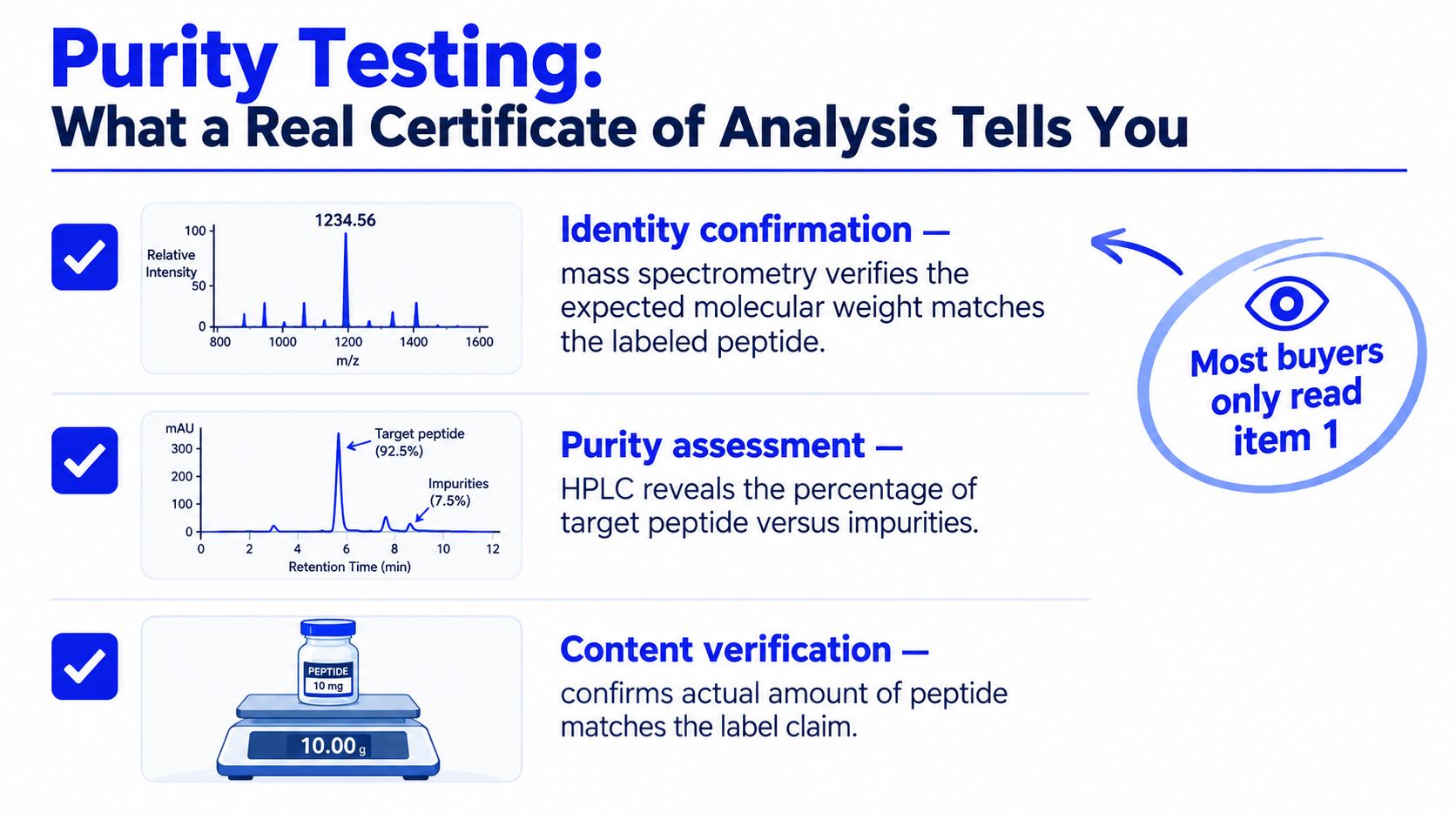
A Certificate of Analysis should answer three separate questions:
Many buyers stop after the first question. Mass spectrometry can support identity by showing whether the measured mass and ion pattern fit the labeled peptide. That's valuable, but it doesn't prove that the material is free from all relevant impurities or that the chain has the intended conformation.
HPLC commonly supports purity assessment by separating components and reporting their relative peak areas. A result of 99% purity means that 99% of the measured sample is assigned to the intended peptide under that method. The remaining material may include truncated sequences, oxidation products, or residual reagents as discussed in this FDA-linked analysis of peptide impurity thresholds.
That number also needs context. A purity result can't tell you how much free peptide is in the vial unless the test accounts for water, counterions, salts, and other non-peptide mass. Some guidance notes that water and counterions can reduce actual peptide content to roughly 60% to 80% of measured weight in its discussion of peptide characterization and content.
For longer peptides, purity alone is especially limited. Mass spectrometry combined with circular dichroism may help assess whether the material has the expected structural behavior, because a correct sequence can still fold incorrectly as explained in this review of synthetic peptide characterization.
Researchers should also check whether the COA includes microbial or endotoxin information when the material will enter an in vitro or in vivo workflow. If a test isn't listed, treat that as missing information, not as evidence that the result passed.
Practical rule: Ask for the raw chromatogram, mass spectrum, test method, lot identifier, and net peptide content. A summary page is useful, but it isn't the complete analytical story.
The label “for research use only” describes the intended sales category. It doesn't mean that a product has been evaluated for human safety or efficacy, and it doesn't convert a research material into a medicine.
An approved peptide drug has a defined indication, a clinical evidence package, controlled manufacturing, and regulatory review. A research peptide may have a confirmed sequence and strong analytical data while still lacking the clinical evidence needed for human use. Those are different evidence tiers.
The FDA's commonly used boundary treats synthetic peptides made from 40 or fewer alpha amino acids as peptides, while longer polymers may be considered proteins under another statutory framework as described in this regulatory discussion. Classification affects how developers think about manufacturing, clinical submissions, quality controls, and product oversight. It doesn't determine whether a particular research vial is suitable for human administration.
Synthetic peptide manufacturing is becoming more capable while oversight is becoming more exacting. Industry coverage reports growing interest in continuous-flow, microwave-assisted, and AI-assisted synthesis. The same coverage reports that the EMA guideline on the development and manufacture of synthetic peptides became effective on June 1, 2026, while FDA advisory discussions in July 2026 reviewed several peptides for possible bulk-substance inclusion in this industry overview.
That creates a practical responsibility for procurement teams. Check whether the material is intended for analytical work, cell-based assays, animal studies, or a regulated development program. The documentation and manufacturing expectations change with the use case.
Compounding categories such as 503A and 503B also have specific boundaries, and a research supplier isn't automatically a compounding pharmacy or outsourcing facility. Researchers should separately check controlled-substance rules when a peptide overlaps with a regulated analog, and sports researchers should consult the current WADA Prohibited List rather than relying on a product page.
Approval belongs to a specific product, use, manufacturing process, and indication. It doesn't attach automatically to every chemically identical or similarly named research material.
The word “synthetic” sounds reassuring because it suggests control and precision. Chemistry can provide both, but it can't supply clinical evidence by itself.
Synthetic doesn't mean safe. Safety depends on the molecule, impurities, route of exposure, formulation, dose, study design, and the quality of the evidence. A clean mass spectrum is not a safety study.
Synthetic doesn't mean effective. A peptide can show activity in a biochemical assay or animal model and still fail to produce a useful or predictable result in humans. Claims about popular research peptides often run ahead of controlled human evidence.
Research-grade doesn't mean pharmaceutical-grade. Research material may be manufactured and tested for laboratory purposes. Pharmaceutical products require a different level of process control, validation, documentation, and regulatory oversight.
A COA isn't a clinical trial. It tells you about the tested lot and the methods used. It doesn't establish an approved indication or guarantee that the material will behave the same way in every biological system.
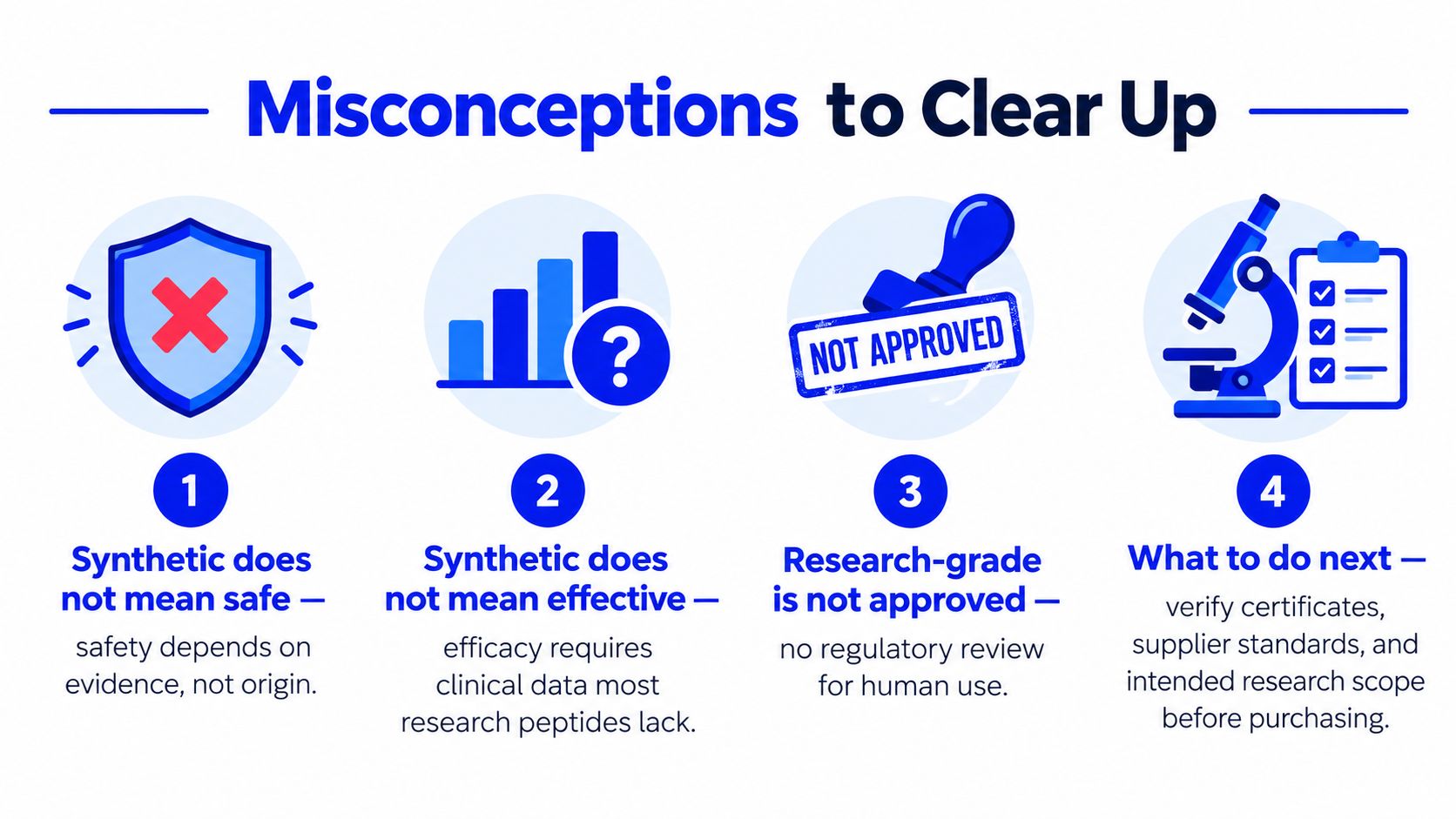
Before ordering a synthetic peptide for legitimate laboratory work, record the intended use and check:
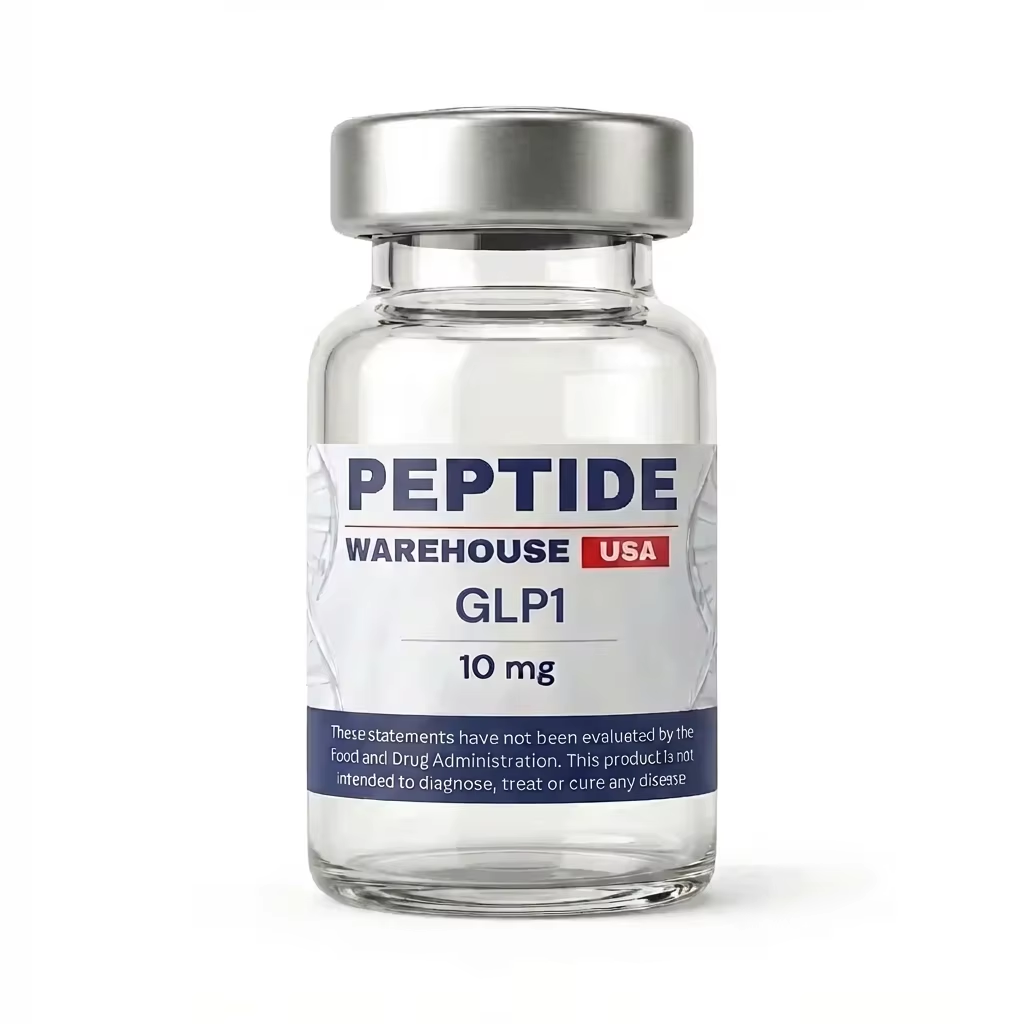
Peptide Warehouse USA offers research peptides and related compounds for laboratory, analytical, and preclinical applications, with product documentation that includes Certificates of Analysis and stated batch-testing information. To compare research-supply options and review documentation before planning your next experiment, visit Peptide Warehouse USA, and keep the intended research scope clear from the start.
Leave a comment