
No products in the cart.



You've got a lyophilized peptide vial on the bench, a checkout page open, and several liquids that appear to serve the same purpose. The labels may say bacteriostatic water, sterile water for injection, saline, diluent, or reconstitution solution. The wording changes from supplier to supplier, while the procurement decision still affects your research workflow.
This guide explains what those labels generally mean, how to match a diluent to a research setup, and how to check what's arriving in the mail. It also separates research-use procurement from pharmacy access and keeps the discussion focused on laboratory handling, not human administration or dosage guidance.
A first reconstitution order often feels more complicated than the experiment itself. The peptide arrives as a dry cake in a sealed vial, but the accompanying fluid may not be included. Your laptop shows several products with overlapping names, different fill volumes, and very different documentation.
The confusion usually starts with the phrase reconstitution solution. It sounds like a specific product, but it's often a broad description for a sterile aqueous diluent used to bring a lyophilized compound into solution. Bacteriostatic water is one type. Sterile Water for Injection is another. Saline is a separate option with its own composition and compatibility questions.
The product label matters more than the storefront category. FDA labeling identifies Bacteriostatic Water for Injection as a sterile, nonpyrogenic preparation containing 0.9% benzyl alcohol, and FDA drug labels can specify either sterile water without preservative or bacteriostatic water as an acceptable diluent for particular products. That's why a buyer should compare the compound's documentation with the diluent's actual label rather than assume that every clear sterile liquid is interchangeable. FDA labeling for bacteriostatic water
The practical question: You're not choosing the “strongest” water. You're choosing the sterile diluent whose composition, access format, and working window fit the research workflow.
A careful buyer needs three answers before clicking checkout:
Those checks are more useful than judging a product by its name alone. A clear label and batch document tell you far more than a product title that says “reconstitution water.”
Reconstitution solution is a general term for a sterile aqueous diluent used to rehydrate a lyophilized research compound. Think of it as the liquid used to prepare a stock aliquot before an assay run. The dry compound is the starting material, and the diluent provides the medium needed to create a workable solution for the documented laboratory procedure.
The term becomes easier to understand if you move from general to specific:
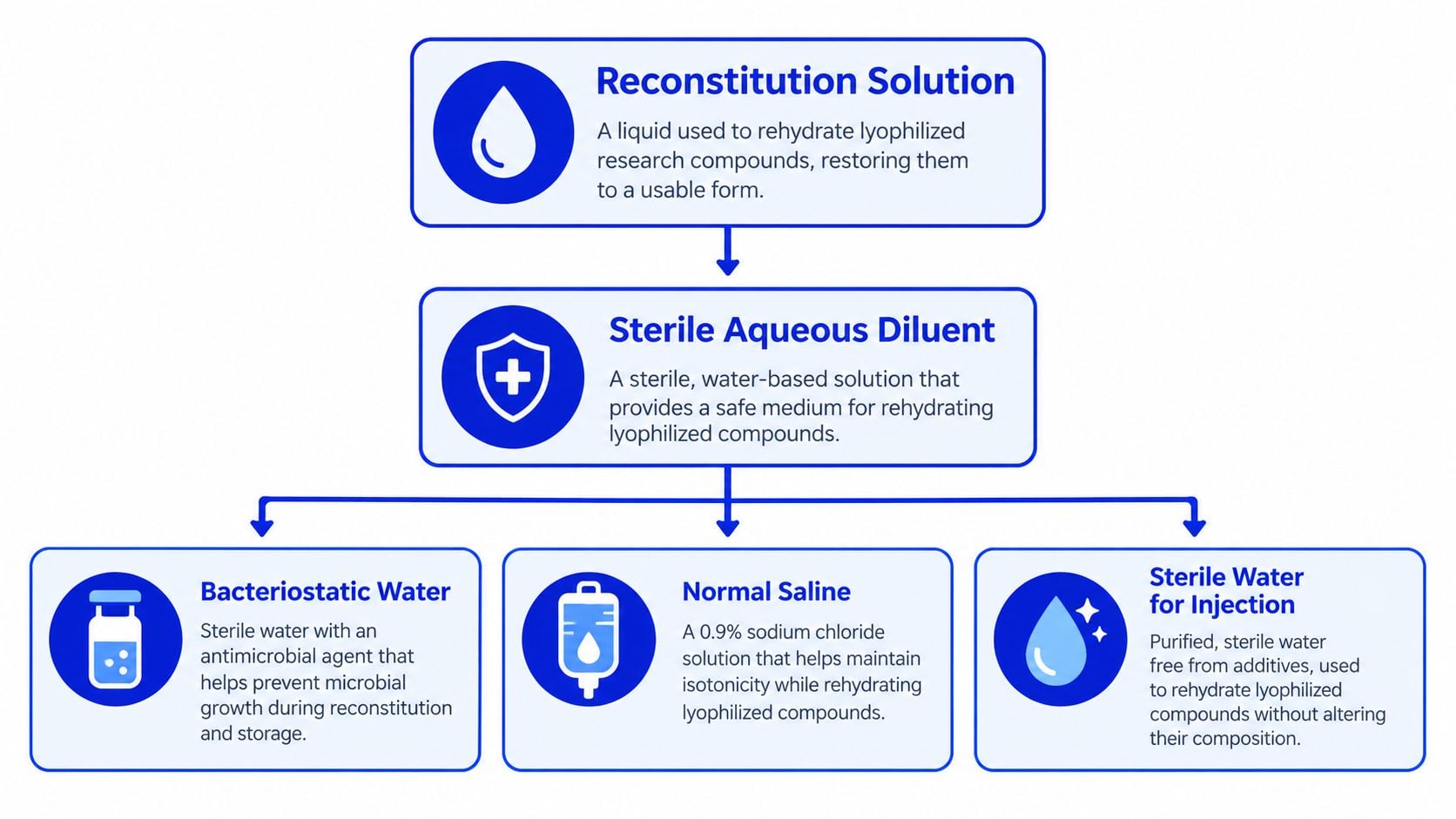
Bacteriostatic water is sterile water containing 0.9% benzyl alcohol as a preservative. The preservative supports repeated withdrawals from a multi-dose vial when the laboratory follows appropriate aseptic technique and the product label permits that use.
Sterile Water for Injection is preservative-free and supplied in a single-dose container. It's commonly selected when the documented procedure calls for plain water and the prepared material will be used in a single session rather than accessed repeatedly.
Normal saline contains 0.9% sodium chloride. Its salt content can make it useful in workflows where an isotonic aqueous medium is specified, but saline shouldn't be treated as a universal substitute for water. The compound's documentation should identify whether saline is compatible.
Suppliers may use “reconstitution solution” as a commercial category while listing bacteriostatic water as the actual product. That naming variation partly reflects USP monograph language and partly reflects how research stores organize their catalogs. A neutral product explanation such as reconstitution solution from Herbilabs Labware can help clarify how the terms are used in practice.
Two vials can contain a clear sterile liquid and still differ in preservative content, container format, intended use, storage guidance, and puncture window. Those differences affect contamination control and procurement decisions even when the liquids look alike.
For a laboratory buyer, the safest habit is to ignore the broad category for a moment and read the specification line by line. Look for the actual formulation, concentration, fill volume, container type, sterility claim, and research-use designation.
Bacteriostatic water and Sterile Water for Injection solve different workflow problems. The key distinction is the preservative. Bacteriostatic water contains 0.9% benzyl alcohol, while preservative-free sterile water is intended for single-dose use. A comparison of bacteriostatic and sterile water summarizes this difference in the context of container format and intended use.
| Attribute | Bacteriostatic Water | Sterile Water for Injection |
|---|---|---|
| Preservative | Contains 0.9% benzyl alcohol | Preservative-free |
| Container format | Multi-dose vial | Single-dose container |
| Repeated access | Designed for limited repeated entry when the label and aseptic procedure allow it | Not intended for repeated access after opening |
| Best workflow fit | A planned series of controlled laboratory withdrawals | One-shot reconstitution of a single vial |
| Main procurement question | Is the preservative concentration and in-use limit documented? | Does the procedure require preservative-free water? |
The FDA chemistry review cited for bacteriostatic water describes an effectiveness window of up to 28 days at 20–25°C, subject to the relevant product and handling conditions. That window isn't permission to ignore the label or aseptic practice. It's a defined handling parameter that helps a lab plan a multi-dose workflow. FDA chemistry review on bacteriostatic water
A bacteriostatic vial can make sense when a researcher expects repeated access during controlled bench work. The preservative helps support that format, but it doesn't eliminate contamination risk. Each puncture still introduces a handling event, so the septum, syringe, workspace, and operator technique matter.
Plain sterile water fits a different scenario. If the documentation calls for preservative-free water and the reconstitution will be completed as a single-use preparation, a single-dose container avoids introducing benzyl alcohol into the workflow. The container should be discarded after opening according to its labeling and laboratory protocol.
Some vendors list common multi-dose formats such as 10 mL and 30 mL, but container size alone doesn't establish quality or suitability. A larger vial isn't automatically better, and a smaller container isn't automatically more sterile. Treat volume as a logistical variable, then verify the formulation and documentation.
Clean judgment: Choose preservative-containing water for documented repeated access. Choose preservative-free sterile water for a one-shot procedure that specifically calls for no preservative.
Start with the lyophilized product documentation, not the diluent store. The product sheet should identify the recommended diluent, any compatibility restrictions, and the target concentration or preparation range used in the research protocol.
The labeled peptide amount helps determine the practical volume needed for the planned stock solution. It doesn't, by itself, authorize a particular volume or make a generic reconstitution table applicable. Use the manufacturer's documented method and record the selected volume in the lab worksheet.
Solubility and pH can also influence selection. Certain amino-acid sequences may behave differently in plain water, saline, or a preserved medium. If the product documentation identifies pH sensitivity, poor solubility, or a preferred buffered or saline diluent, follow that information rather than choosing by price or availability.
The decision isn't a quality ranking between bacteriostatic water and sterile water. It's a workflow-fit decision. A well-documented preservative-containing vial may be unsuitable for a preservative-sensitive assay, while a plain sterile container may be inefficient for a protocol that requires repeated controlled access.
Keep the final record simple: compound identifier, vial content, diluent name, lot number, added volume, preparation date, storage condition, and discard date. That record makes later troubleshooting much easier.
The answer to “where to buy reconstitution solution” depends on whether you're purchasing for research use only, a regulated clinical setting, or another documented laboratory application. Research buyers generally encounter four channels, and each channel carries different expectations around labeling, documentation, access, and shipping.
Dedicated peptide-research suppliers are often the most direct channel for RUO buyers. Their catalogs may place bacteriostatic water beside peptides and related laboratory compounds, making it easier to purchase a diluent within the same research-oriented procurement process.
The advantage is workflow clarity. Product pages may identify research-only status, fill volume, preservative concentration, storage conditions, and available documentation. The buyer still needs to verify those details rather than assume every item in a research catalog meets the same specification.
US-based RUO stores commonly list both bacteriostatic water and preservative-free sterile options. Domestic fulfillment can reduce customs uncertainty and make support, returns, and batch-document requests more straightforward, but the product label still determines what you're buying.
Marketplace listings may use several names for similar products. Neutral listings describe reconstitution solution as a ready-to-use liquid, sometimes specifying 0.9% benzyl alcohol, multi-dose vials, filtration, non-pyrogenic status, pH, and an in-use period. One listing reports a pH range of 4.5–7.0 and sterilization by 0.22 µm filtration, which illustrates the kind of detail a buyer should seek, not a specification to assume for every supplier. Example of a detailed reconstitution-solution listing
Large laboratory-supply marketplaces can be useful for comparing packaging, documentation, and delivery terms. They may carry sterile diluents, but product availability and access rules vary by location and account type. A marketplace name shouldn't replace a review of the manufacturer's label and lot-specific records.
Pharmacies operate under a different procurement model. Access may be limited, a prescription may be required, and the product may be labeled for human-use channels rather than RUO workflows. A market-facing purchasing overview notes that major chain pharmacies may keep bacteriostatic water behind the counter and may require a prescription, which explains why walk-in purchasing can be inconsistent. Information about pharmacy and retail access
| Channel | Typical Product | Price Range | Access Requirement |
|---|---|---|---|
| Dedicated research supplier | RUO bacteriostatic water or related diluent | Varies by vendor and package | Research account or standard online purchase, subject to seller policy |
| US-based RUO retailer | Bacteriostatic water and sterile options | Varies by product and pack size | Research-use labeling and seller requirements |
| General lab marketplace | Sterile diluents from laboratory brands | Varies by brand and container | Institutional, business, or marketplace account rules may apply |
| Pharmacy | Pharmacy-dispensed sterile diluent | Varies by location and product | Prescription or pharmacist-controlled access may apply |
Pricing is inconsistent across markets and listings. Current examples in the supplied market data range from approximately $5.50 to $15 per 10 mL vial, while a two-vial multipack is listed around $30. Example of retail pricing variation Compare the formulation, fill volume, documentation, and shipping conditions before comparing unit prices.
For a compliant RUO buyer, the practical starting point is usually a clearly labeled research supplier or domestic research retailer, not a pharmacy counter.
A supplier's product title is only the first screening layer. Experienced lab procurement treats the product page as a claim sheet and then checks whether the vendor can support each claim with batch-specific documentation.
Request the Certificate of Analysis. Ask for a lot-specific COA and check whether it identifies the product, batch, test dates, sterility information, and any available endotoxin results. Don't accept a generic document that doesn't connect to the vial being shipped.
Confirm the fill volume. Compare the stated volume with the vial label and product page. A listing that says “30 mL” should make clear whether that refers to the actual fill volume, nominal container capacity, or total multipack volume.
Check the preservative concentration. If the product is bacteriostatic water, verify that the label states 0.9% benzyl alcohol, also expressed as 9 mg/mL in FDA labeling. If that information is missing, ask before ordering.
Ask how sterility is achieved. The supplier should identify whether the product is sterilized by filtration or another validated process. The precise method matters because it tells you what claim the supplier is making about production.
Clarify the in-use limit. Ask how long the vial may be used after first puncture and under what temperature and handling conditions. A vendor should distinguish the unopened expiration date from the post-puncture working window.
Request batch documentation. Lot numbers, fill records, sterility results, and storage requirements create traceability. Evasive answers are a procurement warning sign.
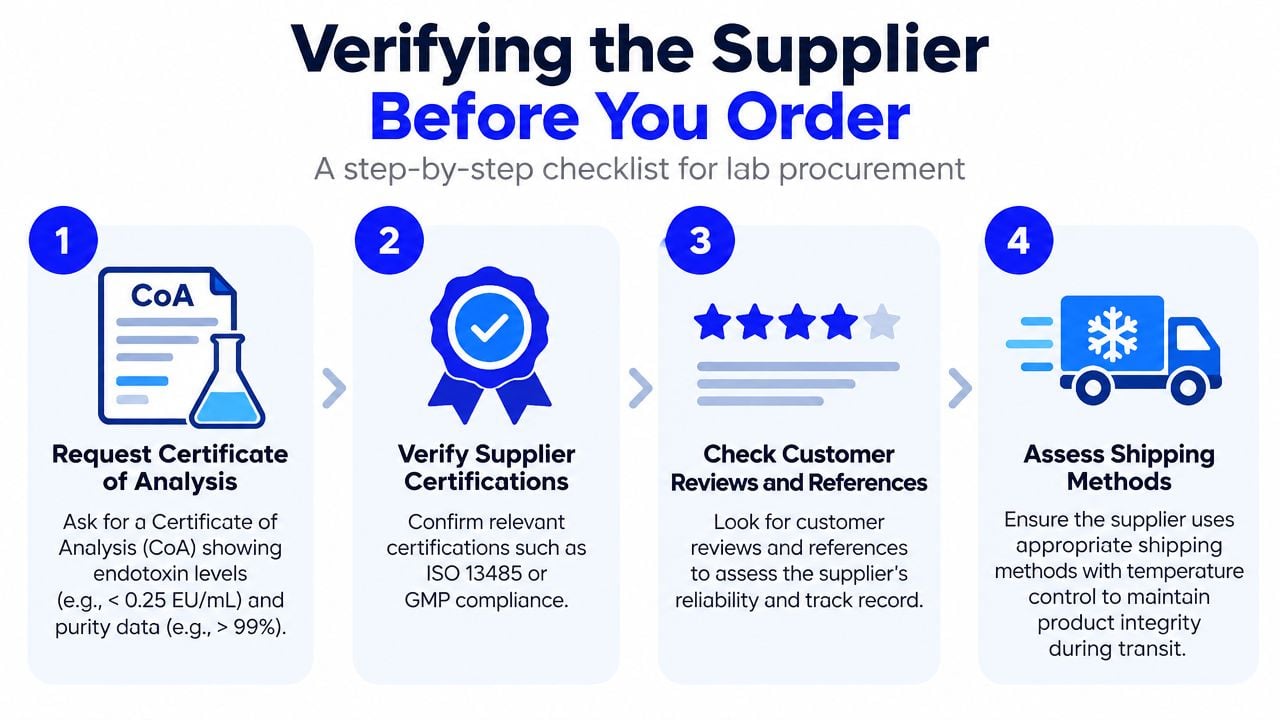
A legitimate supplier should be able to answer reasonable specification questions through its product page or support channel. Fast replies are useful, but the quality of the evidence matters more than response speed. Look for consistent labeling across the vial, website, invoice, and COA.
Procurement filter: If you can't verify what's in the vial, how it was made sterile, and how the supplier defines its in-use period, you're buying a label rather than a reliable laboratory input.
This is also where third-party documentation earns its place. A COA doesn't make an incompatible diluent suitable for your compound, but it can help establish identity, lot traceability, and whether the vendor's written claims are supported.
Storage instructions begin with the supplier's label. For unopened bacteriostatic water, the cited FDA chemistry review uses a 20–25°C storage range, while sterile water products may carry different labeled ranges. Don't substitute a generic temperature rule for the instructions printed on the specific container.
Keep unopened vials in a clean, dry location protected from unnecessary light and temperature swings. Secondary packaging can help limit light exposure, especially when the supplier specifies protection from direct illumination.
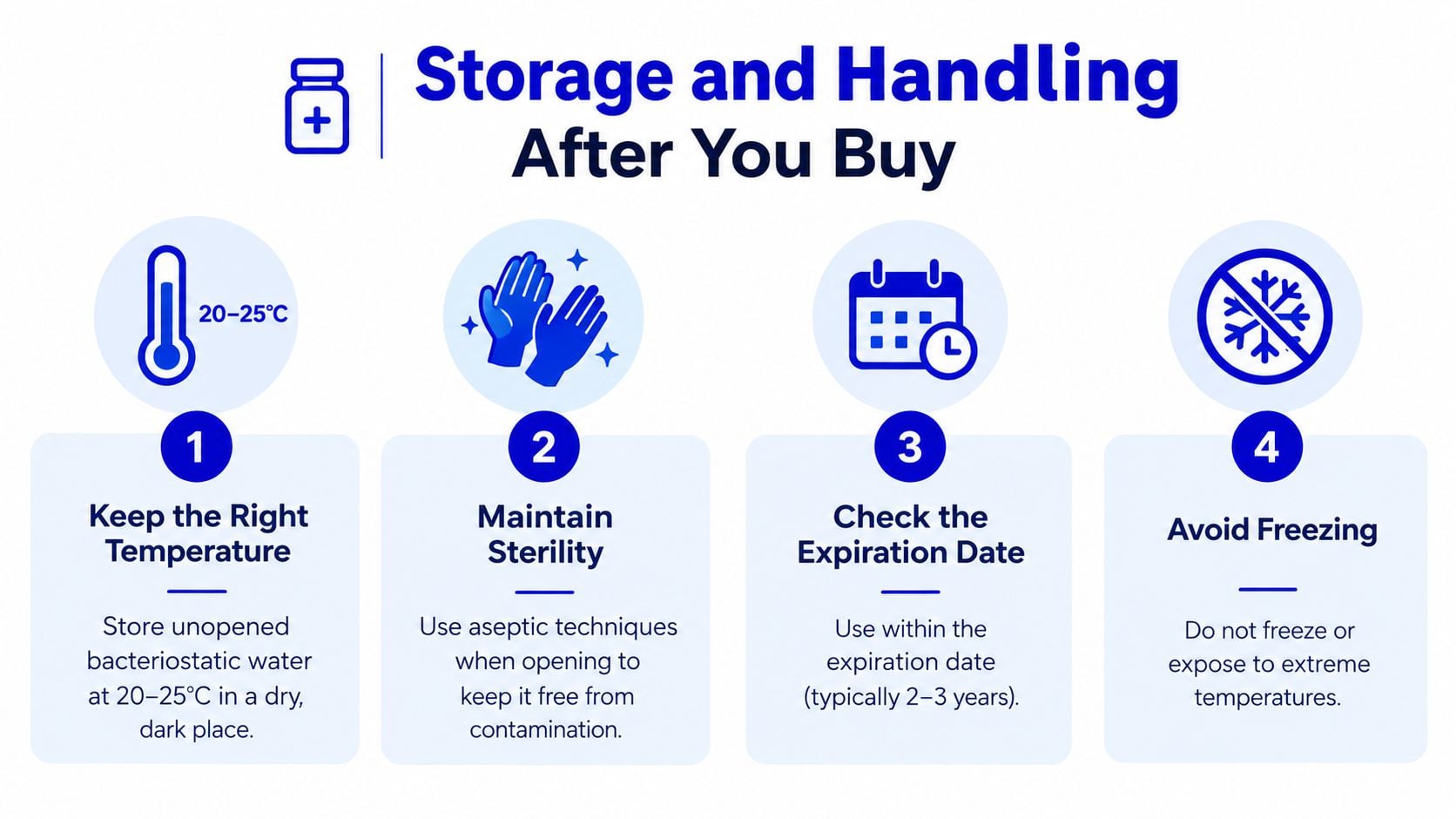
Benzyl alcohol provides bacteriostatic activity, but it doesn't turn careless handling into sterile handling. Repeated entry still requires controlled technique, and the FDA-cited 28-day window applies within the stated storage and handling conditions, not as a universal guarantee for every product or preparation. Clinical considerations for sterile-diluent handling
The same discipline applies whether the vial came from a domestic RUO supplier, a general lab marketplace, or a pharmacy channel. The source changes the procurement pathway, not the need to follow the product label.
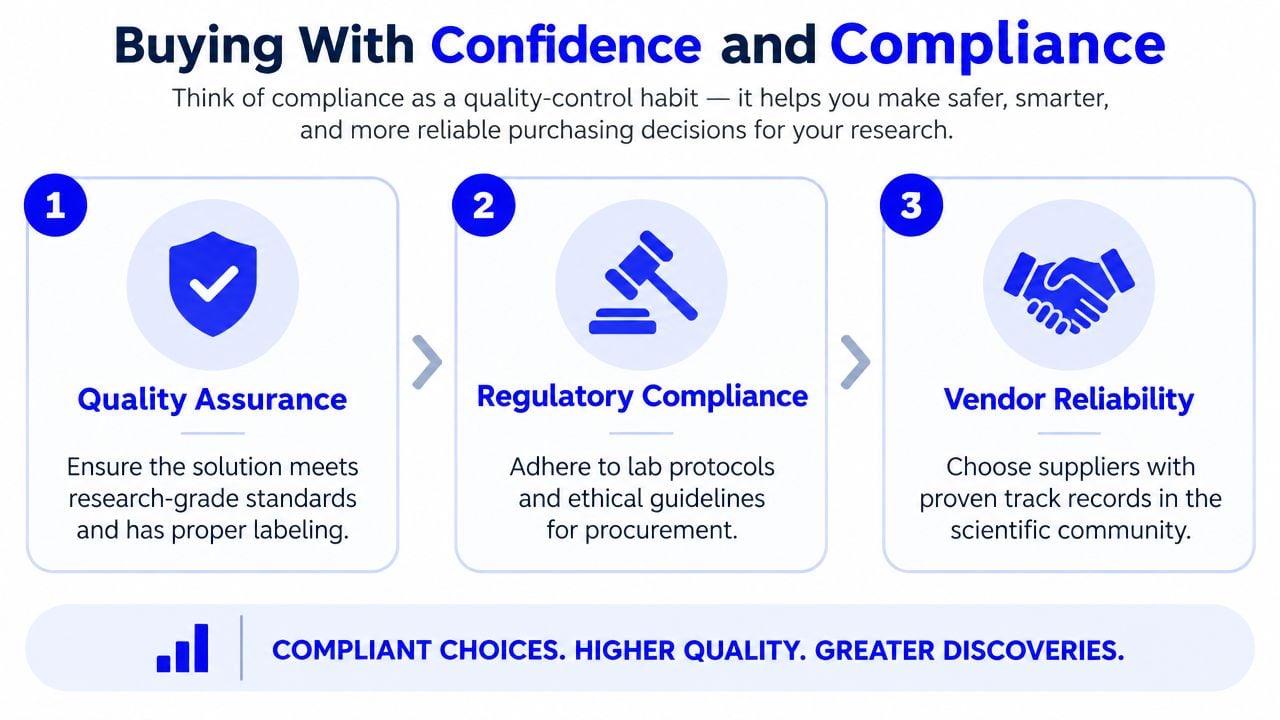
Compliance works best as a quality-control habit rather than a final legal checkbox. Before ordering, apply three filters.
First, match the formulation to the compound and protocol. Confirm whether the documentation calls for bacteriostatic water, preservative-free sterile water, saline, or another specified diluent. Don't treat familiar terminology as proof of compatibility.
Second, verify the supplier. Look for a lot-specific COA, clear fill-volume labeling, preservative concentration, sterility method, storage conditions, and post-puncture limits. A supplier that can't explain those points leaves your lab with avoidable uncertainty.
Third, plan the handling window. Record when the vial is opened, store it according to the label, use aseptic technique, and respect the stated in-use limit. The cited FDA review supports a defined bacteriostatic-water window of up to 28 days under specified conditions, but your product's own documentation remains the controlling reference.
US-manufactured RUO suppliers can reduce customs friction and labeling ambiguity, but domestic origin doesn't remove the need for verification. Confirm that the product is labeled for research use only and not for human administration, and keep the supplier's documentation with your procurement records.
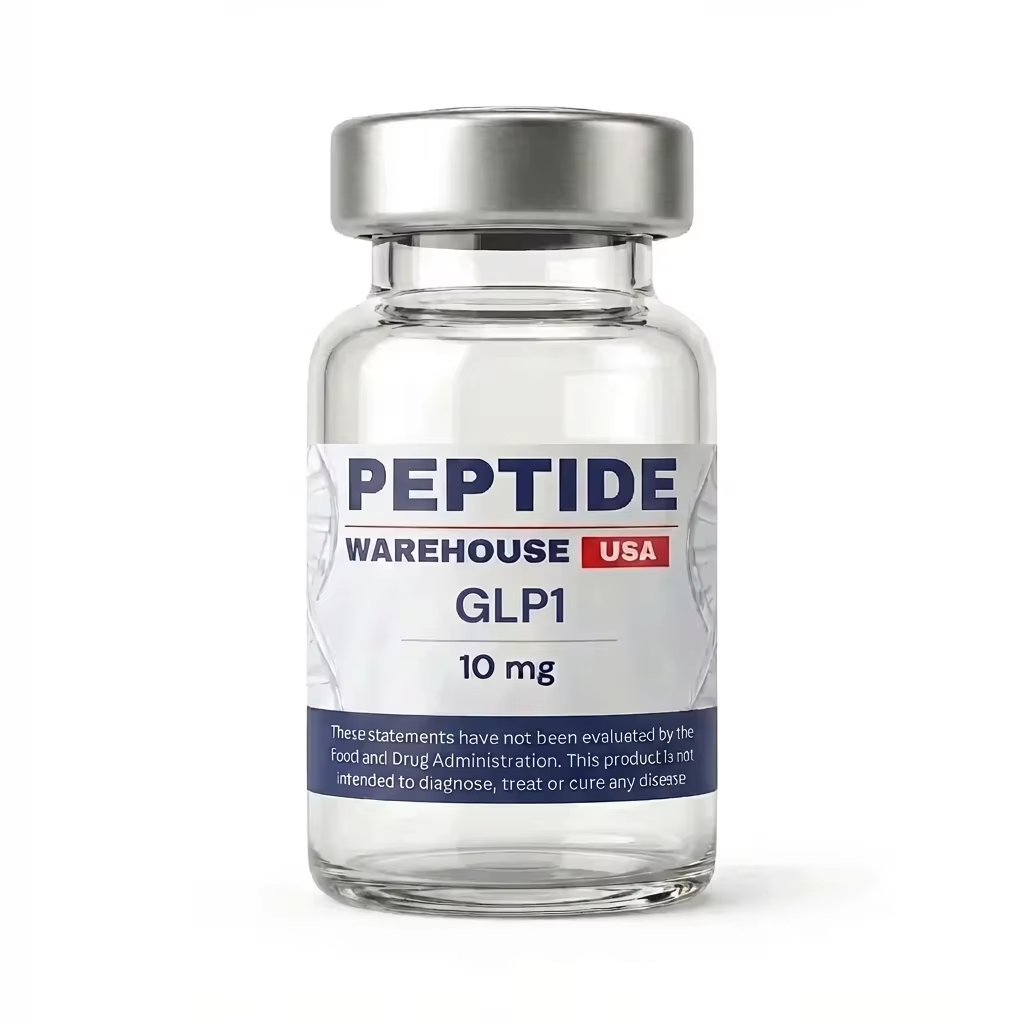
Peptide Warehouse USA offers US-manufactured research peptides and related compounds, along with bacteriostatic water, a reconstitution guide, and a calculator for working through vial quantity and diluent volume in a laboratory context. Researchers can visit Peptide Warehouse USA to review the available research-use products and documentation before placing an order.
Leave a comment