No products in the cart.
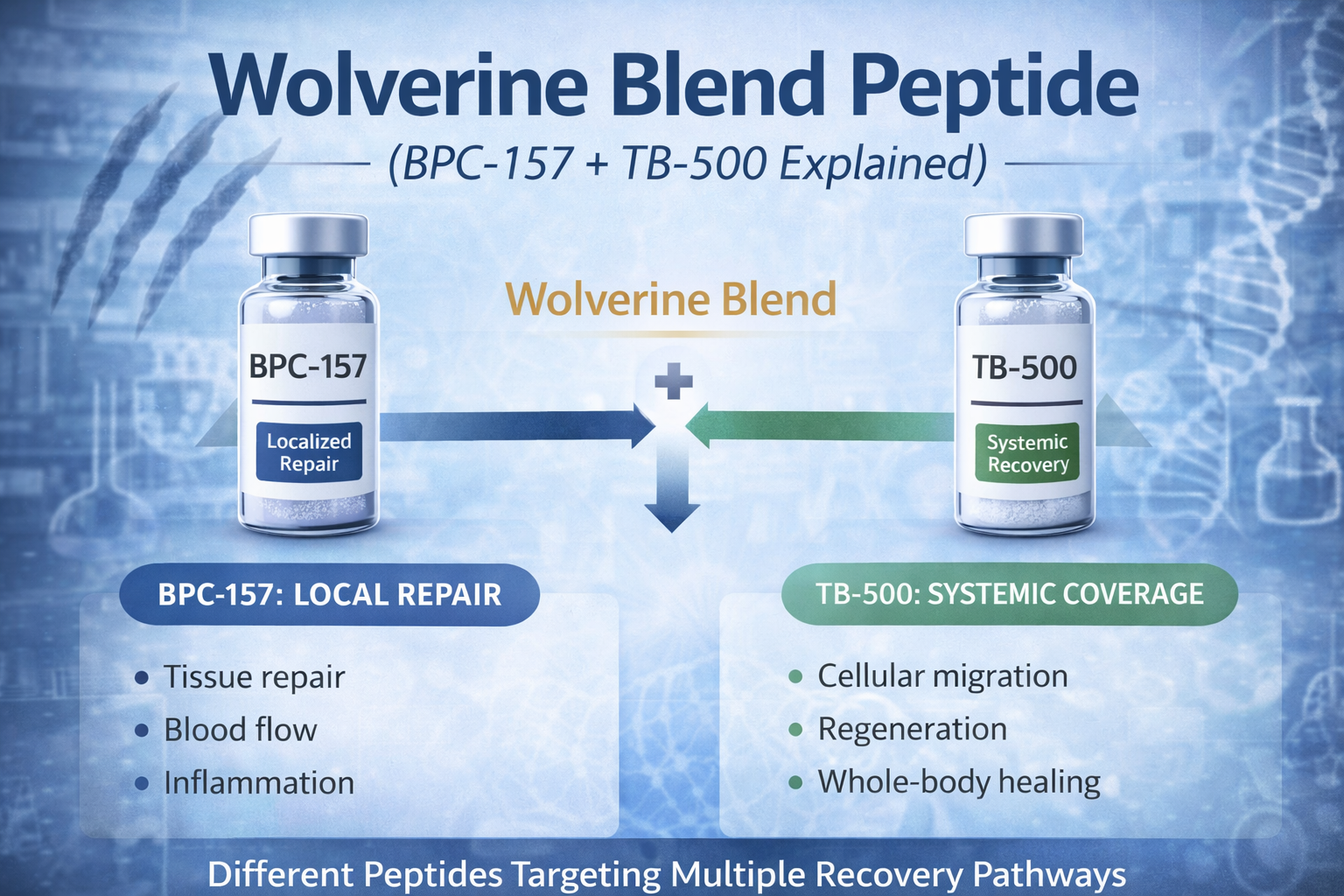


The “Wolverine Blend” is one of the most searched peptide combinations in recovery-focused research, referring to the combined use of BPC-157 and TB-500.
While these two peptides are often mentioned together, they are studied for different biological roles. The reason this combination gets so much attention is not because it is “stronger,” but because it covers multiple stages of the recovery process.
Understanding how this stack works starts with understanding each peptide individually — and more importantly, how they complement each other.
The Wolverine Blend is not a single compound.
It is a combination of two peptides:
The name comes from its association with rapid recovery concepts, but in research settings it is discussed in relation to:
The Wolverine Blend refers to the combination of BPC-157 and TB-500, two peptides commonly studied together in research related to tissue repair and recovery.
They are used together because BPC-157 is associated with localized repair mechanisms, while TB-500 is linked to systemic cellular movement and regeneration.
No. It is a stack of two separate peptides that are often discussed together in research environments.
It targets multiple biological pathways at once, rather than focusing on a single mechanism.
Most peptides are studied for one primary function.
The Wolverine Blend stands out because it is associated with multiple layers of recovery at the same time:
This multi-pathway approach is what makes it one of the most talked-about peptide stacks.
BPC-157 is derived from a naturally occurring gastric protein and is composed of 15 amino acids.
It is studied for its role in:
What makes BPC-157 unique is its association with targeted, localized repair environments.
When tissue is damaged, the body relies on:
BPC-157 is studied for how it may support these processes at the site level.
👉 View BPC-157:
https://peptidewarehouseusa.com/product/bpc-157-10mg/
TB-500 is a synthetic version of a fragment of Thymosin Beta-4, a peptide naturally found in the body.
It is studied for:
Unlike BPC-157, TB-500 is associated more with whole-body coordination and distribution of repair activity.
This includes helping the body support how cells move and respond across different systems.
👉 View TB-500:
https://peptidewarehouseusa.com/product/tb-500/
The value of this stack comes from how the two peptides complement each other rather than overlap.
Think of it like this:
Recovery is not a single-step process. It involves:
This combination is discussed because it touches multiple stages of that process.
A common misconception is:
👉 “Stacking peptides just makes them stronger”
That’s not the reason this combination is used in research discussions.
The real reason:
👉 It targets different biological pathways, not the same one twice
This distinction is what makes the stack relevant.
| Function | BPC-157 | TB-500 |
|---|---|---|
| Focus | Localized repair | Systemic recovery |
| Mechanism | Tissue signaling | Cellular migration |
| Research Focus | Tendons, ligaments | Whole-body processes |
| Role | Initiates repair | Supports distribution |
Not always.
Stacking is only useful when compounds target different mechanisms.
If two peptides perform the same function:
👉 There is less benefit to combining them
The Wolverine Blend is discussed because it avoids overlap and instead provides broader coverage across multiple systems.
When studying peptide combinations, consistency and verification are critical.
Always look for:
👉 Browse all peptides:
https://peptidewarehouseusa.com/buy-research-peptides-usa/
The Wolverine Blend is one of the most discussed peptide combinations because it represents a multi-pathway approach to recovery research.
Instead of focusing on a single mechanism, it combines:
Understanding this difference is what separates basic explanations from a deeper understanding of how peptide stacks are approached in research.
👉 Learn more about the Wolverine Blend:
https://peptidewarehouseusa.com/wolverine-blend-peptide-bpc-157-tb-500/